How far have we come with humanoid robots "taking up factory jobs"?
Humanoid robots entering factories to work: the "first year of the era" has been declared for several rounds, but very few people have fully listed all the real difficulties: the success rate needs to reach over 99%, the work rhythm cannot lag behind the production line, the continuous operation lifespan of a dexterous hand is only a few weeks, and the data gap is as high as a hundredfold. There are five steps from laboratory verification to real-scene training, normal deployment, large-scale replication, and commercial closure. Where exactly have the fastest players in the industry reached?
With this question in mind, reporters from *Sci-Tech Innovation Board Daily* recently visited the Foton Cummins engine factory in Changping, Beijing — one of the earliest factories in China that put humanoid robots into operation; around the same time, the reporters also conducted a large number of intensive interviews at the just-concluded 2026 World Robot Conference (WRC) and the 2nd World Humanoid Robot Games. The combination of factory workshops and the two conferences offers a far more honest answer than the "first year of the era" narrative. Today, the goal of "being able to work" has been achieved, the goal of "working every day" has just started, and no one has yet achieved the goal of being economically viable. Among the five steps from laboratory to commercial closure, the fastest batch of Chinese robot developers have spent a whole year finishing the second step and are knocking on the door of the third step.
"New Workers" in an Engine Factory
In Foton Cummins' factory, AGV trolleys have been widely used for a long time, and cylinder blocks and heads are transported with laser SLAM navigation. But the real pain point lies in the "last meter": there has never been a mature flexible solution for the lifting and handling of materials from material trolleys to racks. Traditional special machines need to replace the gripper when changing a material box, and multiple pieces of equipment are required for depalletizing, transfer and shelving. Production lines with multiple varieties and small batches are most in need of flexibility. It is understood that this is the fundamental reason why the factory chose humanoid and wheeled-arm robots.
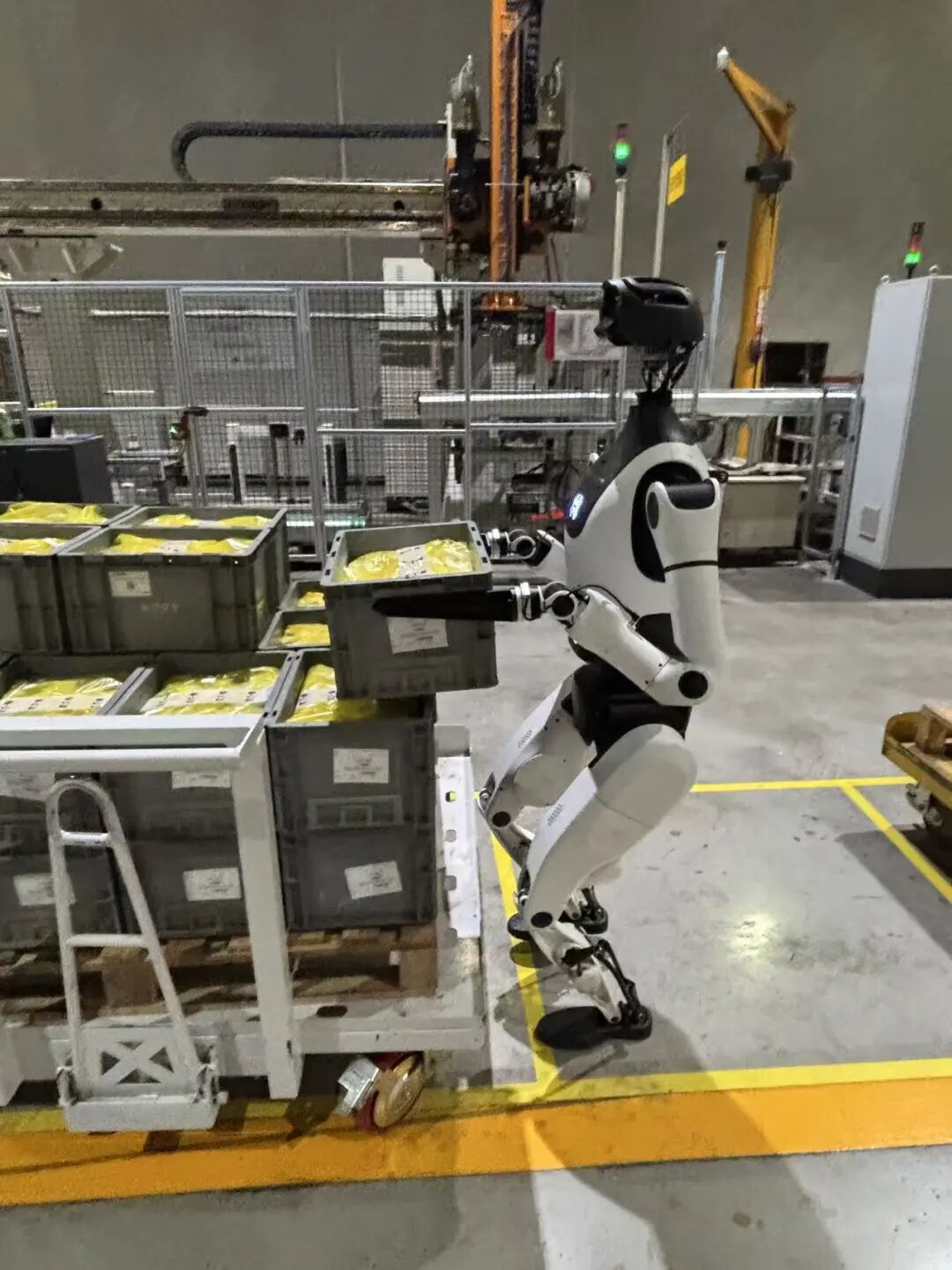
Reporters from *Sci-Tech Innovation Board Daily* learned from the site that at present, the Tiangong 2.0 bipedal robot and Tianyi 2.0 wheeled-arm robot from Beijing Humanoid Robot Innovation Center have been tested in the factory for nearly a year. They are also the first batch of humanoid robots in China to enter factories directly from the competition field: Foton Cummins proposed two industrial test scenarios of material handling and intake/exhaust valve material sorting at the first World Humanoid Robot Games, and the two sides quickly connected to implement the application after the competition.
The factory did thorough research before choosing Beijing Humanoid Robot Innovation Center. According to Huang Yunbao, a relevant person in charge of Foton Cummins, in the early investigation, the factory reviewed all public parameters, stability and reliability data of Figure, and had initial communication with all leading domestic embodied intelligence enterprises. Finally, it selected Beijing Humanoid Robot Innovation Center based on scenario fit, cooperation willingness and implementation progress capability.
The person in charge introduced that the two robots operate autonomously without any custom modification to the whole machine, and the ontology still uses the laboratory version. Only two sets of end grippers are developed for working conditions: the narrow gripper is used for narrow cargo positions with only 2-3 cm of margin between the material box and the rack, and the hook-shaped gripper has stronger load capacity, covering material boxes weighing more than 15 kg. The current goal is to handle materials of 2 to 5 kg, and gradually iterate to more than ten kilograms later.
The real challenge comes from the old factory itself: the material racks that have been in service for 3 to 5 years are deformed and tilted, and the raised structures on the material trolleys trigger the lidar obstacle avoidance function. For the deformed racks, an additional "box pushing" action must be added temporarily to ensure that the material boxes are completely in place. These engineering details that cannot be simulated in the laboratory are solved one by one by R&D personnel stationed on site. Now, Tianyi 2.0 can place six turnover boxes on the shelf in less than four minutes, and Tiangong 2.0 can carry one box in less than one and a half minutes, with the rhythm initially matching the production line pace. The relevant person in charge of Beijing Humanoid's industrial application explained to *Sci-Tech Innovation Board Daily* that the boxes contain fragile engine parts, and the top priority of the robot is "stability" rather than "speed".
What supports all this is the big and small brain collaboration of the "Huis Kaiwu" embodied intelligence platform: the embodied brain completes task understanding, disassembly and arrangement based on the large model to generate a complete task link; the embodied cerebellum is responsible for executing each action.
It is understood that the most intuitive change on site is "no teaching required" — there is no need to program the points of each material box and cargo position one by one. Only one material pile observation point needs to be set, the robot perceives the overall situation through its head camera, and the algorithm independently selects the appropriate material box for grasping and transfer. Before the implementation of new scenarios, the world model can be used for simulation tests first, and the robot can enter the site after the success rate reaches the standard to shorten the debugging cycle. All kinds of material box working conditions collected on Foton Cummins' production line will be sent back to the platform for generalization training, which can be quickly adapted to new factories in a low-code way later — this is the key part of "replicable experience".
In Huang Yunbao's view, "the primary value of robots entering factories is not to replace manpower, but to solve ergonomic pain points — liberate workers from the heavy labor of bending over and lifting materials at high positions. Secondly, they can connect to the factory business system to form a closed information flow, reduce assembly error rates and improve engine quality. The factory only has two criteria for evaluating intelligent equipment: quality improvement and improvement of personnel's working environment."
His judgment on the industry bottleneck is quite calm: Battery life, load and positioning accuracy are three hard thresholds. At this stage, robots are only suitable for positions with low rhythm pressure and loose load accuracy requirements, and cannot completely replace a worker. His advice to peers is only nine words: move fast in small steps, imagine boldly, and verify carefully.
The cooperation between the two sides is deepening. It is understood that in addition to the existing handling stations, there are multiple scenarios to be opened inside the factory; Foton Cummins is building an industry "future workstation", in which humanoid robots are an important part.
If the process of "entering the factory" is divided into five steps — laboratory verification, real-scene training, normal deployment, large-scale replication, and commercial closure — the two robots of Foton Cummins have taken nearly a year, and are now at the threshold from the second step to the third step. This is already one of the fastest progress in China.
Talking about his feelings about humanoid robots "working in factories", Huang Yunbao told reporters: The future has arrived.
Carnival of Output, Major Test of Implementation
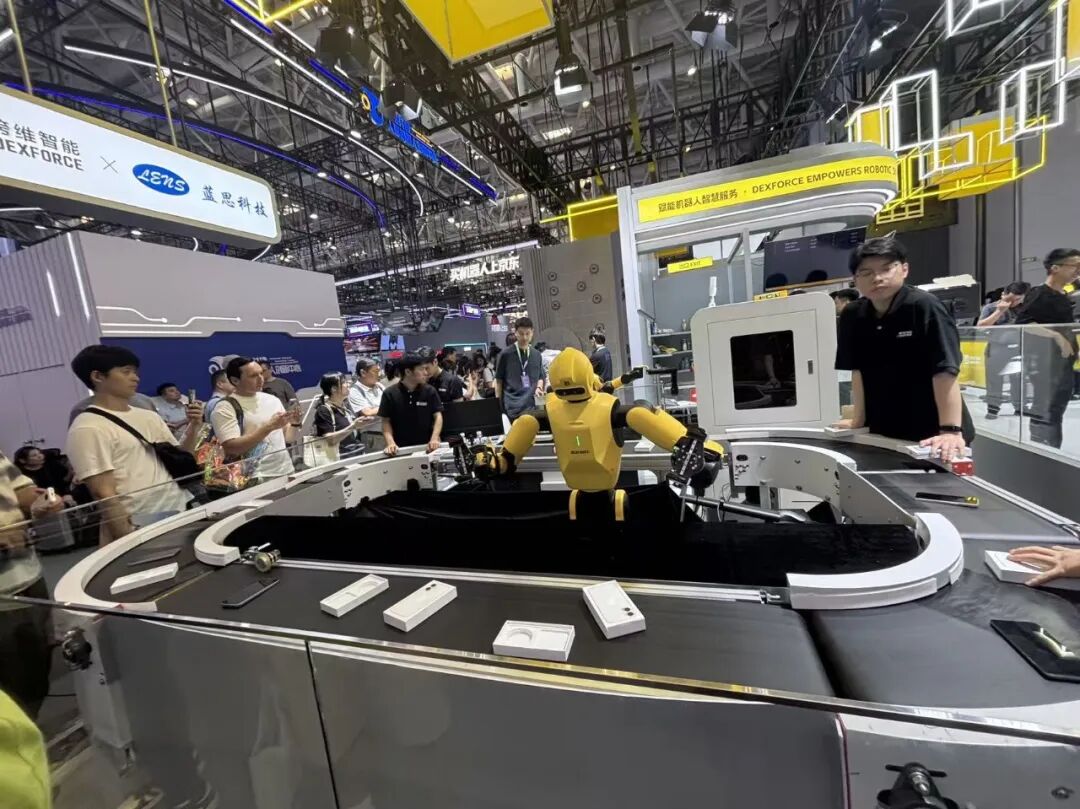
Recently, two major industry conferences were held one after another: the 2nd World Humanoid Robot Games concluded, 2056 robots completed all competition events, and the industrial assembly feeding station became the core highlight; at the 2026 World Robot Conference, 373 enterprises launched 311 new products for the first time, and industrial humanoid scenario solutions became the absolute protagonist. The technical iteration on the competition field and exhibition booth is rapidly approaching the zero-tolerance for error requirements of real production lines.
But as of the first three quarters of 2025, more than 70% of Unitree's humanoid robot revenue came from scientific research and education, and industrial applications accounted for only 9%.
"Only a small number of humanoid robots are actually working in factories, and a large number of robots are still in the stages of practical training, process verification and small-scale trial operation." Xi Yue, co-founder of Star Age, also admitted in an interview with *Sci-Tech Innovation Board Daily* during WRC: Large-scale and mass deployment in industrial scenarios is still relatively rare, and the whole industry is still in this process.
Ji Chao, founder of Lingdong General, described the criteria for "entering the factory" in detail: The requirement of industrial scenarios for robots is not whether they can reach 100% of human level at one time, but whether they can rise from 30% of human level to 60%, 80% after a period of time, and finally exceed manual work in some standard workstations — and this capability can be reused on 100 robots.
An algorithm head of a leading embodied enterprise told *Sci-Tech Innovation Board Daily* that the five steps mentioned above can actually be simplified into three more straightforward sentences: from the first step to the second step, answer "can it work"; the third step, answer "can it work every day"; the fourth and fifth steps, answer "can the work be economically viable". According to this standard, looking at the industry in August 2026: the vast majority of embodied enterprises are still in the first step; leading enterprises are collectively stuck between the second and third steps — "being able to work" has been proven, and "working every day" is being proven; sporadic signals have just appeared in the fourth step, and no one has yet completed the fifth step.
In addition to Foton Cummins, there are two other samples worth recording.
In June this year, Galaxy General's heavy-duty robot Galbot S1 also entered Ningde: its dual arms have a load of 50 kg and a battery life of 8 hours, responsible for material handling and sorting. Since the acceptance in March, Galbot S1 has been running 7×24 hours on Ningde's mass production line for about 3 months.
8 units of Agibot's Elf G2 robots ran continuously in parallel for 6 days, 10 hours a day with full live broadcast in Nanchang factory. It is introduced that during the 6-day continuous live broadcast in Longcheer factory, 8 robots completed more than 64,000 operations with a task success rate of 99.99%.
Combining the three cases, the position on the progress bar is clear: Foton Cummins has "completed the second step for a full year and is knocking on the door of the third step" — the robot can work normally, but it is still on the test track and has not been included in the official establishment of the production line; the 7×24 operation for 3 months of Galaxy General in Ningde and the 105-day operation of Agibot in Longcheer are the only two "third-step verification" cases in the industry, but they are still only for a single production line and a single section.
Reporters from *Sci-Tech Innovation Board Daily* observed that the signals of the fourth step only appeared sporadically this year: Agibot greatly expanded its team in the third quarter, Figure expanded its robot fleet from 40 units to 200 units within the year, and Suzhou Boyin Hechuang obtained a strategic procurement agreement of nearly 2000 units from Dijie Industrial — orders and team expansion are the prelude to large-scale replication, not large-scale replication itself. As for the fifth step, no one has really achieved commercial closure yet.
Reporters from *Sci-Tech Innovation Board Daily* learned from multiple embodied intelligence practitioners that the largest cost is the actuator system. A disassembly based on Tesla Optimus shows that joint modules and dexterous hands together account for nearly half of the total machine cost, of which the screw accounts for 67% of the linear actuator cost, the six-dimensional torque sensor accounts for 66.7% of the sensor cost, and the dexterous hand accounts for about 14% of the total machine cost.
Zhang Zhengtao, chairman of Zhongke Huiling, said bluntly that dexterous hands are "expensive and unstable": a single high-degree-of-freedom tactile dexterous hand sells for more than 100,000 yuan, and its industrial continuous operation life is only a few weeks to two or three months. In terms of cost reduction paths, Wang Xingxing, founder of Unitree, said that the solution is self-development and self-production of core components, vertical integration and large-scale dilution; domestic substitution is also effective — the localization rate of harmonic reducers has reached 60%-70%, and the price is 30%-50% lower than overseas products.
The Industrial Brain Behind Robots
How far the robot can go after entering the factory depends half on the reliability of the ontology, and the other half on the "brain". This year, the divergence of the industry on the brain route has been put on the table.
The representative of the generalist school is Beijing Humanoid. At this WRC, it released the unified embodied intelligence model Pelican-Unify, which integrates visual language understanding, motion control and world model into the same representation, claiming to open up the closed loop of "understanding — reasoning — rehearsal — execution", which has been run through on the real Tianyi robot; it also announced that the embodied brain model Pelican-VL 2.0 is officially commercialized, which is called the first embodied large model in China filed by the Cyberspace Administration of China. The generalization capability of "no teaching required" on Foton Cummins' production line is the direct realization of this full-stack technology in industrial scenarios.
The world model of the pragmatic school is also taking shape. UB Tech integrates the base model Thinker, the world model Thinker-WM, and the action model Thinker-VLA into one, all on a single-chip control board; Tan Min, Chief Brand Officer of UB Tech, told *Sci-Tech Innovation Board Daily* that the company does not directly develop a generalized universal world model, but first deeply cultivates the industrial vertical domain, which is a bit like a puzzle — after implementing 100 different workstations, the robot's understanding of physical space, operation instructions and processes will grow from weak to strong. Ziliangji Robotics bets on the end-to-end world unified model WALL-B, and its path is stated very straightforward: use a more general and intelligent brain, rather than piling up more expensive hardware bodies, to complete more complex industrial tasks.
On this path of "general base + post-scenario training", more focused vertical players have also emerged.
Suzhou Boyin Hechuang was jointly incubated by Galaxy General and Boyuan Capital under Bosch in 2025. Its self-developed Bolt model does not pursue generality, but only carries out vertical training for the two major scenarios of industrial manufacturing and logistics, and sets up a real machine data collection center in Suzhou to replicate the most challenging workstations on the production line and collect complete operation sequence data with force feedback — using the "professional courses" of industrial scenarios to supplement the "general courses" of general models.
It is understood that Galaxy General's "Galaxy Star Brain" AstraBrain and "Galaxy Star Data" data infrastructure provide underlying support for Boyin Hechuang to build vertical model capabilities for industrial scenarios. For Boyin Hechuang, Galaxy General provides joint support for the underlying embodied large model and data infrastructure. Boyin Hechuang further translates these underlying capabilities into implementation capabilities for the manufacturing industry, allowing embodied intelligent robots to truly enter workstations and adapt to rhythm and production processes.
Beyond the bustle, there is a calm reminder. Zhao Xing, assistant professor at the Institute for Interdisciplinary Information Sciences of Tsinghua University, said directly during WRC: What factories need is not demonstration-level product logic, but certainty that can run stably on real production lines. The word "certainty" condemns half of the general narrative to death — the fault tolerance rate of factories is measured by the loss of production line shutdown.
Three Thresholds With No Shortcuts
Putting all the statements together, the threshold for "entering the factory" is actually very clear, and each threshold is harder than the previous one. First look at the problem before the threshold — scenario.
Zhang Tao, founder and CEO of Guangxiang Technology, made a pointed analysis to *Sci-Tech Innovation Board Daily*: "Why is everyone moving boxes? Essentially because they can't do harder things." The founder, who graduated from the School of Vehicle and Mobility of Tsinghua University, bet the company's first stop on automobile manufacturing, which has the most stringent requirements for rhythm, accuracy and reliability, on the grounds that he wants robots to do "real productive work" rather than demonstrations. Handling, loading and unloading, sorting, plugging and quality inspection — the scenarios currently implemented are indeed highly concentrated in these types of "simple and repetitive tasks".
The first threshold is the success rate.