Rewriting the 100-billion-yuan heart failure treatment landscape: How does a Chinese medical device company capture the attention of the global cardiovascular sector?
In the landscape of heart failure treatment, there has long been an uncharted "no man's land" that is extremely difficult to conquer.
For such patients, the pathological changes extend from the left heart to the pulmonary circulation, causing continuous elevation of pulmonary circulation pressure and resistance, and further transmitting the pressure to the right heart, making the entire heart and both ends of the pulmonary circulation under pressure at the same time. However, existing treatments often only cover part of the mechanisms. With the continuous progression of the disease, mature treatment plans targeting this complex pathophysiological process have long been scarce.
Now, an original interventional technology from China is trying to break through this "no man's land".
On the morning of local time August 30, on the main stage B3 of the Munich Exhibition Center, Professor Shaoliang Chen from Nanjing First Hospital presented the PADN-HF-PH study on the Hot Line stage of ESC Congress 2026. The study precisely targets such patients with pulmonary hypertension caused by heart failure who have long lacked effective treatment options, and was released simultaneously with a paper in the world's top journal New England Journal of Medicine (NEJM). This is also the world's first global innovative device technology from Asia to be published on NEJM.
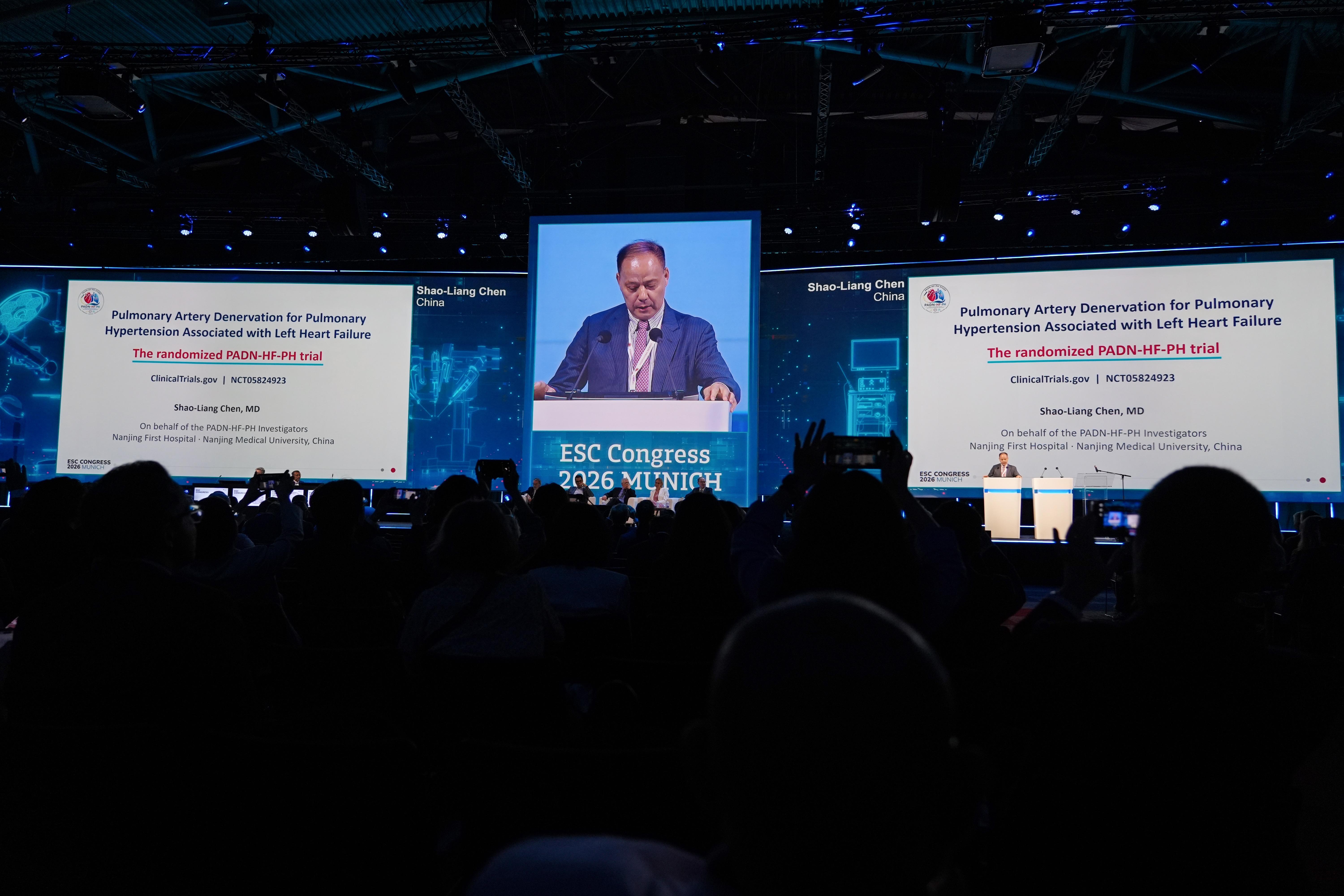
In the global cardiovascular medical community, Hot Line is a key entry point for important research to enter the core evidence-based system.
For Pulnovo Medical, the company behind this technology, this appearance also points to a larger proposition: whether an original Chinese technology can move from solving clinical problems to defining new treatment paths.
The company has been working on Pulmonary Artery Denervation (PADN) for 12 years. From original technology research and development, to clinical evidence generation, registration and access, international verification, and then to commercial implementation, it is trying to establish a new treatment method for patients who have long lacked clear treatment paths.
According to the PADN-HF-PH study announced by Professor Shaoliang Chen at the scene, the possibility of PADN changing the treatment options for patients with heart failure-related pulmonary hypertension is further increasing.
The randomized controlled evidence presented this time shows that after adjustment, the incidence of clinical deterioration in the PADN combined with GDMT group at 2-year follow-up is 25.7%, while that in the GDMT group is as high as 51.1%; PADN combined with GDMT reduces the risk of clinical deterioration by 51% (HR 0.49, 95% CI 0.30–0.82; P=0.006).
This means that a group of patients who previously lacked clear treatment paths are beginning to have the possibility of systematic intervention. If this clinical benefit can be translated into clinical practice, receive continuous supervision and verification, and be further included in guidelines, a potential market with previously blurred boundaries will gradually take shape.
As a result, a highly concerned issue in the industry has also emerged. When Chinese medical device enterprises enter clinical fields where there is no mature answer in the world, can they rely on original innovation to take the lead in defining treatment methods and let the global medical community accept this answer from China?
01 Breakthrough: Entering the "No Man's Land" of Heart Failure Treatment
The commercial imagination space of PADN is firstly built on a long-term unmet clinical demand.
The difficulty for such patients lies in the simultaneous existence of problems at both ends of the heart and pulmonary blood vessels, which is difficult for existing treatment methods to fully cover.
At present, heart failure treatment is based on guideline-directed medical therapy, namely GDMT; traditional pulmonary hypertension drugs mainly target the mechanisms related to pulmonary blood vessels.
For some patients with heart failure-related pulmonary hypertension, especially those with elevated pulmonary vascular resistance and elevated left heart filling pressure at the same time, it is difficult to cover all pathological mechanisms by only dealing with one end.
The superposition of the two sets of mechanisms has made this group of people in a "treatment vacuum" for a long time: the disease burden is clear, but targeted mature solutions are very limited.
Pulnovo Medical thus chose a device interventional path.
PADN refers to Pulmonary Artery Denervation. Its core idea is to inhibit the overactivation of pulmonary artery sympathetic nerves through one minimally invasive interventional radiofrequency ablation, so as to intervene in pulmonary vascular remodeling and the progression of cardiopulmonary diseases.
More intuitively, PADN regulates the sympathetic nerve regulation pathway of pulmonary blood vessels, which was rarely directly intervened by devices in the past, through one interventional operation, adding non-drug treatment options for patients.
The PADN-HF-PH study was thus launched. This prospective, multi-center, randomized controlled registrational clinical trial, led by Academician Yaling Han from General Hospital of Northern Theater Command as the principal investigator, enrolled 264 patients at 25 clinical centers across China. Patients were randomly divided at a 1:1 ratio into two groups: "PADN procedure + GDMT for heart failure" and "receiving GDMT for heart failure alone".
The primary endpoint of the study directly points to clinical deterioration events, including aggravated heart failure requiring intravenous administration, rehospitalization, significant decline in exercise capacity, need for cardiopulmonary transplantation, and all-cause mortality.
In the results announced at Hot Line this time, in addition to the primary clinical endpoint, the PADN-HF-PH study also presents changes in patients' exercise capacity, functional status and related indicators.
The data shows that at 12 months, the 6-minute walking distance of patients in the PADN combined with GDMT group has a net improvement of 24.8 meters compared with the GDMT group; the risk of significant decline in exercise capacity is reduced by 63%. At the same time, the study also observed improvements in indicators such as NT-proBNP and KCCQ, which further supports the clinical benefit of PADN.
As a result, the evidence-based evidence of PADN has further extended from previous hemodynamics and exercise tolerance to multiple dimensions such as clinical deterioration, recurrent events and patient functional status.
From the perspective of the industry, this kind of study answers two levels of questions.
The first level is whether the technology has real and sustainable clinical value.
Whether an innovative device can enter the treatment system ultimately depends on whether clinical evidence can continuously prove the benefits to patients.
The second level is whether a new market can be formed with the establishment of treatment paths.
In fields with mature solutions, new entrants face a stock market with relatively clear boundaries. In fields that have long lacked effective solutions, once a new treatment method is continuously verified, the patient's treatment path itself may be redefined.
Patients who were originally scattered outside the existing treatment boundaries are thus included in a clearer treatment path.
This is precisely an important industrial feature of First-in-Class medical devices: the market scale often takes shape gradually with the establishment of a new treatment paradigm.
Therefore, what PADN needs to verify next is whether this treatment path can enter the global clinical system and finally translate clinical demand into a sustainable market.
02 Advancement: From Chinese Evidence to Global Verification
Original medical devices need to cross a long verification chain from concept to market.
Entering clinical practice is only the starting point. The intensity of evidence, the replicability in different populations, regulatory recognition and doctor acceptance jointly determine how far a technology can go.
PADN has been following this path for 12 years.
The early PADN-5 study accumulated basic evidence-based evidence for this technology. Relevant studies have verified the clinical value of PADN in improving patients' hemodynamics and exercise tolerance, and were published in JACC: Heart Failure.
After the domestic evidence is established, the next level is replicability. Whether the same treatment method can obtain consistent results after entering different countries, different patients and different medical environments is the key to determining whether it can be truly popularized.
For medical devices, this point is particularly important. Differences in patient characteristics, doctor operation habits and medical systems may all affect the final performance of a technology.
Therefore, international multi-center clinical verification has become a necessary hurdle for original devices to enter the global market.
The PADN-Columbus international multi-center study first released at EuroPCR 2026 is an important node in this process.
Compared with previous clinical verification focusing on Chinese patients, PADN-Columbus expanded the scope of evidence to international patients for the first time.
It is understood that among CpcPH patients, the study observed simultaneous decreases in two hemodynamic indicators: pulmonary vascular resistance and pulmonary capillary wedge pressure, and further showed a trend of improved functional status and clinical prognostic benefits.
While the international clinical verification is expanding outward, regulatory access and academic recognition are also advancing simultaneously.
After the product was approved in China, PADN is further promoting commercialization in Europe, and continuing to carry out global verification through the PULSE-LHD IDE clinical trial in the United States. This technology has also been cited in 7 clinical guidelines at home and abroad, including the 2022 ESC/ERS Guidelines for the Diagnosis and Treatment of Pulmonary Hypertension.
Connecting these nodes, we can see a clear path for the globalization of original medical devices.
The first step is to prove that the technology is feasible.
The second step is to verify whether the clinical benefit is stable, and repeatedly verify it in different patients and medical environments.
The third step is to enter the regulatory systems of different countries and regions.
The fourth step is to promote doctors to form awareness, so that new treatment methods can gradually enter clinical practice.
The four links are prerequisites for each other, and all require time accumulation. When this chain is gradually opened up, commercialization can have a stable foundation.
This is exactly the significance of ESC Hot Line to Pulnovo Medical: it further pushes PADN into the global core evidence-based and academic evaluation system.
At the same time, the company's global verification is still ongoing. The first batch of patients has been enrolled in the PULSE-LHD IDE clinical trial in the United States; Pulnovo Medical has also promoted commercialization in Europe, the Middle East, Asia and South America, and continues to expand into a larger market through clinical practice in the United States.
From PADN-5, PADN-Columbus, to the PADN-HF-PH that appeared on ESC Hot Line this time, to China's product approval, commercialization in Europe and other markets, and the advancement of IDE clinical trials in the United States, Pulnovo Medical has gradually built a complete chain of "original technology - clinical evidence - regulatory access - academic recognition - commercialization".
This chain also reveals that the core of medical device globalization is far more than just bringing products to overseas markets.
The deeper globalization is a process in which a technology gradually enters the global medical community to define diseases, evaluate technologies and establish treatment paths; product going global is the final commercial outcome of this process.
For a Chinese medical device company starting with original innovation, this is the path with the highest difficulty, the longest cycle, and the most likely to form long-term barriers.
03 Expansion: From Clinical Value to Global Market
As clinical verification and global access are gradually advanced, the commercialization proposition of PADN has become prominent.
How can a First-in-Class medical device company translate clinical value into commercial value?
First of all, it is necessary to go through a long investment period.
Innovative devices have long R&D cycles and high clinical trial costs. After facing the global market, the company also needs to continuously promote the construction of regulatory, evidence-based and commercial systems in multiple countries.
Before generating large-scale revenue, such companies often have to bear long-term investment.
Since 2013, Pulnovo Medical has continuously received support from professional investment institutions. The latest round was in April 2026, when it completed a $100 million Series D financing. The lead investor was Medtronic, the world's largest medical device giant. Existing investors including EQT, Qiming Venture Partners, Gaorong Ventures, Orbimed and Lilly Asia Ventures continued to follow the investment, and HSG and many other well-known global institutional investors participated in this round.
What is more noteworthy than the financing amount and the lineup of investors is the judgment logic behind the continuous capital investment.
The first level of logic comes from unmet clinical needs, which has been described in detail earlier. The second level of logic comes from the scarcity of original technologies.
Traditional medical device entrepreneurship can often refer to overseas verified products and business models, and the core challenges are more focused on engineering, cost and channels. The First-in-Class path lacks mature answers that can be directly copied, and enterprises need to complete technology verification, clinical verification, regulatory promotion and market education on their own.
Higher risks and longer cycles also make time accumulation itself a competitive barrier.
For PADN, the assets accumulated over the past 12 years have gone beyond a single product. Clinical data, registration experience, guideline awareness, as well as research centers and doctor networks at home and abroad, together form an infrastructure that latecomers cannot replicate in a short time.
With the product approval in China, the continuous advancement of commercialization in Europe, the Middle East, Asia and South America, and the continuous progress of the PULSE-LHD IDE clinical trial in the United States, the focus of PADN's commercial proposition is shifting.
If the early stage needs to answer whether the technology is feasible, the more critical issue at this stage is how many patients this technology can cover, how many countries it can enter, and finally how big a market it can form.
As clinical verification and global access are gradually advanced, the next growth proposition of PADN is gradually shifting to indication expansion, and the third level of growth space has also emerged.
Whether PADN only corresponds to one indication, or can continuously expand its boundaries around pulmonary hypertension, heart failure and more related cardiopulmonary diseases, will directly determine its long-term development potential.
For platform-based device technologies, how many patients the same underlying technology can cover and how many treatment scenarios it can enter often determine the upper limit of a company's long-term value. Therefore, continuously expanding indications will become an important growth logic for Pulnovo Medical in the next stage.
Looking further, the change represented by PADN may not just be the birth of a product.
For a long time, Chinese medical device enterprises have faced a world that has already been defined. How to treat diseases, how to evaluate products, and how to divide the market, most of the mature paths come from overseas.
What Chinese companies are better at doing is to complete catch-up, substitution and efficiency improvement along the existing coordinates.
What First-in-Class innovation really changes is precisely this set of coordinate relationships.
When a Chinese company enters the clinical "no man's land" where the whole world lacks mature answers, what it has to answer is not just whether the original technology is effective, but whether it can rely on continuously accumulated randomized controlled clinical evidence to make a group of patients who previously lacked clear treatment paths be re-seen, let a new treatment method enter the evaluation and treatment system of the global medical community, and thus demarcate new market boundaries.
This is also what makes PADN more worthy of observation than commercialization itself. Over the past 12 years, Pulnovo Medical has gradually brought an original technology into clinical research, guidelines, regulatory systems and global medical evaluation systems; next, it will move towards participating in defining the global market.
The so-called breaking into the "no man's land", the real value may lie here.
There is no ready-made road there. The first person to get through the road not only blazes a trail, but also calibrates the direction of the industry's progress.
In the future, represented by Pulnovo Medical, Chinese original medical device enterprises will further evolve from participants in the global market to initiators and co-builders of new treatment paths.
And this is exactly the most shocking opening chapter of China's medical device industry entering a new stage of original innovation.