Durians are sold all over the world, yet why can't Southeast Asian fruit farmers cheer up?
Over the years, we have achieved "cherry freedom", "blueberry freedom" and "sunshine rose grape freedom".
Now, durian has also become affordable for all.
The wholesale price of Vietnamese Golden Pillow durian widely spread across all online platforms in Guangzhou's market has dropped to as low as 13.8 yuan per jin.
In chain supermarkets in Wuhan, Chengdu and Beijing, special price tags marked 19.9 yuan can be seen everywhere.
The consumer-friendly price has brought a blowout in market demand.
In the first half of 2026, China imported about 1.07 million tons of durian, a year-on-year increase of over 50% compared with 708,000 tons in the same period last year.
However, while some are rejoicing, many others are suffering.
In the durian producing regions of Southeast Asia, many people can no longer force a smile.
Some fruit farmers even have to grow bananas to make up for their losses from durian cultivation.
What on earth is the reason behind this situation?
This is almost a microcosm of many agricultural production tragedies.
01 Supply Side Explosion
The trouble with durian starts with its growth cycle.
A cold storage can be built in a few months, and an express line can be opened in a few weeks, but a durian orchard usually takes 5 to 7 years before it reaches full fruition.
What will happen if fruit farmers plant saplings when the price is high, and the trees start to bear fruits on a large scale years later?
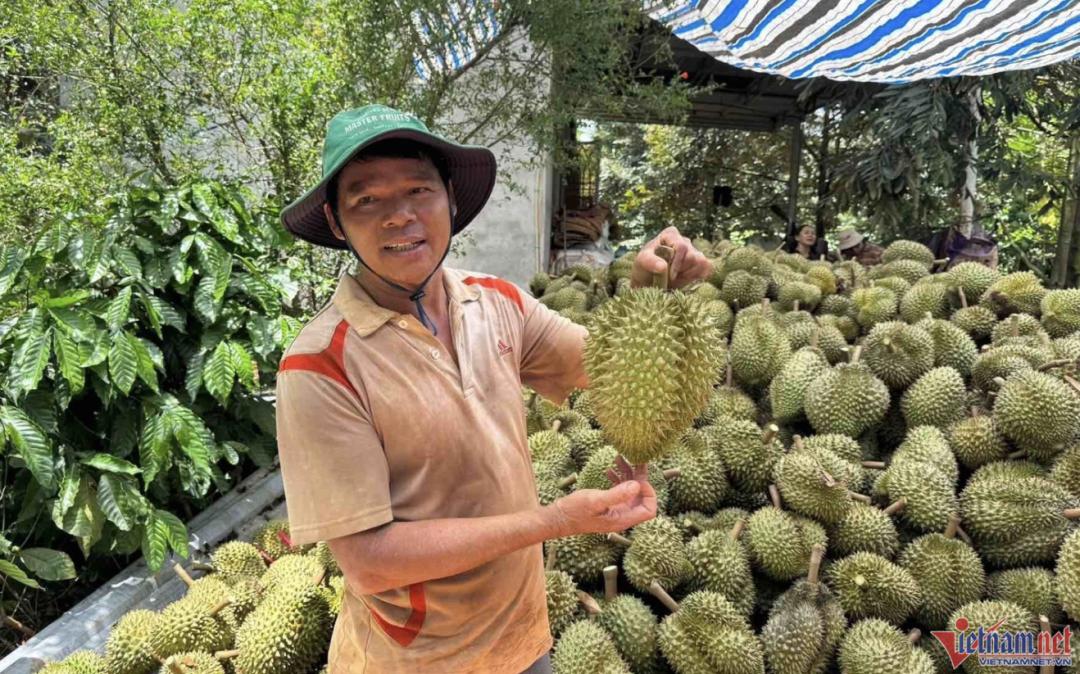
Take Vietnam, the most typical incremental sample, as an example.
Driven by huge demand from external markets, durian cultivation can bring better economic returns.
From 2018 to 2020, a large number of Vietnamese farmers cut down rubber trees and converted rice fields to expand durian planting areas.
The reason is very simple —
Someone in the neighboring village made good profits selling durian, and the income per mu of land seemed much higher than that of coffee, rubber and even bananas.
Catching up with the trend quickly is a rational choice from the individual perspective of smallholders.
The Vietnam News Agency reported earlier this year that over the past 10 years, their durian planting area has expanded by nearly 5 times.
By 2026, the area disclosed by Vietnam's Department of Cultivation and Plant Protection is about 192,000 hectares.
The durian output was about 1.8 million tons last year, and it is expected to reach 2 million to 2.1 million tons this year.
Around 2019, the durian industry policies in Thailand, Vietnam, Malaysia and other countries all depicted a narrative of "earning foreign exchange through exports".
Agricultural authorities encouraged the expansion of planting and orchard construction through policies such as discount interest loans and seedling subsidies.
For example, Tien Giang Province in Vietnam set a target of 14,000 to 16,000 hectares for 2025, but the actual area has reached nearly 22,000 hectares as early as 2024.
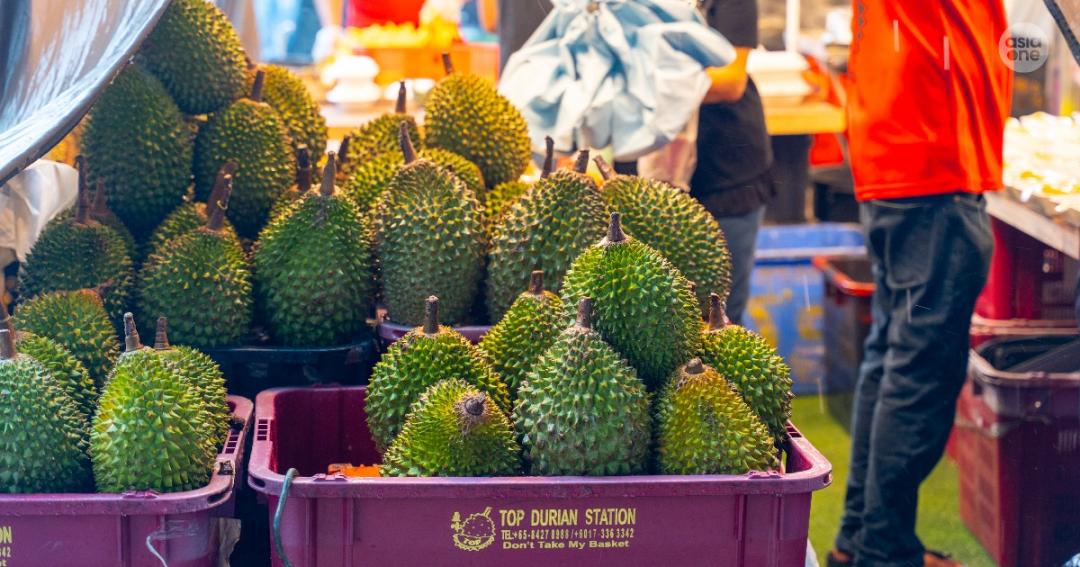
Durian sold in the Singapore market (most of which are imported from Johor and Pahang in Malaysia, with harvest seasons usually from June to July and December)
In those years, a large number of oil palm plantations in Pahang, Johor and other states of Malaysia were converted to durian orchards.
Malaysia's External Trade Development Corporation also proposed this year that the country's fresh durian exports to China should reach 229 million U.S. dollars by 2030.
That is a very ambitious goal.
However, no country or international institution has established a coordinated monitoring mechanism for durian production capacity in Southeast Asia.
In 2025, the total durian output or official forecast of Thailand, Vietnam and Malaysia, the three major producing countries that have disclosed national data, is close to 4 million tons.
China imported 1.868 million tons of fresh durian that year. Together with local consumption in Southeast Asia and markets in Singapore, Japan, South Korea and other neighboring Asian regions, the overall supply is undoubtedly in surplus.
This is the "fallacy of composition" in the agricultural sector.
When several countries expand planting at the same time in the same market cycle and send a large number of fruits to the same target market, the originally profitable business will turn into a stampede of oversupply.
In the past two years, the Vietnamese government has also noticed this risk.
In May 2025, the Vietnamese government issued a special notice, explicitly pointing out that some regions are "blindly expanding planting and rapidly increasing planting areas", requiring production arrangements to be made around the balance of supply and demand, and increasing the proportion of frozen and deep-processed products to avoid price drops during the peak picking season.
But by this time, the cost of making up for the lessons learned is extremely high.
The full fruiting period of durian trees can last for more than 30 years, but new trees do not produce any output in the first 4 to 5 years.
During this period, continuous investment in water, fertilizer and orchard management is required.
The main entities that expanded planting from 2019 to 2021 are mostly inexperienced smallholders, and even urban capital went to rural areas to rent land for durian cultivation, lacking long-term management capabilities and risk resistance capabilities.
After the price plummeted, smallholders are faced with a dilemma: to cut down the trees and lose all their previous investment, or to keep the trees and continue to lose money on management costs?
Some farmers even face loan defaults and abandon their orchards to go out to work, and some fruit farmers are considering growing bananas to offset their durian cultivation losses.
However, local governments in producing regions lack a subsidy mechanism for production capacity withdrawal, so the social cost of production capacity clearance is extremely high.
02 When Premium Products Are No Longer Premium
There used to be a very attractive narrative in the durian industry: as long as you plant high-end varieties, the ordinary agricultural cycle will no longer apply.
Names such as Musang King, Black Thorn and D123 are constantly being hyped up.
They have strong taste labels, and can enter niche tracks such as gifting, high-end catering and cross-border e-commerce.
Consumers are willing to pay more for the "variety", so fruit farmers naturally plant more trees for the "high-end" positioning.
But the name itself does not automatically translate into quality.
In fact, any premium fruit never sells for its sweetness alone.
What it sells is maturity, fruit shape, sugar-acid ratio, pesticide residue control, cold chain, sorting and stable delivery.
If one link is missing, the high-end label becomes just a piece of paper, and consumer trust will decline.
Vietnam's durian industry has received a very specific reminder on this issue.
In early 2025, China strengthened the supervision of auramine O and cadmium in imported Vietnamese durian, requiring batch-by-batch testing with qualified reports attached.
Documents from Vietnam's Ministry of Industry and Trade show that affected by this, in the first four months of 2025, Vietnam's durian export value to China was only about 130 million U.S. dollars, equivalent to 35,000 tons.
In fact, by May 2024, only about 20% to 25% of the nearly 180,000 hectares of durian orchards have obtained the export orchard code.
The so-called export orchard code can be understood as a "traceable ID card" for an orchard to enter the high-standard export market, which is usually applied for by the competent authority of the planter, and then reviewed by the customs of the importing country.
The fruits are still on the trees, but the market access has been blocked by quality thresholds.
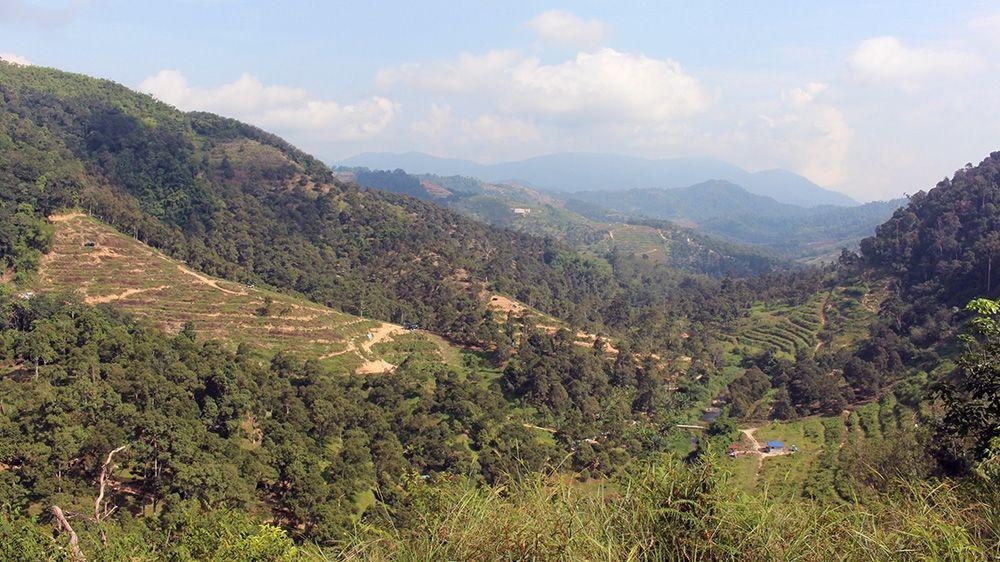
Mountain durian orchard in Raub, Pahang, Malaysia
For Musang King orchards with export qualifications in Raub, Pahang, Malaysia, their products can still be sold to China via air and sea freight, and their prices remain relatively stable.
However, the non-genuine Musang King durian planted by smallholders around these qualified orchards has dropped to less than 10 ringgit (16.7 yuan RMB) per kilogram with no buyers.
These new smallholders lack the capabilities for standardized planting and post-harvest treatment. A large number of low-quality Musang King and D123 durians have flooded into the market, breaking the price system of high-end varieties.
Although the price of high-quality fruits with formal export qualifications and traceability can still be maintained, the market is still in a precarious situation, forming a short-term market panic of "bad fruits driving out good fruits".
Vietnamese official media also admitted that some producers rushed to obtain orchard and packaging plant codes without continuously meeting the requirements of the agreement, and even problems such as code trading, forgery and premature harvesting occurred.
This directly breaks the illusion of "high quality brings high price".
When the price is high, the market adds a halo to every "branded fruit".
After the expansion of planting, the number of orchards increases, but the picking standards are not improved synchronously, and are even disrupted by low-quality products.
Poorer fruit shape, slightly earlier maturity, looser testing, all these will eventually turn into price differences in supermarkets and wholesale markets.
Once such a large number of "premium fruits" hit the market at the same time, the so-called high-end image will begin to loosen and even collapse.
Brands first lose their scarcity, and their quality is questioned, so prices can no longer stay high.
03 This Is Not Just a Story of Others
If we sum up this phenomenon, it is not unfamiliar to us.
A fine variety or new technology emerges, bringing huge dividends;
Subsequently, policies encourage its development, and capital flocks in;
Driven by interests, the upstream planting side also starts blind expansion;
Eventually, due to supply explosion and uneven quality, the market will eventually collapse.
Although the durian incident took place in Southeast Asia, it can bring us a lot of associations and inspirations.
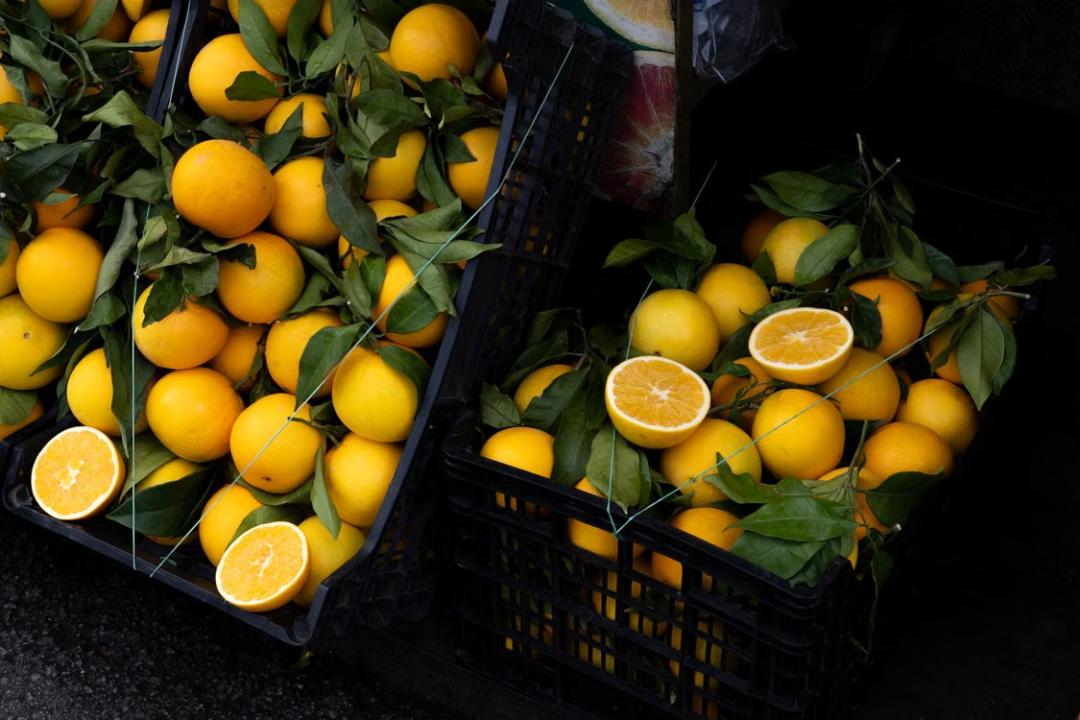
Let's take a familiar example around us.
"Gannan Navel Orange" is a top-tier brand among all Chinese fruit brands.
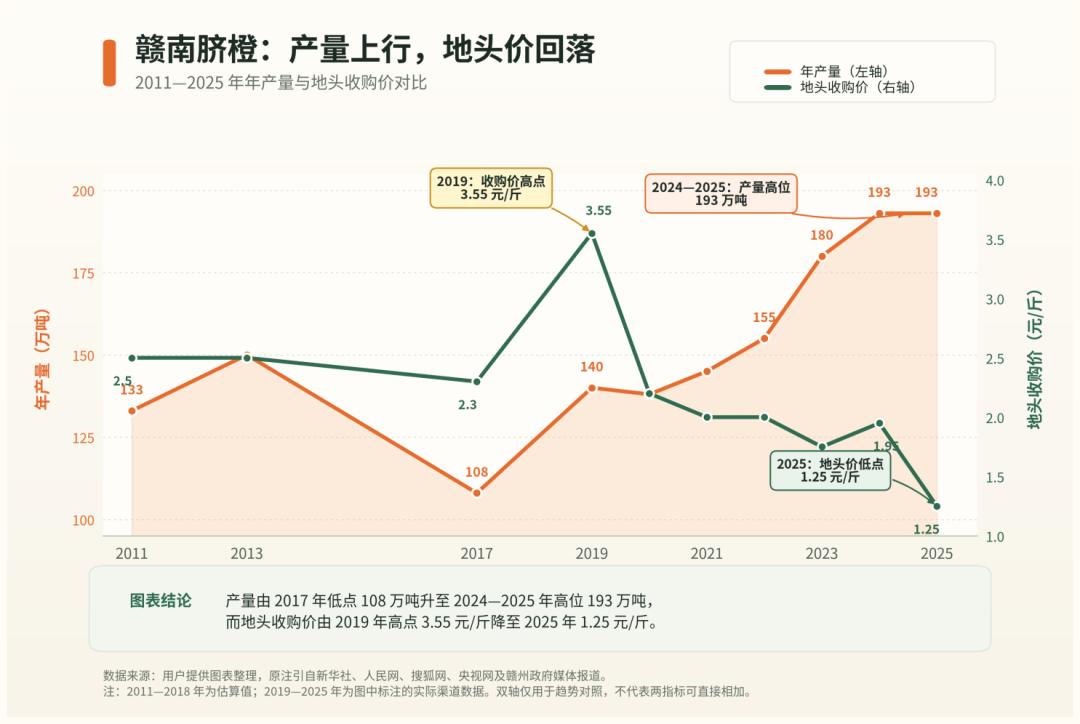
In 2025, the planting area of Gannan Navel Orange reached 1.94 million mu, with an output of 1.93 million tons.
Its brand value is 69.294 billion yuan, ranking first in the fruit category for 11 consecutive years.
This is a dazzling report card.
However, in the winter of 2025, the on-site purchase price of Gannan Navel Orange even fell below 0.8 yuan per jin.
In the cold wind, fruit farmers looked at the golden oranges all over the trees, but their faces were full of sorrow.
A jin of oranges that they worked hard to grow can't even be exchanged for a bottle of the most ordinary mineral water.
In the past, the common price was at least 2 to 3 yuan per jin.
What on earth is the reason for this?
Similarly, the first reason is the "full-line oversupply" on the supply side.
Last year, China's total output of citrus fruits exceeded 70 million tons, accounting for more than 30% of the global total output.
80% of the mid-maturing varieties are all launched in winter, pouring into the sales channels at the same time, just like thousands of troops crossing a single wooden bridge.
In recent years, Ponkan orange has become a "people-pleasing" fruit for its thin peel, large flesh, sweet taste and no sticky hands when eating.
In contrast, the advantages of navel oranges are no longer so prominent.
But the total output of navel oranges continues to rise.
Statistics show that the total output of Gannan Navel Orange increased from 1.33 million tons in 2011 to 1.93 million tons in 2025.
The balance between market supply and demand has long been severely disrupted.
There is no other way out except the brutal price war.
In fact, there is never an easy solution to the problems in the agricultural sector.
The durian orchards in Southeast Asia are not the same orchard, nor are they owned by the same company.
Facing the huge market demand for durian in recent years, they each bear different planting areas, export pressure and trade chains.
The micro individual rational decisions converge into macro irrationality.
Similarly in China, behind the 1.94 million mu of orange orchards in Ganzhou, Jiangxi, there are hundreds of thousands of scattered smallholders, lacking unified standards, production capacity coordination and unified pricing.
To a certain extent, this is also an atomized production mode.
What can we do to solve this problem?
Stones from other hills may serve to polish the jade here.
Let's look at a simple example from the other side of the ocean.
In 1893, California in the United States also faced the dilemma of citrus scale expansion and overcapacity.
Fruit farmers soon realized that letting the market go into chaos would do no good, and working alone would lead to no way out.
Therefore, they made a decision that influenced the next hundred years: to unite for mutual benefit and establish the "Southern California Fruit and Agricultural Products Cooperative" — which is the predecessor of Sunkist.
