With its annual sales that once hit 1,000 units plummeting by 90%, luxury car brand Maserati has now become the "Nokia" in the automobile market.
Unexpectedly, the "Trident" that used to require price premiums and long waiting queues in China has now been exposed to have seen its sales volume plummet by 90% compared to its peak period.
Although official data has not been publicly disclosed, multiple media outlets have estimated Maserati's sales in China in the first three quarters of 2025 through various channels.
According to statistics from different sources, the conservative estimate of its sales volume is above 650 units, and the maximum will not exceed 1100 units. Compared with the peak period when it could sell more than 10,000 units in China in a single year, Maserati's sales in China have shrunk by more than 90%.
In less than 8 years, this Italian ultra-luxury automotive brand has been forced to ride a "roller coaster" from its peak to trough in the Chinese market.
Nearly half of its 4S stores have disappeared, and the remaining stores that are barely maintaining operations have had to launch steep, loss-making discounts:
You can get a brand new Maserati for less than 360,000 RMB.
Chinese car buyers are no longer keen on Maserati
Maserati, the brand with the "Trident" logo, has failed to stop its declining momentum in the Chinese market, and its current situation remains rather grim.
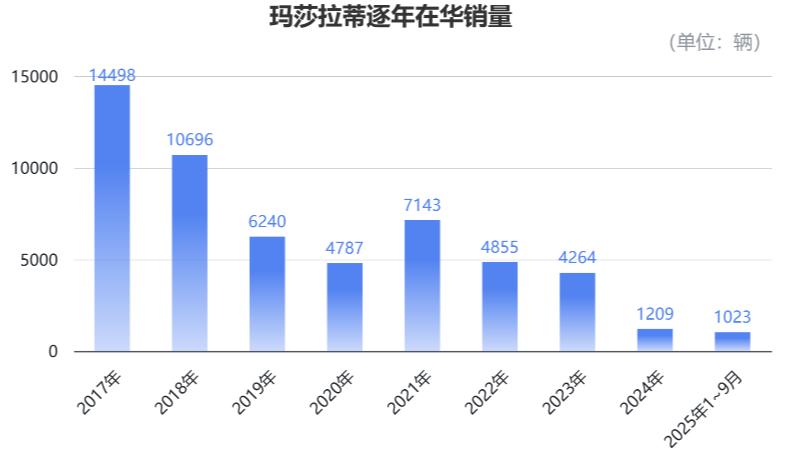
In 2024, Maserati's sales in China reached 1209 units, a year-on-year decline of over 70%.
In the first 9 months of 2025, Maserati's sales in China stood at around 1000 units, continuing to drop by roughly 3% year on year, which translates to about 3.7 units sold per day across the country.
Compared with the peak period in 2017, the current sales volume has shrunk by more than 90%.
To reverse the slump in sales, Maserati has had to launch unprecedentedly steep promotions in a bid to retain consumers.
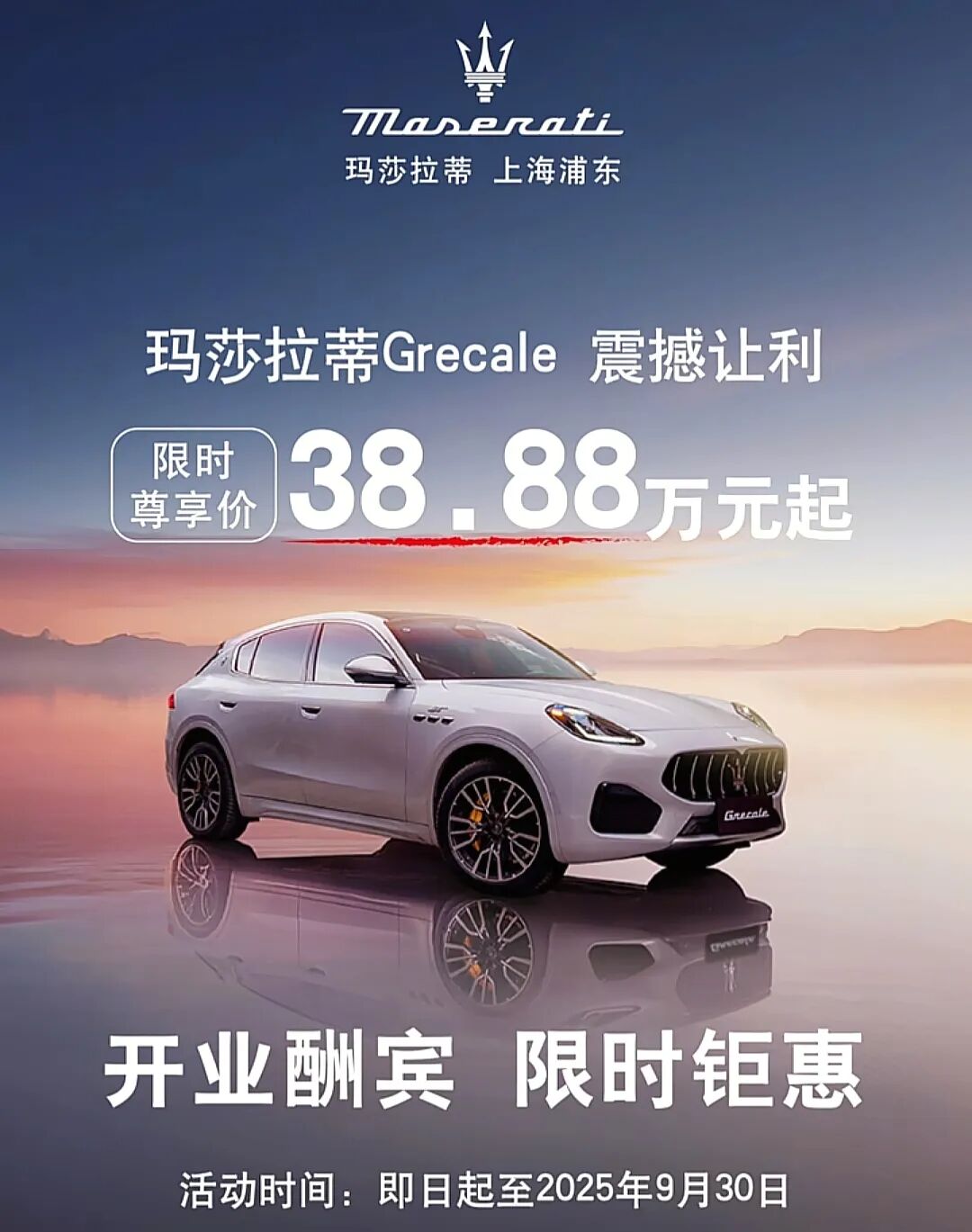
Back in July 2025, Maserati was reported to have rolled out a wave of discounts. At Maserati's store in Pudong, Shanghai, the Grecale SUV, which originally started at 650,000 RMB, was available for a limited-time price starting at only 388,800 RMB, and it is no exaggeration to call this a "stunning profit concession".
Last year during the Double 11 shopping festival, the discount intensity was even higher. Multiple media outlets revealed that some Maserati dealers launched massive clearance sales:
The fuel version of Grecale starts at 380,800 RMB, which is equivalent to a 42% discount off the original price;
The all-electric version of Grecale is even sold at a 60% discount, with a starting price of 358,800 RMB.
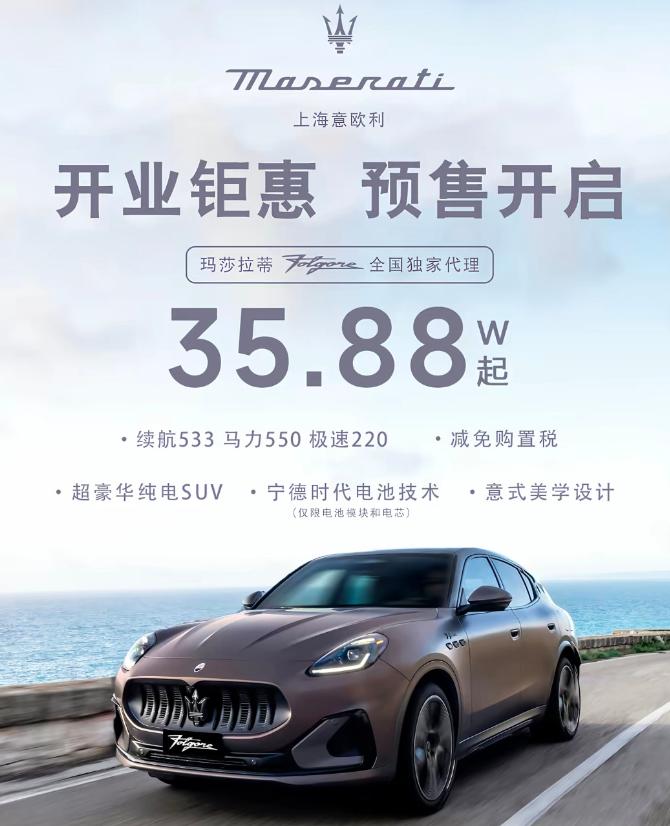
Now you can get your first ultra-luxury sports car for young people for less than 360,000 RMB?
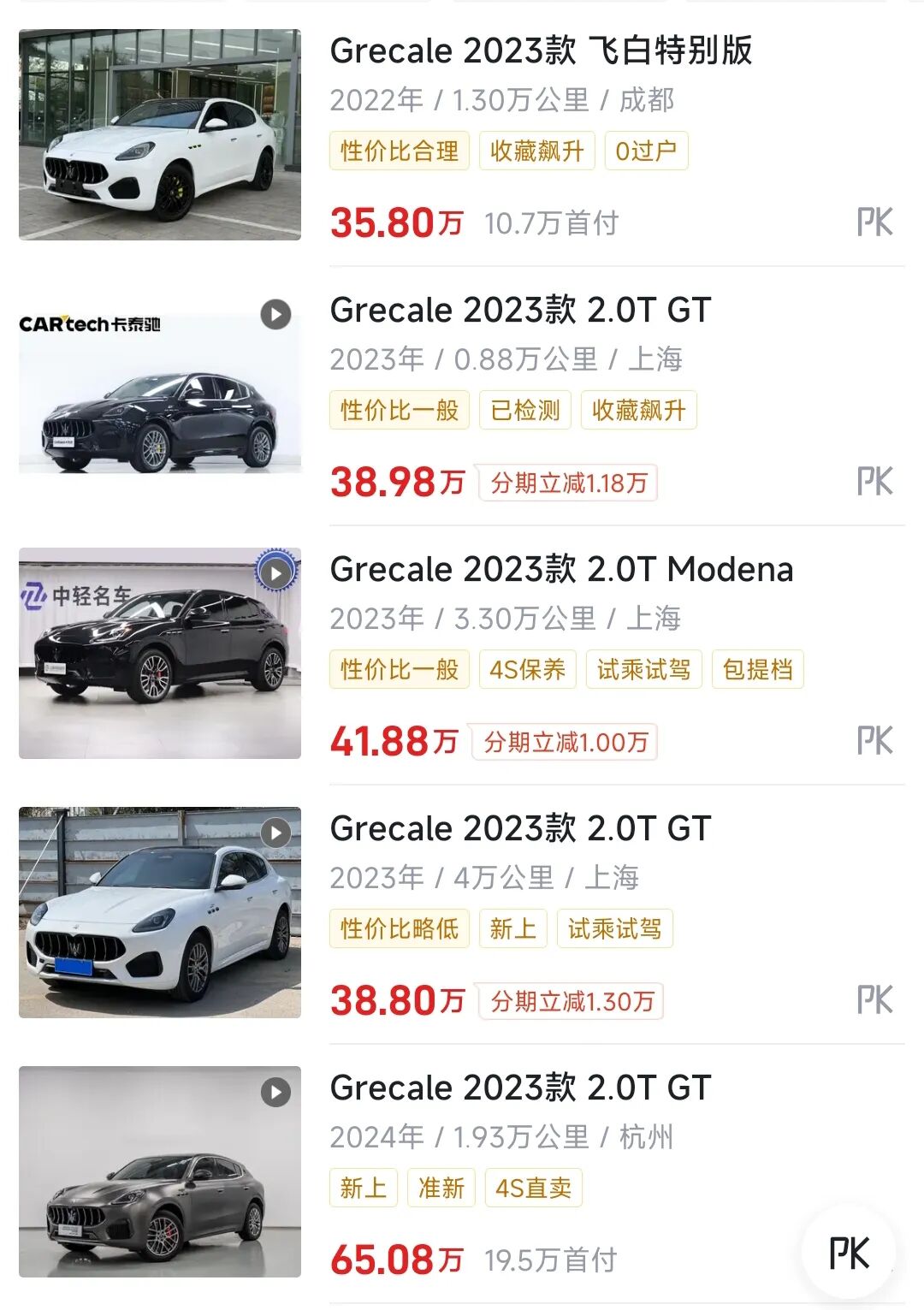
For this 112-year-old Italian ultra-luxury brand, this is the first time in its 20-year history of entering the Chinese market that such a large price cut has occurred, and this price is even lower than that of some second-hand cars of the same model.
△
It is clear that Maserati's situation in China has become quite difficult. Looking back at Maserati's journey in the Chinese market, it has also been full of ups and downs.
In 2004, Maserati officially entered the Chinese market, and began to enter a period of rapid development in 2011. 2017 was Maserati's peak year in China, with annual sales reaching 14,498 units, meaning nearly 40 luxury cars were sold every day.
In that year, China overtook the US to become Maserati's largest single market worldwide, accounting for nearly 30% of its total global sales.
At that time, Maserati's "Trident" logo was almost equivalent to a symbol of "wealth". The sales staff in 4S stores were like luxury butlers, and the customer list was always filled with film and television stars and newly rich entrepreneurs.
This is partly attributed to the arrival of the WeChat business era in 2016. A WeChat business operator purchased 11 Maserati cars at one time to reward agents and employees, which made Maserati quickly become popular among WeChat business groups.
Some dealer stores even launched a 200 RMB-per-photo service for WeChat business operators, which is how the nickname "divine car for WeChat business" came into being.
Although this marketing method boosted sales in the short term, it laid hidden dangers for the long-term development of the brand — Maserati was tied to the image of "WeChat business", and the aura and sense of mystery of its ultra-luxury brand began to fade.
This "aftereffect" was not obvious in 2018, when its sales in China reached 10,696 units, but it began to plummet from 2019, with the annual sales dropping sharply to 6240 units.
The situation became even worse after 2024, with annual sales not exceeding 1500 units, far less than half of the sales volume two years ago, let alone the figure in 2017.
At the same time, as sales plummeted, Maserati's dealer network also began to fall apart. At its peak, there were more than 60 Maserati 4S stores across the country, but now less than 30 are still in operation.
Facing the continuous sluggish performance in the Chinese market, Maserati's China management team has also been in constant turmoil. Since 2023, Maserati has changed three China General Managers.
In May 2023, Fabio Lambertini officially took office as Managing Director of Maserati Greater China, but his term lasted only just over a year.
In September 2024, Yu Hanbang was appointed as General Manager of China. However, only half a year later, Maserati announced another leadership change, appointing Julie Taieb-Doutriaux as the interim General Manager of China.

△
The frequent personnel changes may reflect the anxiety of Maserati's parent company Stellantis about its performance in the Chinese market.
Why has the once noble "Trident" we all remember lost its appeal?
Why has the "Trident" lost its appeal?
Maserati's awkward situation in China is caused by both internal problems and external challenges.
The first is the internal problem. In its more than 100 years of history, Maserati has been sold and transferred seven times, and finally came under the ownership of its current parent company Stellantis, which can be described as a turbulent experience.
Growing up under the control of different parent groups has led to Maserati's status and positioning being awkward for a long time.
Carlos Tavares, former CEO of Stellantis, admitted during the 2024 Paris Motor Show that the root cause of Maserati's problems is not the products themselves, but its vague brand positioning.

△
At the same time, Maserati's product updates and electrification transformation are lagging behind.
To push forward its all-electric transformation, its best-selling models Levante and Ghibli, along with the V8 engine, have been discontinued. The replacement models are not expected to be launched until 2027 and 2028, creating a clear product gap in between.
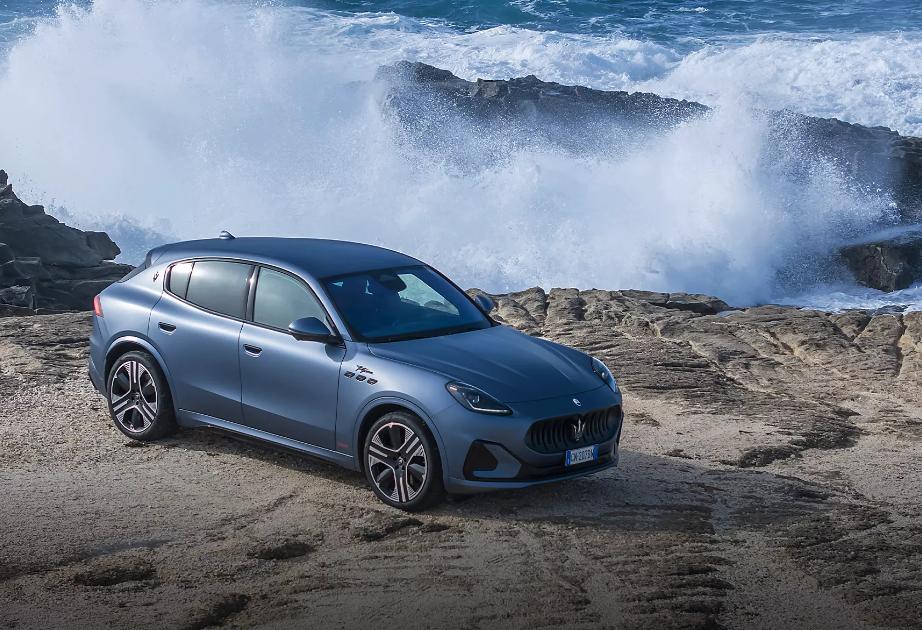
Against the market trend where consumers favor SUVs, Grecale is almost the only main model available for selection.
However, the company's first all-electric SUV, the Grecale Folgore, was not launched until the end of 2024, and its performance in intelligent and digital experience is not outstanding enough.
What's worse, by that time, Tesla had already occupied a considerable market share in China, and local Chinese brands had also risen rapidly, making China's electric vehicle market fiercely competitive.
In addition, Maserati's brand image has suffered backlash. The collapse of its price system and its collaboration with *Honor of Kings* even played a counterproductive role, making some netizens believe that it further "lowered Maserati's class", and some car owners even said frankly that they "felt deeply distressed".
Nevertheless, the impact of external factors cannot be ignored.
An obvious trend is that in the electrification era, Chinese consumers' values for luxury cars have changed: in the past, luxury cars were for showing off to others, but now luxury means bringing comfort to the owners themselves. Therefore, "luxury" no longer only refers to leather, wood grain or the brand itself, but is defined from the experience of intelligent driving and interior space.
Moreover, the "Maserati problem" is not only the problem of Maserati, but also the common problem of the old luxury car era.
In addition to Maserati, other luxury brands such as BBA and Porsche have also encountered the pain of poor sales in the process of transformation.
Even Maserati's parent company Stellantis itself is not in an optimistic situation. Stellantis was formed by the merger of PSA Peugeot Citroën and Fiat Chrysler Automobiles, and owns 14 brands under its group.
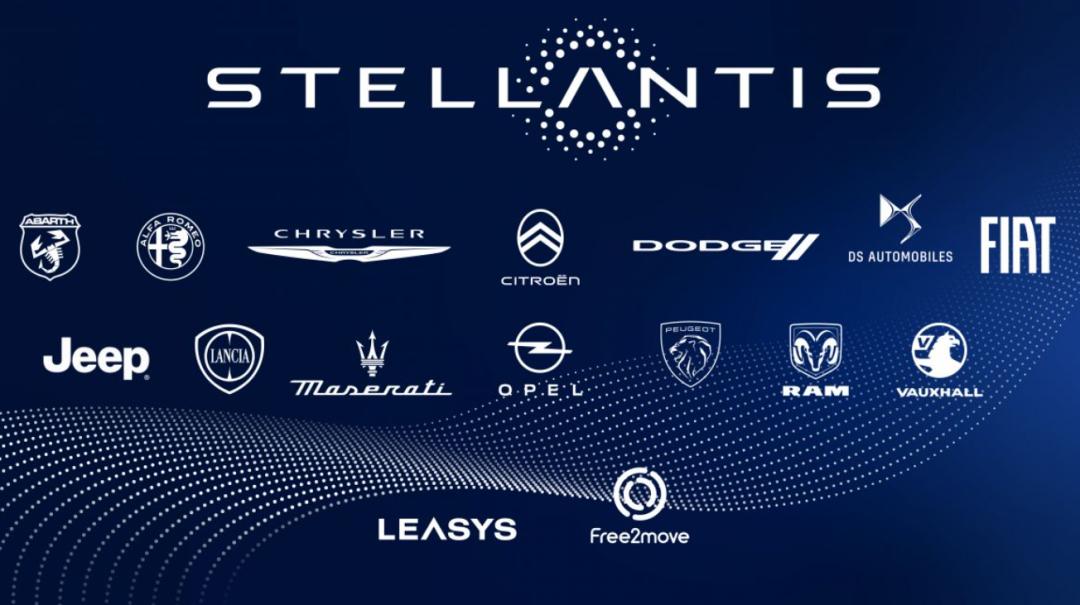
In the first half of 2025, the company's revenue was 74.3 billion euros (about 611.3 billion RMB), down 13% year on year; its net loss reached 2.3 billion euros (about 18.9 billion RMB), while it had a net profit of 5.6 billion euros (about 46.1 billion RMB) in the same period of 2024.
In terms of sales, Stellantis' total global sales in the first half of 2025 reached 2.69 million units, down 8% year on year. Multiple brands under the group have been repeatedly rumored to be "sold", including Maserati...
In the first half of last year, multiple media outlets broke the news that Stellantis Group had considered selling Maserati, but the group finally stated publicly that Maserati is a "non-saleable asset" and will continue to operate as a luxury brand.
However, there may not be much time left for Maserati.
Because Stellantis has found a new partner in China, and is fully betting on Leapmotor, the top-selling new energy vehicle startup in China.
The group invested about 1.5 billion euros to acquire roughly 20%