Terence Tao: 100 Years Later, Mathematics Faces Another Major Crisis
Just recently, Terence Tao, a Fields Medalist, personally published a paper — Mathematics in the Age of AI.
This is the first time he systematically elaborated on the impact of AI on mathematics at an ICM-level event.
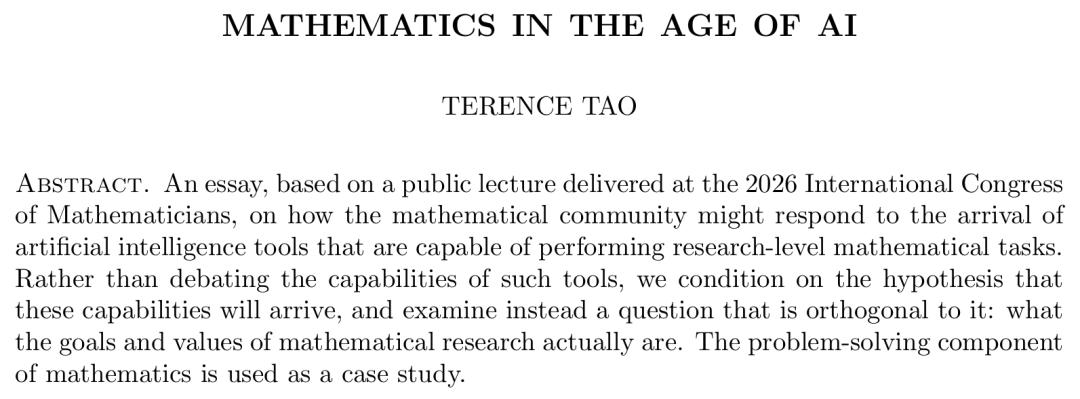
Paper link: https://arxiv.org/abs/2608.16753
In the paper, he cited a set of data that immediately caused a sensation.
10 never-before-disclosed research-level difficult mathematical problems were attempted by 4 cutting-edge AI systems, and at least one "essentially flawless" solution was obtained for 7 of them.
The computational cost only ranges from tens to hundreds of dollars. A problem that a PhD student might spend three years working on can be solved by AI at a cost of just a few hundred dollars.
But Terence Tao did not write this paper to simply share good news.
The question he really wants to ask is far more incisive —
When AI can do mathematics, what exactly are mathematicians doing?
He even put forward a fill-in-the-blank question called the "AI Capability Conjecture".
Within ____ in the near future, AI tools will complete ____ research-level mathematical tasks in ____ mathematical fields at a cost of ____ and under human supervision of ____ degree, with a success rate of ____, and the correctness and quality ____.
Solving problems is only the first step
This is the most hardcore part of Terence Tao's paper.
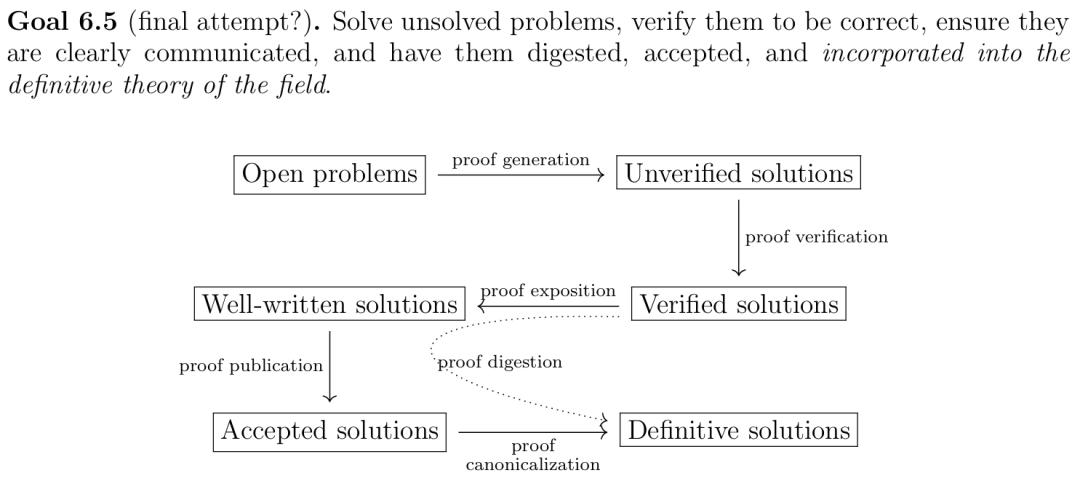
He broke down the process of "solving a mathematical problem" into a five-level pipeline, and raised questions level by level. You think it's enough to get the solution? Far from enough.
The first level is to solve as many unsolved problems as possible.
It sounds reasonable, but if you only pursue quantity, a large number of wrong solutions will be generated. An AI system that rushes to every problem is essentially no different from a PhD student who churns out low-quality papers.

The second level is to add correctness verification on this basis.
This is a step forward, and formal proof tools can allow machines to check every step of the logic.
But being correct and being good are two different things. A proof that is correct but has no insight is just like an article that has no grammatical errors but is completely empty of meaningful content.
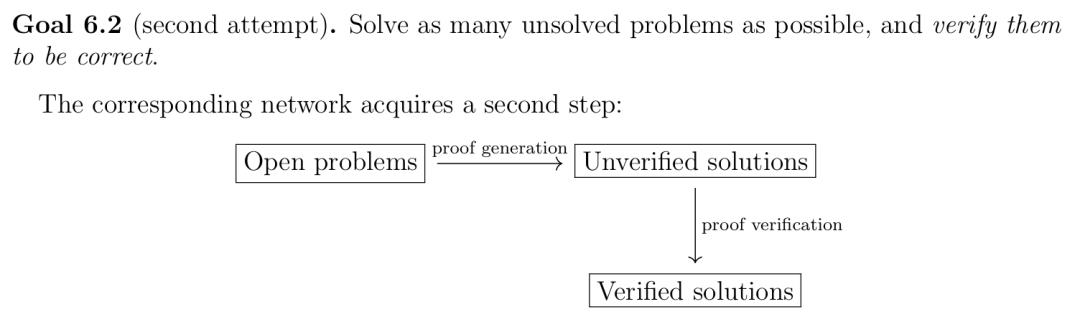
The third level is to add clear presentation to make it understandable to humans.
This is another step forward, but a subtle problem arises here.
Proofs generated by AI are often "too smooth". Every step is logically rigorous, every leap is filled in, and there is no part that confuses you at all throughout the text.
Sounds like an advantage? In the eyes of mathematicians, it is precisely a defect.
Proofs written by humans have a kind of "natural friction". The author will stop at key points to explain why this path is chosen, admit that "this step is not obvious" at difficult points, and leave traces of their own thinking. These frictions look like flaws, but in fact they are signposts left for later generations.
For example, an AI proof is like being teleported directly to the top of the mountain, while a human proof takes you to climb up, telling you along the way that there is a pit here, a small path over there, and that mountain in the distance is also worth a visit.
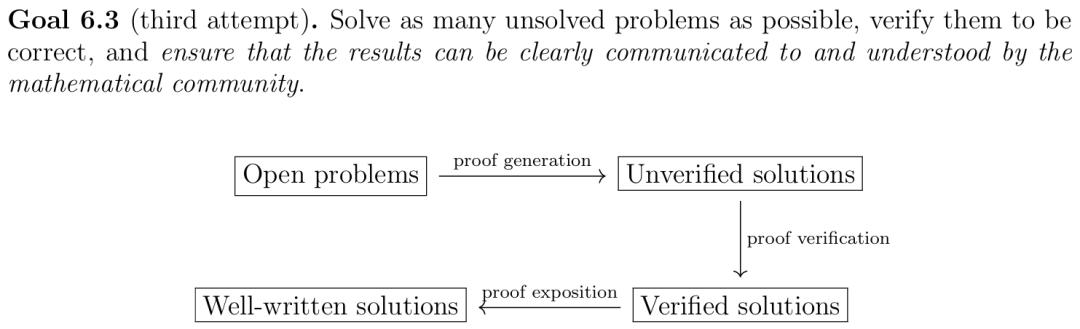
The fourth level is to be digested and accepted by the academic community.
This goes a step further. Publication in journals and passing peer review are not links that can be optimized by a single author or a machine. Reviewers have their own judgments, and the academic community has its own pace.
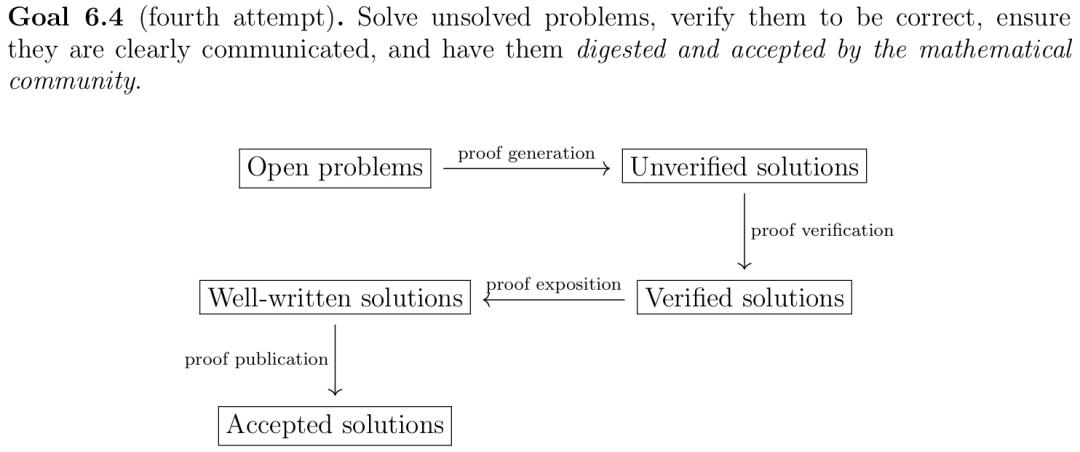
The fifth level is to be finally integrated into the standard theory of the discipline.
This is the highest level. Getting a result proven is one thing, and getting it written into textbooks is another. The classicization process is the slowest link in the entire pipeline, and it is also the most valuable one.
The five steps go from bottom to top, getting slower and slower, and requiring more and more human participation.
Mathematics is about to face "proof indigestion"
From this, Terence Tao put forward a concept, which is probably the sharpest contribution in the entire paper.
"Proof indigestion".
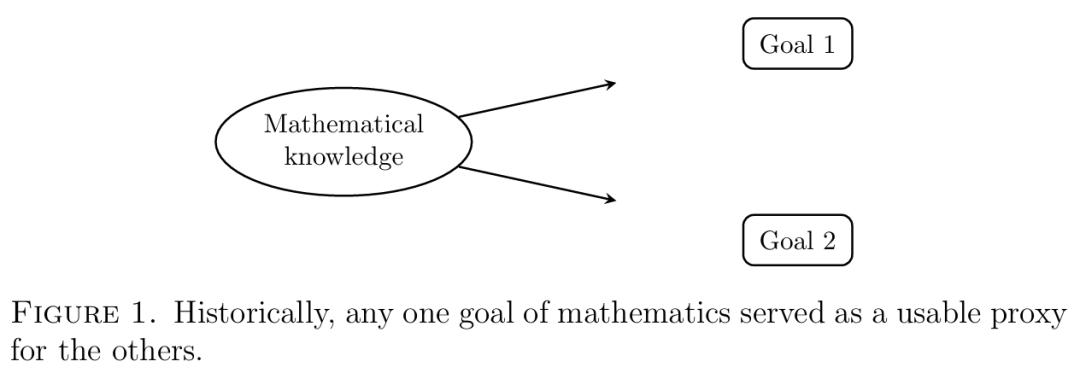
For hundreds of years in the past, mathematics has been in an era of "scarce proofs". There are too many difficult problems and too few proofs, and every proof is precious.
The entire set of infrastructure built around mathematics, from journals to review systems to teaching systems, is all designed for scarcity.
Now, the era is about to turn upside down.
The speed at which AI generates proofs will far exceed the speed at which humans verify, present, review and digest them. The entrance of the pipeline has been torn open, but the processing capacity of the subsequent four levels has not changed.
In other words, the bottleneck of mathematics has changed from "generating proofs" to "digesting proofs".
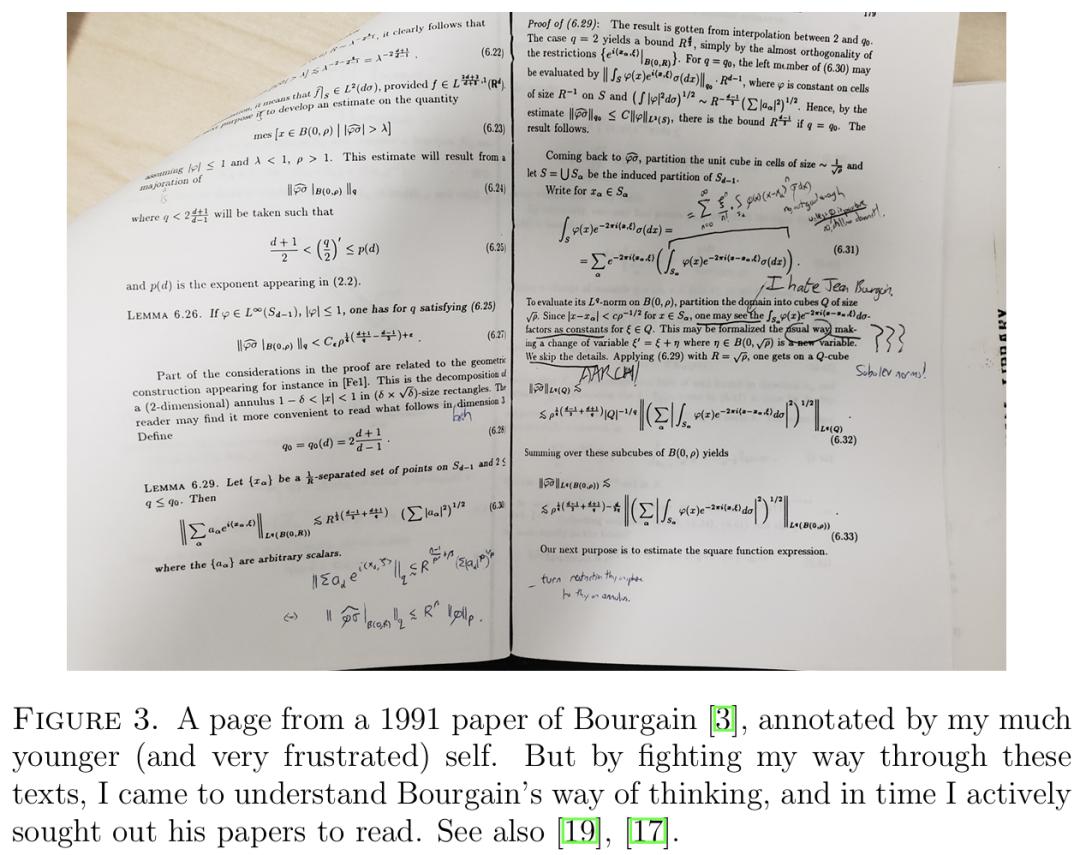
In fact, the last time the mathematics community was this anxious can be traced back to the 1920s. That "foundational crisis" tore apart the entire discipline, with Hilbert and Brouwer clashing fiercely over only one thing — what exactly is the foundation of mathematics.
A hundred years later, the problem of the foundation has been solved. New cracks are opening in a completely different direction.
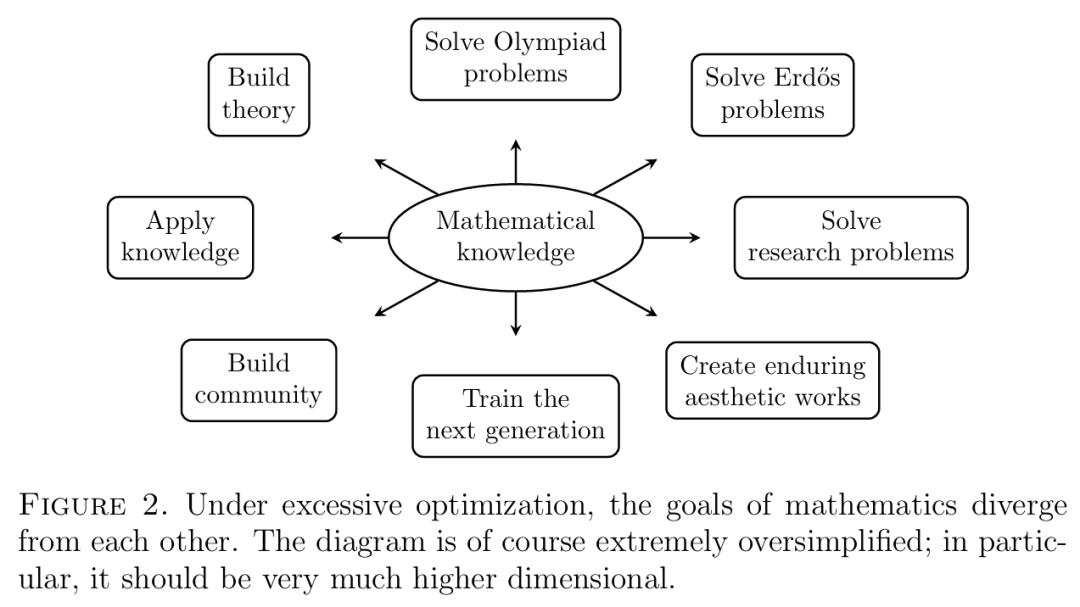
Terence Tao's judgment is very straightforward: mathematics is facing a new upheaval comparable to the foundational crisis. The core of this upheaval, however, is the values and practice methods of mathematical research.
He used a clever strategy in the paper, putting forward the so-called "Working Hypothesis".
The general idea is: stop arguing about whether AI can do mathematics for now, temporarily accept the hypothesis that AI tools will complete a considerable proportion of research-level mathematical tasks within a reasonable period of time, and then ask a completely orthogonal question.
If AI can really do mathematics, what should we do?
If you can't explain it clearly, don't publish it
Facing this storm, Terence Tao put forward his own principles, which he stated on the ICM stage in front of mathematicians from all over the world.
If the author cannot clearly explain their own results, they should not publish them, even if formal verification has been passed.
This sentence directly rejects a spreading attitude: AI helped me complete the proof, Lean helped me verify it, even though I can't explain every step clearly, the result is correct, so just publish it.
Terence Tao said no.
But he did not take the lofty stance of "I don't use AI" at all. He frankly disclosed in his speech that he uses AI for literature search, automatic text completion and chart generation.
There is nothing wrong with using AI. But you must be able to stand on the podium and explain every step clearly.
The "Leiden Declaration on AI and Mathematics" released in June 2026 also talks about the same thing —
AI can participate in mathematical research, but humans must be responsible for the final results.
Back to that fill-in-the-blank question in Philadelphia.
Whether it is 5 years or 50 years, the number filled in the blanks is not important at all. What Terence Tao really left blank is something more fundamental than a timeline.
What exactly are you pursuing when you do mathematics?
If your goal is to have your name engraved on a theorem, the profit of this business is being rapidly reduced by AI. If your goal is to understand why the world works the way it does, then this has never been the job of machines.
The foundational crisis a hundred years ago gave birth to Gödel, Turing, and von Neumann. The crisis did not destroy mathematics. In the process of responding to the crisis, mathematics instead became deeper.
Thurston once said a sentence that sounds particularly piercing today.
We are not theorem production machines. The purpose of proof is understanding.
AI can produce proofs now. But the act of understanding, for the time being, cannot be done by any machine instead of humans.
Terence Tao left the fill-in-the-blank question on the podium. Those blanks are not waiting for a number, but for the entire discipline to re-answer itself.
References:
https://arxiv.org/abs/2608.16753
This article is from the WeChat official account "Xinzhiyuan", written by Mose, and published by 36Kr with authorization.