Bank of China hits a record high.
On the last trading day of August, the broad market indices of both A-share and Hong Kong stock markets weakened, while the banking sector surged against the trend.
The A-share of Bank of China hit a peak of 6.38 yuan during the trading session, up more than 3%, setting a new all-time high; the H-share of Bank of China strengthened simultaneously, touching a peak of HK$5.86 during the session, up more than 4%, hitting a record high since its listing.
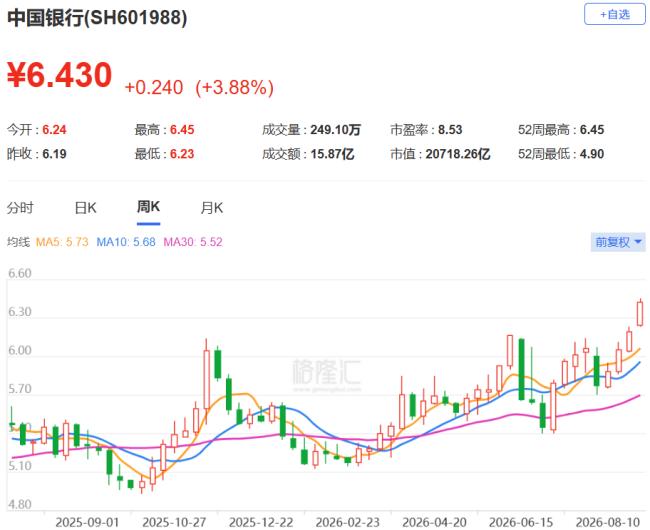
On the same day, shares of China CITIC Bank, Bank of Beijing, Qilu Bank, Postal Savings Bank of China and other banks rose one after another.
The collective rise of the banking sector proves that "elephants" can not only dance, but also dance to new highs.
The trigger for this round of rally is a surprisingly good semi-annual report.
On the evening of August 28, Bank of China disclosed its 2026 interim performance.
In the first half of the year, it achieved operating revenue of 3569.03 billion yuan, a year-on-year increase of 8.48%; the net profit attributable to shareholders was 1235.94 billion yuan, up 5.10% year on year.
Among the six major state-owned banks, this profit growth rate ranks first.
What is more noteworthy is that the net interest income in the first half of the year increased by 10.2% year on year, with the net interest margin at 1.27%, up 1 basis point year on year.
Although this 1 basis point seems insignificant, behind it lies the core profit logic of the entire industry, that is, the "interest spread earning" business of banks is recovering.
Previously, the biggest market concern over bank stocks was the continuous narrowing of net interest margin.
The data of Bank of China proves that the improvement of liability cost is driving the interest margin to bottom out and rebound.
The impressive financial report of Bank of China is not a lone performance.
On August 28, the six major banks including Industrial and Commercial Bank of China, Agricultural Bank of China, Bank of China, China Construction Bank, Bank of Communications and Postal Savings Bank of China collectively disclosed their semi-annual reports, marking the completion of the interim report disclosure of listed banks.
In the first half of the year, the six major banks achieved a total operating revenue of over 2 trillion yuan, with a total net profit attributable to shareholders of about 712.6 billion yuan.
In terms of growth rate, the revenue growth rate of the six major banks ranges from 4% to 11%, and the net profit growth rate ranges from 4% to 6%, all achieving positive growth. This is the first time since 2022 that the six major banks have collectively achieved double growth in revenue and net profit.
Looking at the whole industry, 42 A-share listed banks achieved a total operating revenue of about 3.14 trillion yuan in the first half of the year, up 7.42% year on year, and the growth rate increased by more than 6 percentage points compared with the same period of the previous year; the total net profit attributable to shareholders was about 1.13 trillion yuan, up 2.96% year on year; among them, 32 banks achieved double growth in both revenue and net profit.
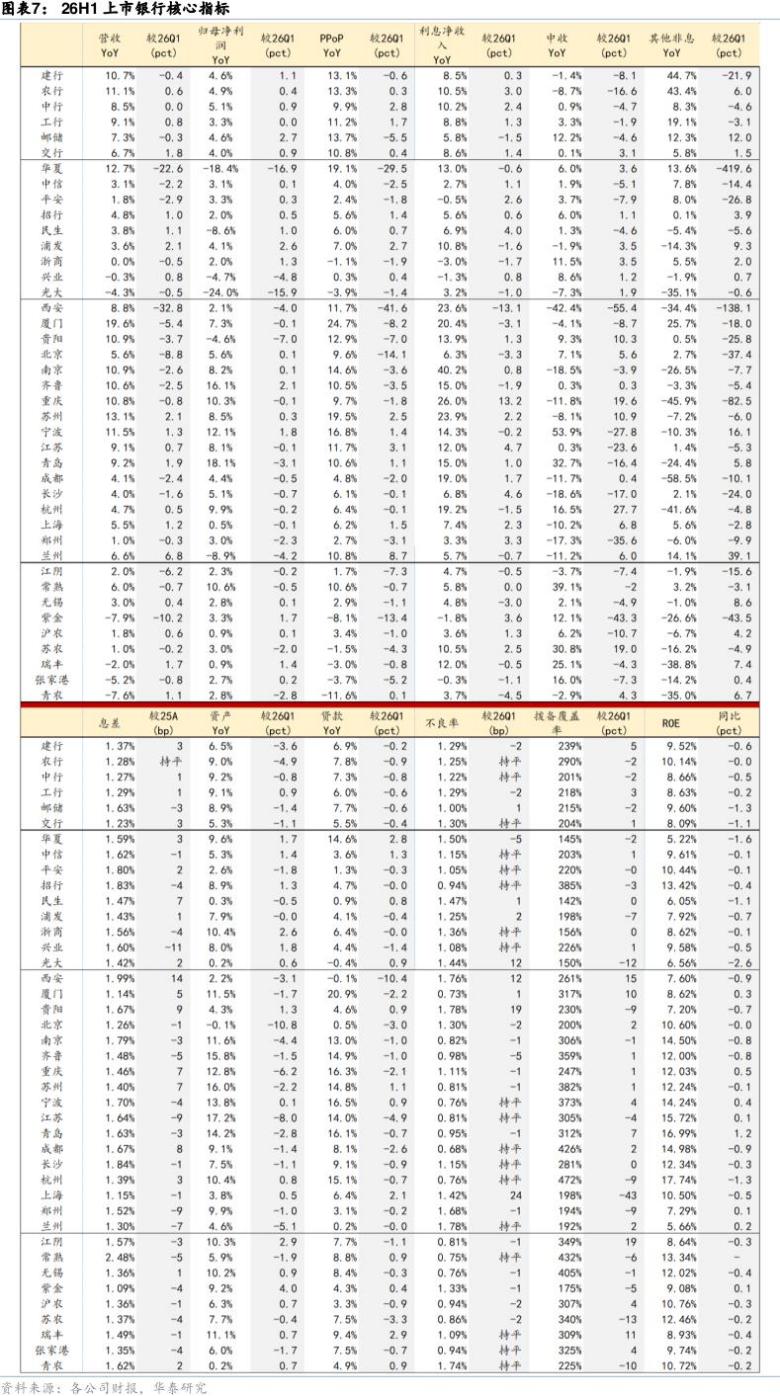
The collective recovery of revenue and profits has completely turned the fundamental narrative of the entire banking sector positive.
If performance provides fundamental support for stock prices, then dividends attract capital inflows even more strongly.
According to the interim dividend plan, the total proposed dividends of the six major banks exceed 220 billion yuan.
Among them, Bank of China proposes to distribute 1.19 yuan (tax included) for every 10 shares, with a total dividend of 38.343 billion yuan. The interim dividend payout ratio of the four major banks has been uniformly increased from 30% to 31%.
At a time when deposit interest rates and government bond yields continue to decline, the dividend yield of bank stocks above 4% is particularly attractive.
At the same time, the official version of the *Measures for the Asset and Liability Management of Insurance Companies* has been released, requiring insurance companies to have a net investment income coverage ratio of no less than 100%. Dividend stocks are expected to become the core tool for insurance funds to cover the guaranteed cost of liabilities.
Industrial Securities pointed out that as the core dividend assets of the current A-share market, bank stocks have the characteristics of high dividend yield, low valuation and low institutional position, and are expected to fully benefit from the inflow of incremental insurance capital.
According to statistics, 7 banks have been increased their holdings by insurance funds in the second quarter, among which Bank of China has been increased its holdings by over 300 million shares by China Life Insurance, and long-term capital is voting with real money.
From a more macro perspective, the banking sector is undergoing a valuation reshaping.
By the middle and late August, the price-to-book ratio (PB) of the CSI Bank Index was only around 0.68 times, and all 42 bank stocks were trading below their net asset value.
An industry where all stocks trade below net asset value contains huge room for valuation repair under the background of full performance recovery.
The record high of Bank of China's stock price conveys a signal that is more than just the rise and fall of a single stock, but also contains other implications.
That is, the profit bottom of the banking industry may have passed, the inflection point of net interest margin is being verified by data, the value of high dividend highlights in the low interest rate era, and long-term capital is continuously expressing its recognition of this value depression with practical actions. The grand drama of the banking sector may have just kicked off.
This article is from the WeChat Official Account "Gelonghui APP" (ID: hkguruclub), written by Gejila, published with authorization from 36Kr.