A 28-year-old veteran golf technology company with self-developed AI simulators generates hundreds of millions of yuan in revenue | Global Insight
Author | Huang Nan
Editor | Yuan Silai
Editor's Note: As overseas expansion has increasingly become the core strategy of Chinese enterprises, how to compete in the global market has turned into an extremely professional topic. Amid the evolution of globalization, a number of Chinese brands have already stood at the forefront of the trend. In view of this, 36Kr Hard-Krypton specially launches the "Insight Global" column to explore the cutting-edge direction and era opportunities of Chinese brands' overseas expansion from the perspective of brand growth and transformation, so as to provide ideas and inspiration for overseas practitioners and the industry.
This is the 64th issue of our column — Starting from golf hitting mats, Greenjoy, which has been deeply engaged in the industry for nearly 30 years, has built up full-stack independent R&D capabilities in hardware sensing and AI. Now it leverages machine vision and hitting data to develop digital golf, deeply integrates into urban sports scenarios, and its business now covers more than 170 cities around the world, serving over 500,000 users.
Back in the era when there were less than 80 golf courses across China, Wang Jijun founded a golf equipment company.
It was 1996, when the Pearl River Delta was full of factory owners who had made huge fortunes. Golf was a popular sport among these new rich. There were only 5 or 6 clubs across the country that could make profits from course operation, and half of them were located in the Pearl River Delta. Membership cards costing hundreds of thousands of yuan each never lacked customers there. Duan Yongping, the owner of BBK, even considered inviting Tiger Woods to play golf in China.
Wang Jijun had just resigned from a state-owned enterprise and worked as a salesperson at a Chinese agent company for American golf clubs. He loved playing golf, but paid more attention to the profitable opportunities in this industry.
After working as a salesperson for two years, Wang Jijun founded Greenjoy, starting from basic supplies such as golf hitting mats and practice balls. At that time, domestic hitting mats mainly relied on imports, which were not only expensive, but also consumables that needed frequent replacement in driving ranges. Graduating with a chemistry major, Wang Jijun saw the opportunity and decided to develop products independently.
He did not take the low-price route, but chose grass filaments, foam, base materials and adhesives with higher costs; at the same time, he set the price at only 85% of that of imported products, and the service life of the product could reach more than five years.
With this product, Greenjoy quickly opened up the market, launched the first 3D hitting mat in China, and successively released products such as ball washers, ball pickers and automatic ball dispensers, expanding from a hit single product to a product system covering all golf driving ranges. By 2008, Greenjoy's hitting mats had a 70% domestic market share and were exported to dozens of countries and regions including Australia, Japan, the United States and Europe.
But Wang Jijun could see the end of this path. "Driving range equipment is a typical low-frequency B2B business. Customers have to invest in building courses first before considering purchasing equipment. The market size is inherently limited, and the project payment recovery cycle is long, making it difficult for the business to achieve continuous and rolling growth."
The turning point came in 2011. On the day when South Korean golf simulator company Golfzon went public, its market value exceeded 1 trillion won. Founded in 2000, the company achieved a revenue of nearly 900 million US dollars in less than ten years.
Wang Jijun keenly captured this signal. The United States had more than 20,000 golf courses, while China only had about 400 at that time; South Korea's golf development was about 10 years earlier than China's, and the user habits of the two countries were highly similar. "South Korea has gone through the difficult process of user education. If they can make it work, why can't China?"
He went to South Korea to try all the simulator products on the market, and his conclusion gradually became clear: there is almost no ceiling in the simulator market, which can not only serve individual families, but also enter scenarios such as enterprises and golf studios, and integrate with mature entertainment modes such as KTV and home theater.
Shortly afterwards, Greenjoy entered the indoor simulator track, established the GOLFJOY brand and the digital golf software and hardware system, and began to independently develop high-speed cameras, sensors and AI algorithms. At that time, ChatGPT had not yet come out, and GOLFJOY actually started its layout many years earlier than its domestic counterparts. In 2026, Greenjoy GOLFJOY officially launched the AI golf assistant function.
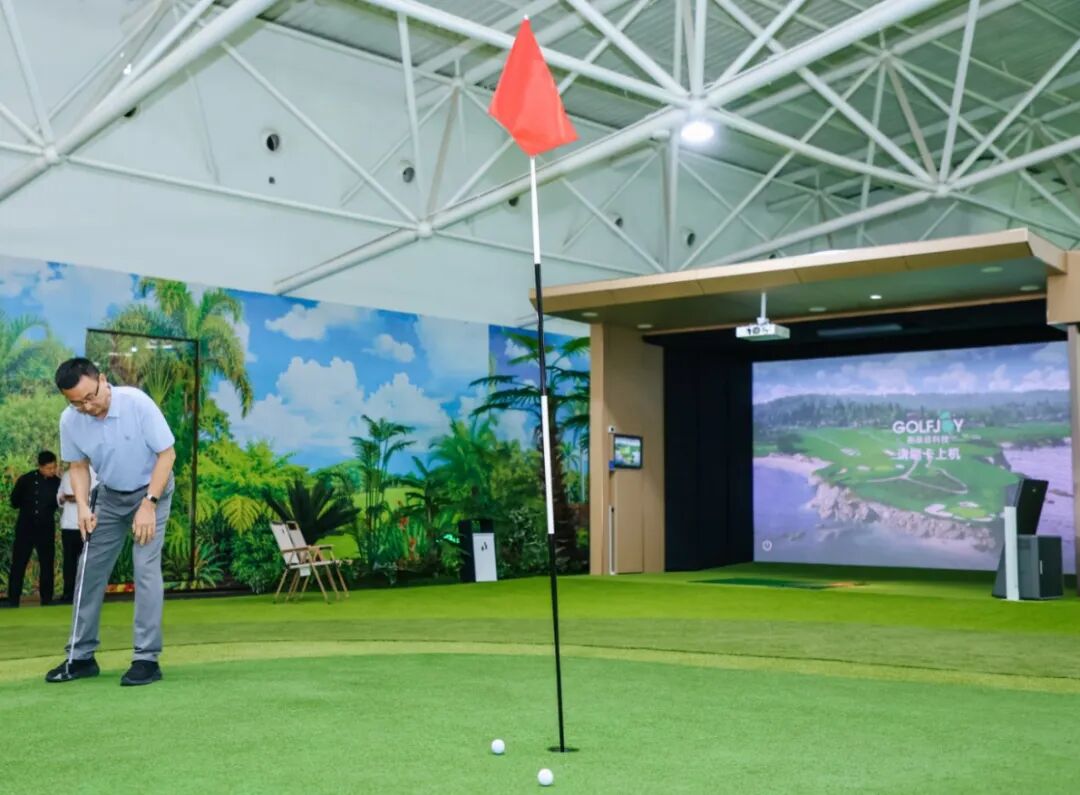
Digital technology restores the real on-course golf experience (Source: Enterprise)
This product does not replace professional coaches, but deeply combines the real hitting data of more than 400,000 users with self-developed algorithms to quantify users' swings, analyze and give improvement suggestions, positioning itself as an always-online digital AI golf coaching assistant that can realize "immediate feedback after hitting".
Official data shows that as of the first half of 2026, Greenjoy GOLFJOY's business has covered more than 170 cities around the world and served over 500,000 users, with its products occupying a market share of over 50% in the domestic indoor simulator market and generating hundreds of millions of yuan in revenue.
The massive amount of data accumulated in the past has become the most core barrier of Greenjoy GOLFJOY. "As the capabilities of underlying large models become convergent, the real barrier does not lie in the model itself. Whoever has more accurate and richer data in vertical scenarios can get better results on the model," Wang Jijun told 36Kr Hard-Krypton.
Wang Jijun did not deliberately chase the trend, but he maintains enthusiasm and curiosity about technology. 28 years after its establishment, this old company operating in a niche track has found a sustainable way of survival in this era.
Full-Stack Independent R&D From Hardware to AI Algorithms
Greenjoy GOLFJOY once faced a key choice in its technical route: to adopt Doppler radar or machine vision solution.
Doppler radar has low cost and mature technology, and most entry-level products on the market before were based on this solution, with a single device costing only a few hundred US dollars. Wang Jijun clearly knew that in the early stage of the simulator market, low price meant easier market penetration. But he finally chose machine vision — a more difficult, more expensive, but longer-term technical route.
"The machine vision solution can be used in all indoor and outdoor scenarios, while some radar devices will have their measurement accuracy limited when the sensing distance is insufficient or the device cannot be placed stably," said Wang Jijun.
The Doppler radar solution estimates the motion parameters of the ball by transmitting and receiving microwave signals based on information such as frequency shift. It performs well in open outdoor venues, but once it enters the indoor environment, the signal is easily interfered by spatial reflection; at the same time, radar devices need to be placed at a fixed distance behind the ball, which is difficult to cover short-distance and low-ball-speed scenarios such as bunkers, short pitches and putts. It has insufficient scenario adaptability, and generally has technical defects such as missed hits, inaccurate measurement of part of the ball and club data, and distorted ball trajectory.
Greenjoy GOLFJOY has been targeting full-scenario applications since the very beginning of R&D: the top-mounted version is mainly for fixed indoor scenarios, while the ground-mounted version breaks through space restrictions, and can operate stably not only in indoor environments, but also in outdoor, driving ranges and even bunkers and fairways of real courses.
"This is not a simple combination of hardware, but a redesign of the entire sensing system," Wang Jijun told 36Kr Hard-Krypton. "It integrates professional theories and practical applications such as optical engineering, integrated circuits, material science, machine vision, industrial design, AI algorithms and deep learning, so that the device can still maintain stable performance, accurate measurement and good response speed under different light, temperature, ground conditions and even electrostatic interference."
This product positioning of full-scenario adaptation alone has brought huge challenges to the R&D team.
The high-speed camera is the core component of the entire sensing system. A single camera needs to capture 2500 high-definition frames per second, and continuously record the position, posture and motion changes of the ball in a few thousandths of a second at the moment of hitting, so as to provide a basis for the subsequent calculation of key data such as ball speed, flight direction and rotation. At this time, if the ball speed is too fast, the light entry time is extremely short, and insufficient light will easily cause image blur, resulting in sensing errors. The system must strike a balance between motion clarity, picture brightness and recognition stability.
The captured photos are transmitted from the image sensor to the processor, which completes key feature extraction, motion parameter calculation and result output within 0.5 seconds. Once the time exceeds, users will feel obvious delay and the experience will be greatly reduced.
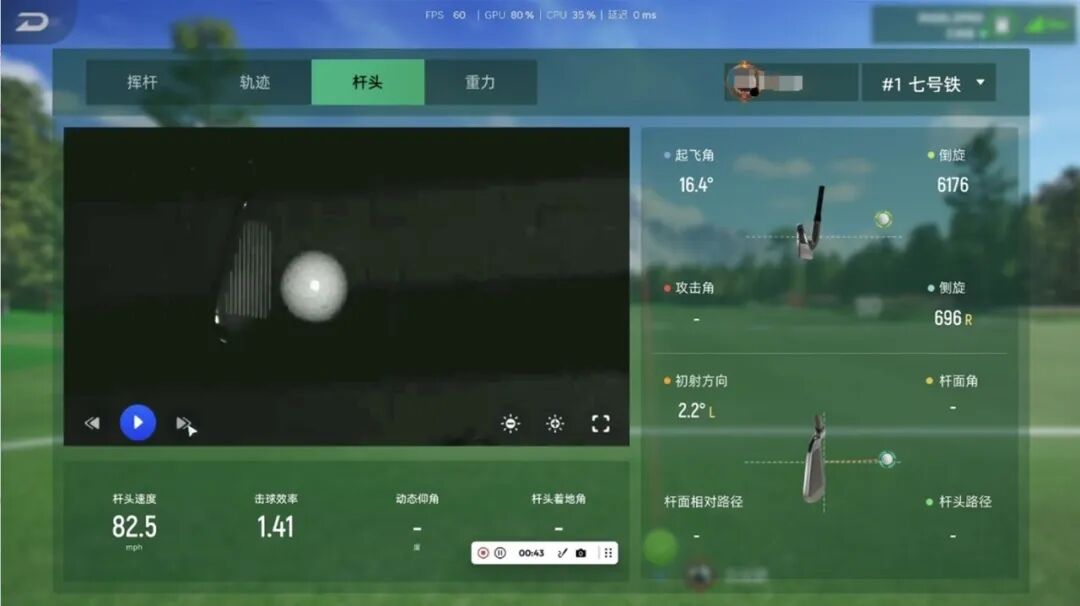
The high-frame camera takes 2500 photos per second, and the algorithm extracts key frames and outputs results (Source: Enterprise)
To solve these experience problems, the R&D team carried out multi-layer optimization of the hardware architecture, embedded multiple acceleration chips in the sensor, and dynamically allocated computing tasks by controlling software; when the computing power of a single chip cannot bear the computing load, it actively calls the second chip for parallel computing, and integrates all computing results for unified output, ensuring that a series of high-speed images of one hit can be parsed and output within the specified time limit.
"Off-the-shelf industrial products cannot be used for high-speed cameras, which require in-depth customization for golf scenarios. Sensing range, anti-environmental light interference, stability under different lighting conditions, etc., are all engineering challenges," Wang Jijun explained. "The problem of 'maintaining capture accuracy under different lighting conditions' alone requires redesigning the aperture, shutter control logic and image preprocessing algorithm."
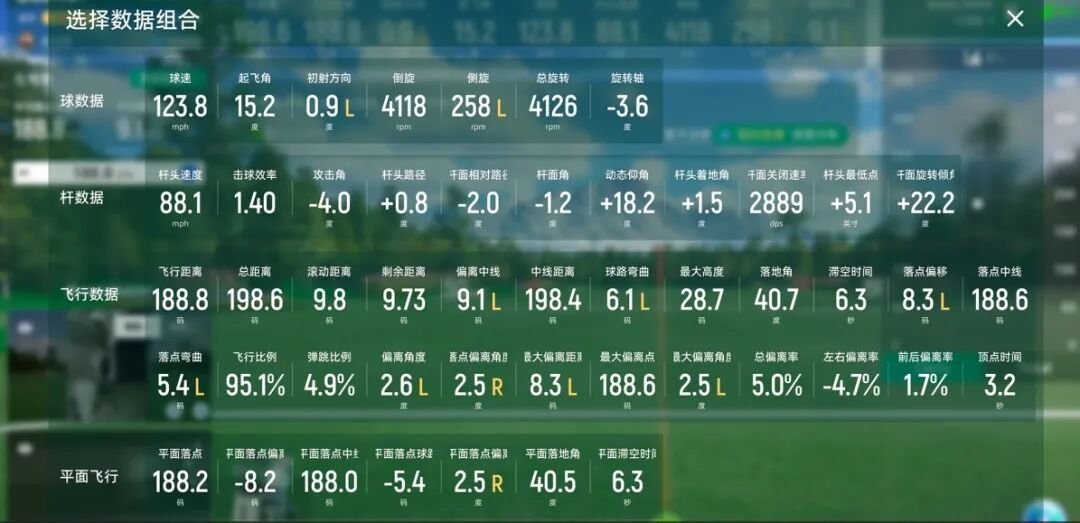
Greenjoy simulator can realize more than 40 items of data in all dimensions (Source: Enterprise)
The more delicate work is hidden in places invisible to users. Anti-static design is another engineering difficulty. Golf hitting mats, shoe soles, clothing and human bodies may accumulate static electricity during repeated movement and contact separation; when static electricity is coupled into the circuit through the club, interface or device shell, transient discharge may cause sensor abnormality, system reset, and even damage components. Dry and cold environments are usually more prone to static electricity accumulation than humid environments. This leads to the problem that the device may operate normally in the humid south, but may frequently crash once it arrives in the dry and cold north.
Therefore, multi-layer electrostatic protection is added to the circuit design of Greenjoy GOLFJOY, and the anti-static capability is upgraded from the commercial standard to the industrial standard, so that the device can operate stably under different climate conditions.
But hardware is only the entry point. What GOLFJOY really wants to build is a closed-loop system of "Hardware + AI Algorithm + Data".
Wang Jijun's attitude towards AI is more prudent than the outside world imagines. Previously, GOLFJOY has launched the AI golf assistant, which is positioned as a training auxiliary tool rather than an AI coach.
"The value of coaches lies in experience and on-site judgment, which cannot be replaced by AI in the short term. We hope to use AI to help coaches save repetitive work, supplement sensory information, and convert training details into quantifiable data, so as to make the empirical judgment that used to rely on 'observation, auscultation, interrogation and palpation' more scientific and accurate, rather than replacing them," said Wang Jijun.
There is a common dilemma in traditional teaching. When a coach says "the hit is not solid", users often do not know where the problem is — is it insufficient thoracic spine rotation, insufficient hip rotation, or insufficient center of gravity transfer? Vague judgment is difficult to directly translate into improved movements. What GOLFJOY AI Golf Assistant wants to solve is exactly this "unclear" problem.
By capturing multi-dimensional information such as the club head, ball trajectory, human swing posture, and gravity distribution, GOLFJOY AI Golf Assistant will analyze each swing record of the user and give improvement suggestions, including knee angle, hip rotation, center of gravity transfer range, etc. The whole process can be completed within a few seconds after hitting.
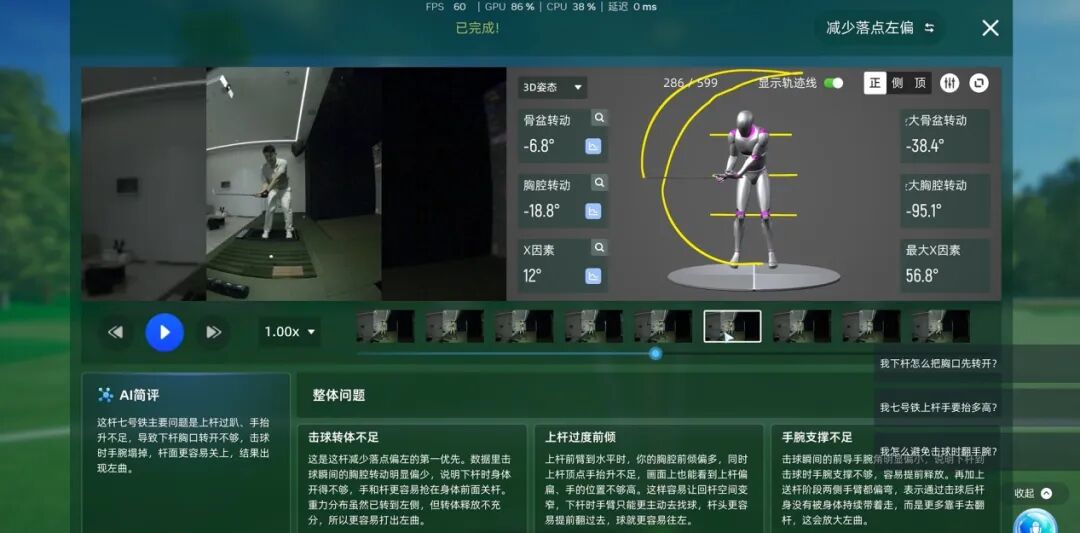
Visual posture recognition - multi-dimensional data analysis - AI diagnosis - personalized training guidance (Source: Enterprise)
When digitization turns the vague "feel" in the past into specific indicators, we still need to solve a deeper problem: what evaluation criteria should users follow to find the right direction for training improvement?
Wang Jijun pointed out, "Nowadays, users' needs have changed. They are not satisfied with knowing 'how far the ball has flown', but also want to know 'why it didn't fly far' and 'how to make it fly far'." Therefore, GOLFJOY put forward another idea in function design — progressive improvement step by step.
Most AI teaching products on the market adopt the method of providing users with a set of standard models. However, even if the action of the legendary American golfer Tiger Woods is very standard and the action of the top Northern Irish golfer Rory McIlroy is very beautiful, ordinary users do not have the flexibility of professional athletes. Practicing repeatedly against a template that is difficult to achieve will bring far more frustration than a sense of achievement.
In Greenjoy GOLFJOY's "step-by-step progress" idea, the AI system will automatically capture the user's best recent hit as an anchor point, so that the subsequent training will move closer to the "best ball path that has been achieved", and update the anchor point when a better ball is hit. At this time, the system does not compare the gap between the user and the world champion, but the gap between the user and "yesterday's self".
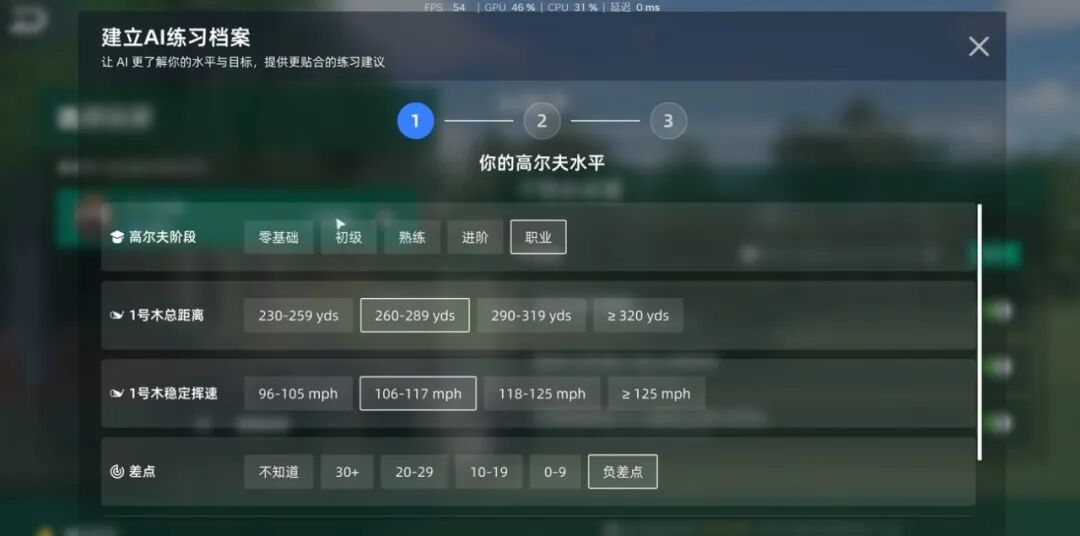
AI golf assistant customizes personalized golf practice plans according to different golf levels (Source: Enterprise)
"Instead of letting users imitate a template that they can never reach, it is better to make them infinitely close to the best version of themselves," said Wang Jijun. When every swing can get clear, specific and executable personalized feedback, training is no longer "based on feeling", but a continuous iterative process with reference and path.
Nowadays, more than 500,000 users generate new hitting data in various application scenarios of Greenjoy GOLFJOY products. In 2025, users completed more than 6 million rounds of golf throughout the year, and the number of hits in driving ranges reached 210 million. The product can not only be hung on the indoor ceiling, but also be carried to outdoor driving ranges, fairways and even roughs