Crowdfunding has exceeded 10 million US dollars, the desktop CNC brand has completed a series of angel round financing worth hundreds of millions of yuan, with HSG, BlueRun Ventures and other institutions placing bets | Product Observation
By | Huang Nan
Editor | Yuan Silai
While financing in the smart hardware track has cooled down, a CNC company has secured hundreds of millions of yuan in financing from leading institutions.
36Kr has exclusively learned that NestWorks (hereinafter referred to as NestWorks), a desktop CNC brand, has recently completed hundreds of millions of yuan in Angel Round and Angel+ Round financing. The investors include HSG, BlueRun Ventures, Zhongding Capital, Vertex Ventures China and Vision Capital, with Gaohu Capital acting as the exclusive financial advisor for subsequent financing.
As a new brand incubated internally by Elephant Robotics, NestWorks was officially established in November 2025. This robotics company with a history of more than 10 years has previously launched hit products such as the myCobot desktop collaborative robotic arm and the metaCat bionic cat. After NestWorks' first product was launched on Kickstarter, it finally raised more than 13 million US dollars.
Entering the desktop CNC track may seem like a cross-border move, but it actually does not exceed their capability boundaries.
"We initially decided to enter the CNC field because our team itself is the demander of such products," said Song Junyi, co-founder of NestWorks. This is Song Junyi's second entrepreneurial attempt after returning to China. He started his business while studying at the University of Melbourne. After returning to China, he co-founded Elephant Robotics with co-founder Wu Qilin, and went through the whole process from R&D to mass delivery of more than 100,000 robots.
NestWorks chose to cut into this market also because it identified the demand for desktop-level CNC in its business operations. For a long time, CNC machine tools have been exclusive equipment in factory workshops. They are huge in size and expensive. To operate them, operators need to master a large number of implicit industry experience such as tool selection and processing parameters. Multiple thresholds have firmly locked them in the industrial manufacturing scenario.
But the inherent boundaries are being broken. In the whole year of 2025, 7 hardware crowdfunding projects in the Tech&Design category on the Kickstarter platform exceeded 10 million US dollars, 2 of which belong to the desktop CNC track. Startups like Elephant Robotics have also begun to use more compact CNC products.
Following 3D printers and consumer-grade laser engraving machines, CNC has also become a key battlefield. But it is also the product with the most immature ecosystem and the smallest audience among the three. This also determines that the popularization of CNC will be slower and more difficult than the previous two.
Product Definition Born From Internal Demand
The starting point for the establishment of NestWorks was not a market analysis report, but a specific, recurring R&D pain point.
In the past, within Elephant Robotics, the R&D team had to process a large number of mechanical arm structural parts every year. When the parts were sent to external factories for proofing, they would fall into a repeated cycle: engineers output drawings, wait for the factory to schedule production for a week to get the samples, find problems during assembly, modify the drawings, and then wait for another week.
This cycle is regarded as a natural cost in the hardware R&D process. However, the long outsourcing cycle often directly slows down the pace of product iteration.
The team came up with a simple idea: can we place a piece of equipment in the office, so that structural engineers do not need to go out or wait for the factory to schedule production, and can get physical parts immediately after outputting the drawings.
This pain point from the real R&D scenario defined the functional definition of NestWorks' first product C500. NestWorks told 36Kr, "The equipment must first have real processing capabilities, and can cut aluminum alloy, stainless steel, brass and various engineering plastics; on the other hand, it must be user-friendly enough, so that engineers who can use 3D printers without receiving professional CNC training can also operate it directly."
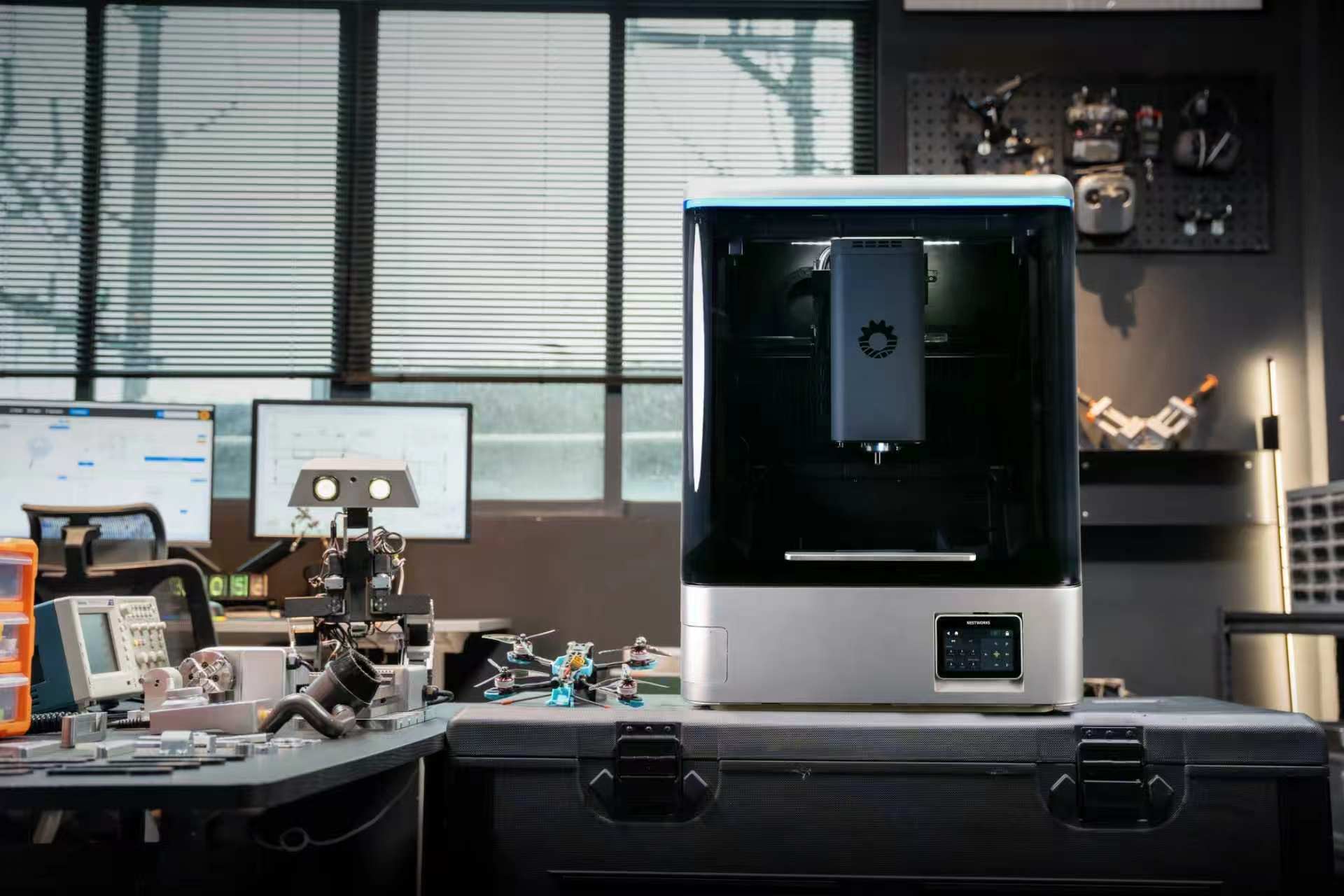
In terms of hardware parameters, the C500 is initially equipped with an 800W spindle with a maximum speed of 18000RPM, and uses MQL minimum quantity lubrication technology for the first time in desktop CNC. In addition to soft materials such as wood and plastics, this power specification also enables it to cut metal materials such as aluminum alloy, brass and even stainless steel.
It is also equipped with an automatic tool change and intelligent tool management system for the first time. When multiple tools are needed to process complex parts, the machine can automatically switch tools and match corresponding processing parameters according to different tools, without manual setting.
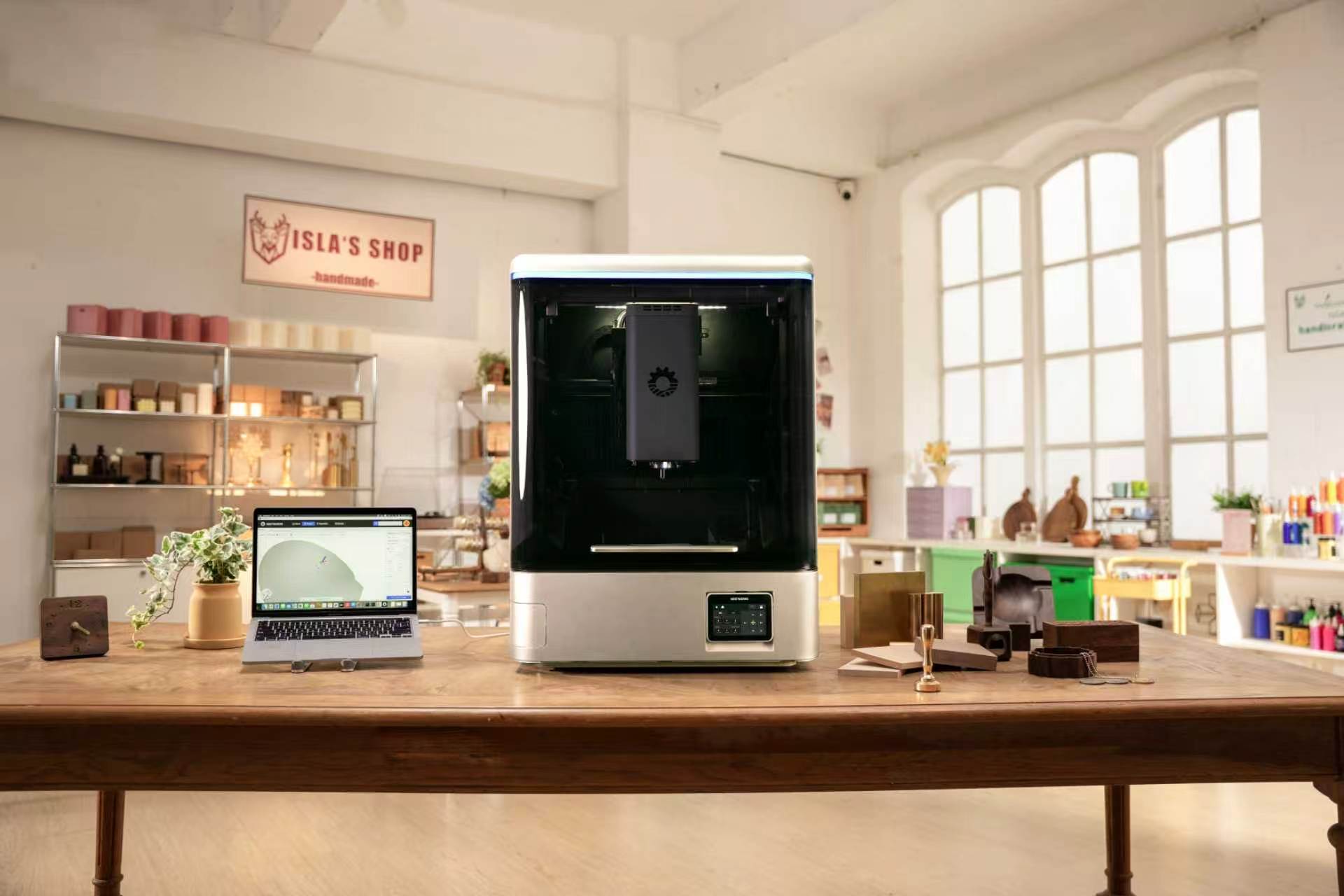
NestWorks' first product C500 (Source/Enterprise)
Compressing all these parameters into a desktop device requires a lot of coordination and trade-offs in structure, heat dissipation and motion control, which is a considerable engineering challenge in itself.
"What we want to do is not a miniaturized industrial machine tool, but to extract the processing capability of industrial machine tools, lower the threshold of use, solve the problem of usability, and allow ordinary engineers to complete metal proofing at their own workstations," said NestWorks.
What truly widens the gap between the C500 and traditional small CNCs is that NestWorks has reconstructed the product usage logic. The process decision-making of traditional CNC is highly dependent on the implicit knowledge of professionals. From tool selection, processing path planning to cutting parameter setting, every link relies on the personal experience accumulation of engineers, and there is no reusable standard path. Therefore, NestWorks told 36Kr that the core difficulty of CNC ecosystem construction is "how to digitize these implicit manufacturing experiences."
The C500 chooses to let software and AI algorithms take on this part of the decision-making. At present, its complete software has opened up the full link from model import to device execution, and model analysis, CAM process generation, tool path planning, and processing simulation can all be completed in a closed loop within the system. Users do not need to be CNC process experts, they only need to clarify what parts they want to make, and issue instructions to the C500 to complete.
As users continue to use it, the system can accumulate drawings, processing results and various process data to further optimize processing efficiency and finished product quality.
The complete software of C500 has opened up the full link from model import to device execution (Source/Enterprise)
But for a device to move from a professional tool to a broader market, the real test lies in ecosystem construction. 3D printing has fully verified the commercial value of community sharing: users can find models in the community and send them to the device with one click to complete printing directly. But this model cannot be directly copied to the CNC track, as the "sharing units" of the two are essentially different.
The core carrier of the 3D printing community is the model file. For the same file, under the same equipment and consumable conditions, the performance of the finished product can be highly stable. However, CNC drawings are more private, and the processing process is affected by many variables. Even if the exact same part model is used, changing tools, adjusting feed parameters, or modifying the fixture scheme may lead to very different physical finished products.
This also means that the CNC community cannot only circulate non-private design drawings, but also needs to accumulate a complete set of supporting manufacturing knowledge, covering material selection, tool matching, processing parameters and practical process experience.
"We believe that the value of the CNC community at this stage is not only to share 'what to make', but more importantly to share 'how to manufacture', and eventually form a new ecosystem around digital manufacturing," NestWorks judges.
Starting from Small B-end Users, AI Unlocks the Long-term Market
There has always been no definite conclusion in the industry about whether the core early users of desktop CNC are B-end or C-end. Behind different views are different judgments on the market path.
Early CNC equipment was huge, expensive, and had extremely high operating thresholds, which naturally excluded ordinary consumers, and almost all users were factories and enterprises. But in recent years, with the miniaturization of equipment, intelligent software and the rise of the global maker culture, the user structure is loosening and user confidence is growing.
But in the short term, the groups with the clearest demand and the strongest willingness to pay are still engineers, designers, scientific research institutions and small-batch production enterprises.
NestWorks pointed out that the core demand of this group of users for purchasing equipment is to solve real product verification and rapid iteration problems. "They have extremely high requirements for processing capability and reliability, are more willing to try new tools, and are more willing to share their usage experience. On the contrary, their sensitivity to price is relatively low." At the same time, individual enterprises, small studios and scientific research institutions constitute a broader mid-tier market.
As the price drops further, software functions become simpler, and the content ecosystem becomes richer, the user boundary will continue to expand outward.
At present, AI is fundamentally changing the design threshold. With the continuous enhancement of AI 3D generation, AI CAD and natural language modeling capabilities, the threshold for mass users to turn ideas into manufacturable digital models continues to decline.
"When the threshold of 'design' is greatly lowered, the released creative demand will be very huge, and the next step will naturally give rise to stronger demand for 'turning digital creativity into physical objects'," NestWorks believes that different types of users are not opposed, but lie on a continuous spectrum. "B-end users provide early product verification and revenue foundation, while C-end users will gradually release incremental space after software usability is improved and prices drop."
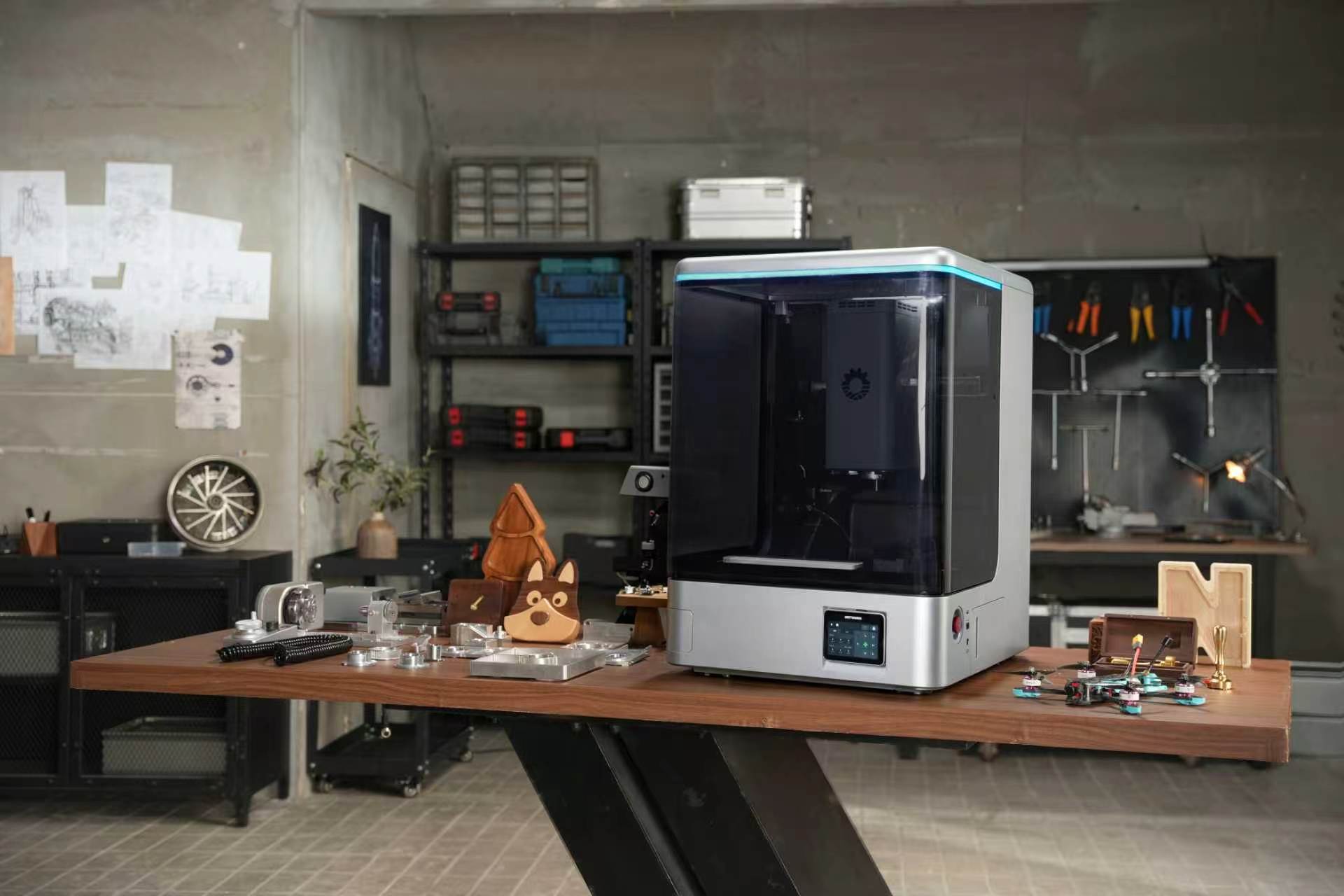
NestWorks' first product C500 (Source/Enterprise)
But it must be admitted that the desktop CNC moving to the mass market still faces some structural physical constraints.
Subtractive processing is inherently accompanied by problems of dust, noise and chips, which have clear requirements for the use environment; equipment weighing more than 100kg is unlikely to be moved as casually as a 3D printer. NestWorks admits that these characteristics determine the market path of desktop CNC, and at this stage it will not simply copy the trajectory of 3D printing "directly entering the home".
"A more reasonable expectation is to penetrate layer by layer from professional scenarios, such as engineers' workstations, school laboratories, maker spaces, small studios, and then to individual users with clear manufacturing needs."
This is a gradual diffusion path, not an explosive curve like consumer electronics.
NestWorks' long-term vision is far more than just a CNC device, but a complete ecosystem around "design - processing - manufacturing". Ultimately, what they hope is not that everyone owns a CNC, but that people can turn their ideas into physical objects through accessible manufacturing tools when needed.
This process requires time and continuous financial support, and only a few teams with strength and patience can win in the end. NestWorks believes that the process of a 10-billion-yuan new category from 0 to 1 is a process of insisting on rapidly transforming technical capabilities into products to meet market demand and achieve PMF. Who can persist until the end will be a marathon.