Vanke's "life buoy"
Vanke's loss has hit a new record again.
On the evening of August 27, Vanke released its 2026 semi-annual performance report. In the first half of the year, its total operating revenue reached 70.169 billion yuan, down 33.38% year on year; the net loss attributable to shareholders was 14.951 billion yuan, with the loss expanding by 25.15% year on year; the non-recurring profit and loss adjusted net loss attributable to shareholders was 13.84 billion yuan, representing a 19.41% year-on-year increase in loss.
Judging from the data, Vanke has once again delivered its worst semi-annual report. Calculated based on the net profit attributable to shareholders, Vanke loses an average of 82.6 million yuan per day. There are three core reasons for the company's continuing growing loss:
The settlement scale of real estate development has shrunk significantly: The settlement revenue of development business was 40.06 billion yuan, down 45.9% year on year, with the settlement gross profit margin of only 5.1%, which is at a low level in the industry;
Provision for asset impairment: New provision for inventory depreciation in the first half of the year was 3.94 billion yuan, coupled with the expanding investment loss of joint ventures and associated enterprises, the net investment loss recognized under the equity method was 3.34 billion yuan, 2.77 billion yuan more than the same period of last year;
Losses from operating businesses and financial investments. Under the cost accounting method, the profit of some held properties has narrowed after depreciation and amortization, and losses have occurred in non-core financial investments.
Under the superposition of the above three loss factors, Vanke is still trapped in the quagmire of continuously declining total assets and rising debt ratio.
As of June 30, Vanke's total assets amounted to 959.761 billion yuan, down 5.96% from the beginning of the year; the asset-liability ratio was 77.51%, up 0.62 percentage points from the start of the year; the net debt ratio was 135.40%, up 11.92 percentage points from the beginning of the year, and the leverage level remains at a high level.
At the same time, Vanke is also facing huge debt pressure. By the middle of the year, the total interest-bearing liabilities of Vanke reached 351.26 billion yuan, accounting for 36.6% of the total assets. The interest-bearing liabilities due within the next year amounted to 178.86 billion yuan, accounting for 50.9%. The short-term debt repayment pressure remains extremely high.
In order to "survive", Vanke has been continuously reducing daily operating costs. In the first half of the year, the closure rate of inefficient sales offices has reached 92%, almost stopping everything that can be stopped; the property service and advertising expenses at sales sites have decreased by more than 20%, with sales expenses down 45% year on year and administrative expenses down 13% year on year.
Under comparable calibers, expenses have declined for 8 consecutive quarters in the past. It can be said that Vanke is intensively investigating and cutting off all unnecessary cost expenditures.
With continuous cost cutting and vigorous efforts to collect sales payments, in the financial data of the first half of the year, Vanke saw its only positive sign: the net cash flow generated from operating activities was 495 million yuan, which rebounded significantly to positive year on year (the net outflow was 30.387 billion yuan in the same period of 2025).
This is the only "+" item in Vanke's core financial indicators, and it is also the first time in three years that Vanke has recorded positive cash flow inflow from its operating side.
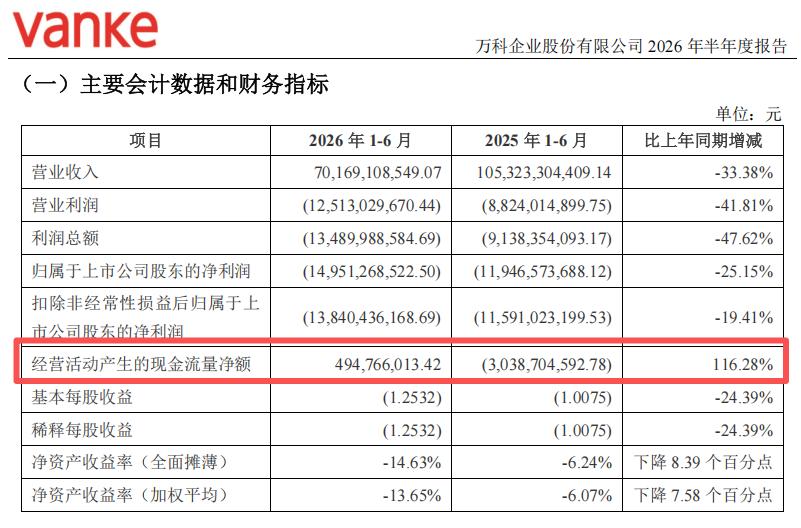
Relevant Data
Since the debt crisis broke out, Vanke has relied mainly on two "lifelines" to stay afloat. The first is the loans from its major shareholder Shenzhen Metro Group. In the first half of this year, the major shareholder provided Vanke with about 4.52 billion yuan in shareholder loans. Moreover, although Shenzhen Metro Group added the condition of "mortgaged assets", the actual mortgage rate is far lower than the prevailing market conditions required by financial institutions.
The significance of the major shareholder's continuous and large-scale loans goes beyond that. While directly "keeping Vanke alive", the endorsement of Shenzhen Metro Group, as well as the special nature of both Shenzhen Metro Group and Vanke, have enabled Vanke to obtain loans at very low interest rates. In the first half of the year, the comprehensive financing cost of Vanke's existing financing was only 2.86%, which is even lower than many real estate enterprises with normal operations.
Stable, continuous, low-condition and low-interest loans are important chips for Vanke to "survive".
Vanke's second "lifeline" comes from itself: the second growth curve it laid out many years ago.
In 2012, Vanke put forward the "Rainforest" strategy, aiming to make the company's business grow "tall trees", as well as "shrubs" and "grass". Although many of the "grass" businesses failed later, after more than ten years of exploration, Vanke retained four non-development business segments: Onewo, Port Apartment, Inlink Commercial, and Vanke Logistics. These segments have been providing stable cash flow for Vanke after it encountered difficulties.
2021 was the last peak of Vanke's development business, and also a turning point for the role of non-residential business. In that year, the revenue of development business accounted for more than 82% of the total, while non-residential business was only a supplement; in the first half of 2026, the total revenue of the four non-development businesses reached about 26.9 billion yuan, accounting for 38.3% of the group's total revenue, and the proportion of development business dropped to about 60%.
During the four years of the real estate crisis, Vanke's development business revenue has dropped by more than 26% cumulatively, while the non-residential business has increased by more than 45% cumulatively, with its proportion rising by more than 20 percentage points, effectively offsetting the cliff-like decline of the development business.
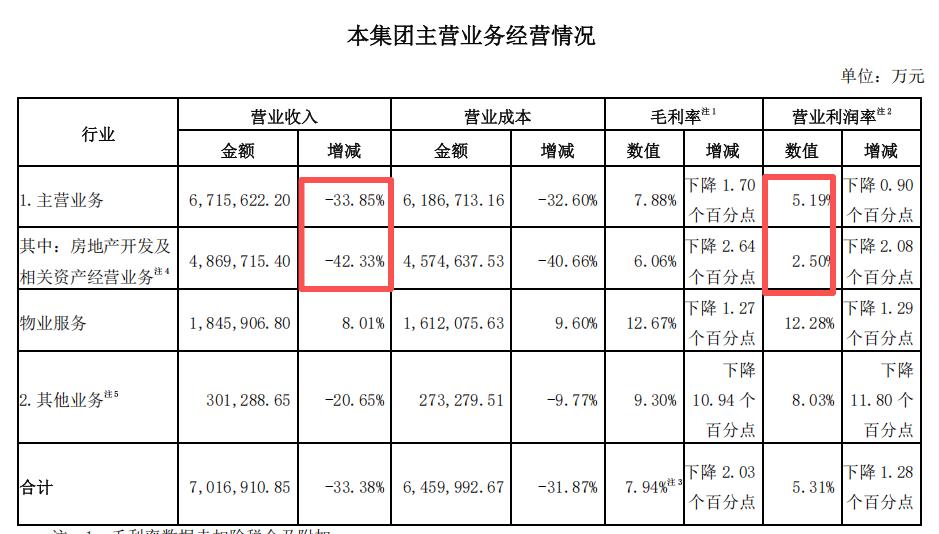
Relevant Data
The real estate crisis is essentially a cash flow crisis. Vanke's sales revenue from development business shrank from 627.7 billion yuan in 2021 to about 310 billion yuan in 2025, with the payment collection fluctuating greatly and continuing to decline; while the non-residential businesses are all operating income, settled monthly/quarterly, with strong prepayment attributes and extremely high cash flow certainty.
Calculated based on public data, from 2022 to 2025, the four non-residential businesses contributed a total net operating cash flow of more than 420 billion yuan. This part of stable cash flow covered about 60% of the group's administrative expenses, sales expenses and interest expenses, ensuring the basic operation of the enterprise in the stage of sharp decline in cash flow of development business.
Among the four non-development businesses, Onewo has the most prominent cash flow value: with annual property fee income of more than 30 billion yuan and a collection rate of over 95%, it is Vanke's most reliable "cash cow".
From 2021 to 2025, Onewo's total revenue increased by 58.4% cumulatively, and its proportion in total revenue rose by 13 percentage points, making it the only segment in Vanke that maintained positive growth for five consecutive years. Its net profit grew steadily from 1.7 billion yuan in 2021 to 2.13 billion yuan in 2025, contributing a total net profit of more than 9.5 billion yuan.
In the first half of this year, Onewo contributed 19.19 billion yuan in revenue and 1.099 billion yuan in profit (after excluding the impact of developer business).
The ability to provide continuous cash flow and profits is the main reason why the team of Onewo has remained stable while the heads of other Vanke business segments have been continuously rotated.
On the other hand, most of the four non-development businesses involve held real estate, which requires large depreciation and amortization (non-cash costs) in accounting, leading to a significant underestimation of the apparent profit on the income statement. In fact, the net operating cash flow inflow of these businesses is much higher than the book net profit, with higher profit quality, and their supporting effect on the group's liquidity is far greater than the figures shown on the income statement.
On the asset side, the strong operating characteristics of non-development businesses also effectively form a hedge against asset value preservation. As of the first half of 2026, the balance of Vanke's inventory depreciation reserve reached 28.51 billion yuan, and residential assets continued to depreciate; while the balance of investment real estate was 122.93 billion yuan, and the long-term equity investment was 102.92 billion yuan, most of which correspond to held assets such as commercial properties, logistics facilities and apartments, with an extremely low impairment ratio. The core high-quality assets even continue to appreciate, effectively offsetting the shrinkage of development assets and stabilizing the basic base of the balance sheet.
However, there are also some hidden concerns in Vanke's non-development businesses. For example, some high-quality projects in Vanke's commercial business have been transferred. At the same time, in some regions, in order to make its held commercial assets "asset-light", Vanke introduced financial institutions such as funds as external investors in the early stage of some project development, which actually diluted Vanke's equity ratio and returns.
Vanke's Port Apartment business also saw a decline in core data in the first half of this year: its revenue was 1.464 billion yuan, down 18.67% year on year. The main reason is that the number of operated apartments of Port Apartment dropped from 273,000 units in the middle of last year to 220,000 units. In the first half of this year alone, the number of operated apartments of Port Apartment decreased by about 49,000 units, and the number of opened apartments decreased by about 29,000 units, a drop of more than 14%. This is the largest "slimming down" in the history of Port Apartment.
This article is from the WeChat official account "Future Habitat", the author is Xiaowu Jiandawu, and is authorized for release by 36Kr.