300,000 recreational vehicles are robbing the hotel industry of its peak season business.
Old Zhang, who operates a mid-range hotel in a prefecture-level city of Guizhou Province, now suffers from a severe headache as soon as he hears the term "recreational vehicle (RV)".
As he puts it, RVs have taken away nearly 20% of his hotel's customer sources during this peak summer vacation season. Looking at those large vehicle shells, Old Zhang has wanted to call the complaint hotline for many times, asking the relevant departments to rectify all kinds of irregular problems of these RVs.
Unfortunately, things did not go as he expected.
The signal released by the relevant person in charge of the Ministry of Culture and Tourism two days ago is that great support will be provided for RV consumption in the future, and research will be conducted to promote the integrated development of culture, tourism, commerce and sports.
This is really not good news. The impact of RVs on traditional hotels is mostly reflected in peak tourist seasons. Many families traveling together choose to skip the hotel accommodation link, and directly integrate "transportation and accommodation" into the space of the vehicle. The vacant rooms of traditional hotels further lead to the situation that room prices cannot rise, making hotels face the dilemma of "no boom in peak seasons".
In the past, many hotel practitioners spent all day studying the pricing, occupancy rate and various creative marketing strategies of their peers within a 3-kilometer radius around their properties. Unexpectedly, these mobile "iron shells" including RVs have directly cut off all their retreat routes.
The country is increasingly supporting the integration of RVs and tourism
The latest development of the integration of RVs and cultural tourism is an official public statement from the competent authority.
Gu Kewei, an official from the Department of Industrial Development of the Ministry of Culture and Tourism, stated at a press conference of the State Council Information Office on August 18 that in the next step, the Ministry of Culture and Tourism will work with relevant departments to formulate policies and measures such as optimizing the allocation of natural resources to promote the standardized and orderly development of the tourism industry and boosting RV consumption, and study and promote the integrated development of culture, tourism, commerce and sports.
He also mentioned that the first batch of national cultural and tourism industry development demonstration zones (entities) will be established to play a leading and exemplary role, promote counties to improve the overall quality of cultural and tourism industry development, and provide better supply and higher-quality services for residents and tourists.
This releases two clear signals.
First, the integration of RVs and tourism will become even closer.
How will they be more closely connected? Lao Sha checked the *Notice on Several Measures to Foster and Expand Consumption in the Automotive Aftermarket* issued in June this year, which clearly states that:
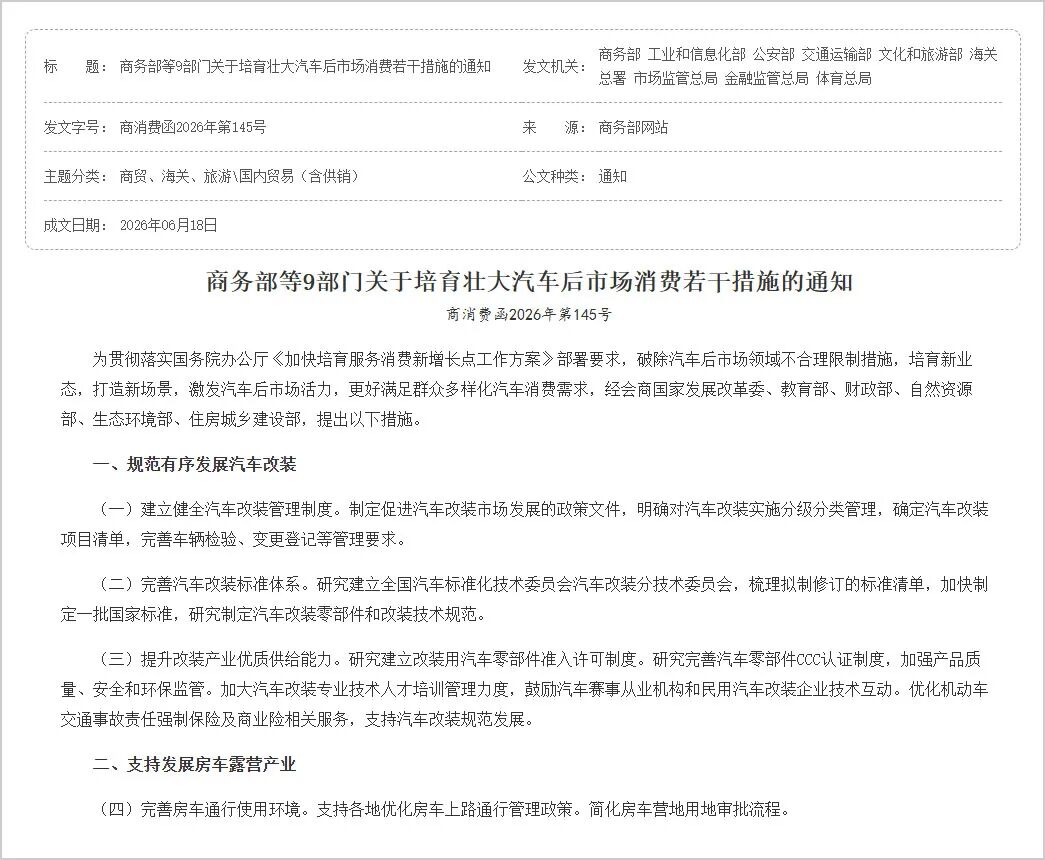
Image source: Official website of the Chinese Government
More RV camps will be built to improve the environment for RV travel and use. Local authorities will be supported to optimize the management policies for RVs on roads, and streamline the approval process for land use of RV camps.
More parking spaces will be provided for RVs: when constructing or renovating public parking lots in cities, dedicated parking spaces for self-propelled RVs and towed RVs can be set up where conditions permit and properly managed, to better meet the parking demand of RVs.
For the hotel industry, this is both good news and bad news.
The good news is that people traveling by RV will no longer easily exploit the free resources of hotels. In the past, due to the lack of formal campsites, a large number of RV owners could only park randomly at service areas, at the entrance of scenic spots, and outside hotels, using public water and electricity for free everywhere.
Many hotels were forced to act as free supply stations, consuming manpower and material resources for no reason. With the accelerated construction of standardized RV camps, this part of demand will be undertaken by professional supporting facilities, which can help hotels get rid of part of the public service burden that does not belong to them.
The reason why Old Zhang said angrily that he would call to make a complaint is exactly that he was exploited by RV campers before.
The bad news is that as more people travel by RV, fewer people will choose to stay in hotels. This is not alarmist talk, because the size of the market cake is fixed. When the number of RVs keeps increasing, there will be more vacant rooms in traditional hotels.
Statistics show that 12,153 self-propelled RVs were registered in the first half of the year, a sharp increase of 32.6% year on year. Among them, 6,838 self-propelled caravans were registered, up 15.3% year on year; 5,315 camping vehicles were registered, up 64.2% year on year.
According to the industry rule that the market performance in the second half of the year is usually better than that in the first half, the total annual registration volume in 2026 is expected to hit a record high, and the number of RVs in China is expected to reach 300,000 by the end of the year. China has become the largest RV market in Asia and the third largest RV manufacturing country in the world, with the market size of the entire industrial chain exceeding 100 billion yuan.
A few years ago, RVs were labeled as "niche luxury toys for the rich". Nowadays, entry-level RVs priced at hundreds of thousands of yuan and new energy modified camping vehicles are pouring into the market in large numbers, continuously lowering the purchase threshold. RVs are no longer just pastimes for a small number of enthusiasts, but are gradually being included in the travel option list of ordinary families.
In addition, the number of RV camps and RV service points is also increasing.
As early as 2025, the Ministry of Culture and Tourism responded to netizens that in recent years, China Tourism Automobile & Cruise Association has launched a total of 79 5C-level and 4C-level self-drive caravan camps in four batches (including 28 5C-level camps and 51 4C-level camps), continuously improving the service quality of the camps. In the future, local authorities will be guided to build self-drive camps in line with local resource characteristics such as urban parks and wetlands.
The Baili Azalea RV Camping Base in Bijie City, which is in the same province as Old Zhang, can accommodate more than 700 RVs. More importantly, the camp provides a large number of supporting services, such as charging piles, complete sewage pipe network and garbage transfer system, as well as fully equipped laundry rooms and shower rooms.
According to the data released by the base, during the summer vacation season in 2025, Baili Azalea received a total of 2.8434 million tourists, including 151,400 RV campers. Up to now, the base has received 112,300 RVs and 278,900 tourists in total, making it the largest RV camping base in China.
The other signal is that the county-level market will become an important market for the integration of RVs and tourism.
The aforementioned official of the Ministry of Culture and Tourism mentioned that the future integration of RVs and cultural tourism will be mainly reflected in the county-level market.
The county-level market is the sinking market, which is a market that both local and international hotel groups are deeply cultivating.
In addition, most of the tourist increments in this market come from people in higher-tier cities, who have more rational and mature travel concepts.
County areas are rich in natural landscapes, mountains, rivers and wetland resources, which are naturally suitable for RV travel. If local authorities have enough high-quality RV supporting facilities, it is estimated that many of these tourists will decisively give up traditional hotel accommodation.
Why are hotels being "replaced"?
In fact, the three core expenses of traveling are transportation, accommodation and catering.
In the past, these three links were completely separated. Later, with the emergence of many full-service hotels and the addition of supporting facilities in limited-service hotels, accommodation and catering have been integrated to a certain extent.
However, with the emergence of RVs and new energy vehicles with larger space, transportation and accommodation have begun to be highly integrated. Even all three core travel expenses can be settled in one RV. An RV integrates the functions of a transportation vehicle, a bedroom and a simple kitchen: you can drive it on the road, stop and rest in it, turn on the stove to buy and cook food, so that the core consumption demands of a whole trip can be fully met on the vehicle.
In fact, the competition of RVs for hotel market share is mostly concentrated in peak tourist seasons, and mainly targets hotels in destination cities. Because at the current stage, hotels generally raise prices during peak tourist seasons, which is an inevitable result of phased imbalance between supply and demand.
However, when consumers have alternative products in the accommodation link, many of them will decisively abandon hotels with skyrocketing prices in peak seasons.
According to incomplete statistics from Lao Sha, when traveling in peak seasons, the accommodation cost of many tourists accounts for 25%-60% of the total travel budget, with the core proportion ranging from 30% to 45%, which is not a small amount of expense.
For example, a family of three travels during the summer vacation, the price of a mid-range hotel is 400-600 yuan per night in peak season, and two nights of accommodation will cost more than 1000 yuan. The total budget for family travel is limited, and accommodation is one of the largest expenses.
With an RV, the accommodation cost can be saved directly. In addition, traditional hotels have check-out time restrictions. Even if hotels offer late check-out services, most of them can only extend the time to 2 p.m.
RVs are completely free from these restrictions: you can lie in bed as long as you want after waking up, park by the lake directly to watch the sunrise, camp at the foot of the mountain to enjoy the sunset, no need to rush to check in or check out, and no need to be restricted by hotel management rules.
When the RV becomes an independent accommodation space, users will have much weaker sense of time during the trip. If the supporting facilities for RVs in various places are enriched, this travel mode of eating and living in RVs will become even more popular.
Therefore, hotels that can only provide guest room products, and those that sharply raise prices in peak seasons, are bound to become the first batch of industries to be impacted.
In the past, "price increase during legal holidays" used to be the survival logic of many tourist hotels. They directly doubled the room price in peak seasons, and earned enough profits for the whole year relying on just a few short legal holidays.
However, the popularization of RVs gives consumers an extra choice: if you raise the price, I will simply not stay in the hotel. The living space of this kind of price gouging practice will continue to be compressed.
This actually reminds the industry that there may not be obvious distinction between peak and off seasons for hotels in the future. Hotels dare not raise prices in peak seasons, while the off seasons will still remain sluggish. Hotel owners who hope to make enough profits for the whole year in peak seasons need to find new development paths. At the same time, hotels that only have the function of "providing a place to sleep for one night" will also be eliminated at an accelerated pace. This kind of hotel with single function is too easy to be replaced.
Lao Sha even believes that in the future, when dividing the formats of the accommodation industry, RVs should also be included as an important supplementary form in the statistics, so that the data can better guide the development of the industry.
Under multiple encirclements, how should hotels fight back?
Mr. Zhang's hotel is an urban business hotel, which only receives vacation customers during peak tourist seasons. Therefore, its daily operation is almost not affected by RV camping.
In fact, RVs are not the most comfortable accommodation solution: the space inside the vehicle is narrow, the bathing conditions are limited, laundry and storage are inconvenient, and there is a lack of experience space.
Lao Sha always believes that RV is just one of the ways for users to resist the price increase of traditional hotels in peak tourist seasons. For this reason, RVs are destined to be only a supplementary form of travel accommodation. Hotel owners including Mr. Zhang do not need to regard RVs as deadly rivals, but learn to amplify their own advantages and find new survival paths.
In Lao Sha's view, in addition to the accommodation function, hotels must also have other competitive capabilities.
In terms of operation logic, break away from the thinking of "only selling rooms" and tap non-room revenue. In addition to serving regular staying guests, hotel owners can also take RV travelers as potential customers.
For example, launch paid supply packages for self-driving RV travelers: paid shower service, self-service laundry, simple meals and afternoon tea, public meeting space, and charging pile supply services.
Some resort hotels abroad have already adopted this operation mode. Tourists sleep in campsite RVs, and consume in hotels for dining, showering and social activities. The hotels do not compete for overnight business, but still obtain considerable operating revenue.
Abandon the concept of "peak season and off season".
A very harsh fact is that there may be no obvious peak season for hotels in the future. Instead of betting on high room prices in peak seasons, it is better to create more experience products. Parent-child amusement projects, family team building activities, health and wellness experiences and other products can offset the weakness of low room occupancy and low room prices to a certain extent.
Sleeping and simple eating can be achieved by RVs. However, exquisite banquets, large-scale conferences, professional health and wellness services, immersive parent-child amusement experiences and high-quality bathing services are very difficult to realize in the narrow space of an RV.
In other words, hotels need to deeply cultivate their experience value, instead of focusing only on the track of "providing a one-night stay".
In the future, the market cake of the accommodation industry will no longer belong only to traditional hotels. Multiple formats including hotels, homestays and RV camps will inevitably compete on the same stage for a long time. Only by accurately identifying their own advantages and finding clear positioning, can hotels keep their own share when the total market size is fixed.