Half-year transcript of the computing power leasing industry: How have the major players performed?
Against the backdrop of continuously rising AI computing power prosperity, considerable sector gains for the year, and continuous influx of cross-border new players, the 2026 semi-annual report provides the market with a review window of "distinguishing the genuine from the fake" — taking "revenue exceeding RMB 10 billion in H1 and net profit attributable to shareholders exceeding RMB 1 billion" as the benchmark, this paper selects 10 large-scale computing power rental/computing power service related companies, and sorts out their financial performance, resource scale, strategic direction and value judgment.
Reporting period: January-June 2026 (semi-annual report) Financial data as of 2026-08-29 Market value/valuation: Closing caliber on 2026-08-28 Currency: RMB [Guangdong-Hong Kong-Macao Intelligent Computing (Hong Kong Stock) converted to RMB for pricing]
Over the past year, the explosive growth of demand for AI large model training and inference has pushed "computing power" to the forefront of the capital market. According to CCTV reports, as of June 2026, the daily average Token call volume in China has exceeded 500 trillion, nearly 5000 times higher than that at the beginning of 2024. Along with the booming demand side, the computing power rental/computing power service sector ranks top in gains for the year, and has also attracted more and more new players — including long-standing "veterans" that have been deeply engaged in the track for many years such as Runze Technology and Guangdong-Hong Kong-Macao Intelligent Computing, as well as new entrants that have transformed into the track such as Co-creation Data, Dongyang Sunshine, Hongxin Electronics, and Xingyun Technology. Even enterprises that originally produced monosodium glutamate, aluminum foil and flexible circuit boards have launched cross-border layouts one after another.
Beneath the bustling scene, good and bad are intermingled. The 2026 semi-annual report season just provides a clear benchmark: excluding concepts and hype themes, which companies have truly turned computing power into a large-scale business? Taking "operating revenue exceeding RMB 10 billion in the first half of the year and net profit attributable to shareholders exceeding RMB 1 billion" as the selection threshold, this paper screens out 10 companies — Co-creation Data, Dongyang Sunshine, Runze Technology, Hongxin Electronics, Zhiwei Intelligence, Invese, Guangdong-Hong Kong-Macao Intelligent Computing, Wangsu Science & Technology, Litong Electronics, Hongjing Technology for one-by-one review.
Financial Performance: Significant Differentiation in Scale and Profit, Uneven "Computing Power Content"
First, look at the most intuitive financial results. The table below is sorted by operating revenue in H1 2026 from high to low, and separately splits the "revenue from computing power/computing power rental business" to observe the "quality" of each company's revenue.
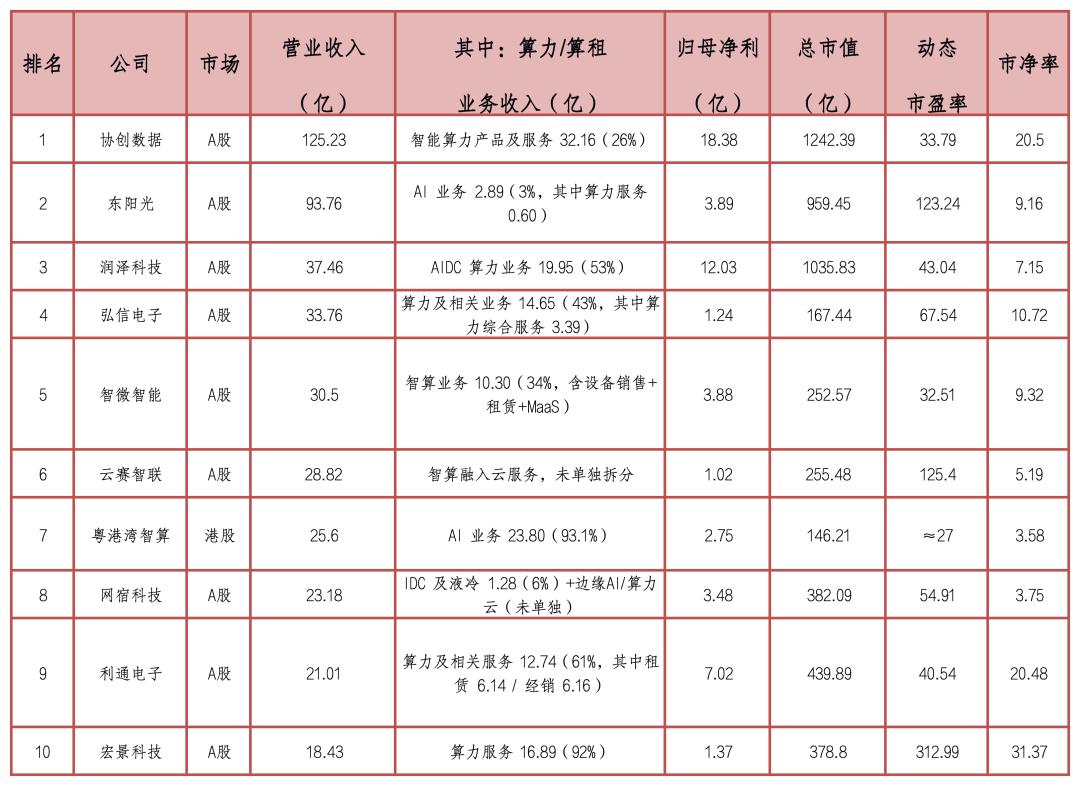
Note: Dynamic P/E ratio = total market value / (net profit attributable to shareholders in H1 × 2) (caliber of Tencent Stock Selector, Guangdong-Hong Kong-Macao Intelligent Computing is calculated based on its H1 annualization and full-year forecast of securities firms to be about 28–33 times); market value/valuation is the closing price on 2026-08-28. The revenue of computing power business is based on the caliber of each company's financial report. "Comprehensive computing power service/rental/technical service" is closer to real computing power service, while "product/distribution/equipment sales" is more inclined to the nature of trade or manufacturing.
Several noteworthy phenomena:
First, the largest scale does not mean the purest computing power. Co-creation Data, the revenue champion (RMB 12.5 billion), takes a clear lead in volume, but its computing power-related revenue accounts for only about a quarter, and a considerable part is "computing power products" (hardware). Manufacturing and trading businesses such as storage and server remanufacturing contribute the main revenue. Dongyang Sunshine (RMB 9.376 billion) ranks second in revenue, but its AI business accounts for only about 3%, and it is essentially a material and chemical enterprise focusing on high-end aluminum foil, fluorine and chlorine chemicals, and electronic components.
Second, the companies with the highest "computing power content" are medium-sized companies instead. The AI business of Guangdong-Hong Kong-Macao Intelligent Computing accounts for as high as 93.1%, the computing power service of Hongjing Technology accounts for 92%, the computing power-related service of Litong Electronics accounts for 61%, and the AIDC business of Runze Technology accounts for 53% — these companies have significantly higher "computing power content" in revenue and are closer to the theme of "computing power service".
Third, the matching degree between valuation and profitability varies greatly. Runze Technology (dynamic P/E 43x, P/B 7.15), Zhiwei Intelligence (dynamic P/E 33x, P/B 9.32), Guangdong-Hong Kong-Macao Intelligent Computing (dynamic P/E about 27x, P/B 3.58) are relatively moderate; while the valuations of Hongjing Technology (dynamic P/E 313x, P/B 31.37), Invese (dynamic P/E 125x, P/B 5.19) and Dongyang Sunshine (dynamic P/E 123x, P/B 9.16) have significantly outpaced their fundamentals, and the P/E ratios of Hongjing Technology, Dongyang Sunshine and Invese are partially or severely distorted.
Resource Scale: Orders and Computing Power Are "Hard Currency", But Their Fulfillment Progress Varies
The core of the computing power business is "resources" — how many orders, how much computing power, and how much has been delivered. The table below is sorted by order scale from high to low; the disclosure caliber of each company is different, and the undisclosed items are marked as "Undisclosed".
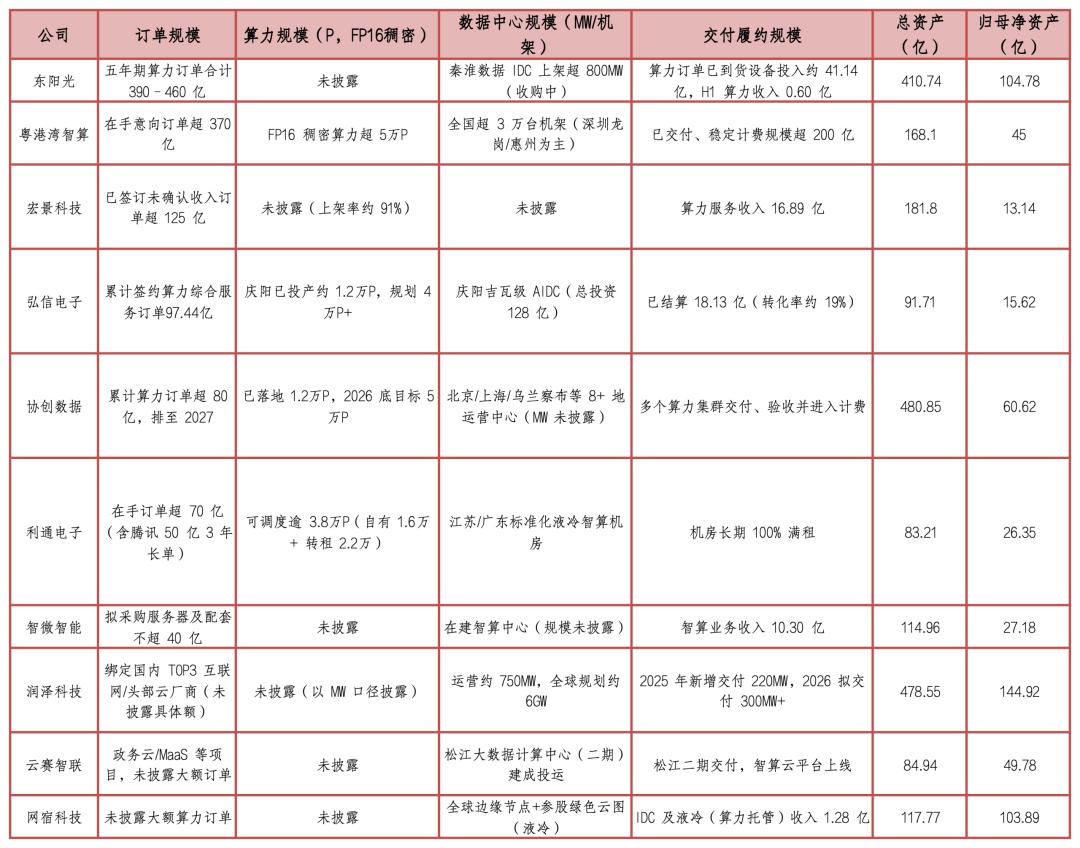
Note: ①
From the resource dimension, according to the disclosed long-term computing power service contract amount, Dongyang Sunshine ranks first with RMB 39–46 billion; Guangdong-Hong Kong-Macao Intelligent Computing discloses that its pending intention orders exceed RMB 37 billion. The statistical calibers of the two are not completely consistent, so it is not suitable to rank them directly. In terms of fulfillment path: most of Dongyang Sunshine's orders are five-year framework contracts, and the actual recognized revenue from computing power services in H1 is only RMB 600 million, which is still in the very early stage of "signing order — construction"; Guangdong-Hong Kong-Macao Intelligent Computing discloses that "the delivered and stably billed scale exceeds RMB 20 billion", indicating that its order fulfillment progress is relatively ahead; but this indicator is not equivalent to the recognized revenue in the reporting period. In terms of computing power scale, Guangdong-Hong Kong-Macao Intelligent Computing (50,000P FP16 dense) and Litong Electronics (38,000P) rank top, followed by Hongxin Electronics (12,000P put into operation in Qingyang, 40,000P+ planned) and Co-creation Data (12,000P, target 50,000P). What is worthy of vigilance is the "order-settlement" gap: Hongxin Electronics has signed a total of RMB 9.744 billion of contracts, while the settled scale is RMB 1.813 billion. Due to the inconsistent term, delivery, acceptance and billing rhythm of different contracts, it is not appropriate to simply calculate the "order conversion rate"; the subsequent revenue recognition rhythm is the core variable more worthy of observation.
Strategic Direction: From "Selling Resources" to "Selling Output", Token/MaaS Becomes the Watershed
Looking at the business and capital actions of various companies in 2026, a clear main line is that leading players are collectively upgrading from "computing power rental (billed by card)" to "Token delivery / MaaS (billed by Token, value sharing)"; at the same time, mergers and acquisitions, private placement, and introduction of state-owned capital have become standard actions for expansion.
Runze Technology: Heavy Asset Self-built AIDC/IDC Leader · Globalization
It has established a differentiated strategy of "domestic AIDC, overseas IDC", realized the cycle of "heavy asset exit — reinvestment" through the REITs capital platform, and promoted the overseas layout of Batam Island, Indonesia (first batch of delivery within the year) and Shaling, Hong Kong (2028). Interpretation: Using "resource positioning + REITs" to turn heavy assets into a recyclable business, it is relatively solid among the 10 companies in terms of current financial performance and infrastructure resources, but its growth is highly dependent on capital expenditure and overseas delivery rhythm.
Co-creation Data: Full-stack High-speed Scale Expansion of "Smart Terminal + Cloud Computing Power + Optical Devices"
Holding Guangwei Technology to supplement the optical module business, implementing private placement of RMB 8 billion to invest in intelligent computing center, and obtaining RMB 130 billion credit line for scale expansion, the target is to achieve 50,000P computing power by the end of 2026, and extend MaaS through FCloud+TokenShare. Interpretation: It takes the full-stack route of "hardware manufacturing as the foundation, computing power service as the boost", with strong scale and execution, but the expansion under high leverage (86.8%) is essentially "using liabilities for growth".
Guangdong-Hong Kong-Macao Intelligent Computing: Hong Kong Stock Computing Power Leader · State-owned Capital Empowerment + Token Super Factory
Self-developed "Quantum Pai" computing power cloud platform, billed by card and by Token; strategic investment from state-owned capital exceeds RMB 1 billion, financing cost is reduced to 3.5%, included in MSCI China Small Cap Index, and it is expected to be included in the Shanghai-Hong Kong Stock Connect in Q1 2027. Interpretation: It ranks top in order and computing power scale, with large delivered billing scale and relatively advanced fulfillment progress. State-owned capital endorsement and low-cost capital are its advantages; but liquidity and valuation (not included in the stock connect, P/E distortion) are the main sources of current discount.
Hongjing Technology: Token Factory + Cloud Going Global
Fully transformed into computing power rental, layout Token factory and large enterprises' cloud going global; the RMB 1.29 billion private placement has been approved by the Shenzhen Stock Exchange and still needs the approval of the China Securities Regulatory Commission. Interpretation: 91.6% debt ratio determines its strategy of "betting on growth with high leverage", and whether the private placement can be implemented to supplement capital is the key variable.
Litong Electronics: Dual Main Businesses of Manufacturing and Computing Power · Nvidia Channel Barrier
With Nvidia Preferred level qualification, it operates 38,000P high-end computing power, binds 3-year long orders from Tencent and other enterprises, and retains structural parts manufacturing as the cash flow foundation. Interpretation: The supply channel constitutes a certain competitive advantage, with full occupancy and high certainty of long-term agreements; but distribution accounts for half of the business, which is of trade nature, the structural parts business still needs to be cleared, and the quality of "computing power service" needs to be discounted.
Zhiwei Intelligence: Intelligent Computing Center + Token Factory + LPU Inference
Implementing private placement of RMB 2.87 billion to invest in intelligent computing center, jointly with Tengyun Intelligent Computing and Yuanchuan Micro released Token factory (adapted to GLM-5.2/DeepSeek-V4Pro), strategically invested in Yuanchuan Micro to layout LPU. Interpretation: It positions in the "end-cloud inference closed loop", Token factory and LPU are its differentiated highlights, but the intelligent computing center is still under construction and the scale has not taken shape, so it is a target in the "layout period".
Hongxin Electronics: FPC + Full-stack Computing Power · Exclusive Foundry of Enflame + Token Factory
Established a joint venture with Enflame to exclusively manufacture its AI chips/servers, the gigawatt-level AIDC in Qingyang has been put into operation, a Token factory is built in Wuxi (introducing RMB 500 million of state-owned capital), and the actual controller fully subscribes for the private placement to supplement liquidity. Interpretation: Its unique full-stack positioning of "energy - chip - computing power - model" and exclusive binding with Enflame are scarce resources; but the gap between RMB 9.7 billion of signed contracts and RMB 1.8 billion of settled contracts exposes the capital chain pressure of "heavy investment, slow fulfillment".
Dongyang Sunshine: Cross-border Layout of Material/Chemical Leader · Acquisition of Qiniu Data + Full Liquid Cooling Chain
Plans to wholly hold Qiniu Data (IDC exceeds 800MW), set up a joint venture with Zhongji Xuchuang to layout liquid cooling, implement RMB 39–46 billion of five-year computing power orders, and build a four-in-one system of "green energy - manufacturing - computing power - AI". Interpretation: It is the most aggressive cross-border player, the combination of green power + liquid cooling + Qiniu Data is quite imaginative; but the computing power revenue is less than RMB 100 million, Qiniu Data has not been consolidated, and the fulfillment of "huge orders to performance" has just started.
Wangsu Science & Technology: CDN/Edge Computing + Security · Computing Power as the Second Growth Curve
Taking CDN/edge computing as the foundation, security service as the profit engine, edge AI gateway, computing power cloud, and liquid cooling IDC as the second growth curve for AI; with stable finance, the medium-term dividend is nearly RMB 200 million. Interpretation: With an asset-liability ratio of only 12% and the best cash flow, it is a robust target that "can advance and retreat freely"; but its computing power purity is the lowest, and its flexibility is not as good as pure computing power stocks, which is more inclined to the logic of "edge AI + security".
Invese: Shanghai State-owned Smart City · Intelligent Computing Starting
Under Shanghai Yidian Group, the Songjiang Big Data Computing Center (Phase II) has been put into operation, the intelligent computing cloud platform has been released, it participates in government MaaS and municipal government cloud, and sets up a RMB 1 billion intelligent computing ecological fund. Interpretation: The core highlight is the Shanghai state-owned capital resources and data element positioning; but its main business is still cloud services/solutions, the computing power business has just started with thin profits, and the 125x P/E ratio is more of expectation pricing.
Value Judgment: Ten Companies, Ten Different Development Paths
Combining finance, resources and strategy, this paper makes a neutral judgment on the subsequent trend of these 10 companies. It needs to be emphasized that the following analysis is based on public information and does not constitute investment advice.
Co-creation Data — The King of Revenue, But "Trade/Manufacturing" Accounts for a High Proportion of Profits
It has the largest revenue scale, the highest net profit and the fastest growth rate, but we must see clearly the "quality" of its profits: data storage (manufacturing), server and peripheral remanufacturing (trade/manufacturing) together account for nearly 70% of revenue, and the "products and services" of intelligent computing power also contain a considerable proportion of hardware. In other words, Co-creation's high growth is more driven by "computing power hardware manufacturing + trade" to win by volume, rather than high-margin pure computing power services. Superimposed with the high asset-liability ratio of 86.8% and the 714% surge in financial expenses (RMB 586 million) in H1, the leverage dependence and profit margin thickness of its growth model are the core variables that need continuous tracking. The utilization progress of the RMB 1300 billion credit line and financing cost determine its scale expansion slope.