Boasting world-class landscapes of mountains and rivers, Guilin cannot even accommodate a top luxury hotel bed: the "dimensionality reduction" predicament of Guilin's hospitality industry.
This article is from the WeChat official account "Space Secret Explorer", authored by Wang Xiaoxiong, and released with authorization by 36Kr.
In the summer of 2026, three mid-to-high-end hotels, namely Courtyard by Marriott, Four Points by Sheraton and the rebranded Wyndham Garden, have all settled in the downtown area of Guilin, kicking off the second half of the year on a positive note. With the recovery of inbound tourism and the rising passenger flow of scenic spots, this time-honored tourist city seems to be embracing a new round of renewal.
However, if we take a broader perspective, we will find that the high-end hotel landscape in Guilin is still relatively thin. Many international brands that entered Guilin in the early years have entered the aging cycle, and the truly ultra-luxury and wilderness luxury hotels have been absent for a long time. Boasting world-class landscapes, why has Guilin not welcomed an Aman or a Ritz-Carlton Reserve for so long? As the wave of non-standardization sweeps across the market, which link is stuck in the city's accommodation market?
International mid-to-high-end brands collectively "land" in Guilin's landscape
Recently, the hotel and tourism market of Guilin, this time-honored tourist city, is seeing a new trend that cannot be ignored.
First, Courtyard by Marriott under Marriott officially settled in Guilin. As the brand's first entry into this time-honored tourist city, the opening of Courtyard by Marriott Guilin City Center has attracted extraordinary attention.
It is reported that the hotel is located in the core area of Qixing District, just a short distance from the city landmark Qixing Park. Guests can easily reach natural and cultural attractions such as Elephant Trunk Hill, Duxiu Peak Royal City Scenic Area, Sun and Moon Twin Towers Cultural Park, with landscapes of mountains, rivers and the city within easy reach.
Almost at the same time, Four Points by Sheraton also chose to open to guests in the summer vacation. The hotel is located on the opposite bank of the Sun and Moon Twin Towers, adjacent to Shanhu Lake and Elephant Hill Scenic Area. The sparkling waves of the Two Rivers and Four Lakes become a daily landscape visible as soon as you push the window open.
The successive entry of international brands has quietly renewed Guilin's accommodation landscape.
At the other end of urban renewal, the narrative of memory and iteration is also unfolding. In August this year, a public notice issued by the Guilin Municipal Bureau of Housing and Urban-Rural Development announced that the old building that has stood on Zhongshan Road for 40 years is about to turn a new page — the well-known Tai Lian Hotel familiar to Guilin locals will soon be rebranded as Wyndham Garden.
This building carries the memories of two generations of wedding banquets, morning tea and vacations, and now it has ushered in a new life in the wave of urban renewal.
Sorting out the group of hotels that entered the Guilin market this summer, the characteristics of these new hotels are concentrated in the keywords of "internationalization", "core plot", "old building renovation" and "mid-to-high end".
Echoing these new trends is the obvious recovery of Guilin's tourism market.
Compared with previous years, the overall atmosphere of Guilin in the summer of 2026 is much more lively. Data shows that during the summer vacation, the number of tourists received by Guilin increased by about 15% year-on-year. The performance of some core scenic spots is even more impressive. The Maorishan Scenic Area received a total of nearly 80% more tourists year-on-year from August 1 to 19, and the mountain clouds and forests are welcoming more and more visitors from afar.
The recovery of inbound tourism has added a more international footnote to this boom. From July 1 to 19, the passenger flow of entry and exit at Guilin Port increased by 43.7% year-on-year, of which the year-on-year growth rate of foreign inbound passengers reached 73.46%. If we look at the whole second quarter, the total number of entry and exit passengers at Guilin Port was 71,000, including 57,000 foreign passengers, a year-on-year increase of about 187%.
However, when we shift our focus from the partial recovery of Guilin to the overall picture of the domestic tourism market, we will find that there are still hidden concerns behind the enthusiasm. Although tourists' willingness to travel continues to rise, the overall pressure on the accommodation industry has not been eliminated.
Authoritative institutions predict that the number of trips in the domestic cultural tourism market this summer will reach 18.39 billion, a year-on-year increase of 3.2%, hitting a record high. The total tourism revenue is expected to reach 3.21 trillion yuan, a year-on-year increase of 2.0%.
But a closer look at these two sets of data shows that the revenue growth rate is significantly lower than the passenger flow growth rate, and the market is showing an obvious trend of rising volume and falling price. More specifically, the average per capita consumption of domestic tourism in the summer of 2026 is about 571 yuan, a year-on-year decline of 3.2%.
Indeed, the combination of high travel enthusiasm and tightened consumption willingness clearly indicates a clear signal: for Guilin, this time-honored tourist city, its accommodation market has indeed reached a critical moment that needs to inject new energy and re-calibrate products and services.
With RevPAR less than 600 yuan, Guilin's accommodation market is undergoing "transition between the old and the new"
The reason why it is described as a surge is that if we extend the time axis slightly, we will find that in the past two years, neither international hotel groups nor domestic chain brands have taken substantial actions to enter the mid-to-high-end and above market of Guilin, this time-honored tourist city.
This land renowned as "the most beautiful landscape under heaven" seems to have fallen into a silent period of high-end accommodation supply for a period of time.
/ New brands, testing the market cautiously
Looking back at 2025, the opening of TUI Blue Guilin Watermark Gallery Hotel attracted much market attention.
As the 4th hotel laid out by TUI in China and the 20th in Asia, the hotel faces the Qifeng Guanyue, one of the eight old scenic spots of Guilin, across the river, and is closely adjacent to Egret Island, a wetland where egrets inhabit. Pushing the window open, you will see an ink-wash painting of the Li River.
Perhaps because the TUI Blue Yangshuo Xiangheli Hotel previously laid out in Yangshuo County has received positive market feedback, TUI has now brought this brand to the downtown area of Guilin, realizing the strategic layout of two hotels in one city.
Mentioning TUI Blue, most people may feel a little unfamiliar, but its parent company TUI Group is actually one of the largest tourism groups in the world. It owns airlines, cruise ships, more than 400 hotels and resorts, and about 1200 travel agencies. Hotels are only a part of its huge tourism industry chain.
In 2016, TUI launched the lifestyle hotel brand TUI Blue, hoping to deeply integrate hotels with destination experiences. The brand is positioned between high-end business hotels and traditional resort hotels, emphasizing leisure experience and local culture rather than unified standard luxury experience, featuring a unique non-standard temperament.
Also in 2025, a hotel owner from Shunde opened voco in Yangshuo Ten-mile Gallery. This store happens to be the 100th voco in the world. After opening, with its magnificent window view overlooking the karst landform, it has become the most expensive voco in China, with the current OTA booking price maintained at 1500-1600 yuan per night.
In terms of configuration, this voco is indeed worth the price. The hotel itself cost hundreds of millions of yuan to build, with a total of four buildings, but only 73 rooms. The room types cover various formats from hot spring pool rooms to high-altitude infinity pool rooms. The viewing platform on the 5th floor of the hotel is a must-see spot. Standing there, you can see the most famous Camel Crossing the River wonder in Yangshuo, with peaks reflected in the water and the river flowing like a ribbon.
Turning back to domestic chain hotel groups, there is also the Manxin Mansion Guilin No.5 Hotel, which officially began preparation in 2025, that also follows the non-standard route. This hotel is renovated from the former No.5 Mansion Jiashan Hotel by the Taohua River. It opened in 1979 and was once an important place for receiving foreign guests back then, which is also a part of the urban memory of a generation of Guilin people.
Although up to now, the new Manxin Mansion hotel is still in the stage of demolishing part of the original buildings and re-decorating, recruitment notices have been posted, and its opening is just around the corner.
As we all know, Manxin Mansion is a select-service hotel under Huazhu, targeting the current mid-to-high end and high-end standards of the market. It is usually located in old buildings with historical heritage, characteristic courtyards near scenic spots, old factories and other places. In other words, this is another hotel with non-standard genes.
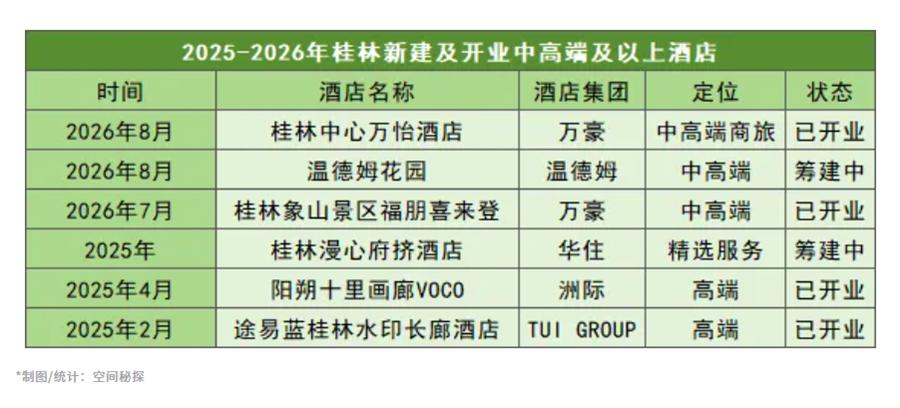
Now, when we look back at these highly anticipated projects in 2025, we will find that "non-standardization" and "small and medium-sized" are their common labels.
Therefore, for the entire hotel and tourism market in Guilin, the high-end supply in 2025 and the mid-to-high-end supply in the summer of 2026 are not very prosperous, but more like a cautious test.
/ Old brands, with insufficient momentum
On top of that, a number of earlier high-end and above hotels in Guilin have indeed reached the cycle of renovation or rebranding.
For example, Sheraton Guilin Hotel Elephant Trunk Hill Two Rivers and Four Lakes Store, which opened in 1988 and is also one of the landmarks along the Li River, completed a full-floor renovation in 2021.
With its accumulated reputation over the years, first-line river view just outside the door, walkable Blade Bookstore and Diecai Mountain, this hotel still holds a unique position in the field of foreign guest reception and resort business travel in the urban area.
In addition, there is Shangri-La Hotel Guilin located on the east bank of the Li River, which opened in 2010; Guilin Lijiang Waterfall Hotel located in the city center, which opened in 2002; Guilin Grand Mansion Hotel snuggled by the Taohua River, which opened in 2014 and was renovated in 2018...
Looking further to Yangshuo, the well-known Banyan Tree Yangshuo located in Fuli Ancient Town opened in 2014, completed a renovation only one year later, and renovated part of the villa area in 2023. In addition, there is Yangshuo Sugar House located by the Li River, which opened in 2017. The latter also experienced many twists and turns, removed the Alila brand in 2020, and was included in Marriott's Design Hotels this year.
Overall, the number of high-end and above hotels in Guilin is not very large, and there is still a clear gap in the echelon construction. Secondly, from the perspective of RevPAR, the situation is not optimistic.
Survey data from authoritative institutions shows that the average daily rate of five-star hotels in Guilin from 2013 to 2024 is 445 yuan. In terms of changes, the overall trend went downward from 2013 to 2016, rebounded to 427 yuan in 2017, and then remained in the range of 390 to 518 yuan, reaching 571 yuan in 2024, showing strong price resilience in the high-end market.
The average daily rate of four-star hotels from 2013 to 2024 is 235 yuan, of which the highest is 293 yuan in 2013 and the lowest is 210 yuan in 2022. It remained in the range of 210 to 246 yuan from 2017 to 2022, and was only 213 yuan in 2024, which fully demonstrates that there is limited room for price increase in the mid-to-high-end market, and the growth ceiling is clearly visible.
When new non-standard forces are injected and time-honored landmarks are successively ushered in the renewal cycle, Guilin's accommodation market is standing at a subtle turning point.
In addition to mid-to-high-end hotels, ultra-luxury hotels are also scarce in Guilin
From the perspective of the hotel landscape of a time-honored tourist city, real ultra-luxury hotels have always been a scarce existence in Guilin. At present, there are only two hotels, Banyan Tree and Songpin, which seem to be out of proportion to the international reputation of this famous landscape city.
Looking at the neighboring city Chongzuo, an emerging destination that has only emerged in recent years, it has shown a more aggressive development posture in the hotel sector.
Guangxi Chongzuo Mingshi LUX* Resort, which just celebrated its 5th birthday in 2026, is hidden on the banks of the Mingshi River at the China-Vietnam border, surrounded by karst landscapes, and has long been a landmark of wilderness luxury resorts in Guangxi.
In recent years, it has been continuously carrying out renewal and maintenance. In addition to upgrading hardware facilities, the resort has also built a secret farm and a small animal paradise, committed to providing an unforgettable experience that integrates play and stay.
This year, the opening of Chongzuo Legend Avana Secret Realm Manor has added a strong stroke to this land.
At present, this hotel has joined The Leading Hotels of the World. There are only more than ten hotels in China that have joined this organization, including The PuLi Hotel and Spa Shanghai, The Puyu Hotel Beijing, and The Seven Senses Hotel Xiamen, all of which are benchmark works that combine design sense and luxury.
Not to mention within the province, let's turn our eyes to Dali, another time-honored tourist city with almost the same market position. Although there was news that the Ritz-Carlton project was stranded this year, the successor, the Grand Mercure, is not weak. Even if the room rate in the off-season is only about 500 yuan, it is still one of Marriott's lifestyle soft brands, belonging to the high-end line.
In addition, it is worth noting in 2026 that Marriott Group has made a high-profile entry with its ultra-luxury trendy brand EDITION and Le Méridien, while Hyatt Group has brought its luxury brand Grand Hyatt.
Previously, Hyatt Hotels Group joined hands with Dahua Group to jointly announce that Dali, Yunnan will welcome two brand hotels, namely Grand Hyatt Dali and Hyatt Place Dali Erhai. The two hotels will be located in the proposed 180-meter-high tallest building in Dali, which is located in the landmark project Dahua Shanhaiying in the core area of Xiaguan District, Dali.
In February this year, news came out that the two hotels are scheduled to open in 2029.
In this regard, luxury and ultra-luxury hotels are slightly absent in Guilin.
First of all, the non-replicability of geography and landscape limits the creation of urban ultra-luxury hotels. Most of the high-quality landscape belts along the Two Rivers and Four Lakes and the Li River in downtown Guilin are protected areas, with very few developable high-rise plots, making it difficult to replicate the ultra-luxury hotel model of core urban landmarks plus super high-rise buildings in first-tier cities.
The top experience in Guilin lies in its landscapes, not urban prosperity. Real ultra-luxury hotels usually require an extremely prime core urban location or a unique natural landform; while Guilin's top landscapes such as karst peak forests and the Li River are more suitable for low-density, secluded resort hotels. Although these hotels have high unit prices, they cannot replace the landmark effect of ultra-luxury hotels in the core urban area.
Secondly, there is a mismatch between the consumption structure and customer group demand. Guilin is a mass tourist city, and its customer groups are mainly domestic individual travelers, families with children, and cost-effective tourists. Their demand for high cost performance and internet-famous check-in spots is far greater than the demand for ultra-luxury hotels with extreme privacy and 10,000-yuan premium.