Changxin Technology, which has spent ten years of painstaking efforts to hone its capabilities, recorded a profit of 77.6 billion yuan in half a year.
Ten years of Changxin and a super cycle.
The domestic leading memory enterprise has reaped huge profits.
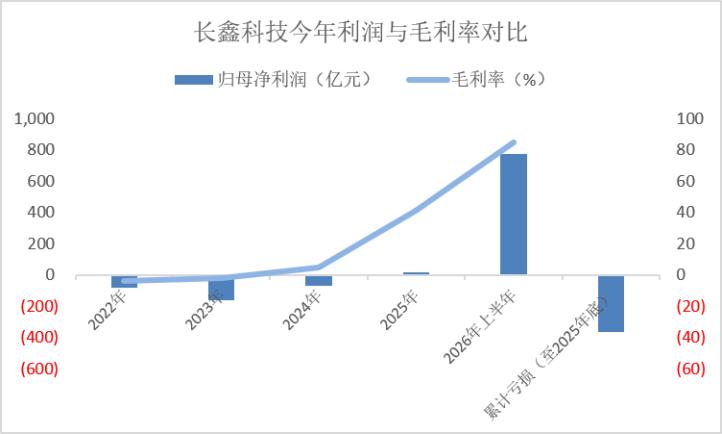
On August 28, 2026, Changxin Technology released its performance report for the first half of 2026, with revenue reaching 150.31 billion yuan, a year-on-year increase of 873.64%, and net profit attributable to shareholders hitting 77.61 billion yuan, ranking 10th among all A-share listed companies.
According to the financial report, the surge in net profit is mainly driven by the rapid growth of global computing power demand, capacity adjustment of major global manufacturers, the undersupply of global DRAM products and the sharp rise in product prices, which has led to a substantial increase in gross profit margin of the company's main DRAM products.
By the end of June 2026, the gross profit margin of Changxin's main business reached 84.84%.
In the capital market, Changxin also delivered impressive results. On the listing day, Changxin's closing price stood at 49.5 yuan, up 471.6% compared with the issue price, and by August 28, the cumulative increase had reached nearly 20%.
"Whoever masters memory technology will dominate the entire integrated circuit industry." In 2005, Zhu Yiming, Chairman of Changxin Technology, put forward such a judgment. Today, the enterprise he founded from scratch has proved the weight of this statement with its half-year financial report.
The AI mega cycle and "Changxin Speed"
It took Changxin ten years to transform from a "money-burning black hole" to a "cash cow", and its half-year profit has far exceeded its total accumulated losses over the years.
After achieving turnaround and small profits in 2025, Changxin's revenue in the first half of 2026 reached 150.31 billion yuan, surging nearly 9 times year on year; its net profit attributable to shareholders hit 77.61 billion yuan. Previous financial data showed that the company's total accumulated unrecovered losses by the end of 2025 amounted to 36.65 billion yuan.
Changxin is not an exception in the memory industry. The industry has long followed the script of "investing for years and getting all costs back at one stroke". Similar stories once happened to Samsung.
In 1983, Samsung officially entered the DRAM field. One year later, Samsung completed its first DRAM production line and realized mass production of 64K DRAM, but immediately encountered the global semiconductor recession. By the end of 1986, Samsung's semiconductor business had accumulated losses of more than 300 million US dollars, and all its equity capital was exhausted.
The turning point came in 1987. The semiconductor friction between Japan and the United States led to a global shortage of DRAM and a sharp rise in prices. Samsung quickly recovered its vitality with the production capacity it built during the downturn. By the end of 1987, the profits from Samsung's DRAM business had completely offset all previous accumulated losses. In the following decades, the memory industry went through multiple cycles, and the profits of Samsung Memory also fluctuated sharply.
The root of this business state lies in the periodicity of DRAM. The price of DRAM will rise and plummet sharply due to drastic changes on the supply and demand sides, and the investment in early production lines is extremely huge. This industry rule can also be confirmed by Micron and SK Hynix: they also went through the same process of entering the DRAM industry, suffering years of losses due to semiconductor recession, and finally making profits to cover all previous losses after the industry recovered.
The three companies spent 3 to 6 years from construction to production, and the payback period fluctuated greatly under the influence of multiple factors such as market price, demand and capacity utilization.
Changxin's payback period is as long as ten years, because the market environment it faces is more complex.
In the 1980s, DRAM manufacturers faced a market with an unconsolidated competitive landscape, where dozens of manufacturers from Japan, the United States and South Korea competed with each other, and latecomers still had the opportunity to get a share of the market through counter-cyclical investment and technological catch-up. However, in the recent memory market, the three giants of Samsung, SK Hynix and Micron have built all-round barriers in technology, production capacity and customer relationships.
Theoretically, such a market will not leave any opportunities for latecomers, but Changxin has still broken through a path by catching up with the rhythm of the "AI super cycle".
Since 2024, the explosion of AI computing power demand has boosted the demand for DRAM. According to data from TrendForce, the global spot price of DRAM surged by more than 410% in 2025, and the contract price in the first quarter of 2026 continued to rise by 80%-95% month on month. Changxin's gross profit margin soared from -2.19% in 2023 to 84% in the first half of 2026.
The training and reasoning of AI large models are essentially high-speed reading, writing, transmission and operation processes of massive data, which require multiple GPUs for parallel computing. The cache of GPU is limited, so data must be temporarily stored in DRAM for real-time calling during training. According to Micron's calculation, the DRAM capacity in AI servers is 8 times that of ordinary servers.
The memory of AI servers usually adopts HBM technology, which connects DRAM in parallel in a compressed form to provide higher memory efficiency. The higher profit of HBM has prompted the three giants of Samsung, SK Hynix and Micron to divert most of their advanced production capacity to HBM production, while the production capacity of general consumer-grade DRAM has been greatly compressed, creating a huge supply gap, which is Changxin's main battlefield.
However, Changxin also reminded in its financial report that the current artificial intelligence industry is in a period of concentrated infrastructure investment, but its commercial application is still in the process of continuous expansion, and the proportion of revenue in related fields during the reporting period is relatively low.
Apart from the external environment, the rising penetration rate of domestic memory under the background of geopolitical conflicts is also a major trend. Changxin is the only original manufacturer in Chinese mainland that has realized large-scale mass production of DRAM, and its products have entered the mainstream supply chains of Xiaomi, OPPO, vivo, Lenovo, Huawei and other brands.
This is also attributed to Changxin's own strategic layout and technological efforts: Changxin has adopted an aggressive generation-skipping strategy, skipping the intermediate 17nm process, and directly launching the 16nm (1Z) process system, which is aligned with the international mainstream DDR5 specification. Changxin started mass production of DDR5 at the end of 2024, and gradually reduced the production capacity of DDR4.
Where will the cyclical memory industry head to?
The market, competitors and the company's own strategies jointly contributed to the explosive performance. Whether Changxin can maintain sustained growth in the future depends on two questions:
First, will AI computing power flatten the cycle or amplify the cycle?
People in different industries hold different views. Optimists believe that AI is "smoothing out" the periodicity. The reason is that AI demand is exponential and structural, rather than linear and predictable. In 2026, AI is expected to consume two-thirds of the global DRAM production capacity. The parameters of AI models double every few months, and there is no ceiling seen in the demand for memory.
Joseph Moore, chief semiconductor analyst at Morgan Stanley, put forward the concept of "Chipflation" in a research report released in June 2026, arguing that this round of price increase is not an ordinary cycle, but a structural reset. This means that the memory demand driven by AI computing power will break away from the original periodic framework, and the price of DRAM will not plummet.
On the other hand, pessimists believe that AI has amplified the periodicity instead. Since the elasticity of AI demand is extremely high, once the capital expenditure on AI slows down, the memory demand may fall off a cliff.
William de Gale, fund manager of BlueBox Asset Management, said that the memory industry often experiences huge ups and downs: "Whenever people claim that the memory cycle has disappeared, I suspect that the situation will still be the same as in the past, and then everything will deteriorate rapidly."
While being optimistic about the short-term market, Goldman Sachs issued a clear warning: although this round of boom cycle has been extended, the momentum of memory price increase will most likely slow down after the concentrated release of new global production capacity from the second half of 2027 to 2028.
In the financial report, Changxin also reminded that the industry is continuously iterating and optimizing artificial intelligence model algorithms, and new hardware architectures and technical solutions such as computing-in-memory and on-chip cache are also under continuous exploration. If the aforementioned technical routes realize large-scale industrial application, they may change the current mainstream computing power deployment mode that matches cloud GPU/AI accelerator card clusters with DRAM, and weaken the driving effect of artificial intelligence on the DRAM market.
At present, the high profit of the memory industry is stimulating enterprises to carry out a new round of capacity expansion. Micron has raised its capital expenditure for fiscal year 2026 from 20 billion US dollars to 25 billion US dollars, and guided that its capital expenditure in 2027 will exceed 35 billion US dollars, almost doubling in two years; SK Hynix announced in August 2026 that it would invest nearly 400 billion US dollars to expand production in South Korea; Samsung's capital expenditure plan for 2026 exceeds 700 billion US dollars.
Under such circumstances, whether Changxin can maintain its technological competitiveness and seize HBM, the biggest cake in the AI super cycle, is essentially a problem of technological generation gap.
In the DRAM field, Samsung and SK Hynix have adopted 12-14nm D1a/D1α and D1b/D1β processes to manufacture DDR5. In the HBM field, SK Hynix has realized mass production of HBM3E and is promoting the development of HBM4, while Samsung and Micron are also catching up rapidly. There is still a gap of one to two generations between other memory manufacturers and these three giants.
In addition to the memory R&D technology itself, this gap is also related to the lithography machine. The United States bans the sale of EUV lithography machines to China, and has joined hands with the Netherlands and Japan to tighten the export of advanced DUV lithography machines. Therefore, the supply of lithography machines has been in an uncertain state in recent years.
Changxin is currently laying out forward-looking directions such as VCT vertical transistors and 4F² cell structure. This idea of "overtaking by changing lanes" can theoretically reduce the dependence on the most advanced lithography equipment and help improve memory density in the future, but it still faces multiple engineering challenges such as yield, cost and reliability.
The half-year turnaround of Changxin Technology is a milestone in China's semiconductor industry. It proves that in the extremely cruel memory industry, latecomers do not have no opportunities at all; it also proves that under the dual background of geopolitical conflicts and AI transformation, the so-called domestic substitution is supported by real market demand and commercial returns.
But the story is far from over. For Changxin, the historical accumulated loss of 36.65 billion yuan can be covered by its half-year profit, but to become the next Micron or SK Hynix, it may still need more wisdom and time.
This article is from the WeChat official account "Baobian" (ID: baobiannews), written by Zhang Jingwei, edited by Xing Yun, and authorized for release by 36Kr.