With the domestic market mired in brutal price undercutting, is BYD entirely relying on its global expansion to bail itself out?
BYD (1211.HK) released its 2026 Q2 performance after the Hong Kong stock market closed on the evening of August 29 Beijing time. The key points are as follows:
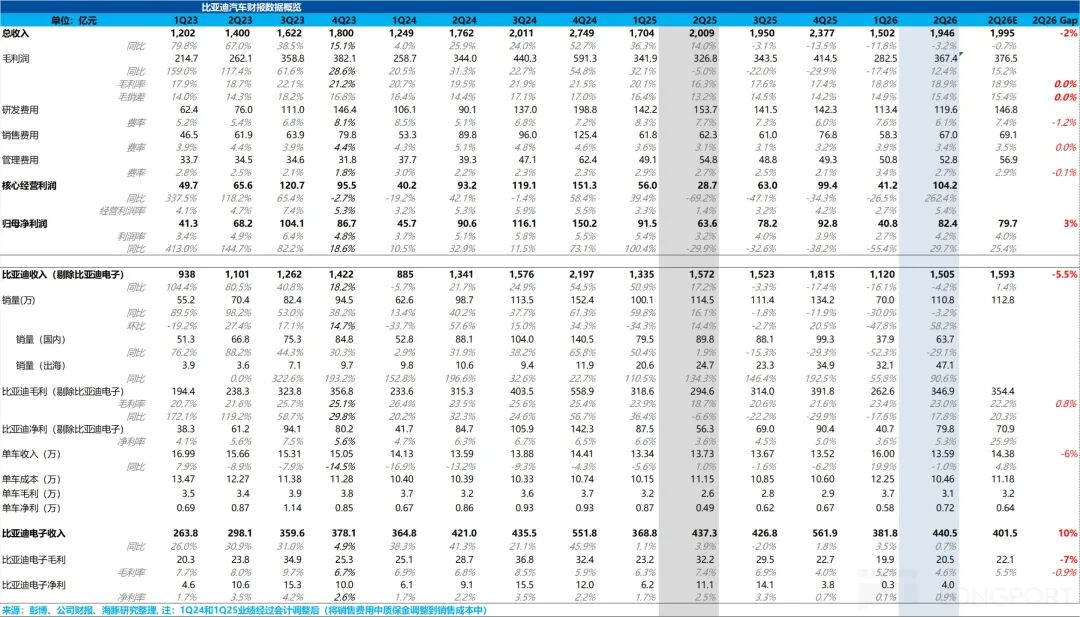
1) Total revenue is slightly lower than expected, mainly due to the lower-than-expected average selling price of vehicles: In Q2, BYD's total revenue reached 194.6 billion yuan, continuing to decline by 3% year-on-year, which is lower than the market expectation of 199.5 billion yuan, mainly due to the lower-than-expected average selling price of vehicles.
2) The average selling price of vehicles dropped sharply month-on-month, and the structural dividend was diluted periodically: In Q2, BYD's average selling price of vehicles was 136,000 yuan, down 24,000 yuan month-on-month, which was also lower than the previous market expectation of 144,000 yuan.
The month-on-month decline in unit price is mainly dragged down by three factors:
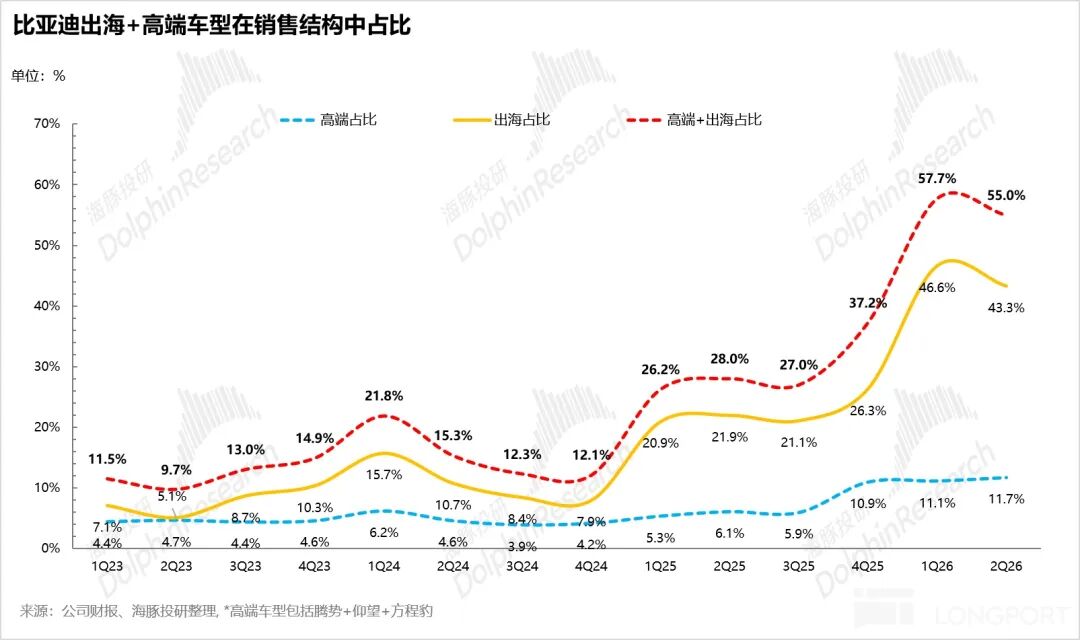
a. The proportion of export sales dropped by 3.3 percentage points month-on-month to 43.3%, diluting the high ASP structural dividend of overseas models;
b. High-priced fast-charging models failed to effectively drive the overall average price due to the severe shortage of production capacity of the second-generation Blade Battery;
c. Old models offered discounts during the inventory clearance process, which periodically dragged down the overall average price.
3) The gross profit margin of vehicle sales shows strong resilience, and the cost reduction effect successfully offsets the decline in unit price: The market previously worried about the rise in upstream raw material costs and expected the gross profit margin of the automotive business to drop to 22.2% in Q2. However, the actual gross profit margin of the automotive business in Q2 reached 23%, with a slight month-on-month drop of only 0.4 percentage points, performing better than expected, which is mainly attributed to the sharp drop in per-vehicle cost (down about 18,000 yuan month-on-month to 105,000 yuan).
The scale effect brought by the increase in total sales shared the fixed costs, combined with the significant cost reduction brought by the self-developed second-generation battery and fast charging technology (for example, the Seal 06 pure electric version uses 10 kWh less power to reduce the cost by about 7,000 yuan), effectively hedging the pressure of the decline in the average selling price of vehicles.
4) Per-vehicle net profit continues to rise month-on-month, and the core operating profit of the main business rises sharply: Against the background of a slight month-on-month drop in gross profit margin, the per-vehicle net profit in Q2 is about 7,200 yuan, an increase of about 1,400 yuan compared with Q1.
This is mainly due to the release of the leverage effect brought by the increase in sales volume and the relatively reasonable control of R&D expenses (down 22% year-on-year to 12 billion yuan). From the indicator that best reflects the quality of the main business, the core operating profit per vehicle in Q2 is about 9,000 yuan, much higher than the about 3,000 yuan in the same period last year.
Dolphin Research View:
Overall, BYD's performance this quarter is generally acceptable. The revenue from vehicle sales declined more than expected due to the slight drop in the proportion of exports and the fact that high-ASP fast-charging models have not yet reached volume due to production capacity constraints. However, with the release of scale effect and the cost reduction of self-developed second-generation batteries, the gross profit margin of vehicle sales only dropped slightly month-on-month, which is higher than market expectations.
The per-vehicle net profit also increased by about 1,400 yuan month-on-month to about 7,200 yuan under the release of the sales leverage effect and reasonable control of R&D expenses.
Looking at BYD's whole year of 2026, its model strategy mainly focuses on the following three aspects:
① Reshape the competitiveness of pure electric vehicles with "long range" and "ultra-fast charging"
BYD is trying to achieve the energy replenishment experience of "same refueling speed for oil and electricity" through technological iteration (it only takes 5 minutes to replenish 10%-70% of power at room temperature, and 9 minutes for 10%-97%). On the basis of 5% higher energy density, the second-generation Blade Battery, combined with the full-domain 1000V high-voltage platform and high-efficiency motor, achieves a step-up in cruising range (for example, the pure electric cruising range of Denza Z9GT exceeds 1036 kilometers).
At the same time, BYD is supported by aggressive infrastructure and marketing strategies (planning to build 20,000 fast charging stations by the end of 2026 and giving 1-year free fast charging rights). More critically, the 6C-level fast charging technology is systematically deployed to the 150,000-200,000 yuan main models (such as Song Ultra EV and Seal 06 EV), directly sniping Geely and Xpeng's layout in the 800V sinking market.
In addition, the pure electric range of plug-in hybrid models (such as Song Pro DM-i) is also approaching the 200-kilometer level, and the cruising range of BYD's 2026 models is expected to increase significantly.
② "Equal access to intelligent driving" continues to sink
To make up for its shortcomings, BYD's intelligent strategy has clearly shifted to "self-research of hardware and software" to reduce dependence on external suppliers and master technological autonomy and cost advantages:
a. Self-developed intelligent driving chip released: BYD released China's first 4nm vehicle-grade intelligent driving chip "Xuanji A3", with a single chip computing power of 700TOPS, and the total computing power of three-chip cluster exceeds 2100TOPS, supporting L3/L4 level autonomous driving. It has started mass production, marking that BYD has achieved full-stack self-research on the core hardware of intelligent driving.
b. Major algorithm upgrade - God's Eye 5.0: Adopting reinforcement learning + end-to-end architecture, adding world model simulation, which can handle complex scenarios such as urban villages, temporarily parked vehicles, narrow road U-turns, and construction diversion, realizing a generational leap in intelligent driving capabilities.
c. Equal access to urban intelligent driving: Yangwang is standard equipped with God's Eye A, Denza is standard equipped with God's Eye B; some models of Fangchengbao, Dynasty and Ocean series are standard equipped, and other models can choose to install God's Eye B (upgrade price 12,000 yuan); low-cost models such as Dolphin (starting from 68,900 yuan) can also be equipped with God's Eye C (upgrading the map-free end-to-end algorithm to achieve quasi-urban pilot, pushing the experience version in September, and full release in December).
d. Industry-first intelligent driving guarantee policy: BYD promises that within 1 year, for accidents caused by urban assisted driving of God's Eye A/B users, BYD will fully compensate the economic losses that should be borne by the vehicle (including own vehicle maintenance, third-party property loss, personal injury), with no upper limit on the compensation amount, and it will not affect future insurance premiums.
③ Accumulate strength for DM 6.0 to defend the basic market of plug-in hybrid vehicles
According to industry chain research, the thermal efficiency of the new generation DM 6.0 platform is expected to exceed 48%. With the support of variable flux motors, not only the comprehensive cruising range with full fuel and full power is further improved, but the fuel consumption in power loss state is expected to drop to 1.8-2.79L/100km (a substantial optimization compared with 2.9L/100km of DM 5.0 in 2024). However, since this technology is most likely to be released in the second half of 2026, it cannot provide timely help for the current pressure on plug-in hybrid sales in the short term.
Dolphin Research believes that in view of the long construction cycle of the supercharging network, the reduction of purchase tax, and the new national subsidy policy tilting to mid-to-high-priced models above 167,000 yuan (which is extremely unfavorable to BYD's absolute main models priced at 100,000-150,000 yuan), the domestic basic market is facing great challenges.
Combined with the pricing of the previous press conference, BYD's strategy on its main models below 200,000 yuan has shifted to "protect profits and stabilize the basic market", and has not adopted the aggressive "price war" strategy of the past.
Dolphin Research expects that BYD's domestic sales in 2026 will hardly achieve a reverse high growth. Therefore, under the neutral assumption, it is expected that domestic sales will continue to decline by 20% year-on-year to 2.85 million units (1H26 down 40% year-on-year to 1.02 million units, and 2H26 is expected to pick up with the release of second-generation battery production capacity and the release of DMI 6.0).
Against this background, the overseas market has become the biggest performance support and highlight in 2026:
Overseas business continued to sell 470,000 units in the single quarter of 2026 Q2, still contributing a high 43% of sales. More importantly, the ASP and gross profit margin overseas are far higher than those in China, making it a real "profit ballast":
BYD has placed "overseas expansion" at the core strategic position in 2026. The company once again raised its export target of 1.5 million units at the beginning of the year to 1.7-1.8 million units (the actual figure is expected to sprint to 1.9 million units). Under the neutral expectation of Dolphin Research, the overseas sales target is 1.8 million units (up 74% year-on-year).
Finally, BYD's total sales volume in 2026 is 4.65 million units, only up 1% year-on-year. Based on the expectation of 3,500 yuan per vehicle net profit in China and 13,000-14,000 yuan per vehicle net profit overseas.
It is expected that there is limited upward space for the company's value at present, and the space to truly open the ceiling in the future still highly depends on the release of its overseas localized production capacity and whether the overseas per-vehicle net profit can exceed expectations.
PS: BYD is a company with a complex business structure, covering automobiles, mobile phone parts and assembly, secondary rechargeable batteries and photovoltaics. However, the in-depth articles on BYD completed by Dolphin Research in July last year "BYD: The Automaker Best at Making Batteries" and "BYD: After the Soaring, Seek Stability for Prosperity" have helped you find the core. There are too many and complicated businesses, but the core still depends on the automotive business. If you need to understand this company, you can first go back to the above two analyses.
The following is a detailed analysis
I. Automotive gross profit margin rises against the trend: Overseas expansion is not only a "lifebuoy", but also a "profit ballast"
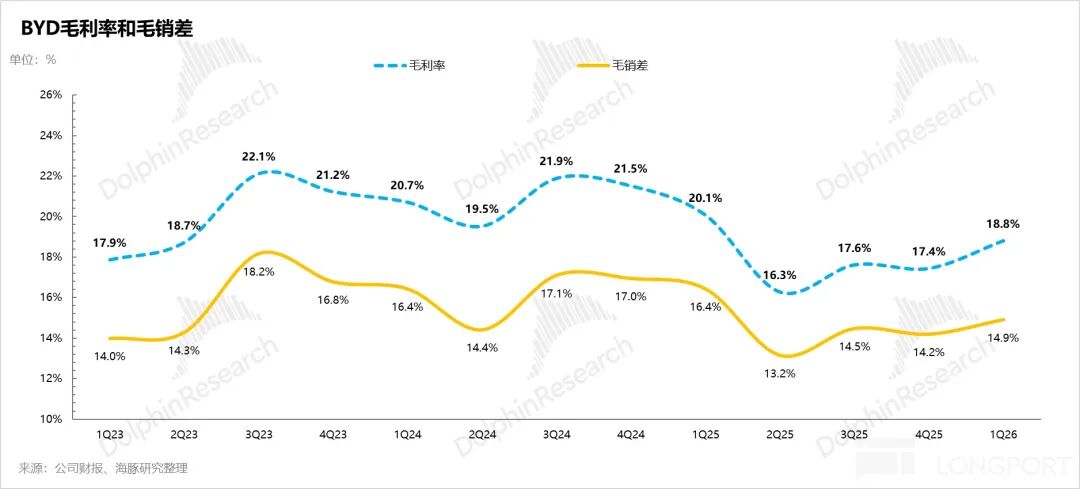
Every time the performance is released, the market is still most concerned about the gross profit margin of BYD's automotive business. When Q2 sales volume increased by 58% month-on-month to 1.11 million units, the market previously expected the gross profit margin of the automotive business to be about 22.2% (down 1.2 percentage points month-on-month), mainly worrying about the squeeze on gross profit margin caused by the rise in upstream raw material costs.
The actual gross profit margin of the automotive business in Q2 was 23%, with a drop of only 0.4 percentage points month-on-month, which mainly came from the sharp drop in the average selling price of vehicles, while the cost of vehicle sales was still declining.
From the perspective of per-vehicle economy:
1) Average selling price of vehicles: sharp month-on-month decline
The average selling price of vehicles this quarter is 136,000 yuan, down 24,000 yuan month-on-month, which is also lower than the previous market expectation of 144,000 yuan. The core reasons are:
a. The proportion of exports declined month-on-month, and the structural dividend was diluted: The export proportion in Q1 was as high as 46.6%, but domestic sales in Q2 increased by 68% month-on-month to about 640,000 units, and the export proportion then fell by 3.3 percentage points month-on-month to 43.3%. Combined with the dilution of the high ASP/high gross profit structural dividend of export models, the overall average price was dragged down.
b. High-ASP fast-charging models are limited by production capacity, and the proportion of low-priced models increases: After the release of fast charging technology in March, orders surged, but the production capacity of the second-generation Blade Battery was severely insufficient - the production capacity in June was less than 100,000 units per month, with a monthly climbing rate of only about 20,000 to 30,000 units. Fast charging models (priced generally above 150,000 yuan, up to above 250,000 yuan) have higher pricing, but limited by production capacity, the penetration rate in Q2 is still low, which fails to effectively drive the overall ASP.
c. Old models are still clearing inventory and offering discounts: The release rhythm of new cars in 2026 is slower than that in early 2025. The core is to prioritize the clearance of old inventory in terminal channels and avoid simultaneous promotion of new and old models in stores. During the inventory clearance process, the proportion of old model sales increased periodically, which also dragged down the average price.
2) Per-vehicle cost: scale effect release and technological cost reduction
In Q2, BYD's per-vehicle cost was about 105,000 yuan, down about 18,000 yuan month-on-month. The main driving factors are as follows:
a. Scale effect release: BYD's total sales volume in Q2 reached 1.11 million units, up 58% month-on-month, mainly because domestic sales got out of the trough in Q1 (up 69% month-on-month to about 640,000 units), and overseas sales continued to increase (up 46% month-on-month to about 470,000 units). The total sales volume rebounded sharply month-on-month, leading to a decline in fixed costs such as depreciation and amortization allocated per vehicle.
b. Self-developed second-generation battery + fast charging technology reduces cost: Fast charging technology brings significant energy consumption reduction. Taking the Seal 06 pure electric version as an example, with the same 605km CLTC range, the power capacity was 79 kWh last year, and only 69 kWh after using the second-generation Blade and fast charging technology this year, reducing 10 kWh of electricity, corresponding to a cost reduction of about 7,000 yuan (the comprehensive estimate after deduct