A post-1970s man in Guangzhou who sold AI employees lost 1.26 billion yuan over 10 years.
A company that helps people save money loses money every year itself.
Over the past 10 years, Jinzhiwei has "recruited" more than 2 million AI employees for enterprises who require no salary, no leave, and no occupied workstations.
Now, the company itself is seeking financing on the Hong Kong Stock Exchange: as of the end of June 2026, its cumulative losses over ten years amounted to 1.259 billion yuan.
Why is selling AI not profitable?
- 01 - Top of the industry, poor financial statements
The founder of Jinzhiwei is Liao Wanli, a post-70s native of Guangzhou.
In 1993, he graduated from the Department of Computer Science, Hangzhou Dianzi University, joined the Science and Technology Department of Zhuhai Branch of Agricultural Bank of China, and developed bank transaction systems.
In 2001, he gave up his stable job and moved to Beijing, working as a project manager in a company specializing in bank system integration and counter development. Due to his excellent work ability, he was promoted to deputy general manager after only 10 months on the job.
In 2005, Liao Wanli started his first business, developing audit software.
In 2016, Liao Wanli founded Jinzhiwei in Zhuhai.
Jinzhiwei initially focused on RPA.
RPA can be understood as an obedient but not very smart "electronic intern": it copies spreadsheets, enters data, checks accounts, logs in to different systems and clicks back and forth. As long as the process is specified in advance, it can repeat the work tirelessly.
After the emergence of large models, the "electronic intern" began to get promoted.
In 2021, Jinzhiwei launched the K-APA digital employee platform; in 2025, it launched the Ki-Agent enterprise-level intelligent agent platform.
The latter is no longer just mechanical clicking. It can understand tasks, plan steps, call tools, and complete work across different software systems.
By June 2026, Jinzhiwei has deployed more than 2 million AI digital employees in total, served more than 1,600 customers, and covered the six major state-owned banks and more than 90% of domestic securities companies.
Its market share has ranked first for three consecutive years.
It sounds quite impressive. But looking at the prospectus, the figures are not optimistic.
- 02 - How does it make money? Project-based model, like moving bricks
Its revenue rose from 217 million yuan to 256 million yuan in three years, with a compound annual growth rate of only 8.7%, while the industry growth rate in the same period was 37.1%.
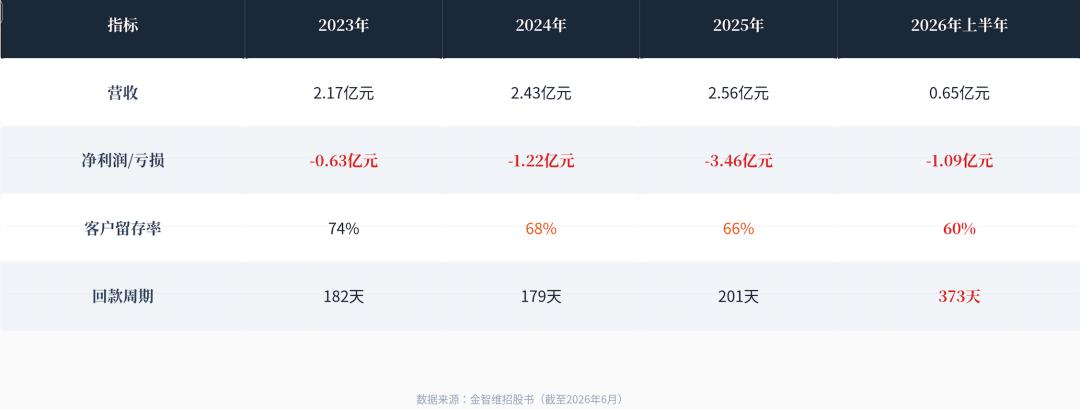
The industry leader cannot outperform the average growth rate of the industry, which in itself speaks volumes.
The problem lies in its revenue structure:
More than 70% of Jinzhiwei's revenue comes from project-based business. What does that mean? It means that customization is required for each customer — sending personnel to on-site stations, connecting with old systems, adjusting processes, and completing acceptance checks. Each project takes 6 to 9 months on average.
The gross profit margin of the project-based model is only 40.3%, while that of the subscription model is 96.3%. One is like moving bricks, the other is like printing money. But the subscription revenue accounts for only 16.8% and is still declining.
This forms a vicious cycle: to achieve growth, the company has to take on more projects; to take on more projects, it has to recruit more staff; more staff leads to higher costs, and higher costs further squeeze profits.
"The biggest problem with AI enterprise services is that the cost of educating customers is too high, which is essentially the exorbitant sales cost," said Yi Tao, an AI technology blogger.
He observed an absurd phenomenon: in the past, enterprises would pay hundreds of thousands or millions of yuan for a SaaS project; now when AI companies send FDE (Frontline Deployment Engineers) to the site, the project value is often only tens of thousands or more than 100,000 yuan. However, the unit customer price has dropped, but the labor cost has not — you still have to send engineers, sales staff and technical support personnel.
This is not the dilemma of Jinzhiwei alone. IDC data shows that in 2024, the service revenue of China's RPA+AI market reached 1.63 billion yuan, exceeding the product revenue of 1.53 billion yuan.
Customers buy AI to reduce their staffing; but AI companies have to send a group of people out first in order to sell their AI products.
- 03 - Where does the loss come from? Three major expenses eat up all the revenue
Nearly ten years since its establishment, Jinzhiwei has lost a total of 1.259 billion yuan, burning more than 100 million yuan on average every year.
Where did the money go? Look at the expense structure:
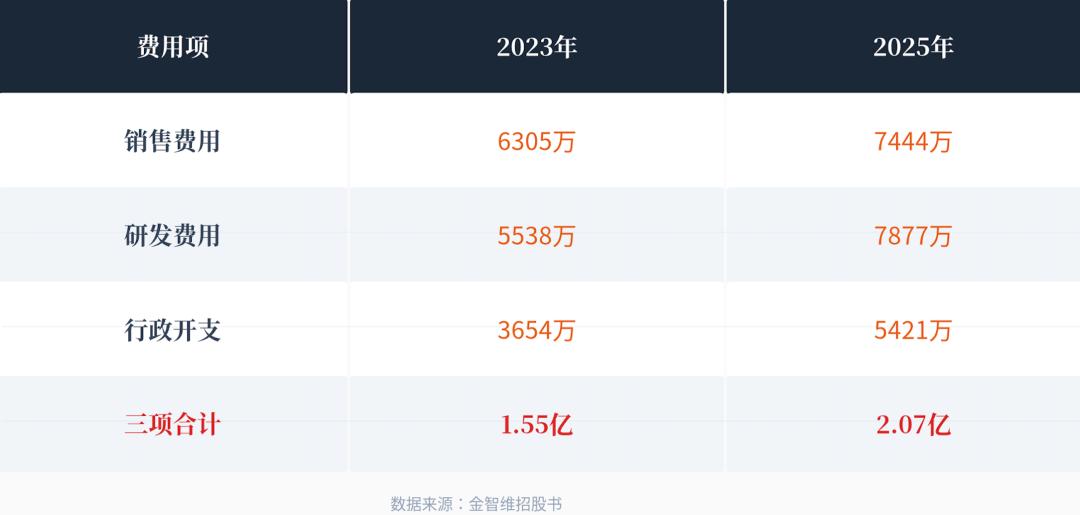
In 2025, the revenue was only 256 million yuan, but the three major expenses ate up 207 million yuan. Coupled with other costs, it is no wonder that the company is losing money.
Operational data is also deteriorating:
Number of customers: 781 at the end of 2025 → 439 in mid-2026, nearly half lost in half a year;
Retention rate: dropped from 74% to 60%;
Payment collection cycle: extended from 137 days to 446 days — it takes nearly a year and a half to get the payment back after finishing the work;
Why do customers leave? A reasonable inference is that after the AI project goes online, the ROI fails to meet expectations, so customers do not renew their contracts.
This is also the status quo of the entire industry.
A survey by McKinsey in August this year clearly shows that 80% of employees feel that AI has improved their efficiency, but only 37% of business owners believe that AI has made a positive contribution to the profit statement.
Employees find it easy to use, but the owners see no returns.
BCG surveyed 115 corporate executives, 75% of whom hope service providers participate in the construction and implementation of key scenarios — but nearly 60% of enterprises said that projects including intelligent agents have not yet brought measurable cost improvements.
- 04 - The next pot of gold: don't sell AI, sell results
Yi Tao has a judgment: the real big business of enterprise AI in the future is neither selling accounts, nor selling solutions, nor doing customization — but to help customers achieve results first, and then share the proceeds from the results.
That is to earn "incremental revenue".
The most profitable group of platforms on the Internet in the past two decades are essentially not just selling software to merchants. Taobao helps merchants get orders, Meituan helps restaurants get customer flow, and Ctrip helps hotels sell rooms.
The platform creates increments first, and then shares the proceeds from new transactions.
ZeroX Technology has been doing RaaS (Result as a Service) since 2019, not selling software subscriptions, but only delivering sales results.
In the insurance sector, it helped leading institutions generate more than 2 billion yuan in new premiums — the same business volume would require a sales team of 800 to 1000 people with the traditional model. The company has achieved large-scale profitability in 2024.
Tianrun Cloud, Bairong Cloud, and Ant Digital Technology have also launched products that are paid based on results.
The survey data from BCG is very interesting: on the demand side, more than 70% of enterprise decision-makers prefer the charging method linked to "output" or "result"; on the supply side, about 60% of AI service providers still charge by man-days or fixed project prices.
The demand has changed, but the supply has not kept up — that is where the opportunity lies.
In the past, when you sold AI customer service, you quoted 1 million yuan a year; in the future, customers will ask: don't tell me how much it costs a year, tell me how many work orders you can handle.
In the past, AI sales were charged by accounts; in the future, it may become: how many valid leads do you find for me? How many transactions do you bring?
Gartner specifically mentioned in August this year: after AI Agent truly undertakes business work, software pricing needs to shift from the traditional "per-seat charging" model to charging based on measurable business activities or even business results.
How big is the opportunity?
IDC says that China's enterprise-level AI Agent market will reach 21.2 billion yuan in 2025, is expected to hit 44.9 billion yuan in 2026, and will reach 332 billion yuan by 2029, with a compound annual growth rate of nearly 100%.
The global total expenditure on enterprise AI Agent is expected to reach 1.4 trillion US dollars by 2027.
But the money will not be distributed evenly.
All scenarios where ROI has been realized have a common feature: clear task boundaries, highly standardized processes, quantifiable results, and closed-loop data feedback.
Customer service is the fastest to get return — Bain data shows that the median payback period is only 4.1 months.
The financial sector is the deepest in implementation — JPMorgan Chase achieved a 20% gross sales growth in its private banking business after deploying Agent.
AI programming has the highest penetration rate — GitHub Copilot generates 46% of new code.
For Jinzhiwei, the problem is also very clear: 2 million digital employees are an achievement, but how to move from "selling projects" to "selling results", from "moving bricks" to "printing money" will determine its position in the next ten years.
This article does not constitute any investment advice.
This article is from the WeChat Official Account "Pencil News" (ID: pencilnews), written by Pencil News, and published with authorization from 36Kr.