Cisco has equipped 90,000 employees with personal Agents that remember everything about you and can handle cross-system tasks on your behalf.
A Cisco employee may no longer need to open Outlook, Webex, Jira and SharePoint in sequence, sift through emails, find files, create tasks, and then notify relevant colleagues manually.
They only need to tell an AI what result they expect, and the AI will determine which systems to call, what information to look for, and in what order to advance the remaining steps.
Cisco Equips 90,000 Employees with "Digital Twins"
On August 27 local time, Cisco announced that it has begun to deploy MyAgent, a personal AI Agent, to approximately 90,000 employees worldwide.
Thimaya Subaiya, Executive Vice President of Operations at Cisco, stated on X that this is not a small-scale pilot, but a full official rollout covering all employees. This Agent is built for all Cisco employees, and he himself has learned a lot in the process of experiencing the Agent. For example, the top priority when he first used it was security and trust.

The Wall Street Journal calls it one of the earlier company-wide personal Agent deployment cases among large enterprises.
In fact, if you only look at the figure of "90,000 people using AI", it is not unprecedented.
JPMorgan Chase's internal generative AI platform LLM Suite has covered 200,000 employees within eight months. In addition, Walmart is also providing different types of AI tools to a larger group of frontline employees.
What makes MyAgent more noteworthy is that Cisco is trying to transform internal AI from a chat box that employees actively open to an execution entry that can continuously memorize, call tools across systems, and advance tasks in the background.
Cisco describes MyAgent as moving from chat-based interaction to supervised autonomous execution.
So what is the origin of this MyAgent?
According to public information, MyAgent is not delivered by an external model company, nor is it an independently trained large model. It is a "super Agent" developed internally by Cisco, jointly built by Cisco's operation system, Cisco IT, Automation and AI Center and other teams, and the underlying layer reuses Circuit, the internal AI platform that Cisco has been building since 2023. The core team of Circuit has about 40 people, with multiple business departments participating in the development together.
Review of Cisco AI Assistant Adoption Journey
In the internal AI assistant architecture review released by Cisco in November 2025, it was mentioned that in April 2023, Cisco launched the first generation of internal generative AI assistant. At that time, ChatGPT had already begun to spread among employees, and Cisco was worried that employees would directly input internal data, customer information and personal identifiable information into public AI services. Therefore, the first-generation system did not solve the Agent execution problem first, but "how to enable all employees to use large models securely".
This version mainly runs on the Azure OpenAI model. Eight months after its launch, only about 30% of employees used it, most of whom were technical staff. Cisco then began to redesign the interface and access internal IT, sales, product and employee service data.
Later, Cisco upgraded the original internal assistant to Circuit.
Circuit is no longer bound to Azure OpenAI, but a multi-model, governed internal AI platform. It can access: Azure OpenAI, Anthropic Claude, Google Gemini, Cisco's self-developed Deep Network Model, other open-weight models, internal Agents developed by Cisco's various business teams, and traditional software automation tools.
The platform automatically routes requests based on task type, cost, latency, reliability and model capabilities.
Employees see the same entry, but the background may not call cutting-edge large models at all: simple, deterministic operations can be handed over to traditional automation; conventional language tasks can be handled by local open-weight models; only complex reasoning tasks need to call external models with stronger capabilities and higher costs.
Circuit has also established an enterprise-level Agent Registry and MCP Registry. Agents, connectors and MCP Servers developed by various Cisco teams can be registered into a unified directory, and then called by other systems after identity, permission and security reviews.
As of the data disclosed by Cisco in 2025, this platform has processed more than 45 million interactions, with an average of about 156,000 interactions per day, which has significantly improved efficiency. 73% of users reported increased productivity, saving an average of 5 hours per week.
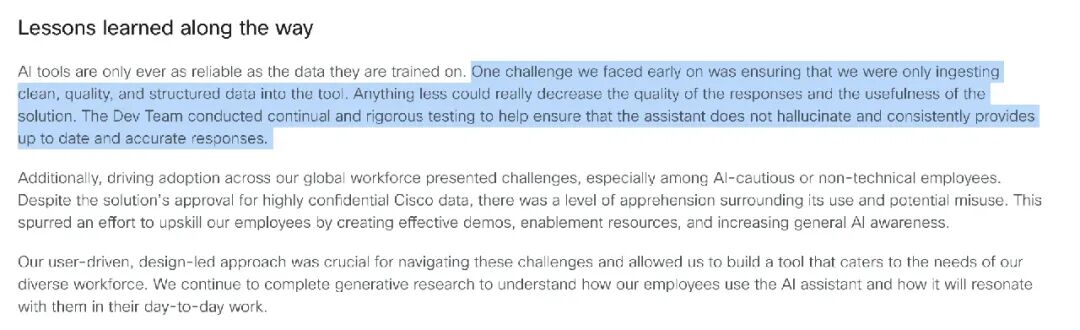
Cisco said that in the process of adopting the AI assistant, they also encountered some challenges. They mentioned:
"The reliability of AI tools depends entirely on the quality of their training data. One of the challenges the team faced in the early stage was to ensure that only clean, high-quality and structured data was input into the tool. Any data below this standard could seriously reduce the quality of responses and the practicality of solutions. The development team conducted continuous and rigorous testing to ensure that the assistant did not make mistakes and always provided up-to-date and accurate responses. In addition, promoting the application of this solution among global employees also faced challenges, especially among those employees who are cautious about AI or lack technical background. Although the solution has been approved for processing Cisco's highly confidential data, employees still have concerns about its use and potential abuse risks. This prompted us to make efforts to improve employee skills, including creating effective demonstrations, providing empowering resources, and raising employees' overall awareness of AI."
Therefore, after more than two years of practice, Cisco launched MyAgent on top of Circuit in 2026. MyAgent is the result of Circuit's evolution from a "model entry" to an "action entry".
Circuit is more like an internal enterprise AI platform that provides employees with models, knowledge bases, search, Agents and connectors, while MyAgent is further oriented to individuals, organizing these capabilities into a super Agent that accompanies employees for a long time.
It adds several important capabilities:
Persistent memory: retain employee preferences, past interactions and work context;
Intent-driven: employees provide goals instead of specifying every step in detail;
Cross-system execution: coordinate tasks across multiple enterprise applications;
Background operation: continue to advance even after employees leave the chat window;
Personalized permissions: obtain data according to the enterprise permissions already granted to the corresponding employee;
Sub-Agent calling: call back-end professional Agents according to tasks.
According to The Wall Street Journal citing Executive Vice President of Operations Thimaya Subaiya, MyAgent does not directly complete all tasks by itself. It is more like a chief dispatcher, connected to more than 800 professional Agents in the background. About 50% to 60% of AI requests are processed by open-weight models, about 20% to 30% are processed by traditional software automation, and only a very small part of the remaining requests need to call external foundation models. Cisco also runs open-weight models on GPUs in its own data centers.
So what exactly can MyAgent do in business scenarios? How should it be used?
According to Cisco's introduction, employees no longer input only specific instructions, but goals, context and expected results. MyAgent will then determine the steps required to achieve the goals, coordinate work between applications such as Outlook, Webex, Jira, SharePoint, and continue to advance in the background under appropriate human supervision.
For example, when facing an abnormal project progress, employees do not necessarily have to retrieve emails, meeting records and Jira tickets separately. The Agent can aggregate information from different systems, find the source of deviation, draw conclusions, and then prepare follow-up notifications. Scenarios listed by Subaiya to The Wall Street Journal also include organizing inboxes, filtering spam, drafting replies, and aggregating and analyzing market information.
This makes the difference between MyAgent and ordinary Copilot not only reflected in stronger capabilities, but also in the change of working mode: Copilot usually stays in the current software to assist people in completing one step, while MyAgent tries to stand above applications and organize a series of steps according to goals.
Cisco calls this form "ambient intelligence": AI is no longer an independent tool that employees need to frequently switch to, but is hidden in the daily workflow, appears when users need it, and continues to work after users leave the chat window.
One of the key capabilities is persistent memory. Cisco says MyAgent retains users' preferences, historical interactions and context to maintain continuity across multiple interactions.
Strictly speaking, this does not mean that it will "remember everything about the employee" without boundaries. Cisco's current public statement only involves preferences, historical interactions and context, and does not disclose the specific storage cycle of memory, whether employees can view and delete items one by one, and how different types of information are stored hierarchically. But in enterprise scenarios, even this information is enough for the same Agent to gradually understand how a certain employee is used to organizing meetings, which business indicators they pay attention to, and what format they usually use for work reports.
In the past, enterprise software was divided by department: sales personnel enter CRM, R&D personnel enter Jira, communication is done in Webex, and documents are stored in SharePoint. Personal Agents may re-centralize the entry to the "person". The software still exists, but employees do not need to understand the complex interface of each system, they only need to express their intentions.
How to Control Costs?
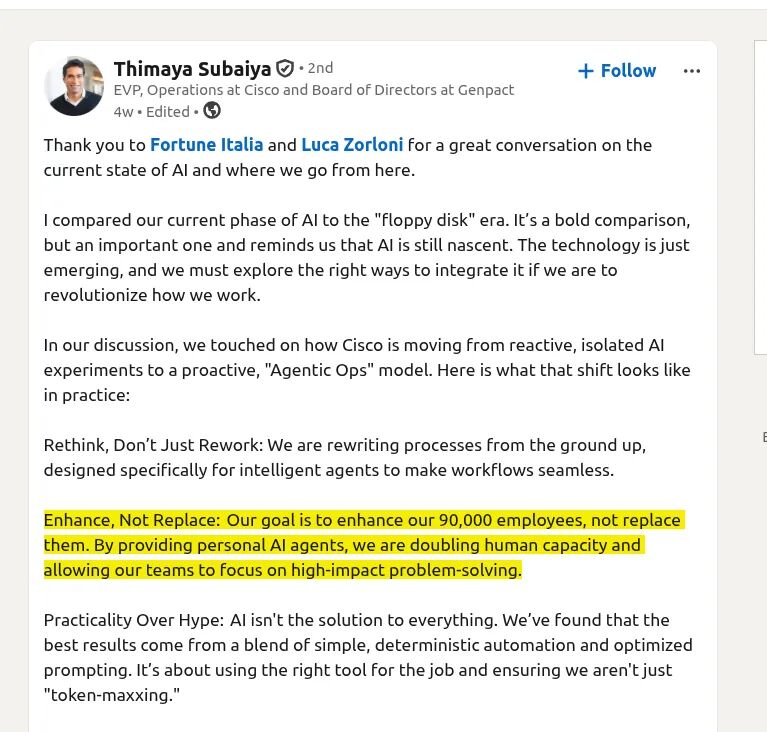
Thimaya Subaiya, Executive Vice President of Operations, posted on LinkedIn that "Cisco is shifting from passive, scattered AI experiments to an active Agentic Ops model, no longer just using AI to improve individual steps in existing processes, but redesigning the entire workflow around intelligent Agents. In this process, Cisco positions MyAgent not to replace 90,000 employees, but to expand employees' capabilities through personal Agents, so that people can focus on issues that require more judgment and have greater impact."
Subaiya also emphasized that AI is not the answer to all problems. Actual deployment should combine large models, deterministic software automation and prompt optimization, select tools with matching capabilities and costs for tasks, instead of blindly pursuing model call volume and Token consumption.
What is reflected behind Subaiya's statement is not only the restraint on the technical route, but also directly related to whether the full-staff deployment can be maintained for a long time.
For a company with 90,000 employees, even a small increase in cost per task will quickly become a non-negligible expense when aggregated across the whole company.
Therefore, another threshold for full-staff Agent deployment must be cost control.
Ordinary chat tools consume Tokens only when employees initiate requests. An Agent that can persistently memorize, continuously read context and execute in the background may need to plan, call tools, verify results and retry multiple times. A seemingly simple task on the surface may generate dozens of model requests behind it.
Cisco has already seen this kind of growth.
The company said that agentic interactions on Circuit have increased by nearly 350% month-on-month. But this figure describes the growth of interaction volume, which is not directly equivalent to productivity improvement, nor does it explain whether the growth comes from the increase of active users or the increase of calls per single task.
In order to control costs, Cisco uses Splunk (acquired via acquisition) to monitor Tokens, and uses an intelligent router to assign tasks to models with sufficient capabilities and lower costs; parts that can be completed by traditional automation are not forced to be handed over to large models.
This is probably the most realistic part of the MyAgent architecture. Enterprise Agents do not let the most powerful model do everything, but take the large model as the planning and judgment layer, and then hand over the steps with high determinism to rules, APIs and traditional automation. Otherwise, 90,000 "always-on" Agents can easily turn the technical vision into an out-of-control computing power bill.
Cisco has provided some latest scaling data.
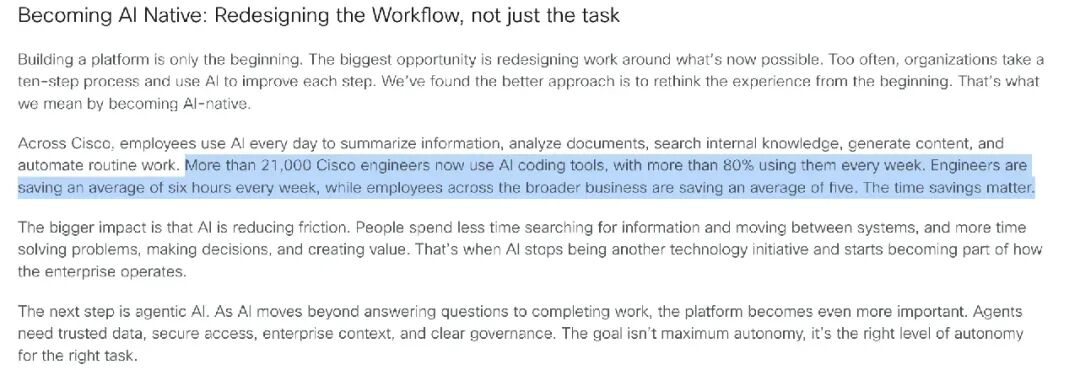
In July 2026, Cisco said that Circuit has reached a 90% employee adoption rate, with more than 21,000 engineers using AI coding tools, of whom more than 80% use them on a weekly basis.
Enterprise AI Begins to Compete for the "Operating System Layer"
Large enterprises are not short of AI assistants.
JPMorgan Chase launched LLM Suite in 2024, which attracted 200,000 employees to use it within eight months. Morgan Stanley's AI Assistant for wealth management advisors has covered about 98% of the advisor team. These cases first solve the problems of secure model access, internal knowledge search and assisted content generation.
MyAgent takes one step further, trying to upgrade the knowledge entry to an action entry.
Once employees get used to describing their goals to a personal Agent first, and then the Agent calls Outlook, Jira or SharePoint, the value focus of enterprise software may change. In the past, software vendors relied on interfaces, workflows and data formats to lock in users. In the future, what employees contact most may not be the underlying applications, but Agents. The original SaaS will gradually retreat to the background providing data, permissions and APIs.
But does this mean that enterprise software will disappear? The author believes that the answer is no.
The more an Agent wants to handle tasks across systems, the more it relies on underlying applications to provide structured data, stable interfaces, permission models and revocable operations. What is really weakened may be the interaction method that requires users to learn and operate repeatedly in every application.
For Cisco, this deployment is not just an internal efficiency project. The team led by Subaiya has long acted as the "zero-number customer" for Cisco's new technologies. The company clearly stated that it hopes to transform internal practices into a blueprint for selling enterprise AI architectures to customers and partners.
After acquiring Splunk, Cisco has observability capabilities, and it already covers network, security, collaboration and data center infrastructure; verifying the connection, governance and cost system of Agents with 90,000 employees is also looking for a model for its external products.
However, whether this model can be established ultimately does not only depend on how many models are connected, how many Agents are registered, or how much the interaction volume has grown.
What really needs to be observed is: how many tasks can be completed in a closed loop without excessive increase of risks; whether employees are willing to entrust their work context to it for a long time; whether errors in the system can be explained and revoked; and whether the time saved can cover the costs of computing power, governance and audit.
In this sense, what Cisco has equipped 90,000 employees with is not a larger chatbot, but an experiment on enterprise control. Whoever can control this new entry point between people and all enterprise systems may master the most important position of the next generation of enterprise software.
For every company, the most difficult question has changed from "whether to use AI" to a more specific one: how much operational power are you willing to delegate to it.
Reference Links:
https://www.wsj.com/cio-journal/cisco-gave-all-90-000-employees-their-own-ai-agent-1a4ad8bc
https://www.reddit.com/r/technology/comments/1w0xy2h/cisco_gives_all_90000_employees_a_personal_ai/
https://blogs.cisco.com/news/my-agent-and-the-rise-of-ambient-intelligence-ciscos-next-step-in-enterprise-ai
https://x.com/search?q=cisco%20agent%20&src=typed_query