Humanoid robots have entered the knockout round.
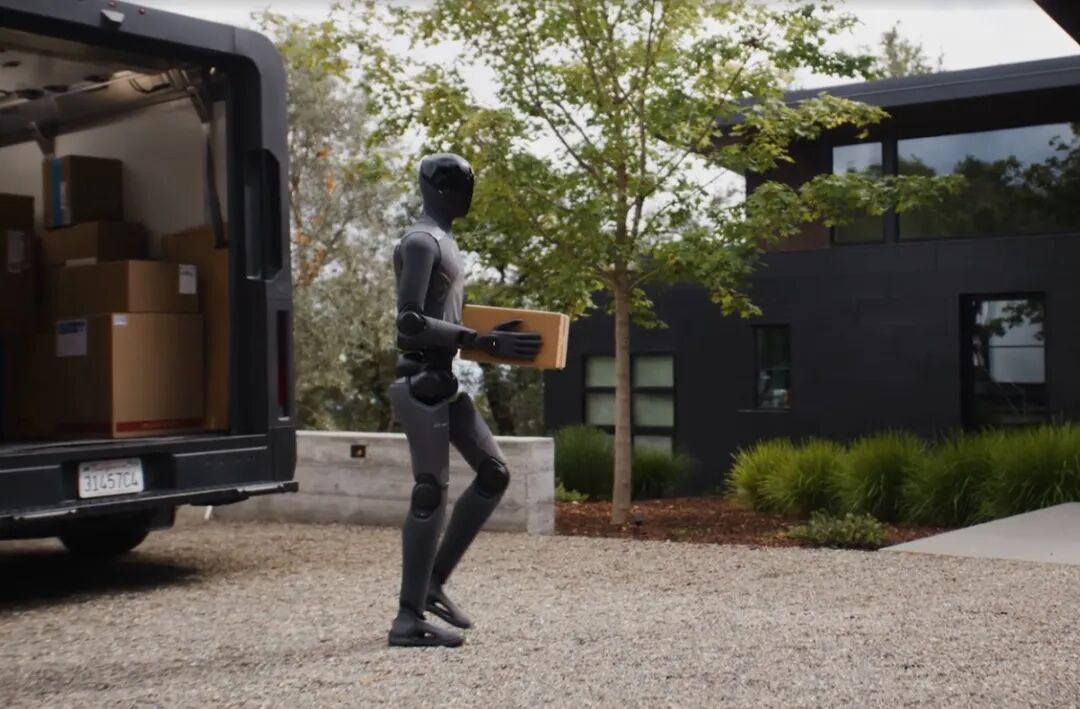
After the AI wave swept across the globe, embodied intelligence has rapidly become the core battlefield of competition in the global technology industry, and humanoid robots are exactly the most high-profile and imagination-rich focus in this competition.
The two grand robot events under the spotlight are clear proof. First, the 2026 World Robot Conference (WRC) held from August 19 to 23, themed "Human-Robot Symbiosis, Industry-Demand Integration", attracted more than 3000 products from 373 enterprises to participate in the exhibition; followed by the 2nd World Humanoid Robot Games (WHRG) held from August 22 to 26, which set up 51 competition events including race, long jump, boxing, etc., with more than 2000 robots from 16 countries participating.
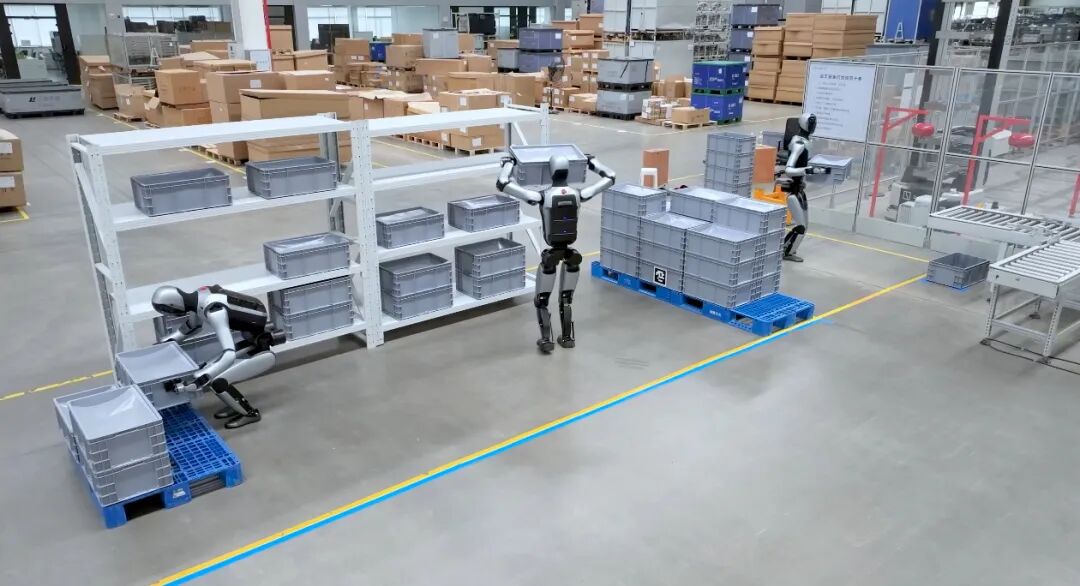
Compared with previous editions, both events put more emphasis on real application scenarios. People are gradually getting used to performance-style demonstrations such as backflips and parkour, and pay more attention to implementable real operations on the exhibition booths such as screw tightening, material handling, and warehouse sorting. Exhibiting enterprises including UBtech, Leju, and Starward Era even replicated the scenarios of robots on factory production lines to the exhibition site at a 1:1 ratio. The Robot Games took scenarios that reflect practical application capabilities as competition events, covering real scenarios such as home services, hotel operation and maintenance, industrial production, supermarket retail, and emergency rescue, to compete for specific tasks such as factory assembly, supermarket picking, and fire rescue.
With the continuous progress of motion control technology, the question of whether humanoid robots can move has become a thing of the past. People's attention has turned to pragmatism and implementation, hoping to see humanoid robots play a human-like role in real scenarios. However, judging from the current performance of robots and limited shipment volume, they are far from reaching the level of mature industrial products.
According to data from research institution Counterpoint Research, in the first half of 2026, the global shipment of humanoid robots exceeded 22,000 units, a year-on-year increase of nearly 300% compared with 2025; the manufacturer with the largest global shipment volume is Agibot (9700 units) with a market share of 43%, followed by Unitree with a 31% share (7000 units), Galaxy Universal with a 5% share (1100 units), UBtech with a 4.4% share (1000 units), and Leju with a 2.9% share (650 units).
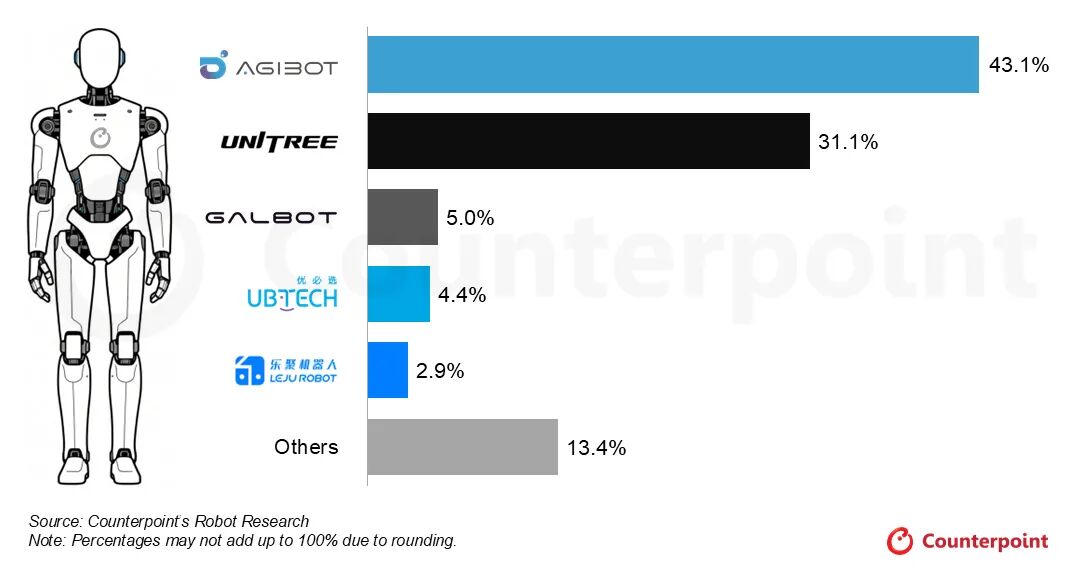
For comparison with the automotive industry, data from research institution GlobalData shows that in the first half of 2026, global light vehicle sales reached about 42.7 million units. The huge gap between 22,000 and 42.7 million indicates that humanoid robots are still in the extremely early stage of the industry, equivalent to the output level of automobiles in the early 20th century. This gap also implies huge imagination space: if humanoid robots can truly replace humans to undertake generalized labor from factories to households, the potential demand will be calculated in units of tens of millions or even hundreds of millions.
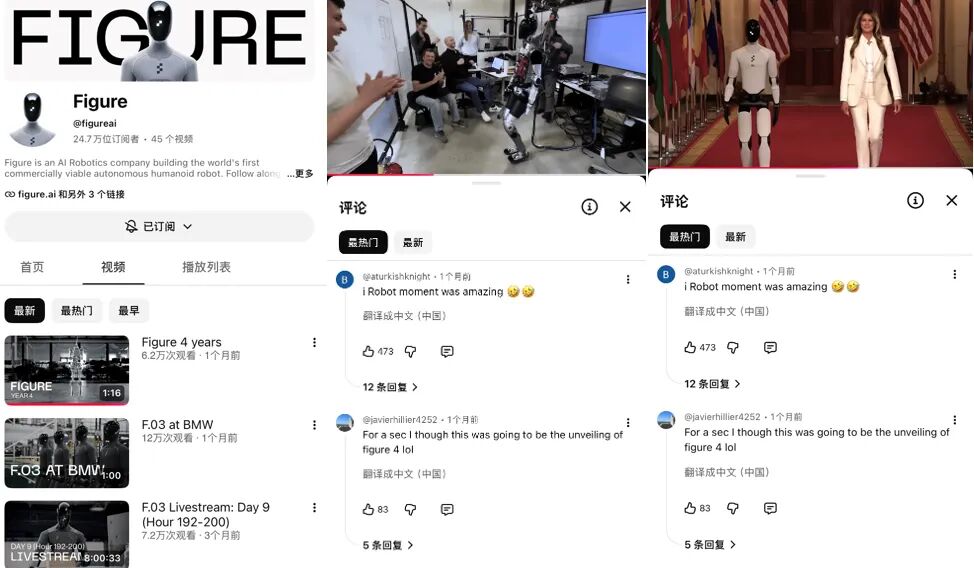
The basis for capital to price the humanoid robot industry is not the annual shipment volume of less than 50,000 units, but the grand story of a potential market size exceeding trillions of yuan. As a result, the market value of leading players in the robot industry is measured in hundreds of billions of yuan — Unitree was listed on the Shanghai Stock Exchange on August 19, with a closing price of 845 yuan per share on the first day, corresponding to a market value of 341.8 billion yuan, and the highest intraday market value reached 444.9 billion yuan. After that, the stock price fell to 585 yuan per share at the close on August 28, with a remaining market value of 236.6 billion yuan; the overseas robot company Figure AI has a valuation of 39 billion US dollars (about 262.1 billion yuan), which is currently the world's highest valuation in the robot track.
Capital will not increase positions forever, optimistic expectations must eventually be implemented, and the extrusion and burst of bubbles have quietly begun. This road is still very long, and the process of fluctuation, pullback and reshuffling cannot be skipped at all.
01
Far from mass production
Even the leading players in the industry with auras have not yet fully obtained market recognition for their commercial closed loops, and their technological maturity has not reached the level required for large-scale implementation.
This is true for both listed UBtech and Unitree. In December 2023, UBtech was listed on the Hong Kong Stock Exchange. Financial reports show that in 2025, UBtech's revenue reached 2.001 billion yuan, a year-on-year increase of 53.3%; among which the revenue from full-size embodied intelligent humanoid robot products and solutions was 821 million yuan, accounting for 41.1%, the revenue from other intelligent robot products and solutions was 628 million yuan, accounting for 31.4%, the revenue from other intelligent hardware devices was 499 million yuan, accounting for 24.9%, the revenue from non-embodied intelligent humanoid robot products and solutions was 47.96 million yuan, accounting for 2.4%, and other business revenue was 4.61 million yuan, accounting for 0.2%.
It should be noted that UBtech's rapid growth is a multiple expansion on a low base. For humanoid robots alone, the delivery volume expanded hundreds of times from 3 units in 2024 to 1079 units in 2025, but the annualized production capacity at the end of 2025 was still only at the level of 6000 units, which has a significant gap from real large-scale production. What cannot be ignored is the loss: according to the financial report, UBtech's net loss in 2024 was 1.16 billion yuan, and its net loss in 2025 was 790 million yuan.
UBtech focuses on manufacturing workshops, and its Walker series industrial humanoid robots have entered the production lines of leading enterprises such as BYD, Geely, Mercedes-Benz, and Foxconn. This route represents strict customer requirements, long deployment cycles, and high customization costs. In the absence of large-scale production, the cost remains naturally high, and there is still a long way to go to profitability.
Then look at Unitree. The financial report shows that in 2025, Unitree's revenue reached 1.699 billion yuan, a year-on-year increase of 332.64%; among which the revenue from humanoid robots was 868 million yuan, accounting for 51.8%, the revenue from quadruped robots was 698 million yuan, accounting for 41.6%, the revenue from robot components was 104 million yuan, accounting for 6.2%, and other business revenue was 6.916 million yuan, accounting for 0.4%.
What is more impressive than UBtech is that Unitree's humanoid robot shipments in 2025 were about 5500 units, and its annual non-net profit after deduction reached 591 million yuan. However, the financial report mentions that more than 90% of Unitree's humanoid robot revenue was sold to scientific research institutions, universities, and technology enterprise customers. In other words, what Unitree delivered is not production tools for factory operations, but hardware platforms that can run, jump, and flip, for university professors to conduct research, technology companies to carry out secondary development, and research institutes to train algorithms. These customers are not sensitive to prices and have low requirements for durability, which are essentially B-end R&D procurement, not real industrial mass production demand.
The fluctuation of stock prices can well reflect the market's different expectations for the two companies. UBtech's issue price is HK$90 per share (about 77.1 yuan), and its closing price on August 28, 2026 is HK$83.5 per share (about 71.6 yuan), with a market value generally stable at the level of HK$40 billion (about 34.3 billion yuan). Unitree's stock price has been declining all the way, closing down for 5 consecutive trading days after listing, and its current market value has evaporated by 200 billion yuan from the highest point.
The valuation of the humanoid robot track, which was previously pushed up by the primary market, is being re-priced in the secondary market. UBtech has long been hovering below the issue price, and the market still has doubts about the profitability prospects of its heavy asset path; Unitree's continuous decline after the first day of listing has also made the outside world more cautious about the expectation-driven valuation logic. The extrusion of bubbles is becoming a systematic valuation reshaping and collective cooling of the entire humanoid robot track.
Even Tesla, which originally has extremely strong production capacity, is limited by various practical technical problems. The mass production time of Tesla's humanoid robot Optimus has been repeatedly delayed. In early 2025, Tesla's founder and CEO Elon Musk vowed to predict that about 10,000 units would be produced by the end of the year; by January 2026, he had to admit that there was not a single Optimus in the factory doing useful work; now the original plan to start the production line in July and August has been blurred in Tesla's second quarter 2026 financial report as expected to start within the year. At Tesla's Q2 2026 earnings call on July 22, 2026, Musk mentioned that this is the most complex manufacturing process in Tesla's history.
02
The generalization problem is difficult to solve
Any emerging industry with revolutionary potential cannot avoid excessive capital pursuit and phased overdraw of valuation in the early stage of development, and the crux of the humanoid robot field lies not only in mass production, but also in intelligence itself.
The enthusiasm comes from the public's excessive expectations for intelligent robots. Influenced by sci-fi film and television works, people easily equate robots with almighty assistants who can clean rooms, take care of the elderly, and repair electrical appliances as soon as they walk into any strange home, but there is still a huge technical gap between reality and ideals, such as the generalization problem often mentioned in the industry.
The so-called generalization, in layman's terms, is the ability to draw inferences from one instance. According to HaiKe Finance, after a robot undergoes sufficient data collection and special training in a fixed scenario, the success rate of completing specific tasks can be close to 100%, but as long as the operated object is replaced or the environment is slightly changed, such as replacing jeans with dresses, replacing the hard charging cable with a soft one, or moving the goods on the shelf from the outside to the inside, the robot's task success rate will drop sharply.
Generalization of a single action is quite difficult, and performing long-horizon tasks is even more difficult. Long-horizon tasks refer to task types that require robots to continuously perform multiple steps, last for a long time, and cope with dynamic changes on the way. Different from single-step operations such as grabbing an object and tightening a screw, long-horizon tasks test the coherence of planning, the ability of self-correction of errors, and continuous memory of the environment. Taking tidying up the room as an example, the robot needs to first identify the scattered clothes and sundries, then judge the ownership of each item, and complete picking, carrying, and placing in turn. If it knocks over a cup halfway, it must adjust the subsequent actions to avoid greater chaos. Any deviation in one link may be gradually amplified in the subsequent steps, eventually leading to the failure of the whole task.
Taking the catering scenario competition of the 2nd World Humanoid Robot Games as an example, according to HaiKe Finance, robots need to complete three consecutive tasks of meal picking, heating, and beverage making in sequence according to on-site voice commands. To break it down, the robot needs to lock the correct meal from the hot food cabinet, hold the food clip to complete the picking, then operate the microwave oven to heat, then pick up the drink and deliver the food smoothly to the delivery area. The final champion is the Galaxy Universal robot operated in full autonomous mode, which finished the race in 6 minutes and 55 seconds without any mistakes throughout the process.
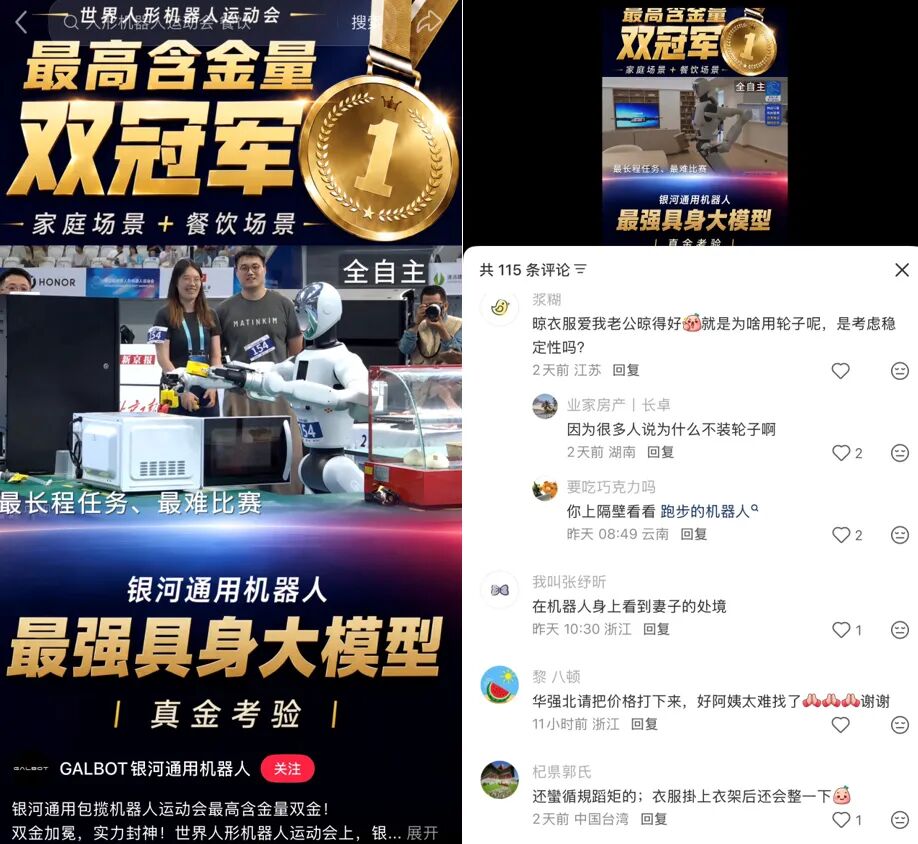
For robots, just operating the food clip is a difficult problem. The food clip cannot be fixedly installed on the manipulator like a special tool. The robot must adjust the clamping force in real time like a human, ensuring that it is clamped stably without dropping due to improper force. Such actions are instinctive for humans, but for robots, they require repeated training of fine control. The efficiency of the 6-minute-55-second championship result also has a gap compared with the real world: ordinary shop assistants may only need one or two minutes to complete the same operation, and the result of nearly 7 minutes is already the answer handed over by one of the world's most advanced fully autonomous robots on the field.
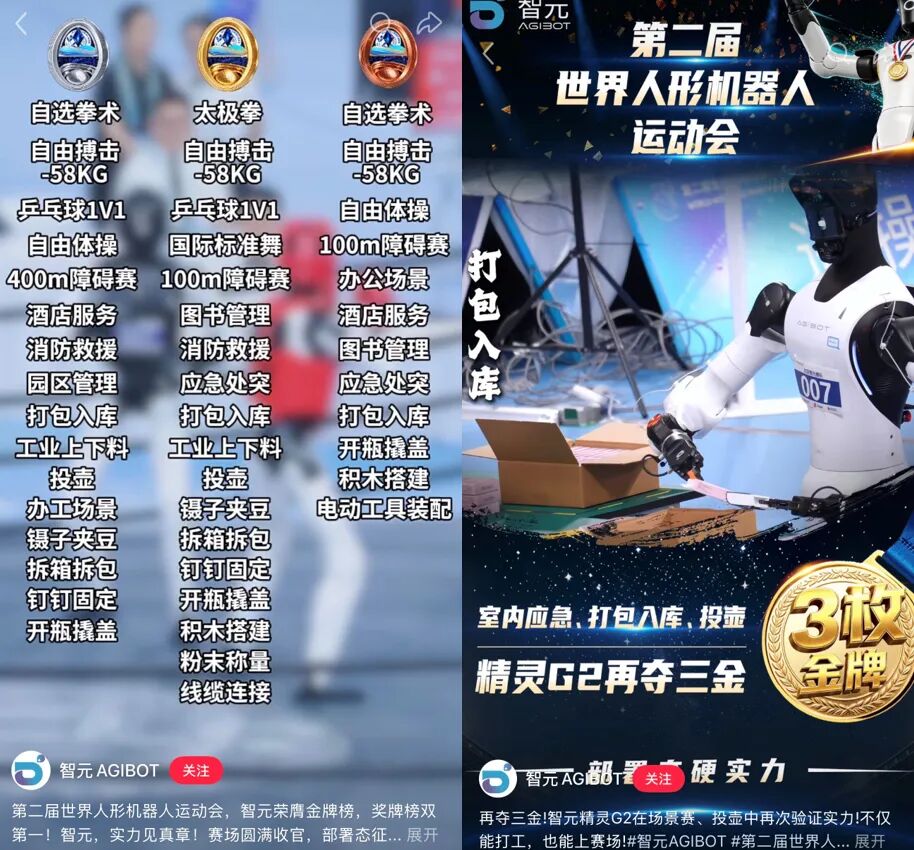
The Agibot robot that won the championship in the packing and warehousing project has a similar situation. This project requires the robot to complete operations such as grabbing and positioning medicine boxes, putting tablets into boxes, folding and inserting flexible instructions, and sealing and closing soft box lids in sequence. Aiming at the difficulty of the soft box lid, the team designed a flexible contact end structure and modified it repeatedly, and finally relied on force control hardware and fine operation capabilities to complete the whole set of tasks, with a championship result of 8 minutes and 32 seconds. Humans may only need two or three minutes for the same task.
More critically, although the competition field simulates the real environment, the objects are placed relatively neatly, the environment changes little, and the task boundaries are clear. The whole is still a standardized scenario. In the real post-meal kitchen or pharmacy, orders are random, moving lines are staggered, and the environment is changeable, whose complexity is far beyond