Crowned double champion at the "Robot Olympics", how was Agibot, the all-rounder with no weak "subjects", forged?
18 gold, 16 silver and 12 bronze medals, ranking first in both the gold medal table and total medal table, this is the performance report submitted by Agibot at its first participation in the 2026 World Humanoid Robot Games, which is known in the industry as the "Robot Olympics".
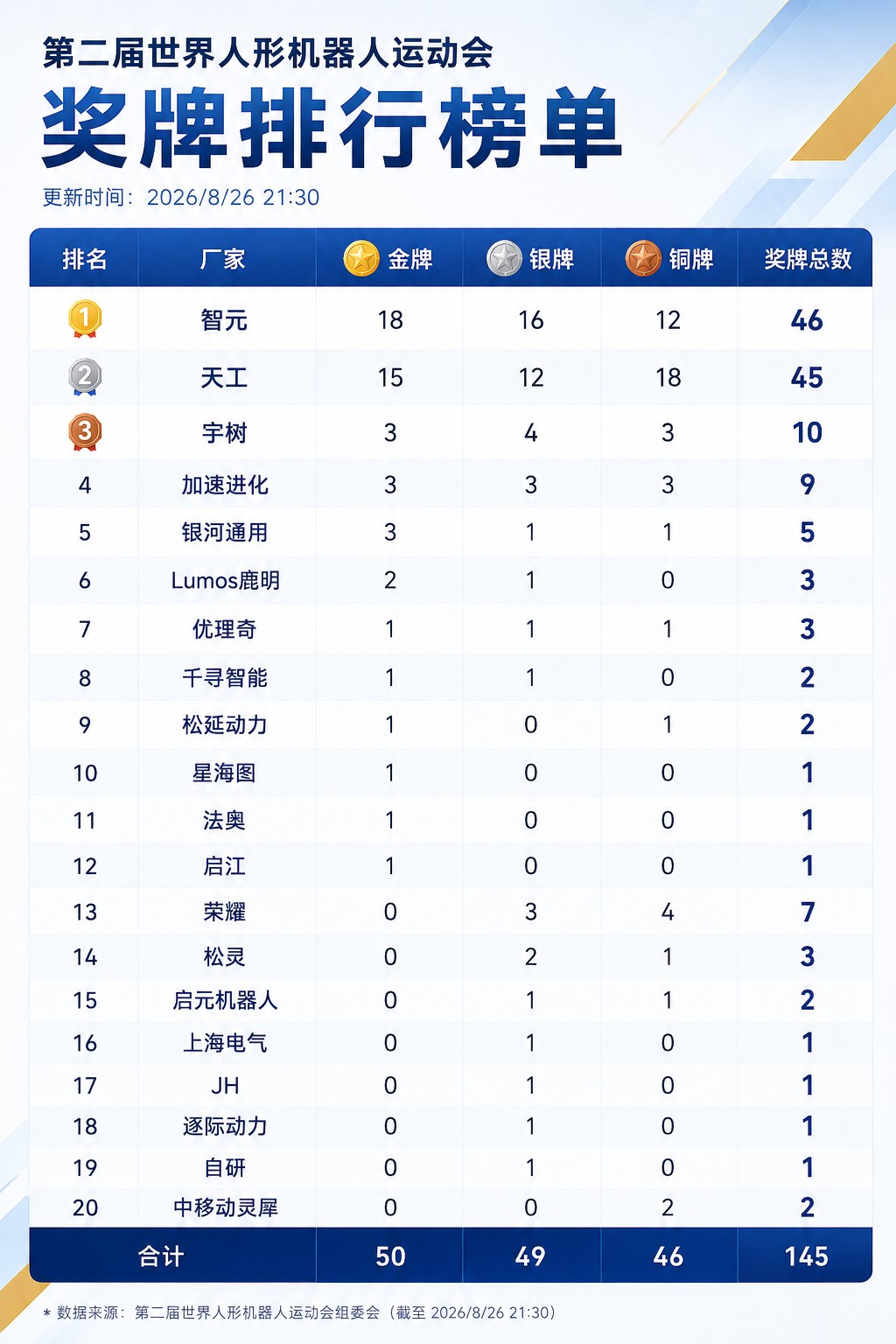
Among them, the mass-produced dexterous hand OmniHand won 7 gold medals out of 8 in the dexterous hand special events; the Elf G2 took 6 out of 12 gold medals in the scenario competition; the Expedition A3 and Lingxi X2 won multiple medals respectively in events such as dance, martial arts, table tennis and obstacle races. It is also worth mentioning that all the competition models Agibot sent this time are mass-produced machines, and no custom prototypes were specially developed for the competition.
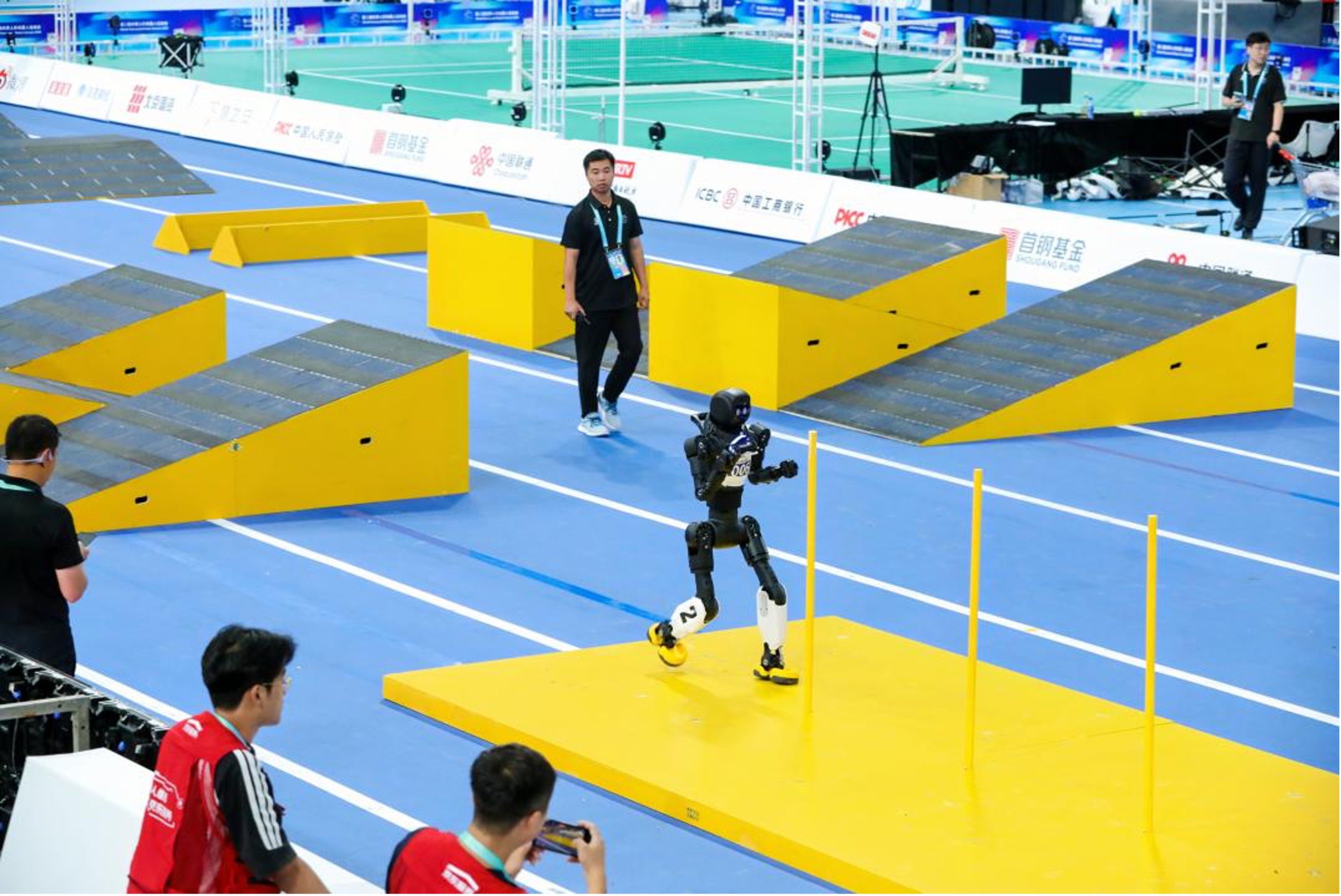
Medals are the most intuitive result of the event, but what deserves more attention than the number of medals is the cross-track capability demonstrated behind them. This also corresponds to the current change in the focus of humanoid robot competition: after the industry enters the deployment stage, competition is shifting from single-advantage capability to systematic capability.
In the past two years, the most visible progress of humanoid robots usually comes from single capabilities such as running, jumping, somersaulting or anthropomorphic interaction. Robot manufacturers have accordingly formed different labels: some are good at prototype and motion control, some emphasize large models and interaction, and some focus on dexterous operation. However, when robots actually enter application scenarios such as factories, shopping malls and public service places, tasks do not appear separately according to technical modules. Robots must complete environmental perception, task planning, body movement and object operation at the same time, and cope with collisions, errors and temporary changes.
This means that humanoid robots with obvious "partial weaknesses" can hardly adapt to the requirements of the deployment stage. The peak of single capability may determine whether humanoid robots can create highlight moments; but whether perception, decision-making, operation, motion and engineering systems can form a stable closed loop ultimately determines whether they can work continuously.
A Systematic Stress Test for Humanoid Robots
This is also the significance of adding scenario competitions to this Games. Facing scenario projects such as book sorting, hotel services, and fire emergency response, robots need to continuously complete a whole set of processes close to real operations. If there is a lack of coordination among various capabilities, even if they perform well in a single link, they may fail to complete the task later due to positioning deviation, grasping failure or decision-making interruption.
Taking the fire emergency scenario as an example, the humanoid robot needs to complete a series of tasks such as hazardous material identification, abnormal valve shutdown, fire extinguisher grasping and fire extinguishing. The difficulty of this process lies not only in identifying targets and planning movements, but also in enabling the robot to smoothly connect all links in the state of movement, contact and load bearing.
Facing fire extinguishers weighing 4.5 to 5 kilograms, which exceed the load capacity of the end gripper of most humanoid robots, Agibot's solution is to install structural parts at the wrist, use the structural strength of the wrist to hook the fire extinguisher, then place it into the chassis carrying bucket with a 20-degree inclination, and the chassis completes the subsequent transportation. In essence, it decomposes grasping and continuous load bearing into hooking, carrying and moving, reducing the burden on the end effector.
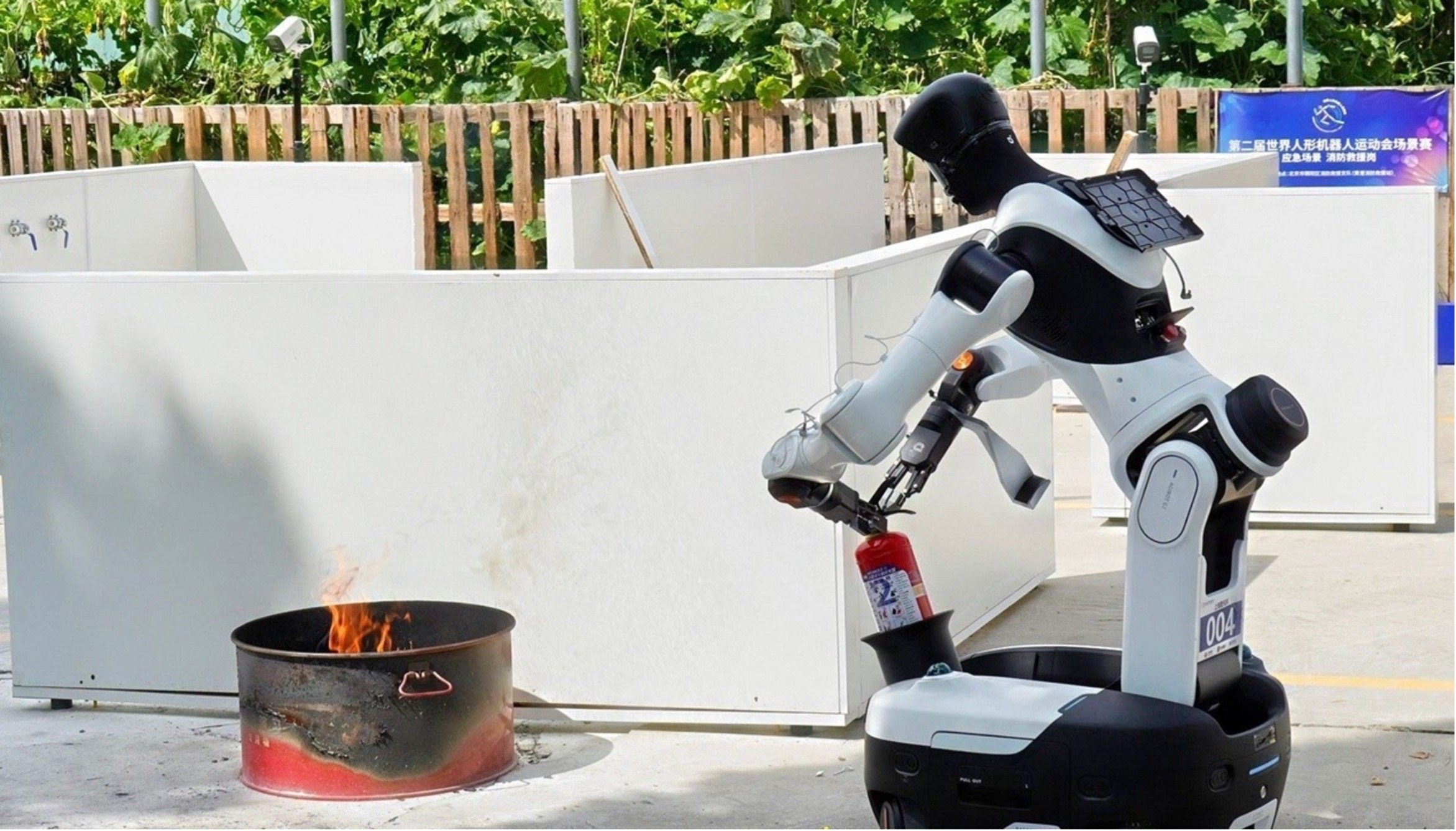
In the operation link, Agibot adopts an over-the-horizon teleoperation system based on VR and inverse kinematics mapping, which converts human movements into robot instructions, and realizes the mapping of the operator's body movements to the whole robot through whole-body control. The force control strategy improves the compliance and fault tolerance of the robot when it contacts the environment, reducing the probability of task interruption caused by minor collisions.
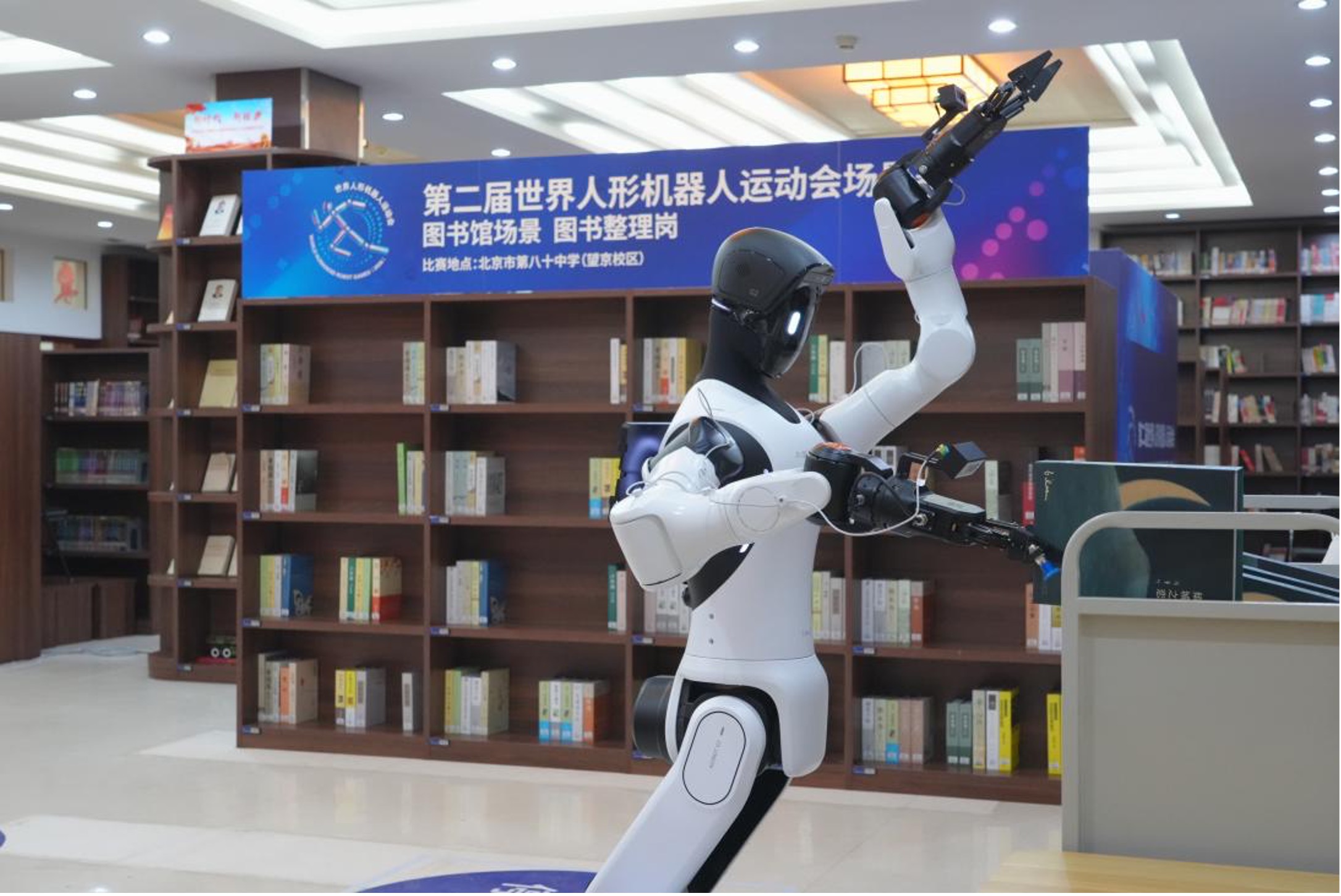
The book sorting scenario includes outbound transportation, shelf placement, and identification and correction of misplaced books. Agibot's solution is to pre-establish a high-precision map and mark points, calculate paths through positioning and navigation, then identify the spine labels with a visual model, and the task decision system connects all links in series. The real difficulty here is not to let the robot complete a single grasp, but to avoid any small error from being continuously amplified in the long process.
It can be seen that the widely discussed "scenario is king" in the current humanoid robot industry not only emphasizes that robot enterprises are starting to compete for more application scenarios, but its more essential meaning is that scenarios have actually become the organizer of technical capabilities: the visual, motion control, dexterous operation and model capabilities that were usually demonstrated separately in the past can form stable and sustainable productivity with social and economic value only when they enter a specific task.
For humanoid robot enterprises, the purpose of participating in competitions has also changed accordingly.
Competitions are undoubtedly not equivalent to real commercial deployment, because actual operation deployment also includes more dimensional tests such as economy, safety and long-term reliability. However, competitions can centrally generate high disturbances and abnormal situations in a limited time, becoming a high-density systematic stress test for humanoid robots. The so-called "promoting research through competition and promoting practice through competition" essentially concentrates and exposes problems that may appear scattered in deployment, and then brings the formed adaptation, control and decision-making experience back to real application scenarios.
Full-dimensional Collaboration on a Unified Base
From this perspective, Agibot's achievements covering dexterous hands, scenario operations and high-dynamic motion are more valuable than the championship of a single event. Because it not only reflects the single advantage of a certain robot, but also the coverage of Agibot's existing products and technical system for multiple capabilities such as motion, operation and scenario operation.
In scenario tasks, Agibot's operation intelligence system first plays a role, which is mainly responsible for the robot's task understanding, planning and skill learning.
Among them, the embodied base model GO is responsible for visual understanding, instruction parsing and task generalization, the world model GE provides a generative interactive environment that conforms to physical laws, the distributed reinforcement learning framework Genie Evolver is used for skill learning and iteration, and Genie Studio Agent is responsible for understanding tasks, disassembling steps and orchestrating capabilities. Specifically for long-process tasks such as hotel services, book sorting and emergency disposal, this system can enable the robot to understand what to do, how many steps to take, and then call corresponding skills according to the progress of the task.
The understanding and planning of tasks must eventually be converted into actions that the robot prototype can execute. Facing fine operations such as grasping, bottle opening and unpacking, the dexterous hand OmniHand adopts the DUET dual-layer embodied contact intelligence architecture, which combines outer layer pose control and inner layer tactile control to adjust force and position according to the shape, friction and force change of objects.
For high-dynamic tasks such as dance, martial arts and obstacle races, the motion pre-training model, whole-body cooperative control algorithm and Sim2Real system are responsible for migrating the motion strategies formed in simulation to the physical robot, and coordinating the torso and limbs to complete movements.
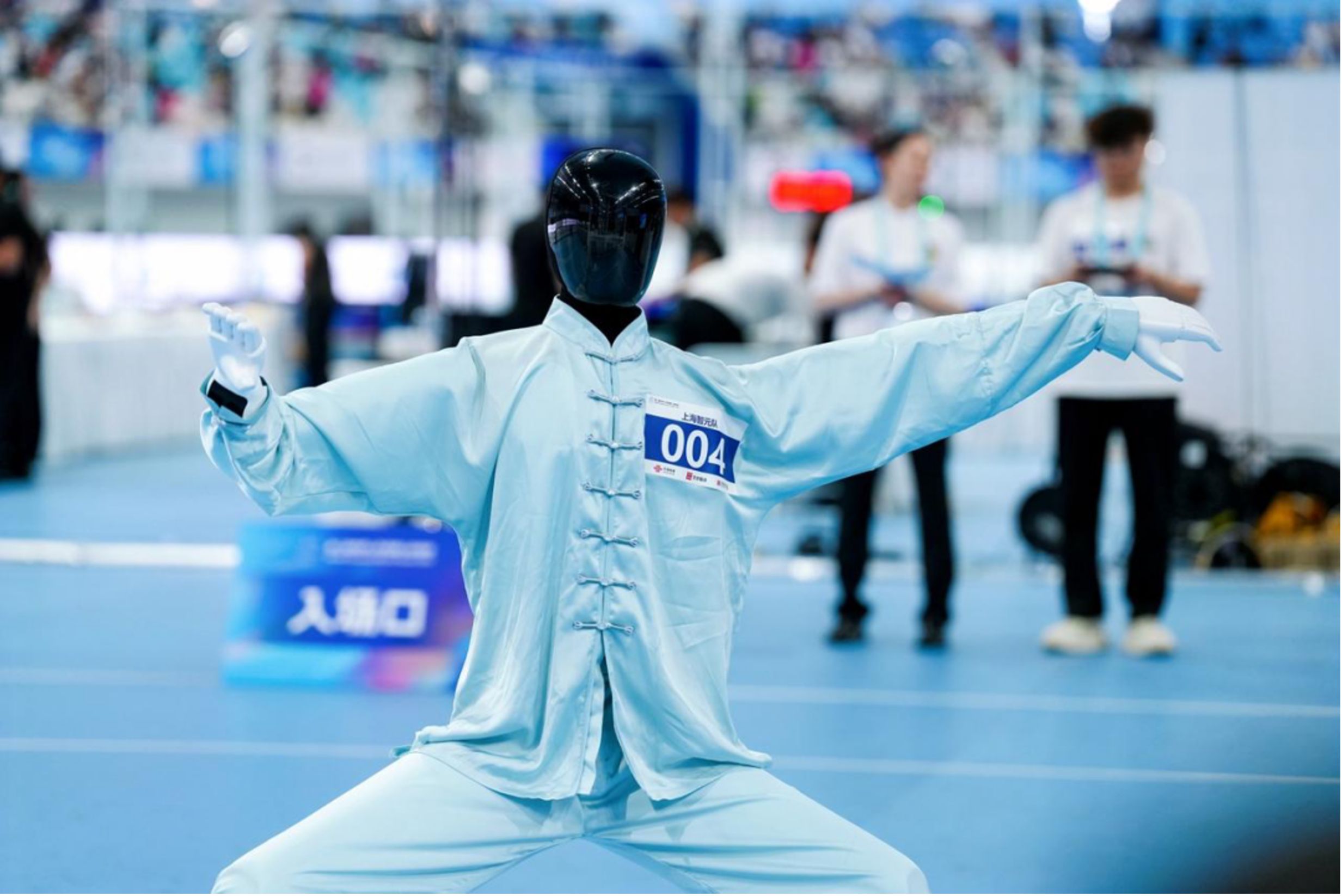
However, the fact that technology has a reuse foundation does not mean that it can be naturally replicated to every robot. For models and control strategies to run stably on different prototypes, it also depends on hardware performance and production consistency. Taking the Elf G2 as an example, its domain controller is equipped with 2070 TFLOPS of computing power, allowing models and algorithms to run on the end side, reducing dependence on external computing power and networks; at the same time, Agibot ensures the consistency of products, enabling algorithms to migrate between different prototypes, reducing the work of repeated debugging for single-machine differences. Only when models, control algorithms and mass-produced prototypes cooperate with each other, can the technical versatility be further converted into deployment efficiency.
Agibot summarizes this complete system covering software and hardware capabilities as "Three Intelligences in One": based on the robot prototype, integrating motion intelligence, interaction intelligence and operation intelligence. This actually implies the core point of large-scale deployment of humanoid robots: problems in real tasks will span models, control and prototypes, which must be iterated across layers, and capabilities must be replicated on a large scale through the consistency of prototype mass production.
Beyond the Competition Arena, Deployment is the Real Long-term Test
The arena is ultimately a prospective verification of robots entering the real operation environment. At the Agibot Partner Conference in April this year, Deng Taihua, Founder, Chairman and CEO of Agibot, used the "XYZ Curve" to describe Agibot's judgment on the evolution process of the humanoid robot industry:
The X curve is the development and early adoption period, where robots can provide development support in scientific research institutions or provide emotional value through cultural and entertainment performances, which has supported the rapid development of the entire industry in the past three years; the Y curve is the deployment growth period, where robots start to work like humans and become a kind of productivity. When more productivity is deployed, a data flywheel in the deployment state is formed; with the continuous accumulation of data and continuous innovation of algorithms, the critical moment of quantitative change to qualitative change is ushered in, entering the third stage of the Z curve — the ChatGPT 3.5 moment.
According to Deng Taihua's definition, deployment is not only delivering robots to the customer site. Only when robots can work autonomously, operate and maintain autonomously, and replenish energy autonomously, minimize manual intervention, and create value independently, can it mean that productivity is truly implemented.
It can be seen that according to this standard, most current humanoid robots are still far from the truly mature deployment state. Robots at this stage can already complete some production and service tasks, but their scope of autonomous operation is still limited, and they often require manual debugging or takeover when facing environmental changes and abnormal situations; capabilities such as autonomous operation and maintenance, autonomous energy replenishment and long-term stable operation have not been verified on a large scale.
Agibot is currently advancing along the path from mass production to deployment. The company's 15,000th embodied robot rolled off the production line at the end of June, forming a certain large-scale production foundation. The Elf G2 that participated in the scenario competition this time has previously entered factories such as Longcheer and SAIC. Focusing on real operation demands, Agibot has also launched productivity solutions for loading and unloading on production lines, industrial handling, logistics sorting, tour guide and shopping guide, security inspection, and industrial and commercial cleaning.
These initial mass production and scenario deployments have accumulated the engineering and data foundation required for Agibot to move towards a mature deployment state. Facing real environments with different stations, materials and operation processes, the adaptation cycle of new tasks, the degree of manual intervention, long-term operation stability and input-output ratio will further test the deployment efficiency of its technical system and determine the large-scale speed of existing solutions.
This is in fact the signal released by this Games that deserves more attention than the gold medal table. Humanoid robots still need to pursue faster, higher and stronger performance, but after entering real scenarios, the upper limit of single capability is no longer enough to determine the final performance. Perception, decision-making, operation, motion, reliability and cost are mutually restricted, and any long-term shortcoming in any of them may affect the continuous and stable operation of robots.
With 18 gold medals and ranking first in both tables, behind the excellent performance presented by Agibot at the "Robot Olympics" is the successful leap of its technical system from "single-point ultimate" to "all-round development". The fact that all medals are won by mass-produced machines also verifies the deep integration of its three major intelligences of motion, interaction and operation on the same base. The deeper meaning is that this competition announces that the competition of humanoid robots has turned to the contest of systematic capabilities, and Agibot has taken the lead in standing on this high ground.