AI games are booming: a group of creators raked in 10 billion yuan in a single year.
In the first half of 2026, more than 7 out of every 10 financing deals in the gaming industry were invested in AI.
More tangible revenue has emerged. In 2025, Roblox paid over 1.5 billion US dollars to 23,500 developers on its platform through the DevEx system, equivalent to more than 10 billion RMB.
On the other side, AI gaming platform Astrocade exceeded 20 million users 8 months after its launch, and raised another 56 million US dollars in financing this May; domestic Aishi Technology has accumulated nearly 3 billion RMB in total financing.
Capital, users and revenue expectations are all pouring into AI games.
But an awkward fact is that truly AI-native games have not yet achieved large-scale successful operation.
Therefore, the most worthy question to answer this year is not whether AI games are popular, but:
Who will be the first to make money?
Selling shovels: The first to make profits
Liu Binxin, founder of Xinying Suixing, told Pencil News that the so-called AI games nowadays have not formed an essential gap with traditional games.
AI can help game companies quickly generate art assets, codes and content, reduce production costs, shorten the development cycle, and even allow ordinary people to generate simple games with one single sentence description.
But in the final analysis, games still need to answer the most plain question: is it fun to play?
Including the currently popular AI NPCs, Liu Binxin does not believe that "connecting NPCs with large models" is equivalent to AI games.
"AI NPC is just a character in the game, it is not equal to an AI game."
In his view, many current products only add an AI selling point to traditional games. New gameplay that can only be realized with the help of AI has not yet fully emerged.
Therefore, at this stage, the people who are most likely to make money first are not those who directly develop AI games, but the companies that "sell shovels" to game companies.
This account is very easy to calculate.
At present, the penetration rate of AI technology among domestic game enterprises has reached about 86%.
For 37 Interactive Entertainment, the proportion of 2D art assets generated with AI assistance has exceeded 80%, the proportion of 3D assets generated with AI assistance has exceeded 30%, and the proportion of advertising material videos with in-depth AI participation has exceeded 70%.
Work that used to require a large number of art, programming and outsourcing teams to complete is now partially replaced by models.
Therefore, AI art, 3D generation, game coding, automated testing, NPC SDK, Agent framework, model fine-tuning and private deployment are all businesses that are easier to get budget support now.
The reason is also very realistic.
No one knows whether players will pay for a brand new AI game.
But if a game company spends 1 million RMB on an AI system and can save 3 million RMB in labor and outsourcing costs, the boss can figure out this account on the very day.
One sells the future, the other sells real money saved from cost reduction.
Therefore, before the real explosion of AI games, tool companies have been the first to get the dividends.
But this is also the most interesting part.
Because once AI really enters the core of games, the accounts of game companies may become completely different from the past.
There will even be a counter-intuitive situation: the more players love the game, the more distressed the company will be.
The AI-native strategy game *History Simulator: Chongzhen* has encountered this problem.
The product initially adopted a 48 RMB one-time payment model, and charged extra fees for AI points.
Because when players chat, hold court meetings and conduct war simulations in the game, they need to call the model constantly. The longer players play and the more they talk, the more Tokens they consume.
That is to say, after a traditional game is completed, if a player plays 10 more hours, the additional cost of the company may be very small.
But AI games are different.
Every extra word a player says in chat, every extra simulation run, every extra round of interaction with NPCs may be "burning money" behind the scene.
In the end, the charging model of *History Simulator: Chongzhen* caused controversy, and the product later changed its main body to free of charge, allowing players to access the API by themselves.
This actually reveals the most tricky commercial problem of AI games at present:
Traditional games worry that players do not play long enough, while AI games may also have to worry that players play too long.
So why is the money from "selling shovels" more certain now?
Because selling AI tools only needs to prove one thing: can I help game companies save money. But to develop a real AI-native game, you need to answer two questions at the same time:
First, why do players have to play your game instead of others?
Second, the more players play, can you still make profits?
The first question has never been easy to solve in the gaming industry for decades.
The second question is a new problem just brought by AI.
Selling companionship: Starting to generate revenue
In addition to selling shovels, the second direction that has begun to show profit potential is AI companionship.
DouDou AI under Xinying Suixing is developed by cutting into the gaming track.
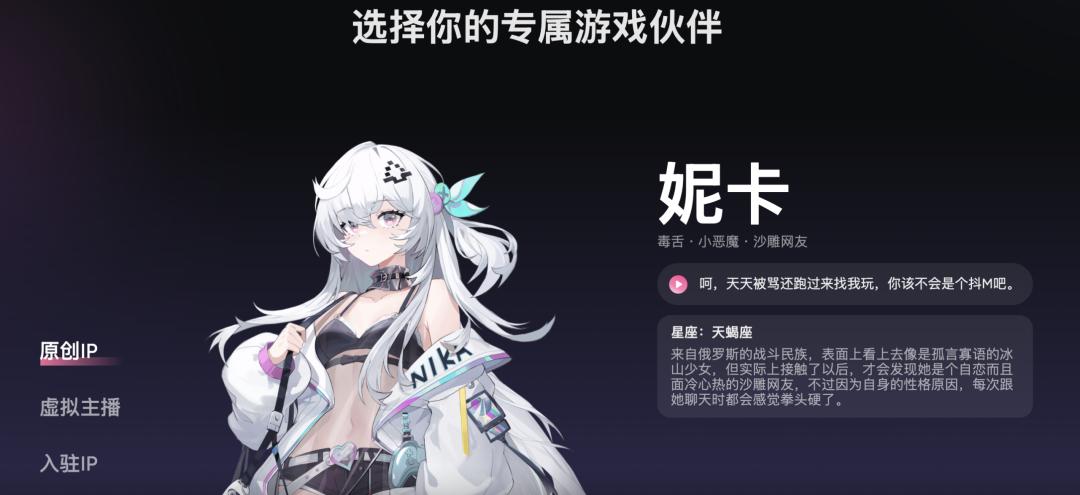
DouDou AI Companion, from the official website of DouDou Game Partner
It can recognize the game screen that the player is playing, and interact with the player via real-time voice at the same time.
The product has accumulated 8 million users during the testing phase, and added 1 million new users 10 days after its official launch in 2025.
At first glance, it looks like a "talking game assistant".
If you can't beat the boss, you can ask it; if you don't understand the task, you can ask it; if you don't know where to go next, you can also ask it.
But Liu Binxin believes that if it only provides strategy guides, this business is not that attractive.
"Functions and strategy guides are the introductions and hooks, but what makes people really pay, the Aha moment that users feel, actually comes from emotional value."
The logic is also very simple.
If players just want to know "how to beat this boss", they can probably find the answer by searching for strategy guides.
What really makes AI different is that it is always there.
When you win, it knows you just won.
When you lose, it knows you were just defeated by the boss.
It remembers where you stopped yesterday, and can continue the conversation when you log in today.
At this point, it is no longer just a tool.
Strategy guides solve a single problem, while companionship solves the need of "whether there is someone experiencing this thing with me".
This is also a very interesting change after AI enters the gaming industry.
The NPCs in the past are essentially more like pre-recorded actors.
What to say at what time, when to give tasks, when to disappear, all have been written by developers in advance.
But AI characters are different.
They can remember what happened to the player before, respond according to the player's current state, and even gradually form a continuous relationship with the player.
As a result, a product that was difficult to sell in batches in the past has the opportunity to become a commodity: relationship.
What players pay for may no longer be just a function, or several strategy guides.
It is that "this AI knows me".
If a player is willing to log in a little longer and chat a few more words every day because of a certain AI character, and even extend this companionship from games to watching videos and browsing web pages, then what it competes for is not just the revenue of game assistants.
It competes for the time that users originally allocated to "companionship" in a day.
This is the real imaginative part of AI companionship.
In the past, games sold skins, equipment and attribute values. In the future, there may be another type of product for sale: an AI that always remembers you.
Let players make games for you: Platforms make profits
The third direction that has shown commercial opportunities is AI+UGC.
In the past, making games was a highly professional work with high threshold. You need to know how to write codes, how to build models, understand art, and be familiar with game engines.
Even if an ordinary person has a very good game idea in mind, the first step to make it come true is often not "start making", but to find programmers, artists and planners to form a team first.
AI is tearing down this barrier little by little.
Liu Binxin believes that AI-native games and AI+UGC are not mutually exclusive.
In the future, large game companies will still produce large-scale games with higher and higher investment and more exquisite pictures, and AI will help them reduce costs and add more content.
On the other hand, AI will also make game production easier and easier, so that people who could not write codes or make art assets in the past can also participate in game creation.
His metaphor is about movies and short videos. After the emergence of short videos, movies did not disappear.
Hollywood blockbusters still have audiences, but at the same time, hundreds of millions of ordinary people have the ability to produce video content for the first time.
The gaming industry is likely to experience a similar change. On one side, companies like Tencent and NetEase will continue to make high-cost high-quality games. On the other side, a large number of ordinary players will make games conveniently while playing games.
This change has already begun.
The "TapTap Creation" launched this year allows users to complete game production by talking to AI.
Users do not need to learn codes from scratch, nor do they need to go through a thick game engine tutorial first.
They only need to tell AI: "I want to make a game like this." Then modify it through rounds of dialogue.
In half a year, the platform has helped creators to make nearly 5000 games, with more than 11 million accumulated players. Among them, *Emerald Management Simulator* has obtained 1.178 million players 58 days after its launch.
The overseas product Astrocade takes a more direct path.
Users can generate, modify and publish games by inputting natural language.
8 months after the product launch, it has more than 20 million users. In May this year, it received another 56 million US dollars in financing.
Why does capital like this model? Because what it sees may not be just "AI helps people make games".
It wants to replicate a larger business that has been proven by the short video industry: in the past, the platform produced content by itself, now it lets users produce content for the platform.
Traditional game companies make money in a very tough way.
They have to keep recruiting people, setting up projects, developing and launching games one after another. The last game became a hit, the next one may not be popular. Every time, it is like placing a new bet.
The UGC platform wants to change the gameplay.
It no longer gambles on which game will be popular by itself, but hands the tools to thousands of users: you come to make games.
The platform is responsible for providing AI tools, traffic and trading systems.
As long as there are enough creators, there will always be someone making content that players like.
This is just like short video platforms do not need to shoot all the hit videos by themselves every day, they only need to make enough people willing to shoot every day.
Once AI reduces the difficulty of making games to a level close to "shooting a short video", the change will be very huge. In the past, hundreds of millions of people were only players. In the future, some of them may become creators at the same time.
What the platform earns is the revenue from memberships, virtual props, advertisements and transactions generated behind these creations.
Roblox has already proved the upper limit of this model. In 2025, Roblox paid more than 1.5 billion US dollars to creators on its platform through the DevEx system.
Its real advantage is not that Roblox itself is very good at making games. But that it lets countless people make games for it.
Today this game is popular, tomorrow that game is popular, the platform always stands in the center.
Therefore, the really attractive part of AI+UGC is not that "one person can also make games".
But it may change the gaming industry from: a small number of companies make games, billions of people play games, to: among billions of players, there are constantly people who can easily make games.
If a company makes games by itself, it only earns the revenue of one product.
If it can build a creation platform, it can compete for the revenue of the entire ecosystem.
Major players have entered the track, startups need to find unique gameplay
Major manufacturers such as Tencent and NetEase have fully entered the AI gaming track. Do startups still have opportunities?
Liu Binxin's answer is very clear: of course there are.
But there is a premise - don't fight head-on with major players in the areas they are best at.
Tencent, NetEase and miHoYo have more sufficient capital, better art and planning talents, as well as stronger operation capabilities and traffic advantages.
If a startup still wants to compete with them on assets, art, talents and operation, "it will definitely not win".
The logic is very simple. Others can arrange hundreds or thousands of people to polish a blockbuster, if a startup follows this path, it is equivalent to hitting an aircraft carrier with a small boat.
Therefore, the opportunity for startups is not "to make another game that Tencent will also make with fewer people". What is really worth looking for is something that major players don't know how to do for the time being, or even haven't realized that it can be done.
This is why among this round of AI game startups, many teams that "don't look like traditional game companies" have emerged.
Some cut in from large models, some make world models, some enter interactive content from video generation, and others like Xinying Suixing cut into the gaming industry from AI companionship.
Their common point is: they do not start from "how to remake traditional games", but start from the new capabilities brought by AI.
Liu Binxin believes that the real AI games in the future may not even be born in traditional game companies.
Video generation, interactive video and other content forms may all integrate with games.
In other words, the next AI game that really stands out may not look like the "game" defined today at first glance.
This is the opportunity for startups.
What Tencent is best at is to mobilize teams of hundreds or thousands of people to deepen, expand and refine a large market that has been verified.
The real advantage of startups is to focus on a very small, very new, and even a bit strange demand at the beginning, and quickly try and make mistakes.
For example, some people found that players actually want a friend who is always online and truly understands them, so DouDou AI came into being.
Others found that people who can't write codes also have the urge to "make a game by themselves", so Astrocade and TapTap Creation appeared.
These opportunities have one thing in common: they do not make a certain work in traditional games a little faster or cheaper. They create experiences that did not exist at all in the past.
But the other side is also very cruel.
Once AI reduces the cost of making games, the game itself may quickly become less valuable.
In the past, making a game may require dozens of people and several months. In the future, one person can make a product in a few days, or even a few hours.
It sounds like a