Jensen Huang: NVIDIA has achieved AGI
At the latest earnings call, Jensen Huang declared: NVIDIA has already achieved AGI!
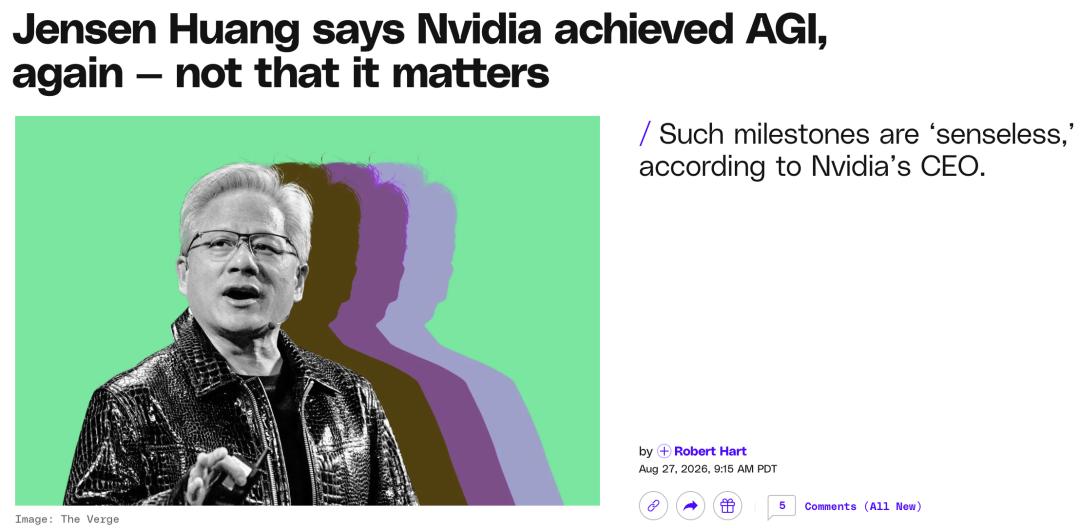
Shortly after, he put forward a staggering prediction —
In the future, NVIDIA may only need 40,000 human employees to command 400,000 or even 4 million 24/7 AI Agents to work nonstop at the same time!
What does it mean if NVIDIA takes the lead in achieving AGI?
NVIDIA already owns the world's largest computing power base. After realizing AGI, an astonishing moat of "computing power feeding back to R&D" will be completely dug through.
Once AGI unlocks Recursive Self-Improvement (RSI), NVIDIA will have incubated a super army of millions of AI Agent scientists internally.
This army will feed back to itself, automating the development of the next-generation more advanced GPU architecture, and even rewriting CUDA code.
This kind of dimensionality reduction attack, which boosts progress through self-acceleration, will bring unprecedented high monopoly profits to NVIDIA. As the supply chain in the physical world is tightly restricted, the vast majority of competitors will be locked out of the market.
Eventually, NVIDIA will not only monopolize the vast majority of effective "AI labor" worldwide, but also gain the most lucrative monopoly dividend in the stage of human progress towards silicon-based civilization!
"AGI has been achieved, and dwelling on its definition makes no sense"
In the tech industry, AGI means that AI can perform as well as or even better than humans in most work scenarios with high economic value.
Over the past few years, countless tech giants have competed fiercely to be the first to reach the threshold of AGI.
However, at Wednesday's earnings call, when asked about his views on the fanatical pursuit of AGI by companies like OpenAI, Jensen Huang said calmly
For many tasks, we can say that we have achieved AGI.
This is not the first time he has said so. As early as March this year, on the Lex Fridman podcast, he expressed similar views bluntly.
But this time, he not only announced that he had reached this milestone, but also immediately overturned the established consensus.
Jensen Huang pointed out unreservedly that it is completely meaningless to continue dwelling on "what AGI is exactly" and "what standards count as achieving AGI" now.
Why?
Because the entire tech industry has no universal consensus on "intelligence" itself, let alone how to measure AGI.
It's like everyone is running towards a finish line, but no one knows what the finish line looks like. In that case, isn't arguing about those illusory definitions a waste of time?
What really excites Jensen Huang, and what the whole of humanity really needs to be alert to, is the fundamental qualitative change in AI capabilities.
According to the latest data, NVIDIA's Avo architecture has achieved a 100% completion rate with full marks on ARC-AGI-3, the benchmark test for long-horizon autonomous agents!
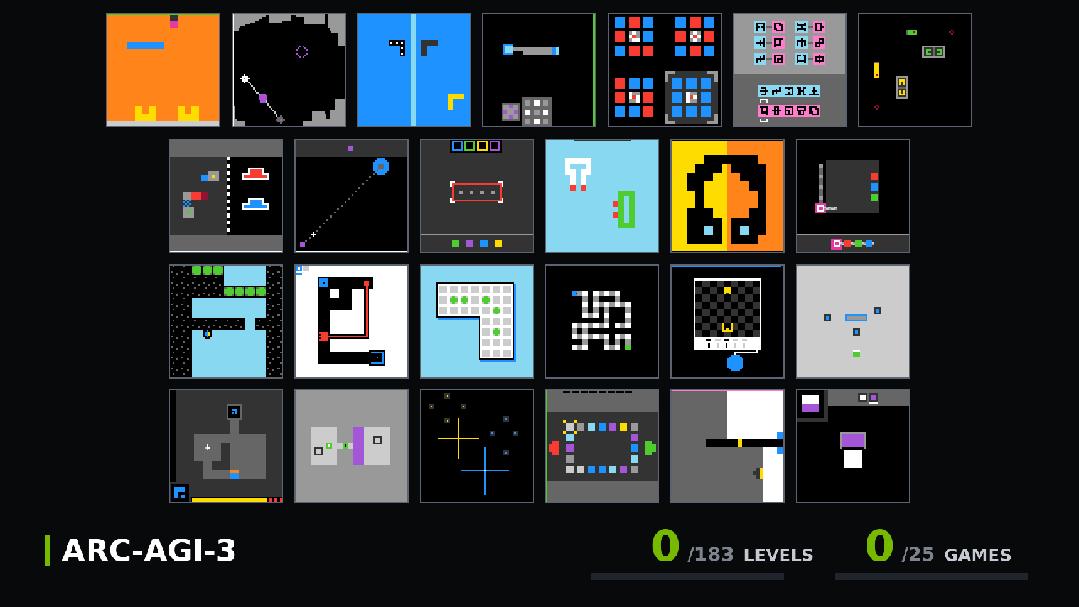
This full mark is of great significance. The ARC test, proposed by François Chollet, the father of Keras, is recognized as the "strongest intelligence test" in the AI field.
It specifically targets the weakness of large models of "memorizing test questions", requiring AI to demonstrate human-like abstract reasoning ability with only a very small number of examples when facing never-seen logic puzzles with no historical data for reference.
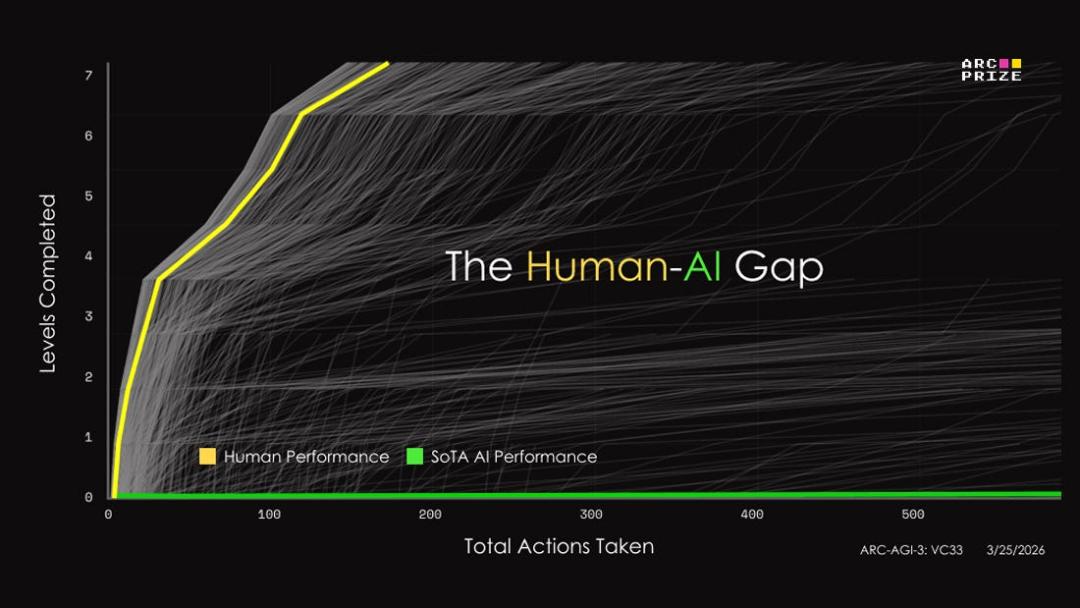
In the past, even the most powerful models from OpenAI and Google failed in this test, and it was extremely difficult to break through 50% accuracy.
However, NVIDIA's Avo architecture not only scored 100% full marks, but also passed all 183 levels in 25 public environments with pure zero-shot prompts, no clear rules, and relying entirely on autonomous reasoning!
This not only means that NVIDIA has become the world's first giant to get full marks in this test, but also marks that AI has completely stepped out of the dead end of "pattern matching" and truly has the general cognitive ability to solve unknown complex problems.
AI will bid farewell to the passive era of "you ask and AI answers".
The current AI is an autonomous agent with a cutting-edge general architecture.
After receiving a task, it can independently break down steps, execute autonomously, and even reflect and learn new skills after the task is completed to achieve "recursive self-improvement".
It can not only work, but also summarize experience by itself, and become smarter the more it works. This is the real "AGI implementation" in Jensen Huang's eyes.
If the benchmark performance is not convincing enough, how credible is NVIDIA's implemented "AGI for chip design"?
At Computex and GTC Taipei 2026, Jensen Huang joined hands with Cadence to jointly release ChipStack AI Super Agent — the official claims that its autonomous capability has reached Level 5.
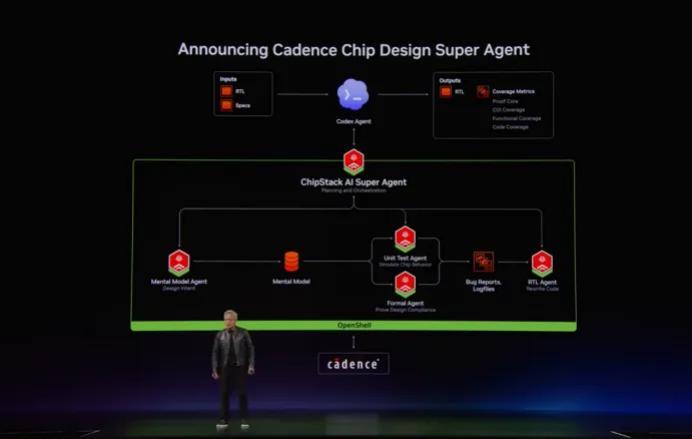
The system uses Codex and Nemotron as engines to orchestrate workflows, calls Cadence Xcelium for RTL simulation and Jasper for formal verification, and all tasks run in the NVIDIA OpenShell sandbox.
The data released by the official is exciting: the typical verification closed loop is compressed from about five weeks to less than one day, and the RTL verification cycle is accelerated by more than 40 times.
NVIDIA's huge internal verification system of "thousands of engineers, billions of computing hours per year, and millions of tests" will be carried by this agent system.
Earning 1 billion US dollars a day! Profitability is the absolute priority
If "achieving AGI" is only a technical shock, then NVIDIA's financial report is a shock from the capital market, which fully exceeds market expectations
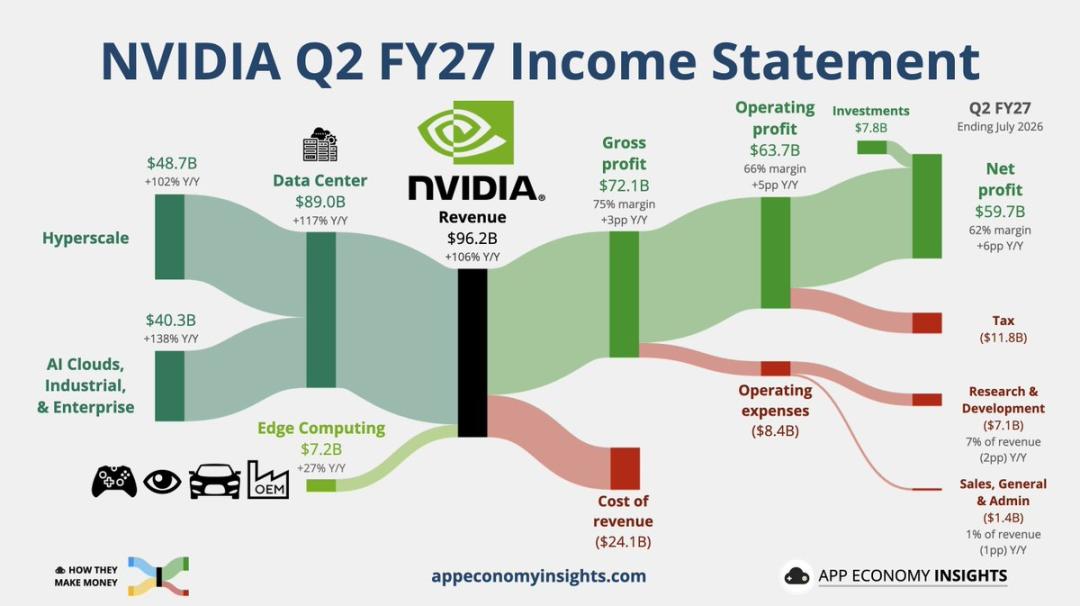
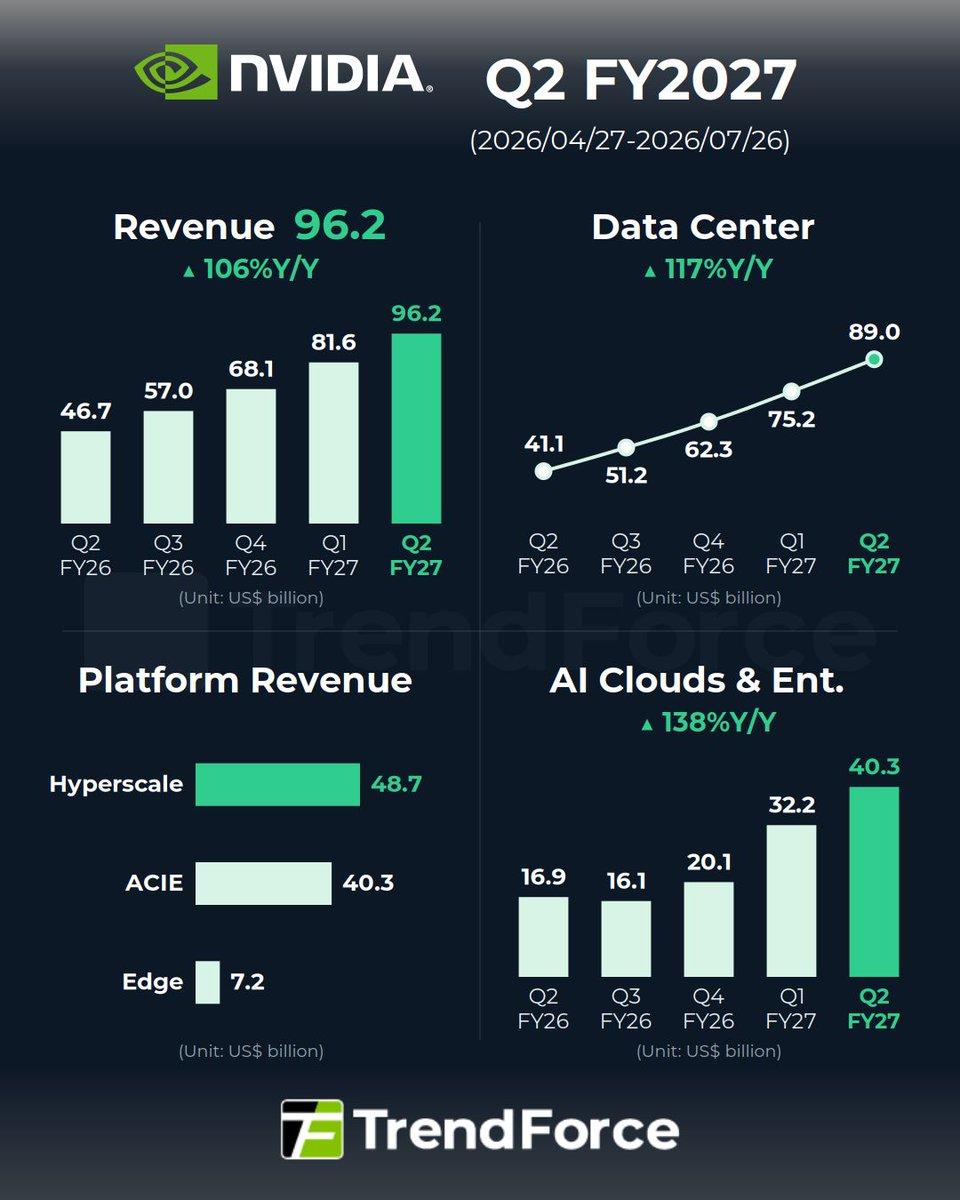
In the latest Q2 financial report of fiscal year 2027, total revenue in the last quarter reached a record 96.2 billion US dollars, an increase of more than 10 billion US dollars over the previous quarter.
Data center business revenue alone more than doubled year-on-year to a record 89 billion US dollars, and profits also more than doubled to 59.7 billion US dollars.
Key data for this quarter:
• Revenue: 96.2 billion US dollars (expected 92.2 billion US dollars, up 106% year-on-year)
• Data center: 89 billion US dollars (expected 85.8 billion US dollars, up 117% year-on-year), driven by hyperscale customers (48.7 billion US dollars) and enterprise AI business (40.3 billion US dollars)
• Net profit: 59.7 billion US dollars (a staggering 62% net profit margin, up 6% year-on-year)
• Gross margin: 75% (expected 75%, up 250 basis points or 2.5% year-on-year), with gross profit reaching 72.1 billion US dollars
• Adjusted earnings per share: 2.22 US dollars (expected 2.10 US dollars, up 120% year-on-year
Calculated on the basis of 91 days, the revenue is equivalent to about 1.06 billion US dollars per day, every day including weekends.
The guidance for the third quarter is eye-catching: revenue is expected to reach 108 billion US dollars!
This will be the first time in NVIDIA's history that it breaks through the 100 billion US dollar mark in a single quarter, and the average daily revenue will soar to nearly 1.2 billion US dollars!
A year ago, cutting-edge AI labs were still burning venture capital to stay afloat; but now, as deduced by Dylan Patel, founder of SemiAnalysis, AI has transformed from a money-burning bottomless pit into an extremely terrifying money printer —
The basic computing power cost of about 10 million to 15 million US dollars per megawatt can be converted into 50 million or even hundreds of millions of US dollars of end revenue.
When NVIDIA and its core customers can steadily "turn 10 dollars into 100 dollars", it has absolute "unlimited firepower" in the market.
Following giants such as Amazon, Apple and Alphabet, NVIDIA will also join the "single-quarter 100-billion-dollar revenue" club
But the real "ace in the hole" at the earnings call came from CFO Colette Kress. She gave the guidance for the entire fiscal year 2028 one year in advance: Revenue is expected to grow by about 70%! This is unprecedented in NVIDIA's history.
Wall Street's previous expectation was only a meager 44%.
What does this mean? Calculated based on the nearly 400 billion US dollar consensus for the current fiscal year, total revenue for fiscal year 2028 will approach a staggering 673 billion US dollars.
This will make NVIDIA directly surpass Apple and Microsoft, becoming the second largest US technology company by revenue after Amazon.
Jensen Huang added in a seemingly humble but actually showing off tone:
70% is only a figure limited by supply chain supply. If there is no production capacity constraint, the real demand growth rate of customers is close to 100%!
Calculated roughly at a 65% net profit margin, NVIDIA's net profit in fiscal year 2028 may be close to 450 billion US dollars.
Its net profit in one year may be higher than the GDP of most countries in the world. It can only be said that the imagination of Wall Street investment banks can no longer keep up with the speed of NVIDIA's revenue growth.
Token is the money printer, a super "cyber factory" is born
Since the definition of AGI is meaningless now, what is the core most essential change in the tech industry right now?
Jensen Huang gave an answer full of capital's bloody taste:
AI is doing extremely efficient and useful work, and is generating Tokens that can directly bring profits.
What does "generating profit-making Tokens" mean?
In the world of large AI models, Token is the basic unit of text processing.
In the past, these Tokens were just data in the lab. But now, with the deep integration of AI Agents and actual business, these Tokens have turned into real commercial value.
When AI automatically generates a piece of bug-free back-end code for you, the efficiency improvement brought by this code is the profit-making Token;
When AI automatically crawls global market data, generates investment strategies in seconds and executes transactions, the real money earned is even more an absolute profit-making Token!
In the past, AI was a money-burning bottomless pit. But now, times have changed.
Jensen Huang explained this logic thoroughly: more computing power = more Tokens output = inevitably more profits.
This is why the key indicator to measure the success or failure of the next stage of AI war has become "number of Tokens produced per dollar" and "number of Tokens produced per watt".
This is why Silicon Valley giants don't care at all what AGI is called now, and everyone is betting heavily on it. As Jensen Huang said: "This is exactly the stage we are in right now, and that's why everyone is sparing no effort to increase their investment."
Whoever controls computing power controls the "money printer" in the new era. Under this logic, AI has substantially reshaped production relations and become the strongest engine driving the global economy.
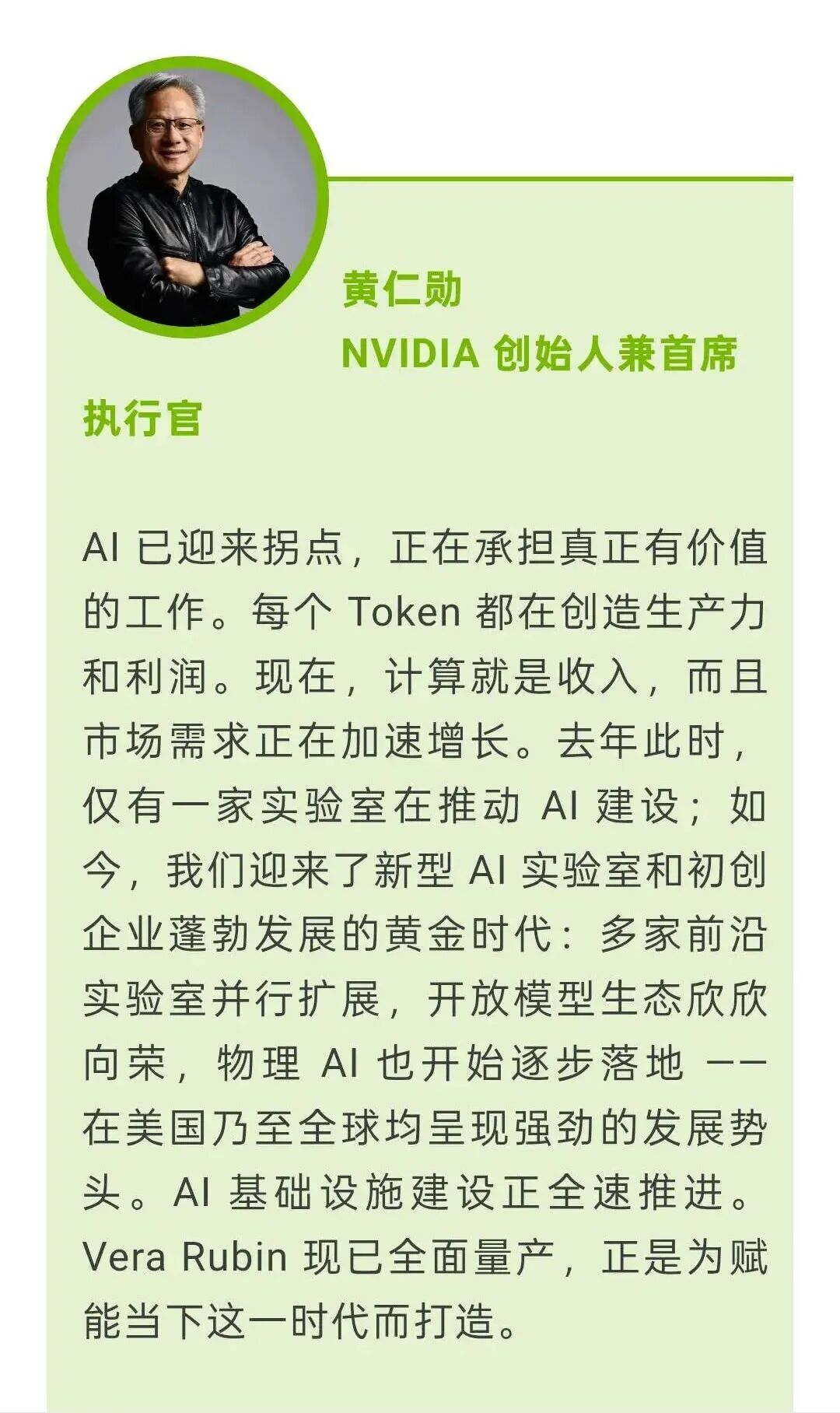
NVIDIA's fully operational and on-schedule Vera Rubin architecture has skyrocketed the revenue opportunity per GW of data center from 18 billion US dollars of Hopper to 40 billion US dollars. Through these rapid iterations, it is turning itself into the most efficient "money printer engine" in the global digital economy.
Last year, only a few top labs were competing for infrastructure; but today, generative AI has ushered in a golden era of vigorous development: new AI labs, national AI teams, physical robot AI, and the Internet of Everything are all scrambling for computing power frantically.
Based on the strong autonomy and self-evolution capabilities demonstrated by current AI Agents, Jensen Huang put forward the following prediction:
In the near future, NVIDIA may only need to maintain a human employee size of about 40,000, but they will have 400,000, or even 4 million digital employees (AI Agents)!
Please think carefully about this set of data. A human-machine ratio of 1 to 10, or even 1 to 100!
As the ultimate conclusion deduced by Dylan Patel from the books: the expansion of computing power at the level of hundreds of trillions will trigger more than 5 trillion US dollars of credit demand across the entire ecosystem.
In the next two or three years, the economic operation of the entire real world — pushing up market interest rates, leading to a plunge in the valuation of traditional value stocks due to the surge in discount rates — will directly become the result of this AI computing power monopoly and expansion.
Token is power
This earnings conference in August