ByteDance has gone all out to launch the full product suite of Doubao.
The horse race is over, ByteDance is concentrating its forces to launch an annihilation offensive, making successive moves within 25 days, and its sense of urgency is clearly visible.
On August 25, ByteDance officially released "Doubao Work", which is officially positioned as "a brand-new Agent product and brand launched by Doubao for productivity scenarios". Media reports show that two teams under ByteDance, the AI programming product TRAE and the agent development platform Coze, have also been merged into the Doubao system, with product and operation teams reporting directly to Zhao Qi, head of Doubao products.
ByteDance responded to *China Entrepreneur*: "This adjustment aims to better coordinate product and technical resources, provide users with higher-quality AI work experience, and existing user rights and interests will not be affected."
This is a fast-paced integration march. On July 30, Feishu and Doubao products were integrated; on August 24, TRAE and Coze were merged; on August 25, Doubao Work was released. In less than a month, all AI products of ByteDance for productivity scenarios have been brought under the Doubao banner.
So far, "Doubao Work" has become the all-in-one product for ByteDance's B-end business — with Doubao's 300 million monthly active users as the entry, Feishu's decade-long accumulated to B scenarios as the context base, Feishu taking charge of collaborative office, TRAE outputting AI programming capabilities, and Coze responsible for agent development.
Behind this series of actions is the firm will at the group level. On August 6, Liang Rubo, CEO of ByteDance, set the tone at the mid-year all-hands meeting: the AI business should be "high-priority, focus on main lines, and optimize for the long term", and proposed to "cultivate Doubao into a brand-new main AI business".
The "horse racing period" for AI office products of large tech companies has come to an end, and chat dialogue capabilities and commercialization capabilities all need to be implemented and transformed into B-end productivity. In just over a month, how did ByteDance complete the integration of multiple product lines? Why did Doubao, rather than Feishu or other products, end up taking the lead?
Three Successive Moves
"In more than 20 days, ByteDance has built its own 'WorkBuddy'", Yang Yi, a developer working for an AI accelerator, commented to *China Entrepreneur*.
The industry window period waits for no one. Data shows that in June, the total visits of AI native office agents on China's PC side exceeded 60 million for the first time, and Tencent's WorkBuddy topped the list with 20.97 million visits in a single month, exceeding the sum of the second and third places. Inside Tencent, WorkBuddy is regarded as a "super project" supervised personally by Pony Ma; Alibaba has also completed the integration of three product lines, launched "Qianwen Office", which entered internal beta on July 27 and is directly managed by Wu Yongming.
*China Entrepreneur* noticed that "Doubao Work" and WorkBuddy have many similarities in product form: both adopt a "left-center-right" three-column layout; both support remotely issuing tasks from mobile phones to computers, calling cloud PCs, and building a multi-agent collaboration mechanism. WorkBuddy is equipped with "Expert, Skill, Connector" functions, and "Doubao Work" is correspondingly designed with "Skill, Connector, Partner" functions. Both can connect to external applications such as Feishu and WeCom.
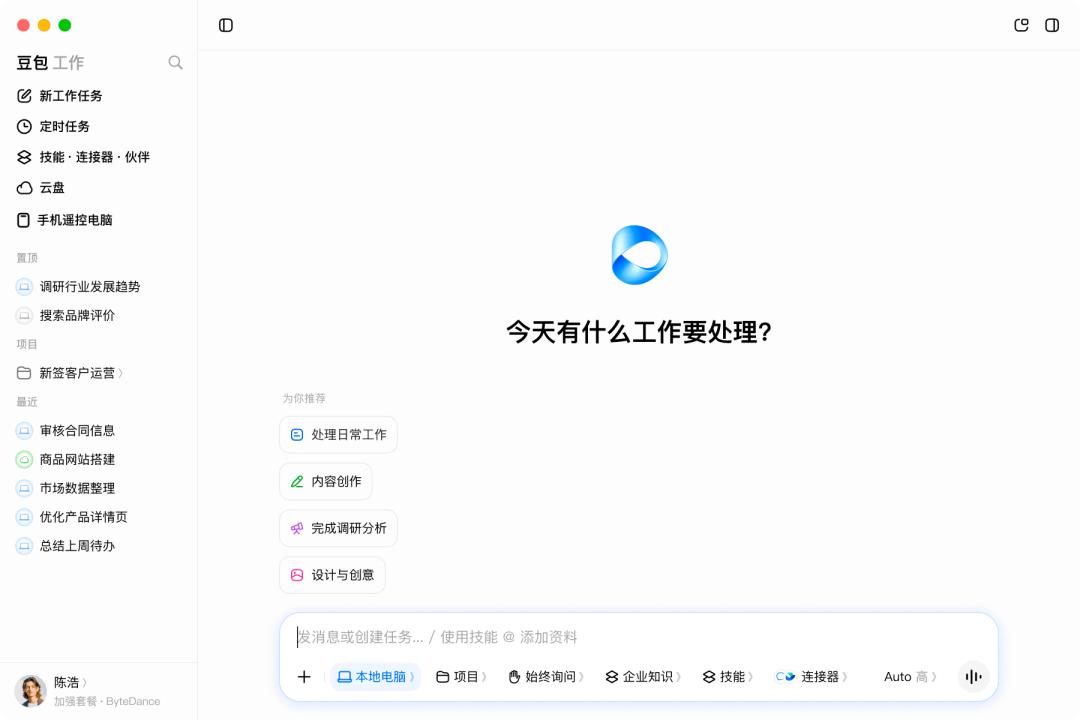
Source: Screenshot of Doubao Work interface
On social platforms, user evaluations are polarized. "The interface is more concise than WorkBuddy, supports cloud data storage + multi-device synchronization, which is more convenient than WorkBuddy." "Doubao Work can only call the Doubao model, but WorkBuddy can specify the model."
*China Entrepreneur* observed that recently, "Doubao" has split more and more "quick dialogues" into "work tasks", and the response mechanism has been iterated accordingly. In the past, Doubao pursued millisecond-level dialogue feedback; after the update, some dialogues have been converted into long-term tasks, focusing on task delivery.
How Did It Integrate Three Geeker Products?
"Among domestic large models, Doubao has the largest traffic, but its capabilities are also the most ridiculed. This time it has swallowed three of ByteDance's geek products, Feishu, TRAE and Coze, which fully demonstrates the group's determination to turn the tide," an industry insider analyzed.
Previously, the outside world predicted that TRAE Work would become ByteDance's key card to compete against WorkBuddy.
"WorkBuddy is more suitable for civilian staff. TRAE Work is derived from the programming product TRAE, and the integrated production and research group with coding needs will directly use TRAE Work," the above person said.
TRAE is divided into two business lines within ByteDance: TRAE IDE and CLI for developers, and TRAE Work, which was just renamed from TRAE SOLO in June and oriented to general work scenarios. This is also interpreted by the outside world as ByteDance's intention to use TRAE Work to fight head-on against WorkBuddy.
However, various details show that the integration pace of Doubao Work this time is rapid.
*China Entrepreneur* learned that from June to July, the TRAE Work team was still recruiting a large number of operation, promotion and growth personnel. From mid to late August, both TRAE Work and WorkBuddy launched marketing advertisements during prime time on CCTV. In addition to traditional placements such as airports, elevators and TV, TRAE Work also followed ByteDance's "free" marketing tactics, launching promotions such as giving points and extending membership periods.
As an AI programming tool, data shows that TRAE ranks first in China's AI programming market with a 41.2% share, with millions of individual users. TRAE Work originally had two major modes: Work mode for non-technical users and Code mode for professional developers. After integration, TRAE Work is classified into the Doubao Work scenario; TRAE IDE and CLI will continue to operate as Doubao's programming business line.
This time, the integration of TRAE Work is also to complement Doubao's programming capabilities: code generation, cross-end development, and continuous execution of long tasks. The most intuitive change is that when a user proposes to "make a sales data dashboard web page", Doubao Work no longer only outputs a solution document, but can directly produce a runnable and editable web page or even an application.
Coze, positioned as an Agent development platform, serves as an "ecological ammunition depot" for Doubao Work. Official data shows that Coze was launched in February 2024, with more than 3 million registered developers worldwide and more than 800,000 daily active agents by the end of 2025.
Compared with TRAE Work, the integration of Coze had been hinted at earlier. On June 1, Coze 3.0 completed a full upgrade of the PC side and App, allowing users to create and manage tasks on the web page, connect local files on the desktop side, advance tasks on the mobile side, or remotely operate the computer — all these capabilities now appear on the Doubao Work page.
In terms of actual experience, Yang Yi gave an example: if an operation staff needs to create a new "daily competitor monitoring" skill, the "data crawling", "research", "design" and other agents called by the Doubao Work background all come from Coze.
The real killer feature of Doubao Work lies in its "in-depth integration with Feishu". "In the current battle for office entrances, what is most lacking is context," an industry insider said.
It is reported that after logging in with a Feishu account, Doubao Work can fully inherit enterprise knowledge and work context — chat records, documents, meeting minutes, schedules, and the original "Doubao Enterprise Edition" entrance in Feishu has also been upgraded to Doubao Work.
Doubao Must Drive Revenue Growth for ByteDance
In addition to the pressure of AI office competition, the launch of Doubao Work also stems from ByteDance's search for a new breakthrough path for Doubao. "Doubao is becoming more and more like Codex," industry insiders analyzed.
Codex is no longer limited to the positioning of a coding tool. In June this year, Codex launched six major job Agent plugins, covering data analysis, sales, creative production, product design, and equity investment, whose application scenarios are almost the same as those of Doubao Work.
A verifiable commercial closed loop has been running smoothly overseas. On June 3, OpenAI disclosed that Codex is one of its fastest-growing products, with weekly active users exceeding 5 million. More importantly, 20% of Codex's users are knowledge workers, such as lawyers, analysts and operation staff, and the growth rate of non-developers is 3 times that of developers, directly driving OpenAI's revenue of 5.7 billion US dollars in the first quarter.
This sends a signal: large model vendors are verifying another commercial possibility beyond the Anthropic paradigm: to generalize programming and Agent into a general work platform, so that the entrance of super apps has the ability to realize monetization.
Previously, Doubao, Feishu, TRAE, and Coze all failed to open up large-scale commercialization for ByteDance. "Doubao Work may become the real first step in commercialization," a to B track investor told *China Entrepreneur*.
Doubao's C-end payment attempts have already experienced a round of practical setbacks. On May 4, "Doubao charges" topped the Weibo hot search list. Among 91,000 voters, 96.7% opposed payment. Some media estimated that Doubao lost about 6.1 million users after charging was introduced. On June 24, Doubao still insisted on launching a paid professional version, with a standard package of 68 yuan for continuous monthly subscription, an enhanced package of 200 yuan, and an advanced package of 500 yuan. Although the price is less than half of ChatGPT Plus, it still caused user dissatisfaction.
The ceiling of C-end payment is clearly visible, and the launch of Doubao Work is expected to open the payment floodgate for 382 million monthly active users.
Giving 30-day free subscriptions after launch is just the starting point of customer acquisition. There are indications that Doubao's enterprise side is brewing a new and independent billing system. Feishu's official website has previously listed three tiers of quotations for enterprise services, ranging from 1188 yuan to 5488 yuan per year. Relying solely on C-end personal subscriptions is no longer enough to cover the high computing cost of AI, and enterprise payment is the real incremental market it is betting on.
But in the final analysis, this intensive organization and product integration of ByteDance is still a defensive offensive at present.
Ecological barriers are still unavoidable practical obstacles. "WorkBuddy can directly import data from WeCom and Tencent Meeting," a distributor in the consumer industry said. A large number of practitioners in the industry who rely on WeCom for business are more inclined to choose WorkBuddy directly; switching to Doubao Work requires migrating massive amounts of historical enterprise data, which is quite troublesome.
However, with Feishu, TRAE and Coze all merged into Doubao, ByteDance's B-end combat power has been fully consolidated, putting all its chips on the table. ByteDance's breakout battle in the AI office field is already a do-or-die mission.
This article is from the WeChat official account "China Entrepreneur Magazine" (ID: iceo-com-cn), written by Sun Xin, authorized by 36Kr for release.