Cars are getting larger and larger. When B-class sedans drop to the 100,000-yuan price range, will A-class small cars be completely phased out?
A few days ago, He Zhiqi, Executive Vice President of BYD, posted on Weibo that vehicles have been getting larger in recent years. The "532" specification (5 meters in length, 3 meters in wheelbase, 2 meters in width) that used to be exclusive to luxury cars priced from hundreds of thousands to millions of yuan has now penetrated into the 200,000-yuan market. It is estimated that in a few years, all models with a wheelbase below 2800mm will disappear.
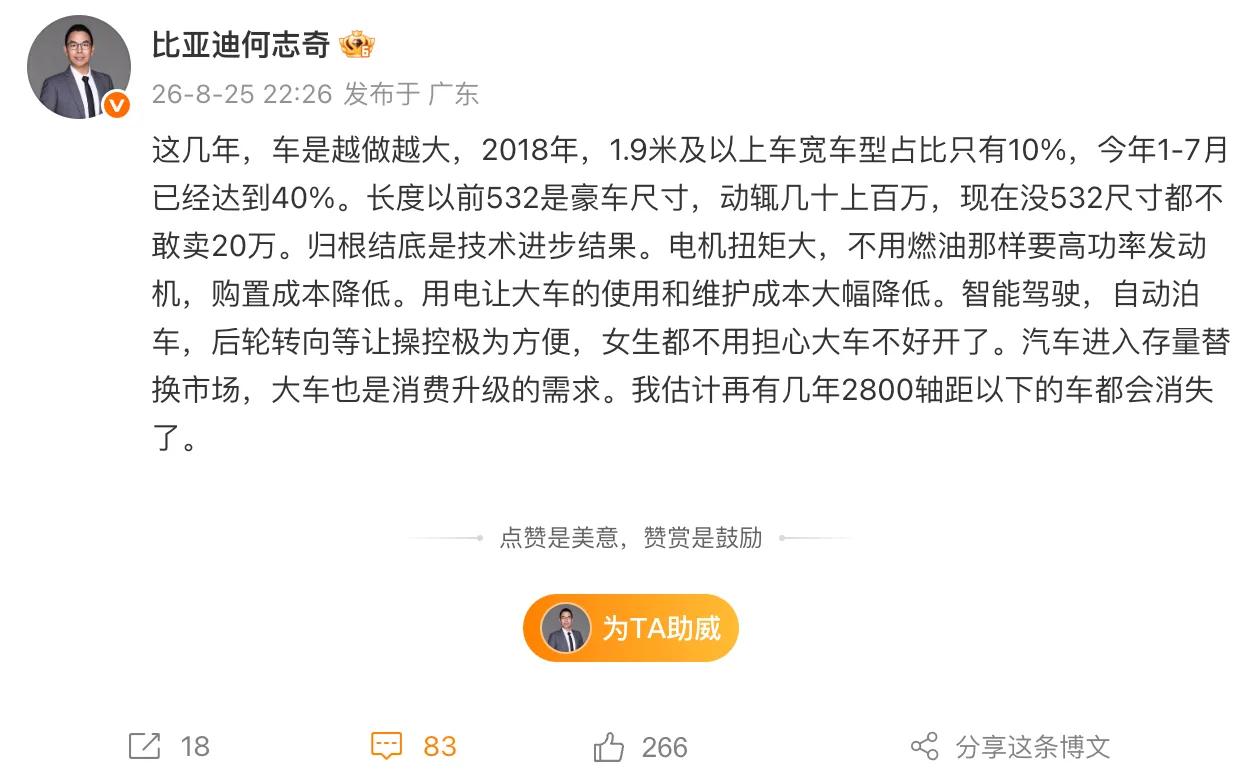
(Source: Screenshot from Weibo)
After entering the electrification era, the size of automobiles has visibly "expanded". B-class vehicles have sunk into the market below 100,000 yuan, and D-class vehicles can be purchased for less than 200,000 yuan. However, does the rise of large-sized vehicles really mean that small-sized vehicles will completely die out?
In the stock competition era, large space becomes the core competitiveness
The change of vehicle size is closely related to market demand and technological development. Previously, Dianchetong (ID: dianchetong233) discussed the issues of width and weight of new energy vehicles. To accommodate large batteries, new energy vehicles have reached the width level of sports cars, and their weight far exceeds that of fuel vehicles of the same class. The same goes for body size, and large vehicles better meet the needs of current domestic consumers.
As He Zhiqi said, China's automobile market has entered an era of stock competition. When consumers replace their cars, they pursue "experience upgrading". The large space and imposing manner brought by large size is an experience improvement with extremely obvious differences. There is more headroom, more legroom in the back row, which can be perceived as soon as you sit in the car. The oppressive imposing manner brought by large size is also visible at a glance.
Therefore, the rear legroom, trunk volume, and vehicle quietness, which used to be bonus configurations, have become hard thresholds for many families when purchasing cars.
In the era of fuel vehicles, a larger body means a sharp rise in curb weight. To maintain power performance, a large-displacement engine must be equipped, which leads to a simultaneous increase in purchase cost, fuel consumption, and later maintenance cost. In addition, the domestic automobile market in the fuel vehicle era was dominated by joint-venture car companies, and brand premium kept the prices of B-class and above large vehicles high, making it difficult for ordinary families to afford a large-sized family car.
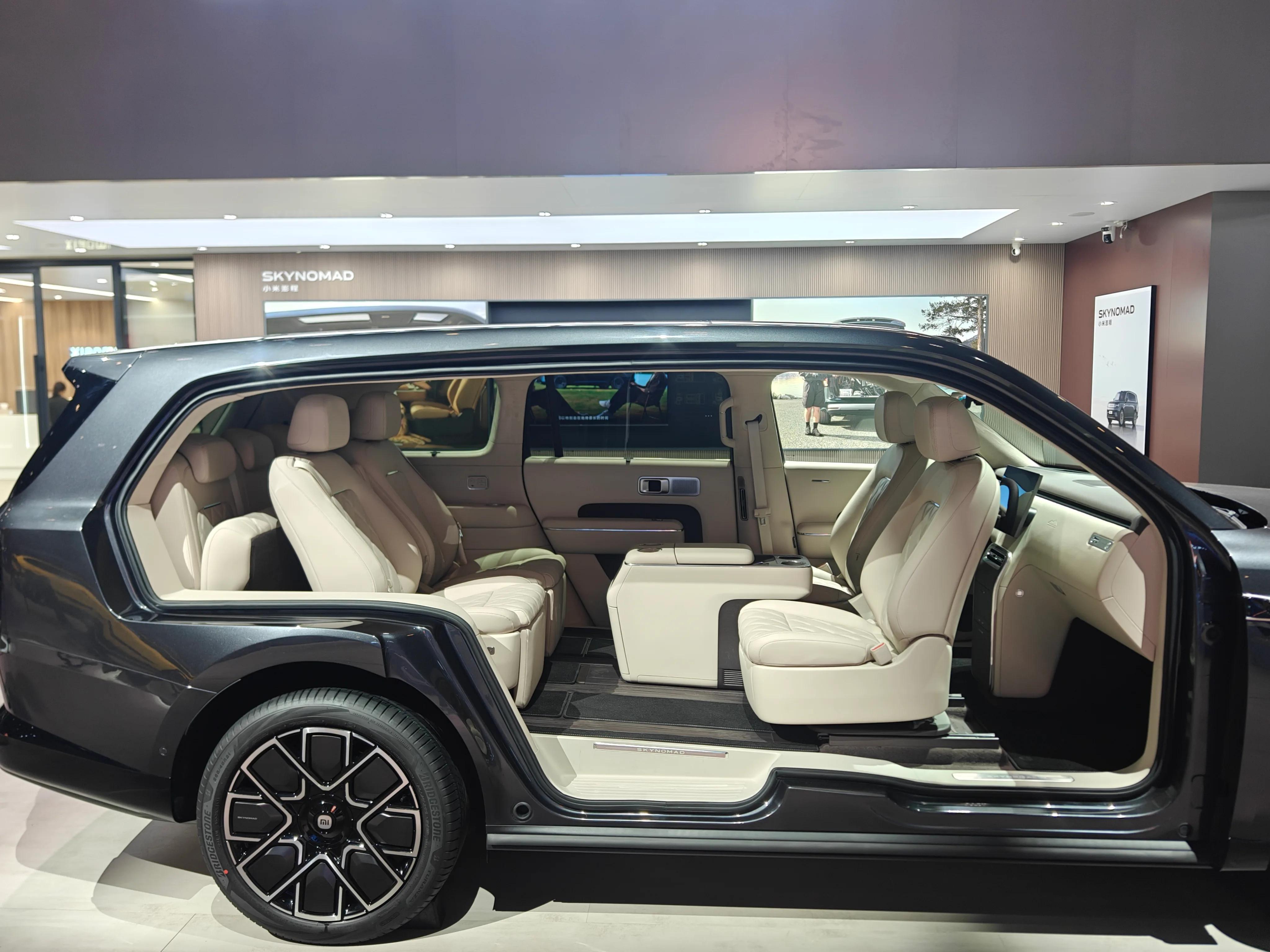
(Source: Shot by Dianchetong)
New energy vehicles are completely different. Motors are inherently capable of outputting high torque, eliminating the need for complex and expensive large-displacement powertrains, which will not cause a sharp increase in the cost of the power system.
The rapidly popular rear-wheel steering function enables D-class vehicles to have a turning radius comparable to that of A-class vehicles, ensuring flexibility. Intelligent driving technology further solves the problem of difficult manipulation and parking of large vehicles. Especially when encountering narrow parking spaces, large fuel-powered vehicles are inconvenient for passengers to get in and out after being parked, while high-end self-owned brand new energy vehicles can realize remote parking in/out, so that drivers do not need to "outsmart" the vehicles in the adjacent parking space.
Most importantly, with the efforts of self-owned brands, high-power motors, rear-wheel steering, and high-level intelligent driving are no longer configurations exclusive to million-yuan luxury cars. Take BYD Tang EV as an example, this car is priced from 239,900 yuan, the maximum power of the rear motor is up to 300kW/370kW, the high-end version also supports dual-motor four-wheel drive, and is equipped with ±7° rear-wheel steering and God's Eye B as standard.
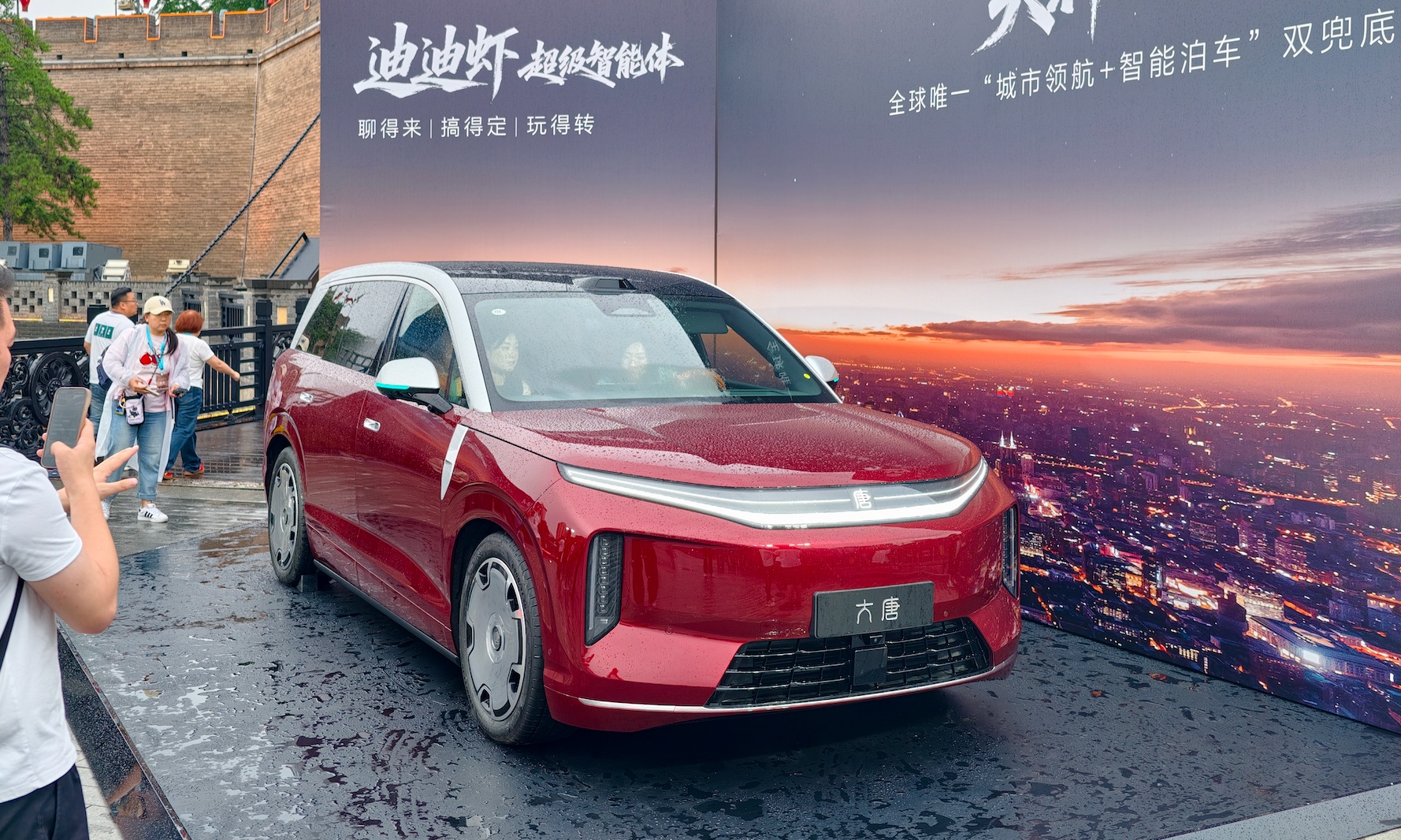
(Source: Shot by Dianchetong)
Models such as BYD Qin Max and Geely Galaxy Xingyao 7 Max, which are sized at B-class and even touch the threshold of C-class, have penetrated into the 100,000-yuan market. The price position that once belonged to A-class cars is being continuously eroded by larger models.
Consumers can buy B-class and C-class products with a wheelbase of more than 2800mm with the budget that used to buy a small A-class car, with comprehensive upgrades in space, chassis and configurations. There is no reason for us to reject this change in the automotive industry.
Dianchetong believes that electrification and intelligent technology have eliminated the shortcomings of large vehicles, stock replacement has spawned market demand, and the rise of self-owned brands with low brand premiums has jointly led to the surge in sales of large vehicles. The living space of traditional economical small vehicles is being continuously compressed, but the trend does not equal the end. The market tilts towards large size, which does not mean that models with small wheelbase will completely die out.
Small vehicles will not disappear, scenarios determine demand
Simply looking at the full-scenario family travel, large vehicles almost completely outperform small vehicles. They have larger riding space, better configuration expansion capability, and longer battery life, which are far beyond the reach of small vehicles. However, not everyone needs to drive a large vehicle with the whole family on the highway. In urban usage scenarios, small vehicles still have irreplaceable value that large vehicles cannot match.
Many cities in China have large areas of old urban areas built in early years, where roads are narrow, two-way two-lane roads are everywhere, roadside parking spaces are cramped, and garages in many communities follow old standards from many years ago, with parking spaces less than 2.4 meters wide being common. Due to the high car ownership in first-tier and second-tier cities, the traffic congestion problem in old urban areas is even more serious.
Driving and parking in such an environment is a test of driving skills. Compared with large vehicles, small-sized vehicles have better trafficability and are easier to park.
In Japan, where traffic pressure is greater, relevant authorities have specially formulated regulations to restrict consumers from buying large vehicles. K-Cars, which are narrower than the common A00-class cars in China, have become the mainstream models in Japan. Due to urban construction problems in some developed countries in Europe, small vehicles are also very popular, and many vehicles are equipped with anti-scratch strips, with bumpers regarded as consumables.
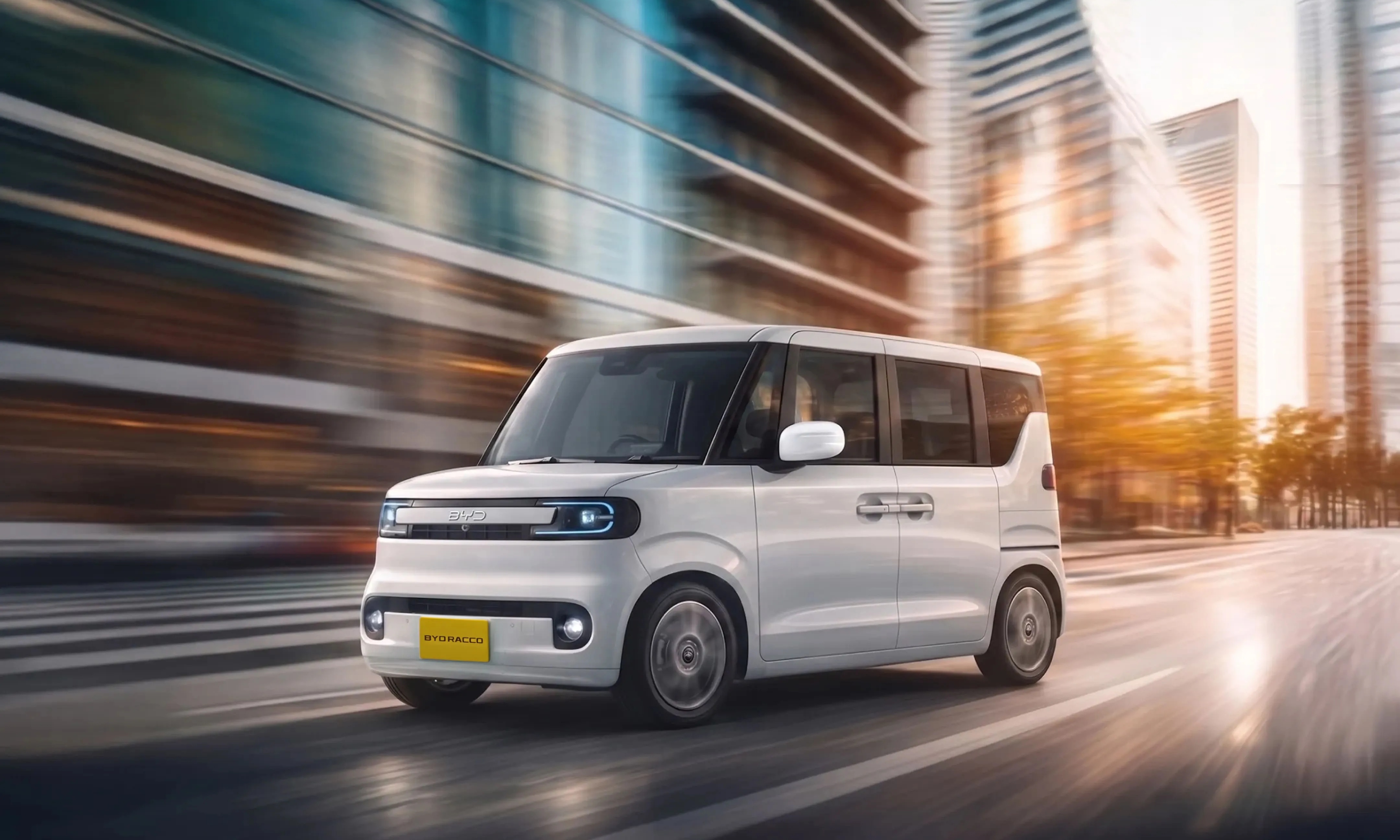
(Source: BYD)
Domestic car ownership is increasing day by day, and traffic pressure will only become greater. In the future, compact A00 to A-class vehicles will have considerable application scenarios.
In addition, although large vehicles are good, not everyone needs them. The economy of small vehicles is temporarily irreplaceable by large vehicles. Although domestic car companies have compressed the cost and profit margin of the whole vehicle in various ways to achieve small profits but quick turnover, there is a marginal limit to the cost reduction of the whole vehicle. In short, no matter how much cost is saved for large vehicles, they will use more steel than small vehicles.
While large vehicles are reducing prices, small vehicles can also cut prices to maintain a leading price advantage. Due to their light weight, small vehicles have low energy consumption per 100 kilometers, and the cost of using them for daily commuting, grocery shopping, and picking up children in family scenarios is also lower.
From the perspective of Dianchetong, in the field of full-scenario family travel, large vehicles, with spacious riding space, rich configuration expansion capability and better battery life performance, have comprehensively outperformed small vehicles in overall strength, and are the preferred choice for long-distance family travel and all-scenario mobility. However, automobile consumption is not a single full-scenario demand. The crowded and complex urban road conditions make small vehicles have irreplaceable value.
Even if large vehicles continue to cut prices and penetrate into lower market segments, small vehicles can still rely on their extreme price advantages and lower daily car maintenance and commuting costs, making them more suitable for lightweight usage scenarios such as single-person commuting and short-distance pick-up.
It should be noted that body size cannot be simply equated with experience. Intelligent or comfort configurations will also affect the experience of passengers in the car. In the future, small vehicles may embark on a high-end refined route.
Refinement becomes the only way out for A-class small vehicles
Although the cost and price of large vehicles will not really be lower than that of small vehicles with the same configuration, after the price gap between the two narrows to a certain extent, consumers may pay more to upgrade the size. Just imagine, if A-class cars and B-class cars with similar configurations are placed in front of you, and the price difference is only 5,000 yuan, would you like to pay more for the B-class car?
Dianchetong believes that small vehicles will eventually embark on a refined route like brands such as Mercedes-Benz smart, BMW MINI, and NIO Firefly, instead of continuously cutting prices to fight price wars with large vehicles.
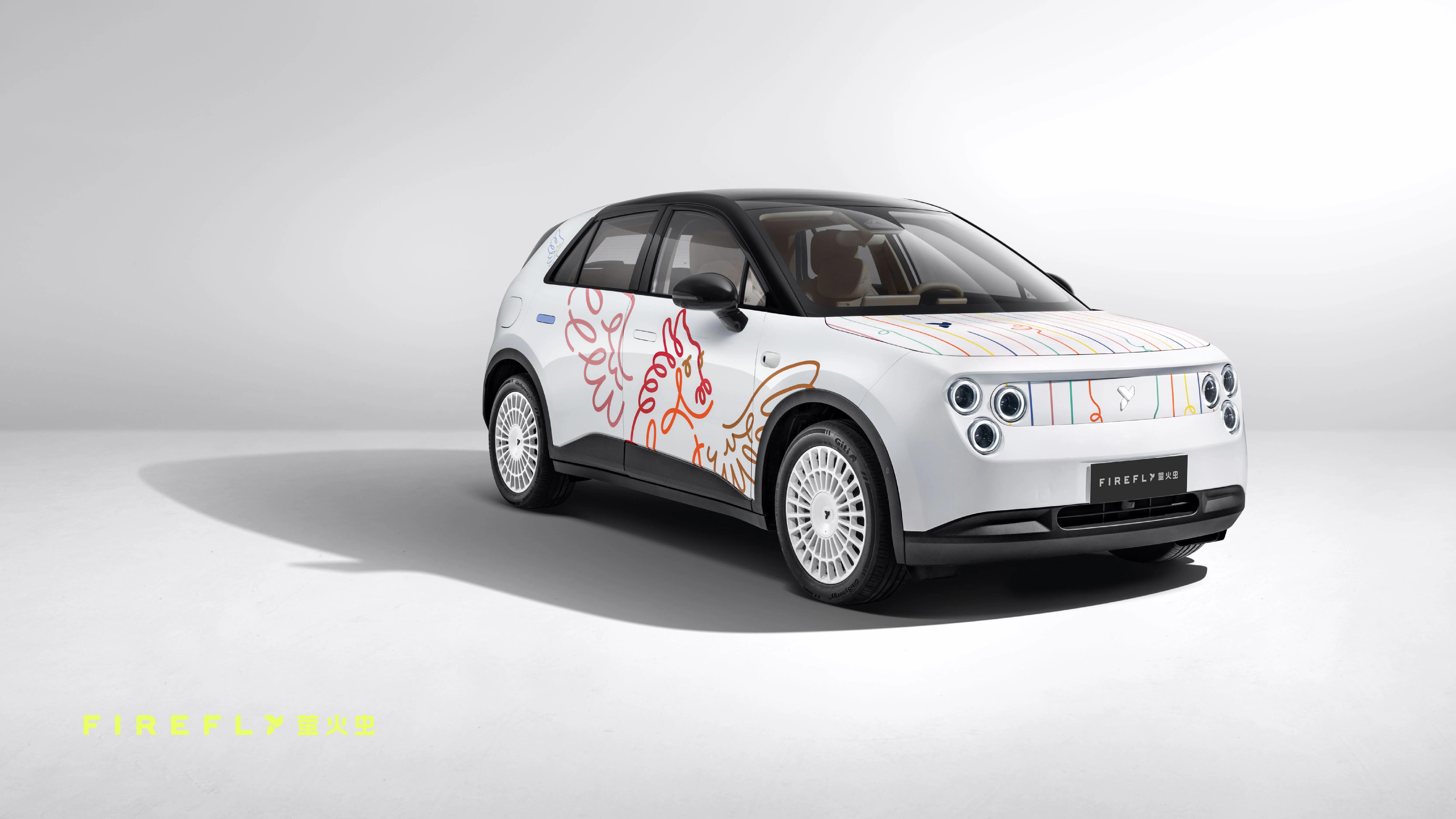
In the first half of this year, the cumulative sales volume of Firefly reached 29,172 units, a year-on-year surge of 271.9%, with an average monthly sales volume of nearly 5,000 units. In July, 5,771 new Firefly units were delivered, maintaining year-on-year growth. The success of Firefly proves the possibility of refined small vehicles. But before achieving refinement, car companies still need to establish a high-end brand image.
(Source: Firefly)
The hot sales of Firefly are inseparable from the long-term brand image built by NIO, as well as its intelligent and comfort configurations that surpass products of the same class. High-end configurations such as high-level intelligent driving, seat massage, and battery swapping are all available on Firefly.
Models such as Leapmotor A05, BYD Seagull, and Wuling Bingo are already creating refined small vehicles by equipping with high-level intelligent driving and high-end configurations. Among them, BYD Seagull, relying on BYD's brand influence, has monthly sales of more than 20,000 units, but its selling price and configurations are relatively low, which can only be regarded as initially reaching the "refined level", and there is still room for improvement in product power and price. Wuling Bingo and Leapmotor A05 need car companies to further improve brand recognition.
In general, the prices of B/C-class models continue to drop, constantly squeezing the living space of traditional economical small vehicles, but A00 to A-class small vehicles will not completely die out.
Small vehicles are flexible and highly economical, and still have irreplaceable advantages. In the future, strengthening personalized design, intelligent configurations and brand tonality, and focusing on lightweight travel demands such as single-person commuting and short-distance mobility may become the main development direction of small vehicles.
This article is from "Dianchetong", authorized for release by 36Kr.