FAW buys efficiency, Leapmotor trades for scale
The Second Algorithm of Scale.
Last March, when FAW and Leapmotor signed their first cooperation agreement, the two sides announced three cooperation directions: joint development of new energy passenger vehicles, carrying out component cooperation, and exploring capital cooperation.
In the automotive industry, such strategic memorandums with wide coverage are not rare. They can be the starting point of long-term cooperation, or they may only remain at the signing ceremony stage.
17 months later, the two sides have signed three agreements. At the end of last year, FAW subscribed for about 5% of Leapmotor's shares with 3.744 billion yuan, and its subsidiary Qixin Power signed a powertrain cooperation agreement with Leapmotor at the same time. In August this year, the scope of cooperation was further expanded to ten fields including complete vehicles, assisted driving, power batteries, intelligent chassis, embodied intelligence, and body process equipment.
The progress of the two projects was disclosed simultaneously. The first model jointly developed by the two sides is about to be mass-produced; the hybrid engine of Qixin Power will provide supporting parts for Leapmotor's global models.
FAW integrates Leapmotor's technology into the Hongqi brand, and Leapmotor installs FAW's engines into its global models. The two sides have begun to become core partners of each other.
Leapmotor's Second Type of Scale
On August 24, Leapmotor released its interim performance. In the first half of 2026, Leapmotor delivered 356,500 vehicles, a year-on-year increase of 60.8%; the revenue reached 38.11 billion yuan, a year-on-year increase of 57.2%; the net profit was 210 million yuan. In July, Leapmotor's monthly delivery volume exceeded 100,000 units for the first time.
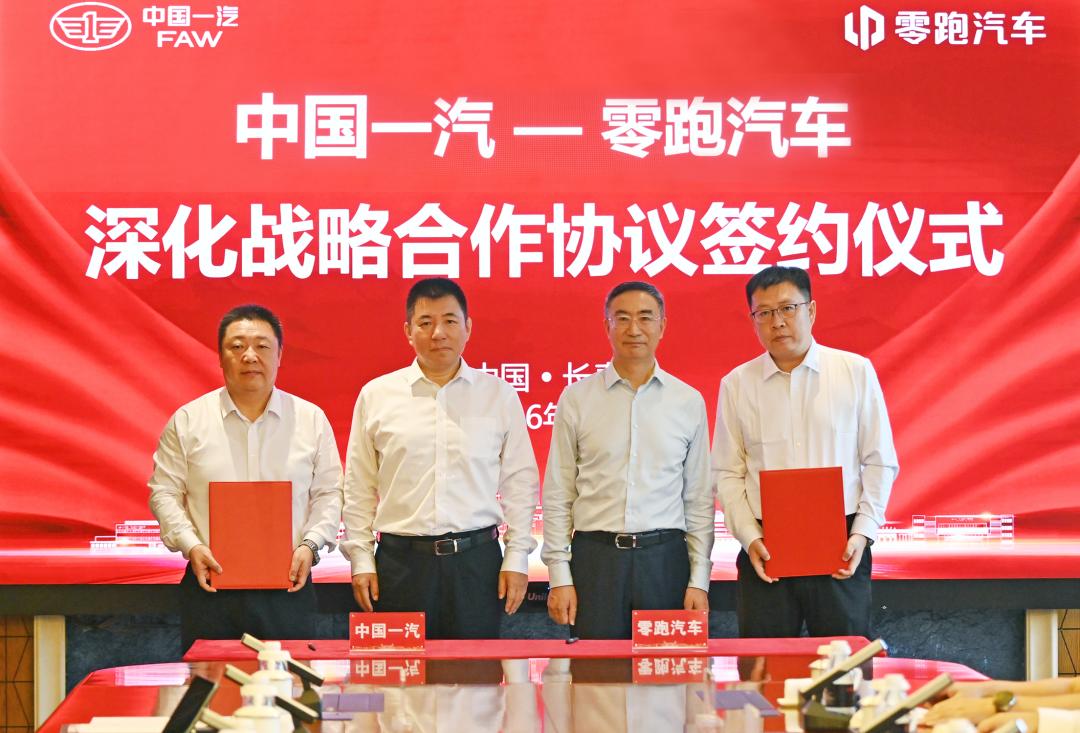
On the same day, Leapmotor also signed an in-depth strategic cooperation agreement with FAW in Changchun.
The two sides first signed a memorandum of understanding last March, agreeing to jointly develop new energy passenger vehicles, carry out component cooperation, and study capital cooperation. At the end of last year, FAW subscribed for 74.83 million domestic shares of Leapmotor at a price of 50.03 yuan per share, investing 3.744 billion yuan, with a shareholding of about 5%. Qixin Power, a subsidiary of FAW, signed a powertrain cooperation agreement with Leapmotor at the same time.
The cooperation completed in August this year is the third signing between the two sides within 17 months. It is worth noting that the projects negotiated in the first two times have entered the delivery period. Li Tengfei, Vice President of Leapmotor, previously stated that the first cooperation project between the two sides is Hongqi's overseas model. The latest public statement shows that this vehicle is about to be mass-produced.
FAW thus obtained a set of market-verified new energy platforms, as well as the electronic and electrical architecture, battery, chassis and component systems extended from the platform. Compared with re-establishing a project for development, the cooperation with Leapmotor shortens the cycle for a new energy model to enter the market.
The resources Leapmotor obtained are more diversified. The 3.744 billion yuan investment, engines from Qixin Power, FAW's industrial resources, and a large external customer.
Judging only from the financial report, Leapmotor has no shortage of cash. By the end of June this year, Leapmotor's cash, time deposits and financial assets totaled 38.59 billion yuan. Leapmotor's operating cash flow in the first half of the year was 2.17 billion yuan, which is still positive.
However, for new car-making enterprises that are aggressively expanding globally, cash is still a safety cushion for future strategies. In the first half of this year, Leapmotor's capital expenditure was 2.03 billion yuan, and there was another 7.76 billion yuan in capital commitments, mainly used for factory equipment and production lines for new models.
According to the subscription plan, about half of the funds invested by FAW will be used for R&D, and the other two parts will be used to supplement working capital, expand sales and service networks and brand building.
Leapmotor's need for continuous investment is related to the competitive method it chooses.
The company's self-developed and self-manufactured high-value-added core components cover about 65% of the total vehicle cost, the platform generalization rate exceeds 88%, and 18 core component factories have been built. Battery packs, electric drives, domain controllers, electronic and electrical architectures and chassis control systems are reused between different models, and R&D expenses, molds and production equipment are allocated to more vehicles.
This vertical integration helps Leapmotor control costs, enabling it to rely on the "cost pricing" strategy for a long time to compete with much larger competitors. But it also increases the company's fixed costs. Self-built production lines require stable orders, the R&D team needs to continuously launch new platforms, and the capacity utilization rate of the factory directly affects the profit per vehicle.
In 2025, Leapmotor tasted the benefits of scale for the first time. Its annual sales volume doubled, revenue increased by 101.3%, the total of sales, management and R&D expenses increased slowly, and the expense ratio dropped from 19.1% to 15.2%. Leapmotor thus crossed the annual break-even point.
In the first half of this year, Leapmotor's product system and scale continued to expand. The A series entered a lower price range, the D series expanded upward, and the overseas network continued to spread. The resulting performance is significant, with Leapmotor's sales volume increasing by 60.8%.
However, the growth of sales volume also brings new investment in R&D, manufacturing and sales. Leapmotor's gross profit margin in the first half of the year was 11.7%. The company stated that the reasons limiting the improvement of gross profit margin include rising raw material prices and changes in product mix.
As sales expand, the growth rates of revenue and profit begin to diverge. Relying solely on the sales volume of the Leapmotor brand, all fixed investments have to be recovered from its own models.
External customers provide another path for cost allocation.
FAW's procurement of Leapmotor's batteries, domain controllers or chassis systems can improve the utilization rate of component factories; joint models can share platform R&D and engineering verification investment; after the same set of architecture is applied to more products, Leapmotor's own models can also obtain lower costs.
Leapmotor has previously provided components and technologies to some external customers. FAW has larger scale and higher requirements. To enter the mass production projects of large automotive groups, it is necessary to pass complete R&D processes, quality standards, durability verification and continuous supply assessment.
After the first model is successfully mass-produced, Leapmotor will obtain a case where a large domestic automaker adopts its complete vehicle platform and core technology.
The Qixin Power engine constitutes reverse supply. Leapmotor has not built its own engine system, and its range-extended models have long used outsourced engines, with suppliers including Dong'an Power, Xiaokang Power and Geely's Aurora Bay. Qixin Power's entry into Leapmotor's global models meets real demand and also increases Leapmotor's supply options.
There are already many mature solutions in the engine market, and Leapmotor retains room for selection. The new energy platform and product efficiency that FAW needs are more difficult to re-establish in the short term. The two-way procurement in the agreement forms a closed loop for cooperation, and the scarcity of resources invested by both sides is still different.
Why is Leapmotor Getting Closer to FAW?
FAW is the second important strategic shareholder of Leapmotor in the complete vehicle enterprise sector.
In 2023, Stellantis invested about 1.5 billion euros to obtain about 20% of Leapmotor's shares. The two sides subsequently established Leapmotor International, in which Stellantis holds 51% of the shares, responsible for the sales and production of Leapmotor vehicles in global markets outside Greater China.
The revenue brought by this cooperation can already be seen in Leapmotor's financial statements.
In the first half of this year, Leapmotor exported 96,300 vehicles, a year-on-year increase of 372.6%, exceeding the total export volume of 2025, accounting for 27% of the total delivery volume. Revenue in Europe rose from 1.85 billion yuan in the same period last year to 8.88 billion yuan; Leapmotor International has established more than 1,000 sales and service outlets in 45 overseas markets, including more than 900 in Europe.
Overseas sales also bring in carbon credit revenue. Leapmotor's service and other revenue in the first half of the year increased from 1.15 billion yuan to 2.51 billion yuan, a year-on-year increase of 118.3%. The financial report attributes the growth mainly to carbon credit transactions driven by increased overseas sales.
Stellantis initially helped Leapmotor sell vehicles, providing channel and after-sales resources for Leapmotor's overseas sales. Now, the cooperation has expanded to the component and platform level.
In May this year, the two sides announced plans to produce the B10 at the Zaragoza plant in Spain, and evaluate a brand-new Opel C-class pure electric SUV. According to the information released by Opel, the new car is planned to adopt the core components of Leapmotor's latest pure electric architecture and battery technology, while retaining Opel's design, chassis, cockpit and seat systems.
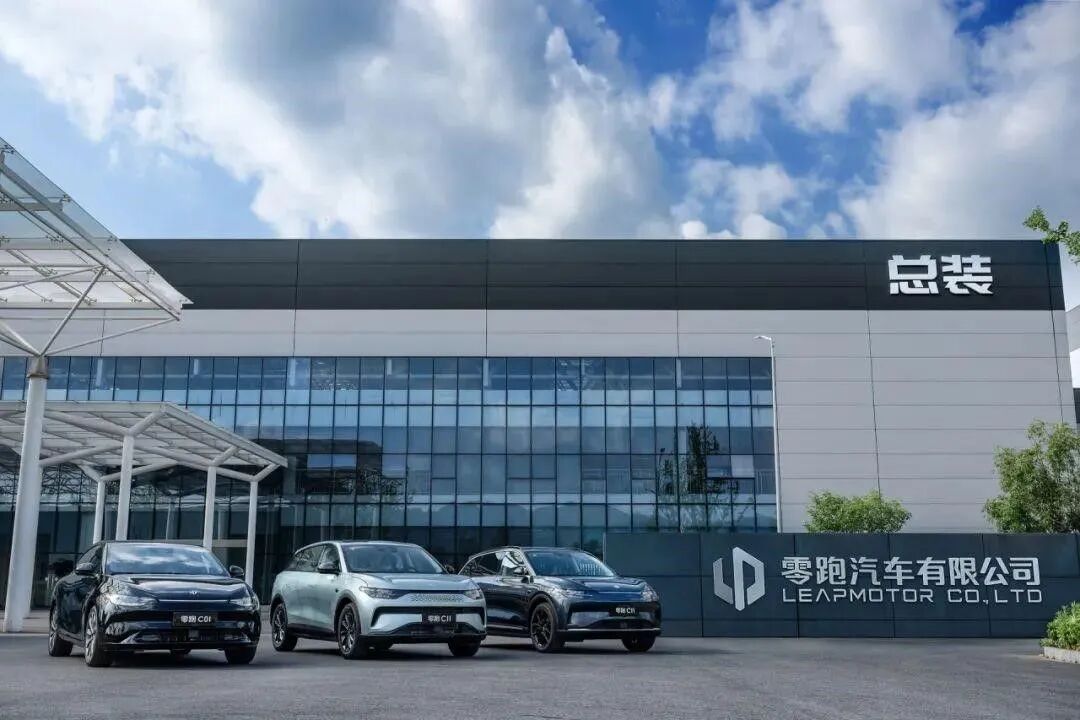
The relationship between Leapmotor and Stellantis has evolved from channel borrowing to technical supply. The Opel project provides an intuitive sample that Leapmotor's architecture and batteries can supply new energy core components to international customers beyond its own brand's products.
FAW and its influential brands are a complete test of this cooperation model in the Chinese market. The mass production of the jointly developed Hongqi model shows that Leapmotor's platform has completed the adaptation of another set of product definition, development process and quality system; the cooperation in batteries, assisted driving and intelligent chassis extends a single vehicle project to repeatable component supply.
The external supply of core components can directly bring revenue. In the current market environment, the profit may not be lower than that of complete vehicles.
More critically, Leapmotor's strategy of high self-development and complete vehicle cost pricing is highly dependent on scale, which determines the cycle in which Leapmotor needs to dilute costs and R&D expenses.
Previously, the realization of scale could only rely on the increase of complete vehicle sales. With the opening of external component supply, there is a new way to achieve scale in the future. When the same set of platforms and core components are applied to other brands, the denominator of scale can be expanded from Leapmotor's sales volume to the total installed capacity of Leapmotor's technology.
Leapmotor's financial report still discloses the revenue of complete vehicles and components together, and the relevant revenue in the first half of the year was 35.6 billion yuan. The second type of scale has not yet formed an independent accounting item, and the clearer evidence currently comes from the product plans of Hongqi and Opel.
When the industry enters the knockout round, scale will be self-reinforcing. Procurement volume determines component cost, sales volume determines R&D allocation, and cash flow determines the next round of investment.
Zhu Jiangming once said that Leapmotor wants to be the "UNIQLO" of the automotive industry. In the past, this metaphor pointed to highly versatile platforms, vertical integration and more sales. Now it has an additional layer of meaning.
Leapmotor crossed the break-even point by relying on the first type of scale. But the second type of scale represents its resilience in the next round of competition.
This article is from the WeChat official account "Auto Pixel", author: Hu Chengxu, published with authorization from 36Kr.