Is the narrative that AI is killing SaaS starting to reverse?
Following CRM's earnings report yesterday, IGV surged roughly 7.74% to $110, with a 7.5% increase year to date and a 47.74% rebound from this year's lowest point. Software stocks staged their strongest collective recovery of the year: Salesforce rose 22.6% in a single day, ServiceNow climbed more than 9%, while Adobe, Fortinet and other peers also trended upward in tandem.
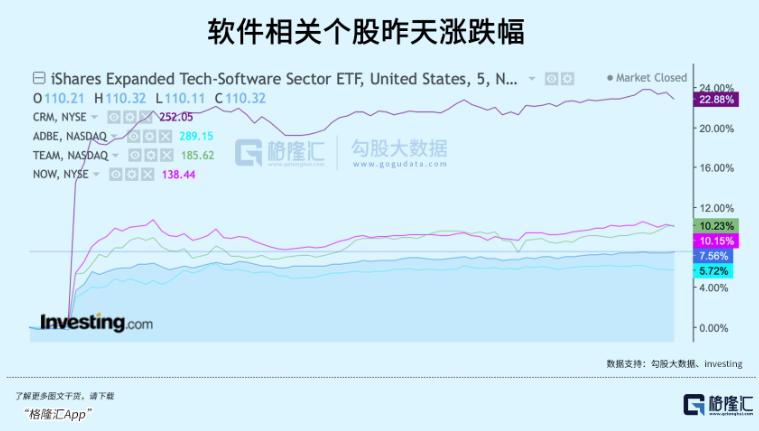
This is completely different from the market narrative at the start of the year, when the biggest concern was that AI would boost labor efficiency, reduce corporate headcount, and eventually eliminate seats — the most critical billing unit for SaaS. "AI kills SaaS" once became the dominant trading logic for software stocks.
Does last night's rally mean the "AI kills SaaS" narrative has begun to be disproven by actual performance?
01. Back then, the market truly believed SaaS was doomed
By the end of January this year, sentiment toward software stocks had already started to deteriorate.
On January 29, the earnings reports of SAP and ServiceNow first poured cold water on the market. SAP plummeted more than 16% as its cloud business and full-year guidance fell short of expectations, and ServiceNow also dropped 11%.
Worse still, the market quickly escalated "underwhelming earnings of individual companies" into an industry-wide issue: as AI grows increasingly powerful, can traditional SaaS sustain the growth rates it delivered in the past?
On that day, Salesforce fell 7.1%, Atlassian dropped 12.6%, Datadog slid 8.3%, and Intuit declined 7.8%, with almost the entire software sector taking a hit collectively.
The next day, AI dealt another blow. On January 30, Google opened up Project Genie, which can directly generate interactive virtual worlds via prompts, causing Unity to plummet roughly 22% that day.
On the same day, Anthropic launched plugins for Claude Cowork targeting scenarios including legal services, sales, marketing, and data analytics. The market suddenly realized that AI was no longer satisfied with "assisting software operations", and had started to directly encroach on the core revenue streams of software companies.
Panic fully erupted on February 3. Investors began to reprice Anthropic's suite of plugins: if Claude can independently perform contract review, sales follow-up, and data analysis, do enterprises still need to purchase so many vertical SaaS products? That day, software and data service stocks in the US and Europe tumbled again, with Thomson Reuters down nearly 16%, LegalZoom down 20%, and traditional software stocks such as Salesforce remaining under pressure.
Moreover, this was not a short-term sentiment blip. In the following quarter, software stocks never truly recovered. The S&P 500 Software & Services Index posted a maximum drawdown of over 33% from its October 2025 high to April this year.
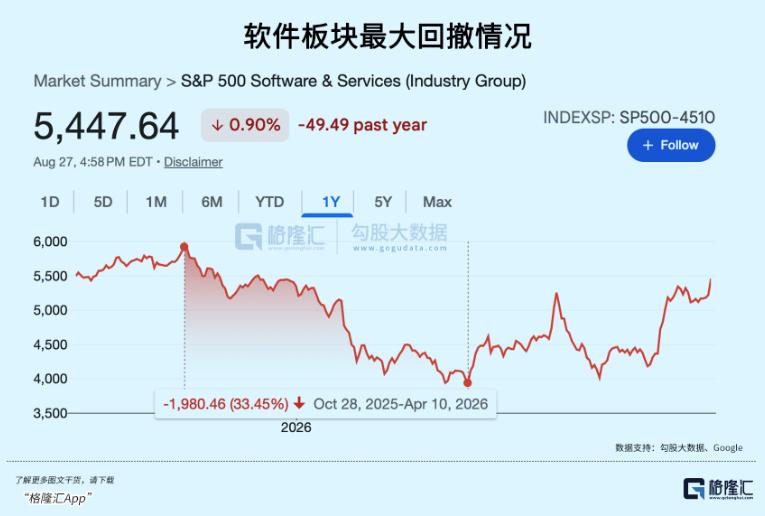
The market's logic back then was very straightforward:
AI improves labor efficiency → enterprises hire fewer people → fewer seats; agents further bypass the software UI directly → SaaS may even lose its entry-level value entirely.
For a time, "AI kills SaaS" almost became the most mainstream trading logic for software stocks.
02. Business performance starts to pour cold water on the "AI kills SaaS" narrative
Half a year later, the first batch of companies that were hit hard by the sell-off have begun to release their earnings results.
Atlassian fired the first shot of the counterattack: its CY27Q2 earnings report sent its share price up more than 35%, with total revenue rising 28% year over year and cloud revenue growing 31%, accelerating from the 26% and 29% growth rates recorded in previous quarters. Its RPO (Remaining Performance Obligation) increased 44% year over year, and the number of large enterprise contracts also hit a record high. More critically, the cloud business beat expectations primarily driven by cross-sell and seat expansion, as customers are indeed purchasing more products and adding more seats.
The usage of its AI product Rovo is even more notable. Rovo can be understood as Atlassian's built-in enterprise AI assistant, which can access internal company projects, documents and knowledge bases, helping employees search for information, summarize content and execute tasks.
Customers using Rovo completed 20% more work items in Jira — the project management and task tracking tool — than other customers; they also created or edited 25% more pages in Confluence — the enterprise internal knowledge base and collaborative document tool. The number of Jira tasks and Confluence pages automatically generated via the AI interface even nearly quadrupled month over month.
This set of data directly addresses the market's biggest prior concern. After AI improves labor efficiency, the volume of code, tasks, documents and collaborative work has not decreased — instead, it has increased. Atlassian originally primarily helped enterprises "manage work done by people", and now it has begun to evolve into a system that "manages work generated by both people and AI".
Salesforce delivered a similar signal.
Its Q2 revenue only grew 11%, which does not look particularly impressive on the surface, but the far more critical new order metric NNAOV posted its fastest growth in four years, cRPO grew 14% at constant exchange rates, and the company explicitly projected that organic revenue growth will re-accelerate in the second half of the year.
Meanwhile, the ARR of Agentforce and Data 360 has reached nearly $3.9 billion, representing a year-over-year increase of more than 210%; Agentic Work Units hit 3.2 billion this quarter, up 97% month over month, and bookings for premium SKUs such as Agentforce One Edition doubled month over month.
The underlying logic is also very clear. AI allows one salesperson to engage with more customers at the same time, and enables one customer service agent to handle more cases, but every interaction generates more customer data, more workflows and more API calls.
Salesforce holds the most critical customer context of enterprises. The more data it accumulates, the more dependent agents will be on its platform. As a result, the business that used to charge purely on a seat basis has begun to layer in premium SKUs, data services and consumption-based billing.
Yesterday, the entire software sector was pulled up directly: ServiceNow rose roughly 10%, Adobe climbed about 6%, Fortinet gained nearly 10%, CrowdStrike surged more than 18%, and Autodesk went up nearly 6%; IGV posted a single-day increase of roughly 7.74%, marking one of its strongest single-day performances of the year.
Half a year ago, the market's formula was: AI improves labor efficiency → fewer employees → fewer seats → declining SaaS revenue.
The earnings reports now present a different path: AI improves labor efficiency → per-employee output surges → higher volume of work, data and interactions → SaaS platforms capture even more value instead.
03. The logic of SaaS may be shifting from "selling headcount" to "selling workload"
Over the past decade, the most classic growth formula for SaaS was: as enterprise headcount grows, the number of seats increases, and software revenue rises accordingly. That is why when AI first started to pressure software stocks, the market's biggest fear was that this formula would fail — fewer people would naturally mean fewer seats.
But in the agent era, what truly needs to be redefined may be "software demand" itself. The number of enterprise employees may decline, but tasks, transactions, data calls and automated workflows in the digital world will not necessarily decrease — instead, they will likely grow rapidly as AI boosts production efficiency. In the future, the unit for measuring software value may gradually shift from "how many people are using it" to "how much work the system is processing".
Billing models will also evolve accordingly. In addition to traditional seat subscriptions, AI premium tiers, consumption-based billing per call, data processing and automated execution all have the potential to become new revenue streams. Software companies will ultimately earn revenue not just from employee accounts, but from the massive volume of digital work that enterprises generate and process every day.
Moats will also shift. As AI models themselves become increasingly accessible, the truly scarce assets are the long-accumulated internal enterprise data, permission relationships and business workflows.
Whoever controls the core System of Record and workflows will more easily become the underlying system where agents actually perform work; conversely, software that only provides a simple UI layer and lacks proprietary data and workflow accumulation faces a higher risk of being replaced.
Therefore, this round of rebound in software stocks does not mean that all SaaS companies are safe. A re-segmentation is far more likely: in the past, all players grew together driven by seat expansion, but in the future, the key differentiator will be who can truly translate the productivity gains brought by AI into more calls, more data and a larger share of enterprise wallets.
Disclaimer: The copyright of this article belongs to the Research Team of Beijing Gelonghui Investment Consulting Co., Ltd. (Duan Yuehan, A0160625050003). This report is produced based on the principles of independence, objectivity, fairness and prudence, with all information sourced from public materials collected, extracted and edited legally, reasonably and appropriately.
Stock market investments carry risks, and caution is advised before entering the market. No investment recommendation in this article shall be deemed as a basis for your investment transactions. You must make your own independent investment decisions and bear all associated risks. Any entity or individual that without permission publishes, reproduces, disseminates, posts online or reposts this article will be deemed to have committed infringement, and the company will pursue legal liability against such infringers in accordance with the law.
This article is from the WeChat Official Account "Gelonghui Finance Hotspot" (ID: glh_finance), written by Gelonghui Editorial Team, and published by 36Kr with authorization.