Jensen Huang's latest interview: The rise in memory prices is a good thing!
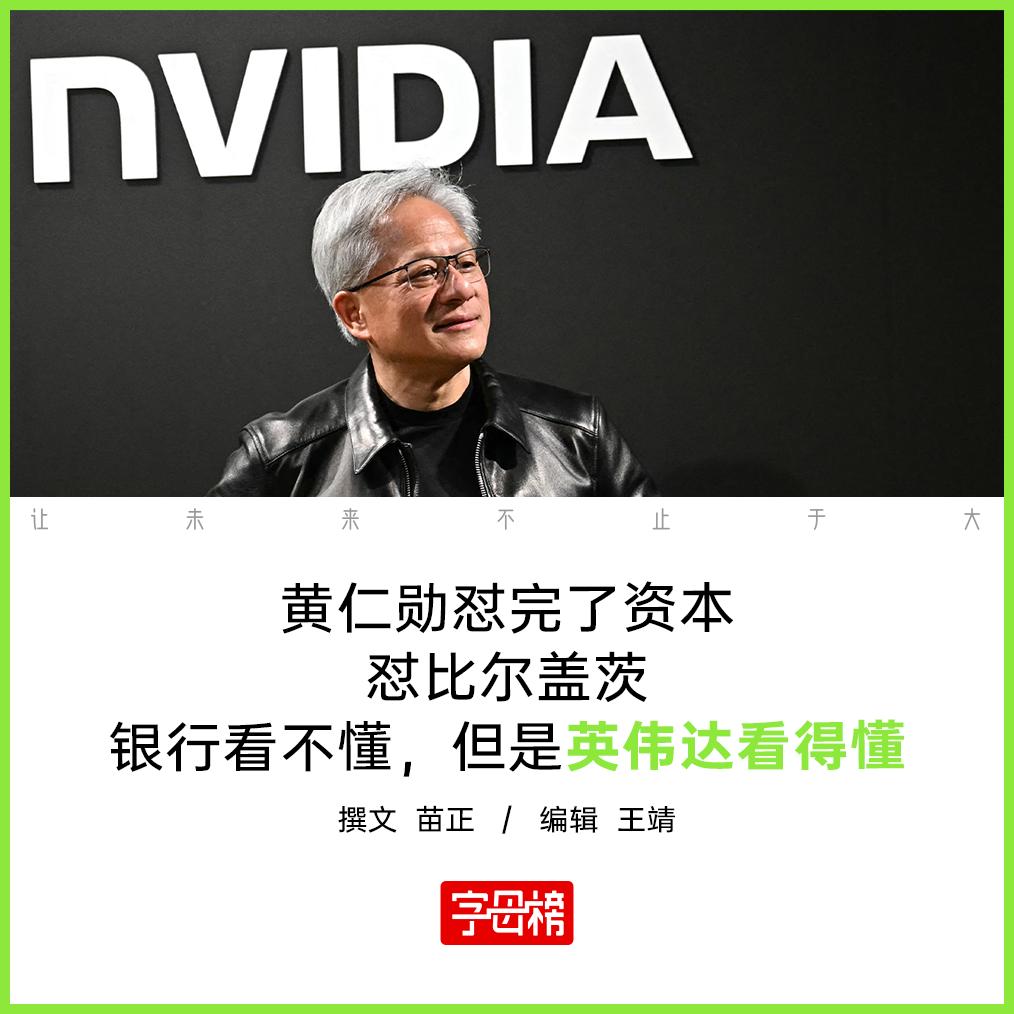
As Jensen Huang earns more and more revenue from AI business, NVIDIA has gradually fallen into a well-known pattern: its stock price almost always slumps on earnings release days. Among the past 8 earnings announcement dates, NVIDIA's stock posted declines for 6 times. This quarter is no exception. After the release of the second-quarter financial report for FY2027, NVIDIA's share price once dropped by more than 3%, and closed down 1.59%.
Not long before this earnings release, NVIDIA just experienced a 7-consecutive-trading-day losing streak.
On August 28, NVIDIA rallied 8.7% throughout the trading day, with its market capitalization surging by 442 billion US dollars in a single session, marking the largest one-day gain since April 2025. Its total market value reached 5.5 trillion US dollars, regaining its title as the most valuable company worldwide by market capitalization.
After the earnings report was published, Jensen Huang accepted an interview with overseas media. Although the interview only lasted 15 minutes, every question raised was targeted at the core concerns about NVIDIA's development.
For instance, the host asked Jensen Huang that Samsung and SK Hynix have raised memory prices one after another, whether this means NVIDIA is facing mounting profitability pressure. At present, capital markets generally regard memory price hikes as a negative factor for NVIDIA.
Jensen Huang admitted that NVIDIA has lowered its profit guidance for the next quarter.
However, Jensen Huang later stated that he does not think the memory price hike will bring negative impacts to NVIDIA. He explained that only when there are certain constraints in the supply system, can the most competitive technologies and optimal solutions be screened out, pushing all industry participants to improve efficiency, and ultimately making the whole industry and market more agile and competitive.
From Jensen Huang's perspective, the memory price hike is actually a favorable event for the long-term development of the industry.
A.
Jensen Huang said, "This quarter we decided to tear off the band-aid, reset the market's expectations for our gross margin, and make it clear to all stakeholders that we have absorbed the pressure of rising costs, and re-priced our products accordingly."
"Based on the new pricing structure, the gross margin next year will drop from the current 75% to the range between 72% and 73%," Jensen Huang noted.
To cope with the memory price increase, NVIDIA's solution is to raise the price of its own products. CFO Colette Kress officially confirmed for the first time during the earnings call that the prices of new-generation GPU chips including Vera Rubin and Grace Blackwell will be raised in the first quarter of next year. Market rumors say the price of the flagship new product Vera Rubin will increase by around 15%, which translates to a total cost of about 8 million US dollars for a full set of Vera Rubin server racks.
Jensen Huang said that instead of letting the market keep speculating and worrying continuously, it is more reasonable to complete cost transmission and expectation reset at one go, raise product prices directly in one step, and pass on the pressure of rising upstream costs.
In his view, the memory price hike is never an isolated incident, but an inevitable result of the surging demand across the entire AI industry.
Jensen Huang said that demand is growing at an accelerating pace. Although the current demand is already very strong, it is still continuing to rise faster.
"There are many bottlenecks restricting computing power supply apart from memory," Jensen Huang said. "Wafer manufacturing, advanced packaging, network transceivers, silicon photonic devices, power supply for data centers, qualified construction land, and even skilled technical workers are all facing tight supply."
Jensen Huang pointed out that AI "is the largest-scale infrastructure construction in human history, and no single link can fully keep up with its development pace."
Jensen Huang believes that the rise in memory prices is only the first part of the supply-demand imbalance across the entire industrial chain that is amplified by price signals. Rising prices are not trouble for the industry, but clear proof that market demand is strong enough. If the whole world is not scrambling for computing power resources, memory prices will never rise to such a high level.
Furthermore, Jensen Huang even holds the view that moderate supply constraints are not a bad thing at all.
"Having some constraints in the system is not a negative thing. It will push the most advanced technologies to emerge and the optimal solutions to win market recognition," he said. "This will make all participants more agile, and make the entire market operate more efficiently."
Rising prices will force memory manufacturers to speed up capacity expansion and develop more advanced memory technologies, and also push downstream AI companies to use computing power more efficiently, optimize model architectures, and eliminate low-value inefficient demand.
In the long run, Jensen Huang believes this is exactly a key part of the healthy development of the industry. No technological revolution ever occurs in a state of fully balanced supply and demand with no pressure at all.
B.
The day before NVIDIA released its earnings report, Bill Gates published a long article that sparked widespread heated discussions across the internet. He warned in the article that AI will replace a large number of white-collar jobs and cause severe employment shocks, so he proposed to levy taxes on AI-generated tokens, use the tax revenue to subsidize affected workers and help them transition to new jobs.
When asked directly about his opinion on this proposal in the interview, Jensen Huang gave an unambiguous answer: "My view is very different from his."
Jensen Huang does not deny that AI will bring changes to the occupational structure. "Of course some jobs will be changed, everyone's work will become different due to AI, and some positions will disappear," he said. "But more new jobs will be created. Throughout human history, this is what happens every time a revolutionary technology emerges."
His core judgment is that AI will eventually become the largest net job creator in human history, creating far more positions than it eliminates. Jensen Huang explained that there are two layers of logic behind this conclusion.

The first layer of logic: enterprise growth.
Many people think that "higher efficiency will lead to layoffs", but from Jensen Huang's perspective, this violates the basic laws of business operation. "The vast majority of enterprises have the ambition to expand their business. When AI makes enterprises more productive and more profitable, they will not choose to stick to their existing business and lay off staff to cut costs. Instead, they will invest the extra profits in new business tracks, explore new markets, and then hire more employees."
"When companies become more efficient, they will not lay off their staff, they will recruit more people," Jensen Huang added. "Because companies have the ambition for growth. When they are more productive and generate more profits, they will have the ability to invest more resources to pursue greater growth."
"Looking back at history, you will find that every time a revolutionary technology emerges and brings huge progress, it will eventually create net new jobs. I believe AI will follow the same rule this time."
Previously, Jensen Huang also expressed similar views: AI tools that process medical images do not make doctors lose their jobs, but assist doctors in making more accurate judgments, and improve the cure rate of diseases.
The second layer of logic: AI infrastructure construction.
"Don't forget that before AI is truly popularized in all industries, chip factories, packaging factories, server factories, and countless AI data centers are being built continuously on a global scale."
"As we speak, hundreds of thousands of new jobs are being created right now."
Jensen Huang said that from chip manufacturing engineers, advanced packaging technicians, to data center operation and maintenance personnel, and assembly line workers in server production workshops, the entire AI hardware industrial chain is absorbing a large amount of labor force around the world.
Jensen Huang attaches great importance to the economic value of this trend. He pointed out that in the past, the U.S. industrial structure was overly concentrated on white-collar positions, and this wave of AI infrastructure construction will cultivate a large number of skilled industrial workers, promote the re-industrialization of the United States, and make the overall economic structure more healthy.
In response to Gates' proposal of "taxing tokens", Jensen Huang also gave a tactful but clear negative response.
"First of all, I support paying taxes. For any high-productivity entity, making contributions to the society and the economy is a very positive behavior," he then raised his doubts: "But there are many different ways to solve problems. I do not see the problem that he described, what I observe is a completely different picture, so my proposed solution will also be different."
In other words, in Jensen Huang's view, the employment opportunities brought by AI far outweigh the challenges, and there is no need to adopt the idea of "restricting development through taxation" to deal with it. Instead of focusing on how to divide the existing cake, it is more meaningful to think about how to make the cake bigger together.
C.
As NVIDIA's influence in the industry keeps growing, the controversies surrounding Jensen Huang are also increasing. Overseas media once commented that NVIDIA is no longer a pure chip company, but has become the "banker of the AI boom". It sells chips to customers, makes investments in downstream companies, and even provides computing power guarantees for AI manufacturers, acting as both a supplier and an investor at the same time. This dual identity blurs NVIDIA's positioning and hides a large number of potential risks.
Jensen Huang responded directly to this question in the exclusive interview, dividing NVIDIA's industrial investments into two completely separate parts.
The first part is ecological venture capital. Jensen Huang said its operation logic is similar to that of traditional VCs, and the boundary of this business is very clear.
"We are investing in the entire industrial ecosystem, and in this regard we are just like venture capitalists. But the difference is that we only invest in companies that use NVIDIA's technology," Jensen Huang said. "We only invest in companies with extremely excellent teams, broad business prospects, core critical technologies, and that build their business on our platform."
He emphasized that NVIDIA does not distribute capital blindly, but is a "highly informed investor". Because NVIDIA has the deepest understanding of related technologies and the whole industry, it can accurately evaluate the value of target companies, and its investment returns are also very considerable.
Jensen Huang cited Elon Musk's SpaceX as an example, noting that NVIDIA was an early investor of SpaceX, and after SpaceX went public, this investment brought tens of billions of US dollars in returns.
From Jensen Huang's perspective, this kind of investment is not made to earn pure financial returns, but its essence is to cultivate the AI ecosystem. Helping more startups grow their business with NVIDIA's platform will eventually translate into long-term stable demand for NVIDIA chips.
The second part is about the market's accusation of NVIDIA's "computing power backstopping" business.
Jensen Huang explained that this kind of guarantee service is only provided to a very small number of top AI labs.
"These companies have very strong competitiveness, their businesses are at the inflection point of explosive growth and are starting to become profitable, but since they are not listed yet, they do not have investment-grade credit ratings, so they cannot get low-cost loans from traditional financial institutions to purchase the huge amount of computing power required to support their rapid growth."
"We have a clear picture of their business status, and we also know how critical computing power is to their growth," Jensen Huang said. "Now is the best time to help them activate their growth flywheel. I believe this will be a very high-quality investment, and it is also a strong support for two of the most important companies in the history of technology."
In other words, Jensen Huang does not consider this behavior as "lending money", he regards the whole process as a form of value endorsement based on NVIDIA's in-depth understanding of the industry.
Traditional banks cannot evaluate the value of AI companies' computing power assets and dare not lend to them, but NVIDIA can. It clearly knows how much value the tokens generated by these computing resources can create, and how high the growth certainty of these companies is, so it is willing to step forward to provide guarantees.
This article is from the WeChat official account LetterBoard (ID: wujicaijing), written by Miao Zheng, published with authorization from 36Kr.