Cities on the verge of joining the trillion-yuan GDP club are poised to open up a "new corridor"
From reports of Xinhua Daily and Xuzhou Daily, Xuzhou has recently officially released *Several Measures on Supporting the Innovation-Led Development of Xuzhou Science and Technology Innovation Corridor (Trial Implementation)*, rolling out 15 systematic measures covering three major systems of whole-chain innovation capability support, talent introduction and cultivation at all levels, and agglomeration development incentives, to accelerate the construction of Xuzhou Science and Technology Innovation Corridor and build an innovation source hub at the provincial border area of Jiangsu, Anhui, Shandong and Henan.
Focusing on local advantageous industries, key emerging industries under development and future industries to strengthen original innovation advantages, the new policy provides R&D project support ranging from a maximum of 10 million yuan to 2 million yuan for national (provincial) innovation centers and national (provincial) key laboratories settled in the Corridor; newly recognized national (provincial) future industry (technology) research institutes can obtain R&D project support ranging from a maximum of 2 million yuan to 1 million yuan.
In addition, high-level talents will be provided with project subsidies of up to 5 million yuan and housing purchase subsidies of up to 2 million yuan; for young talents, a three-in-one guarantee policy of "purchase, rent and subsidy" has been launched. Specifically for doctors, masters and undergraduate graduates who are employed within the Science and Technology Innovation Corridor and purchase their first house, housing purchase vouchers of 300,000 yuan, 120,000 yuan and 80,000 yuan will be issued respectively, which can be used superimposed by both spouses, demonstrating the sincerity of attracting and retaining talents with real money.
As the leader of the "Five Strong Cities in Northern Jiangsu", Xuzhou's economic volume has long ranked sixth in Jiangsu Province, and it is also the city closest to the "1-trillion-yuan GDP Club" following Suzhou, Nanjing, Wuxi, Nantong and Changzhou.
As early as 2021, the proposal for the 14th Five-Year Plan of Xuzhou put forward the goal of "striving to rank among the cities with a total economic output of 1 trillion yuan by 2025". Since then, this goal has been written into the government work report for four consecutive years.
However, Xuzhou failed to achieve the goal as expected by the outside world. In 2025, Xuzhou's GDP reached 995.72 billion yuan, still a step away from the 1-trillion-yuan threshold.
At that time, the local top leader of Xuzhou publicly stated that "we should not dwell on this number, nor should we be burdened by it".
Even so, some scholars pointed out through analysis that behind the seemingly tiny gap, it is actually exposed that the core driving force supporting Xuzhou's total economic output to break through the trillion mark is still insufficient.
As a traditional heavy industry city, Xuzhou started with resource-based industries such as coal and steel in the past. Although it has been promoting industrial transformation in recent years, the proportion of traditional industries is still relatively high, and the growth space of such industries is relatively limited, making it difficult to continuously provide strong incremental impetus.
Previously, Xuzhou also pointed out in its self-analysis that "insufficient innovation vitality and industrial strength are still prominent shortcomings of Xuzhou".
Data reflects this shortfall more intuitively: the intensity of R&D investment of the whole society in Xuzhou has long been lower than the average level of the whole country and the whole province; the proportion of high-tech enterprises and specialized, refined, differential and innovative "little giant" enterprises in the whole province is not outstanding.
For a major economic city aiming to rank among the cities with a GDP of 1 trillion yuan, this is undoubtedly a hurdle that must be crossed. Putting innovation in a more prominent position has become the choice of Xuzhou.
To this end, accelerating the building of a regional science and technology innovation center with national influence has become a key task that Xuzhou must accomplish. The key to solving the problem lies in the Xuzhou Science and Technology Innovation Corridor with a planned area of 101.3 square kilometers.
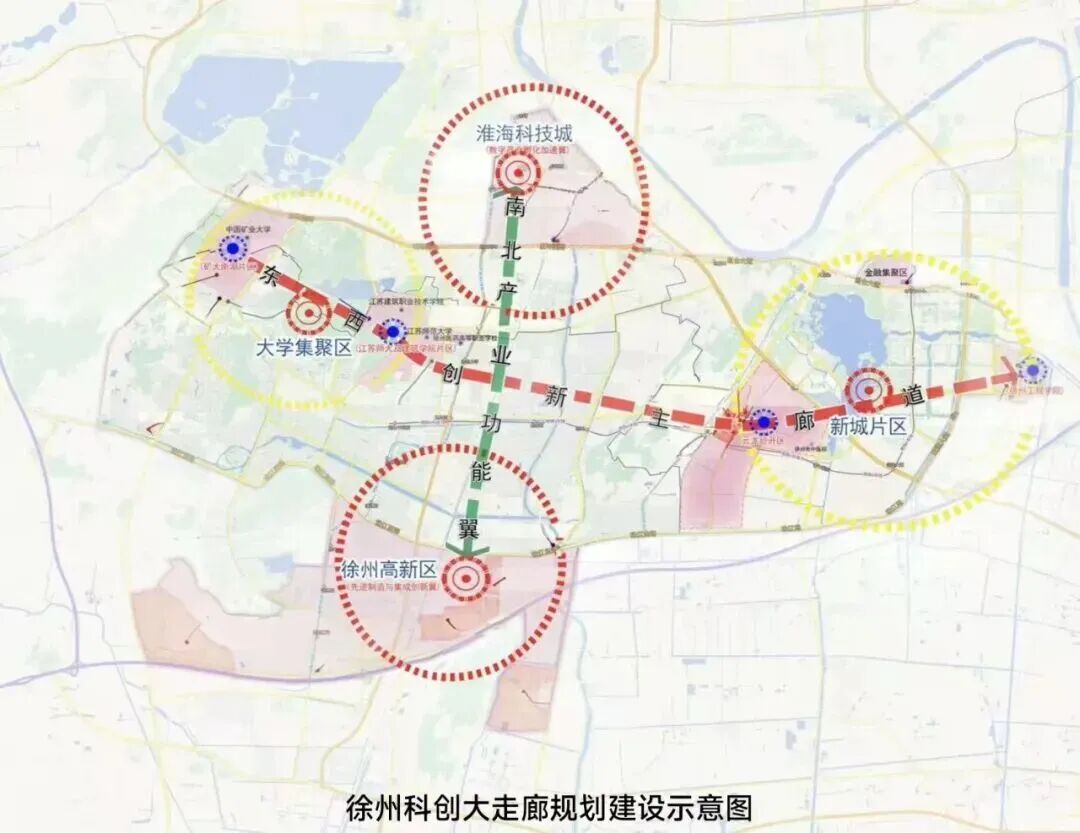
Image source: Xuzhou Daily
According to public information, Xuzhou Science and Technology Innovation Corridor takes universities (China University of Mining and Technology, Jiangsu Normal University, Xuzhou University of Technology, Jiangsu Vocational University of Architectural Technology, etc.) and science and technology parks (Xuzhou High-tech Zone, Yunlong Economic Development Zone, Huaihai Science and Technology City, etc.) as the core, gathering nearly one third of the provincial-level and above science and technology innovation platforms in the city, about half of the college students on campus, and one fifth of the high-level talent teams, generating one third of the high-value invention patents.
Looking at home and abroad, using the spatial form of a "corridor" to gather innovation elements has become a repeatedly verified effective model.
The Science and Technology Innovation Corridor along Highway 101 in California, USA, has given birth to tech giants such as Apple and Google; the G60 Science and Technology Innovation Corridor across Shanghai, Jiangsu, Zhejiang and Anhui, and the Guangzhou-Shenzhen-Hong Kong-Macao Science and Technology Innovation Corridor running through the core cities of the Greater Bay Area, have also achieved initial results in regional collaborative innovation.
This is exactly the underlying logic for Xuzhou to build the Science and Technology Innovation Corridor: to "stitch" isolated innovation islands through the axis, break the barriers between campuses, parks and communities, allow knowledge spillover, technology diffusion and talent agglomeration to generate real "chemical reactions", and finally become the main engine of innovation source leading the future development of Xuzhou.
This article is from the WeChat Official Account "Urban Evolution Theory", written by Liu Yanmei, and published by 36Kr with authorization.