Breaking: Chinese authorities have launched a crackdown on "hastily produced substandard vehicles".
The Chinese government has launched a crackdown on "rush-to-market vehicles".
Che Dongxi reported on August 27 that the Ministry of Industry and Information Technology, the Ministry of Public Security, the Ministry of Ecology and Environment, and the State Administration for Market Regulation have jointly launched a one-year special campaign targeting production consistency improvement and quality upgrading of road motor vehicle products, focusing on addressing four types of issues: production consistency, reliability, durability, and new technology testing and verification.
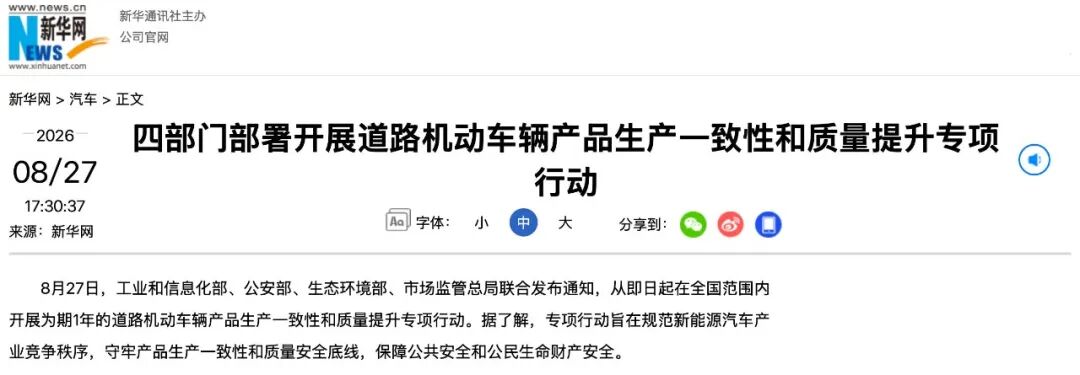
▲ Four authorities jointly launch a one-year special campaign
The supporting supervision and inspection plan also clearly stipulates that regulators will enter automobile enterprises and testing institutions "without prior notice", to sample mass-produced vehicles and key components on site, and re-conduct tests including crash test, battery safety test and emission test.
Although the official document does not use the term "rush-to-market vehicles", it covers almost all controversies surrounding such vehicles within the inspection scope.
This means that the long-debated "rush-to-market vehicles" issue has moved beyond public confrontations between corporate executives and online quality doubts, and entered the stage of on-site vehicle sampling, physical testing and joint punishment.
However, this round of regulation does not require all automobiles to be developed for three to five years, nor does it simply prohibit car companies from rapid iteration.
The core that the government really aims to manage is: automobiles can be developed quickly, but necessary verifications cannot be omitted; products can be continuously upgraded, but consumers cannot be treated as test drivers.
01.
Three checkpoints set for automobile enterprises
Unannounced inspections can be carried out directly
This plan is only three pages long, but lists a large number of inspection items. In general, relevant authorities have set up three mutually verifying checkpoints for automobile enterprises.
The first checkpoint: verify whether the enterprise has completed all tests.
The document requires verification of the performance, reliability and durability verification of complete vehicles and key assemblies, and checks whether enterprises have carried out corresponding risk assessments when adopting new technologies, new processes and new materials.
Whether product technical documents, process documents and design changes have undergone review, verification and confirmation is also included in the inspection scope.
These requirements are directed at R&D evidence. Enterprises can fully leverage mature platforms, digital tools and concurrent engineering to improve efficiency, but they must prove that such efficiency is not achieved at the cost of omitting necessary verifications.
In particular, structural fatigue, component aging, chassis durability and long-term operating condition changes of batteries often require sufficient actual operation to be exposed.
What the supervision focuses on is whether this process is truly implemented, and traceable records are kept.
The second checkpoint: verify whether the automobiles produced by the enterprise are still the products that were originally approved for market launch.
This is the "production consistency" that the document emphasizes repeatedly.
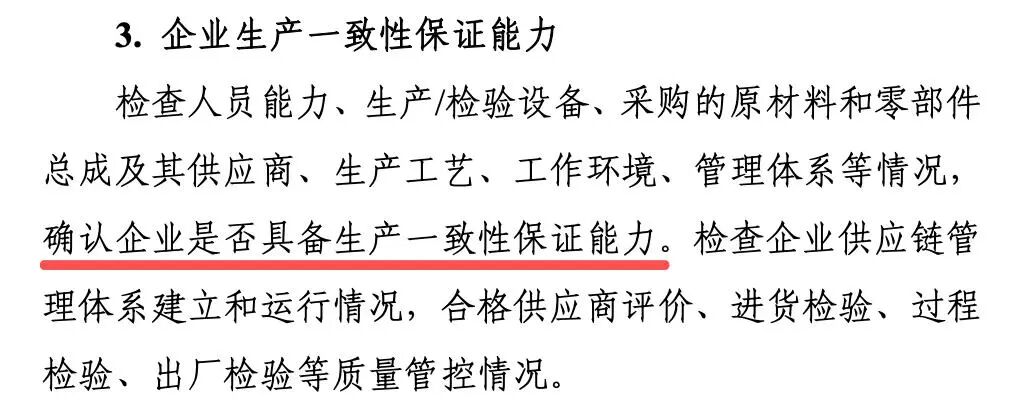
▲ Emphasizing consistency is the core priority
It not only prevents enterprises from specially manufacturing a high-standard sample vehicle for inspection, but more importantly, manages the continuous changes of vehicle models after they are launched on the market.
In the current market environment, after a vehicle enters mass production, automobile enterprises may replace suppliers, adjust components, change materials and production processes due to cost, supply or technical improvement, or modify software through OTA.
These adjustments themselves do not equal violations. The problem is that if the changes have affected vehicle safety, performance or announcement parameters, but the enterprise has not carried out re-assessment and verification, the sample vehicle that originally passed the inspection can no longer represent the subsequently produced vehicles.
The third checkpoint: verify whether the test conclusions can withstand recheck.
This round of inspection is not only targeted at automobile enterprises, but also testing institutions responsible for product access and supervision sampling inspection are included in the supervision scope.
The document requires testing institutions to carry out tests in accordance with the law in a fair and objective manner, to prevent false reports and major testing errors; they shall ensure that samples are traceable within three months after the test is completed, and relevant records, images and video materials shall be traceable within six years.
The logic is simple: if whether an enterprise has conducted sufficient tests mainly depends on a single report, while the samples, data and test process behind the report cannot be rechecked, even the strictest access standards may become ineffective.
The R&D records of enterprises, mass-produced products on the market, and the test conclusions of testing institutions can confirm each other, thus forming a complete chain of evidence.
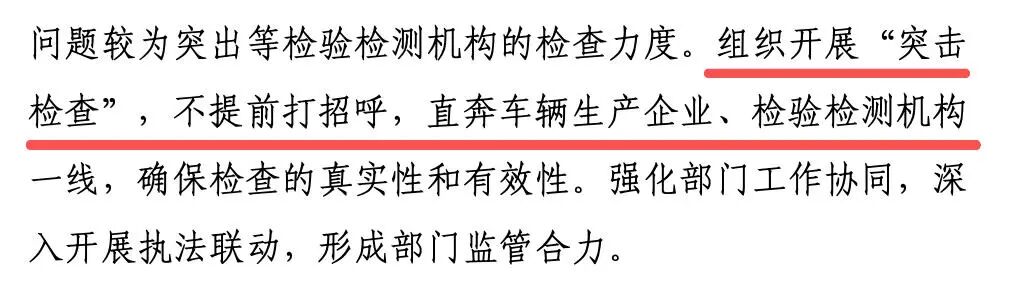
▲ Clear arrangements for launching "unannounced inspections"
To ensure the implementation of these three checkpoints, it mainly relies on a short but highly weighty sentence in the plan — organize and carry out "unannounced inspections", without prior notice, and go directly to the front line of enterprises and testing institutions.
This is quite similar to the "no prior notification, direct on-site inspection" requirement for automobile enterprises.
02.
Verify the design and development capabilities of enterprises
Guide automobile enterprises to use OTA functions in a standardized manner
Another change in this document is that the supervision scope is expanded from traditional mechanical and electrical safety to software, algorithms and cloud systems.
In the document, functional safety, safety of intended functionality, cyber security, data security, software upgrade, combined driving assistance and autonomous driving systems are all included in the inspection scope.
Enterprises shall not only complete assessment and testing before functions are launched, but also establish mechanisms for safety monitoring, incident reporting, user notification and emergency response.
Behind this is the change of automotive product form.
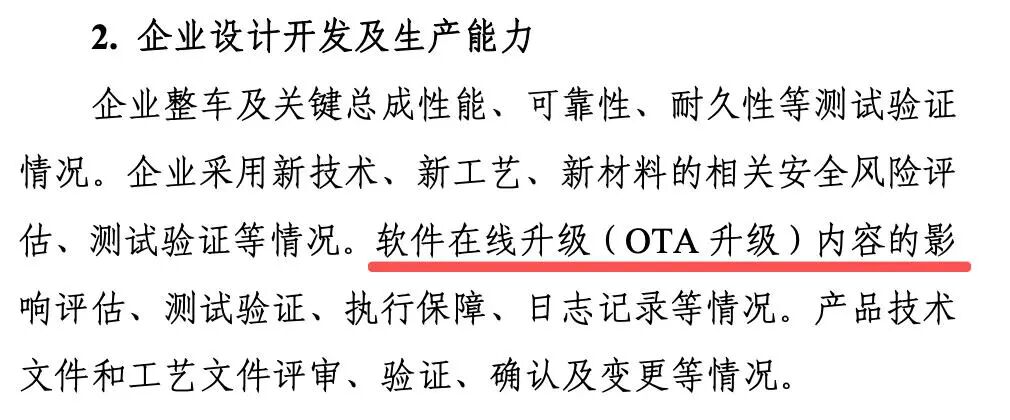
▲ The standards clearly define OTA functions
In the past, after a car left the production line, its main performance was basically fixed.
Now, a single OTA may change the vehicle's power output, energy management, driving assistance capabilities, and even human-computer interaction logic.
A delivered smart car may still have its functions and safety boundaries continuously changed.
Therefore, the supervision no longer only checks whether a car is qualified at the time of delivery, but also checks whether the enterprise has the ability to control every important change of the car after delivery.
03.
Strengthen quality management of the automobile industry
Not a sudden move targeting internet buzzwords
Judging from the timeline, this round of governance was not introduced temporarily after "rush-to-market vehicles" became a hot topic, but gradually escalated from daily random inspections to a cross-departmental campaign.
In May 2026, the annual production consistency supervision inspection already proposed to increase the intensity of random inspections on enterprises and vehicle models with many reports of irrational competition problems and high quality and safety risks.
On July 17, the First Equipment Industry Department of the Ministry of Industry and Information Technology held a symposium for key automobile production enterprises, requiring the investigation of problems in production consistency, reliability, durability and new technology verification.
Subsequently, regulators entered some enterprises, sampled vehicles and power batteries on site for inspection.
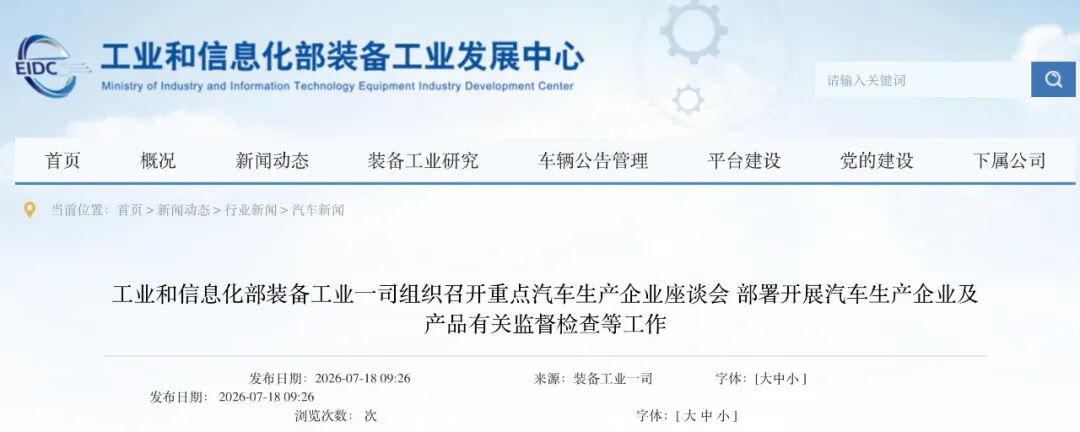
▲ The First Equipment Industry Department of the Ministry of Industry and Information Technology holds a symposium for key automobile production enterprises
The standards are also adjusted synchronously. Recently, three sets of revised rules for new energy vehicle type test procedures have been publicly solicited for comments, which plan to unify the total mileage of reliability driving tests for pure electric, hybrid and fuel cell vehicles to no less than 30,000 kilometers, so as to further align the relevant requirements for new energy vehicles with those for fuel vehicles.
By August 27, the four authorities further integrated the previous risk investigation, on-site sampling inspection and standard revision into a one-year national special campaign, and linked product access, mandatory certification, defect recall and vehicle registration.
If it is found that an enterprise can no longer maintain the production access conditions, or the relevant products do not meet the national standards and production consistency requirements, the regulatory authorities may take measures including public notification, suspending the "Announcement" of relevant products and mandatory product certification certificates, refusing to handle vehicle registration, and imposing fines. Testing institutions with serious problems may also have their qualifications revoked.
It can be seen that the government has taken very strong measures this time, and it is an all-round campaign from point to area.
04.
Conclusion: Four authorities define the bottom line of automobile manufacturing supervision
Automobiles can be developed faster, but the necessary verifications cannot be reduced.
The supply chain can be adjusted, but mass-produced products cannot quietly deviate from the access status.
Testing institutions can issue qualified conclusions, but every conclusion must be traceable and recheckable.
In the final analysis, consumers do not need to know whether a car has been developed for 18 months or 36 months.
Consumers only need to get a provable answer: the car in their hands has been fully verified, and it is indeed the same car that passed the inspection originally.
This article is from WeChat Official Account "Che Dongxi", Author: Janson, Editor: Zhihao, Published with authorization from 36Kr.