Nearly 70% of the companies are loss-making, and film and television stocks are facing their most difficult first half of the year.
The earnings season has arrived as scheduled, but this time it is no longer the usual scenario of "some rejoice while others grieve" — almost all players in the industry are facing widespread distress.
Among the 13 listed film and television companies that have released their 2026 interim financial reports, only Mango Super Media, Huace Film and Television, Enlight Media, and Shanghai Film recorded positive net profit attributable to shareholders, with the highest profit reaching 202 million yuan, and the total sum of profits of the four companies is merely 417 million yuan.
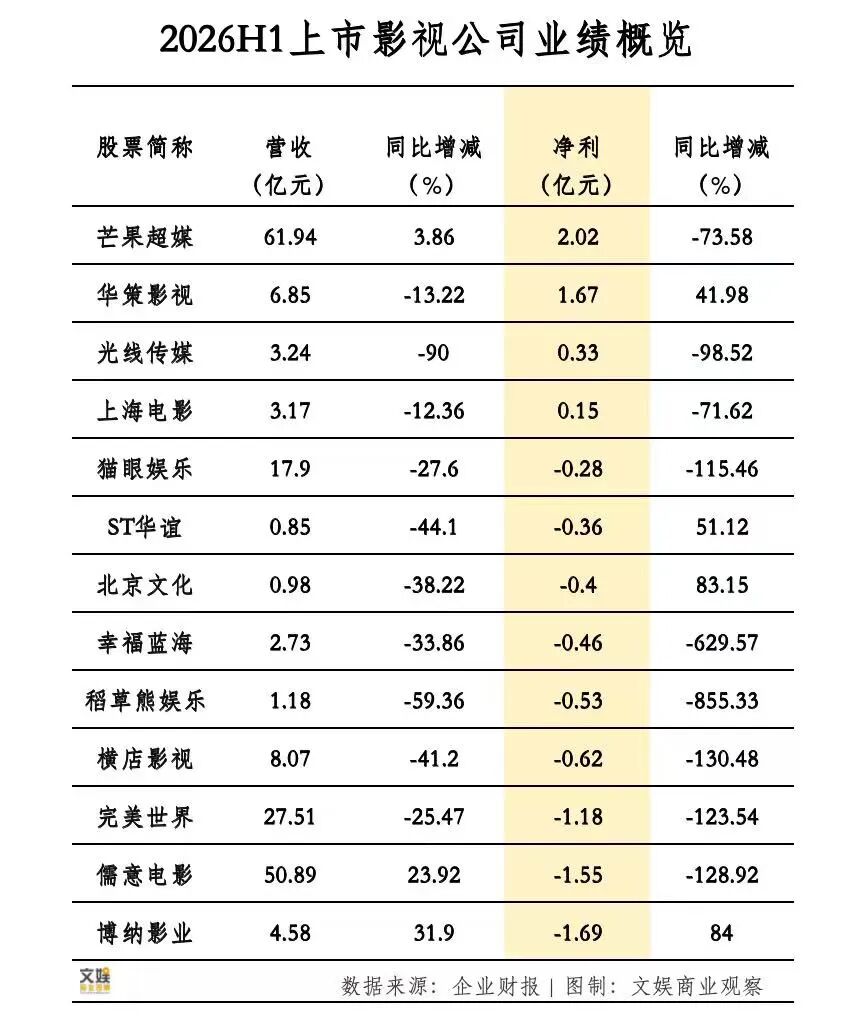
Even these four rare profitable companies are also under great operational pressure.
Mango Super Media sees rising revenue but no corresponding profit growth, Huace Film and Television records profit growth without revenue increase, while Shanghai Film suffers a double decline in both revenue and net profit. As for Enlight Media, which made a huge splash last year with *Ne Zha 2*, its performance has plummeted sharply: its net profit attributable to shareholders nosedived from 2.229 billion yuan in the same period last year to 33.01 million yuan, representing a year-on-year decrease of 98.52%.
Companies that have swung from profit to loss year on year also include Maoyan Entertainment, Ruyi Pictures, Perfect World, Hengdian Film and Television, and Happiness Blue Ocean, etc.
On the other hand, although the net profit attributable to shareholders of Bona Pictures and Beijing Culture both increased by more than 80% year on year, with their loss amount shrinking significantly, they have not got rid of operational difficulties.
During the reporting period, the net loss attributable to shareholders of Bona Pictures still stood at 169 million yuan, the largest loss among the 13 companies, and its revenue scale also shrank obviously. The core main business of Beijing Culture, the film business, only generated revenue of 214,800 yuan, a sharp year-on-year drop of 99.81%, and its proportion in the total revenue plummeted from 72.82% in the same period last year to 0.22%, which is almost close to zero.
01
The Market Chill Deepens
Is the Problem Entirely Caused by Cyclical Fluctuations?
What is the root cause of the problem?
Looking through the financial reports of various companies, we can clearly see a highly consistent answer — the realization pace of main business returns has slowed down.
Perfect World and Huace Film and Television, which have long taken TV drama production and distribution as their core business, both explicitly stated in their financial reports that the main reason for the performance change in the first half of the year is the decrease in the recognized revenue scale of drama projects.
Among them, the revenue of Perfect World's film and television sector fell by 86.56% year on year to 103 million yuan, and its proportion in the total revenue dropped sharply from 20.79% in the same period last year to 3.75%. The revenue of Huace Film and Television from TV drama production and distribution, as well as copyright distribution, decreased by 90.35% and 7.96% respectively year on year, and the cinema box office revenue also dropped by 42.55% year on year, only reaching 11.5056 million yuan.
In addition, in the profit warning released by iQiyi Straw Bear earlier, a similar explanation was given for the sharp expansion of the company's loss in the first half of the year. Corresponding to this, the company's semi-annual report shows that its revenue from drama content broadcast right licensing decreased by 73.54% year on year in the first half of the year.
In terms of the cinema market, the total box office of China's film market in the first half of this year was 17.354 billion yuan, with 421 million moviegoers, representing a year-on-year decrease of 40.6% and 34.3% respectively. Under the overall cold market environment, a large number of cinema and content companies represented by Enlight Media, Ruyi Pictures, and Hengdian Film and Television are naturally facing difficult operating conditions.
Financial reports show that in the first half of the year, the revenue of Enlight Media from film and television dramas and related derivative businesses decreased sharply by 95.68% year on year, only reaching 134 million yuan. The revenue of Ruyi Pictures from film screening and catering commodity sales fell by 27.49% year on year to 3.655 billion yuan. Hengdian Film and Television realized operating revenue of 710 million yuan from film screening and related derivative businesses, a year-on-year decrease of 45.90%.
The weakening of core businesses has not only become the main drag on the performance decline of the three companies, but also led to a "blood loss" state in their cash flow. During the reporting period, the net cash flow generated from operating activities of Enlight Media dropped from 2.982 billion yuan in the same period last year to -134 million yuan, that of Ruyi Pictures fell from 1.628 billion yuan in the same period last year to 252 million yuan, and that of Hengdian Film and Television also dropped sharply by 98.15% year on year to 11 million yuan.
Admittedly, no egg stays unbroken when the nest is overturned, but this cannot fully explain the widespread main business realization dilemma faced by leading film and television companies.
After all, the industry under pressure is no longer a new topic, and the quality of content supply has always been the key dividing line.
Enlight Media is the most typical example. The key reason why it achieved counter-trend growth last year is the phenomenal hit work *Ne Zha 2* as its strong support. However, in the first half of this year, the company failed to deliver a high-quality self-produced work that is enough to boost market confidence, so the "roller coaster" of its performance is inevitable.
Following this logic, the third-quarter performance of Ruyi Pictures is expected to achieve considerable recovery relying on the two core box office hits of the summer season, *Welcome to Dragon Restaurant* and *Eight Immortals!*.

As of press time, the total box office of *Welcome to Dragon Restaurant* and *Eight Immortals!* has both exceeded 1.7 billion yuan, and the Douban score of the former has risen from 8.4 at the premiere to 8.7. Benefiting from the strong word-of-mouth effect of *Welcome to Dragon Restaurant*, not only the share price of Ruyi Pictures, one of the producers and distributors of the film, once rose continuously, but the long-silent film and television sector also ushered in a wave of sentiment recovery.
92
When One Door Closes, Another Opens
Can "Dabbling in Unrelated Businesses" Become a Good Solution?
However, *Welcome to Dragon Restaurant* has not brought lasting relief, and the difficulties of listed film and television companies are far from over.
Looking deeper, the full outbreak of emerging entertainment products such as short dramas and comic dramas has already promoted an irreversible shift in audiences' content consumption habits, leading to a continuous shrinkage of the traffic base of traditional film and television. The current shortage of high-quality content hits in the film and drama market is also a direct reflection of this structural problem.
The revenue ceiling of the overall market has already moved down, which means that in the future, even if listed film and television companies can maintain their original project output rhythm, it will be difficult for them to obtain the same level of revenue as in the past.
Transformation is therefore imperative. Looking back at the first half of this year, the growth of their side businesses has indeed helped a number of listed film and television companies effectively hedge the pressure from their main businesses.
The financial report of Huace Film and Television shows that its net profit attributable to shareholders in the first half of the year increased by 42% year on year, which is mainly due to the formation of a dual-pillar business structure of computing power and talent agency. Among them, the computing power business realized a year-on-year revenue increase of 184.03% to 160 million yuan, accounting for 23.41% of the total revenue, and became the largest revenue source of the company for the first time. The talent agency business ranked second (22.37%), realizing revenue of 153 million yuan.
Similarly, the content e-commerce business of Mango Super Media rose to become the second largest revenue source of the company in the first half of this year, realizing operating revenue of about 1.1 billion yuan, a sharp year-on-year increase of 146.35%. Together with the new media interactive entertainment content production business which saw a slight year-on-year increase of 1.24%, it jointly offset the drag caused by the decline of Mango TV's internet video business.
The advertising revenue of Ruyi Pictures achieved a counter-trend growth of 7.54% year on year to 541 million yuan in the first half of this year, with its gross profit margin remaining at a high level of 58.76%. At the same time, benefiting from the fact that its Australian cinema chain Hoyts' market share in Australia exceeded 30% for the first time in the second quarter, hitting a record high for quarterly market share, the company's overseas business revenue increased by 20.02% year on year to 1.906 billion yuan, becoming another important support to ease the company's operating pressure.
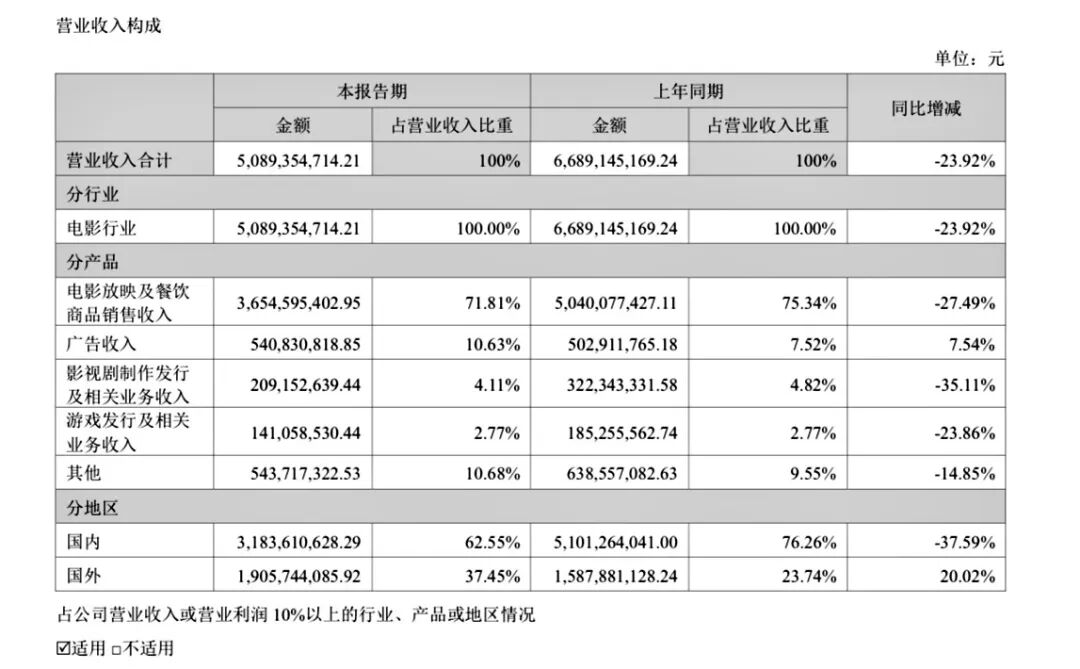
The talent agency business and other sectors, which are regarded by Enlight Media as a key pillar of its new round of transformation strategy, increased by 35.58% year on year in the first half of this year, realizing revenue of 190 million yuan that exceeded the revenue of its main film and television drama related derivative business.
Nevertheless, while the growth of side businesses is gratifying, the corresponding cost input is also huge.
In the first half of the year, the operating cost of Huace Film and Television's computing power business rose by 127.53% year on year. Meanwhile, it also announced in early May that it plans to invest no more than 3.3 billion yuan to purchase servers in batches from multiple suppliers to provide cloud computing power services externally, and this investment has exceeded the total revenue of the company in the whole year of 2025 (2.828 billion yuan).
The operating costs of Mango Super Media's content e-commerce business and new media interactive entertainment content production business both exceeded the year-on-year growth rate of their revenue, and the year-on-year growth rate of the former even reached 183.94%. Moreover, the gross profit margins of these two businesses decreased by 12.42 percentage points and 6.03 percentage points respectively in the first half of the year.
The same is true for Ruyi Pictures and Enlight Media. The operating costs of Ruyi Pictures' advertising revenue and overseas business increased by 10.76% and 13.93% year on year respectively. The operating cost of Enlight Media's talent agency business and other sectors rose by 62.85% year on year, but its gross profit margin decreased by 12.18% year on year.
That is to say, developing side businesses can solve the urgent problem for a while, but it is not enough to support the overall development of the company. As for whether these side businesses will eventually grow into a reliable new growth engine, or end up as another high-cost trial that yields no results, the answer remains unknown.
The only thing we can be sure of is that in the future, it will be even more difficult to make profits.
This article is from the WeChat official account "Entertainment Business Observation", written by Short Giant, and authorized for release by 36Kr.