Is the AI halo fading? Alphabet's market value has evaporated by 692 billion US dollars in three months, and investors have begun to question the prospects of AI.
Google, once the star among large-cap tech stocks over the past year, is now facing a severe test as its AI narrative falters.
Since hitting its all-time high on May 13 this year, the share price of Alphabet, Google's parent company, has plunged by 15% cumulatively, erasing $692 billion in market value, making it the second-largest weighted stock dragging down the S&P 500 index over the same period.
The core pressure comes from two dimensions: the continuous exodus of key AI talents, and the R&D delay of its flagship model Gemini 3.5 Pro, both of which have jointly shaken investors' confidence in Alphabet's leading position in the AI race.
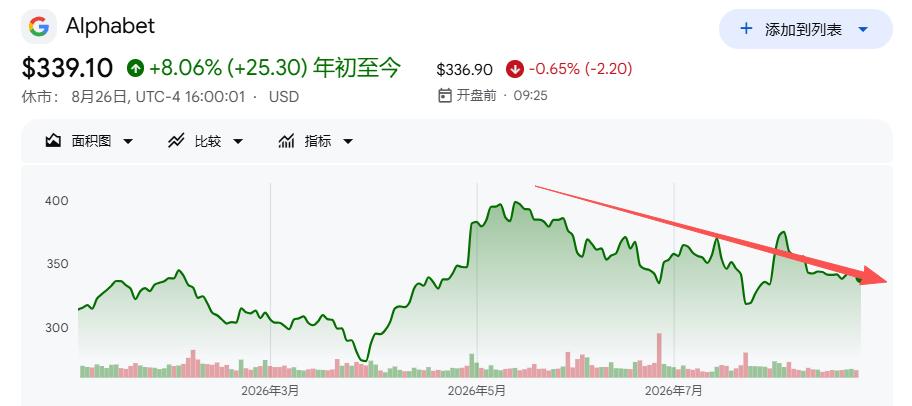
The turning point of market sentiment came on August 5. On that day, Jeff Dean, the core figure of Google's AI strategy, announced his departure to start his own business and took many senior executives with him, while Demis Hassabis also stepped down as CEO of Google DeepMind.
After the news was released, Alphabet's share price plummeted 4% in a single day, with its market value evaporating by $18.6 billion in one day. At the same time, the company's $25 billion bond issuance completed in early August, as well as its continuously rising capital expenditure and financial outlook of negative free cash flow, further exacerbated investors' concerns.
01
Talent Exodus Undermines AI Leading Position
The talent pressure facing Alphabet has lasted for several months. A few months ago, two senior executives at Google successively left for Anthropic and OpenAI. At the beginning of this month, Jeff Dean's resignation and his move to take many core colleagues with him pushed this issue to the forefront of public attention.
Angelo Zino, Senior Vice President and Head of Technology Research at CFRA, said: "This brain drain does bring risks, because this is the area that everyone in the current market is focusing on — can you monetize AI?"
It is worth noting that the talent battle among large tech companies is not a unique dilemma for Alphabet.
According to Bloomberg, Meta once poached Ruoming Pang, head of the AI model team at Apple, with a multi-year compensation package of $200 million; OpenAI has attracted more than 400 Apple employees with generous salaries and stock options, and Apple subsequently sued OpenAI for trade secret theft. However, for Alphabet, the talent problem is just the tip of the iceberg.
02
Gemini Delay Exacerbates Valuation Pressure
The more direct hidden danger lies in the lagging R&D progress of Gemini 3.5 Pro, Alphabet's most powerful AI model.
The model is still under improvement, especially in coding capabilities — which is precisely the shortboard where Alphabet is considered to have fallen behind Anthropic and OpenAI. Two weeks ago, Google released the new version of the Gemini 3.7 Flash model, but did not mention the launch schedule of Gemini 3.5 Pro at all.
Divyaunsh Divatia, an analyst at Janus Henderson, pointed out: "If you are the winner in the AI track, you have a leading cutting-edge model, and the market will give you a corresponding valuation premium. This is exactly the logic reflected in the stock price over the past nine to twelve months, and this premium has now faded at the margin."
In response, Google holds an optimistic stance. A Google spokesperson said: "Our AI development momentum and product delivery speed are at the highest levels in history. Gemini 3.7 Flash has become our fastest-growing model ever, and the number of downloads of Gemma has also exceeded 1 billion."
03
High Capital Expenditure, Pressured Free Cash Flow
The financial pressure cannot be ignored either. Alphabet's share price fell after its earnings release at the end of July, precisely because investors were uneasy about its high capital expenditure and negative free cash flow. According to previous reports from Bloomberg, the company announced a spending plan as high as $205 billion, triggering market concerns about out-of-control AI costs.
Divatia said: "Capital expenditure will increase significantly next year, free cash flow will turn negative, the company has already issued additional equity, and it is still borrowing on a large scale. This is where many investors' anxiety lies — the company is financing this AGI race through the equity and debt markets, which makes them feel uneasy."
This dilemma is not unique to Alphabet. Investors across the entire technology industry are increasingly urgently demanding that leading AI companies present proof of returns on data center investments. The Nasdaq 100 index, which is dominated by tech stocks, has failed to hit new highs since May. The Middle East situation at the macro level, US-Canada trade frictions, and interest rate hike expectations brought by stubborn inflation have also continued to suppress market sentiment.
04
Bull-Bear Divergence, Next Catalyst Lies in Earnings Report
Despite the pressure on its share price, some investors remain optimistic about Alphabet's long-term prospects.
Daniel Pilling, Portfolio Manager at Sands Capital Management, said that talent flow may not be a bad thing: "Maybe this is a good thing, maybe you need a new group of people to try and get Google back to where it should be. They have one of the best chips in the world, and possibly one of the largest computing power clusters globally, so they deserve to be able to achieve success."
From a longer-term perspective, Alphabet still recorded an increase of about 65% in the past 12 months, outperforming the broader market and other members of the "Magnificent Seven Tech Giants".
However, market patience is narrowing. Melissa Otto, Head of Technology, Media and Telecommunications Research at Visible Alpha, said: "I don't care much about which specific person it is. I'm more concerned about how they explain AI's performance in the next earnings call, and how it will truly translate into fundamental growth. This is still to some extent an open question."
This article is from the WeChat official account "Wallstreetcn Max", Author: Bu Shuqing, published with authorization from 36Kr.