The veteran major automotive province is looking to turn the tables with the help of "new forces".
On August 24, FAW and Leapmotor signed an in-depth strategic cooperation agreement in Changchun.
On the same day, Secretary of the Jilin Provincial Party Committee and Chairman of the Jilin Provincial Committee of the Chinese People's Political Consultative Conference met with a delegation led by the Secretary of the Jinhua Municipal Party Committee in Changchun.
This is no coincidence, but an industrial "marriage" that evolves from capital cooperation to strategic symbiosis.
Standing at the center of the stage are FAW, the "eldest son of the Republic's automotive industry", and Leapmotor, the top-selling new energy vehicle startup. Hidden behind the scenes are Jilin, which is currently facing the core bottleneck of the automotive industry, as well as Jinhua, Leapmotor's "hometown", and its hundred-billion-level industrial chain behind it.
Not long ago, the Secretary of the Jilin Provincial Party Committee carried out investigations or attended events related to the automotive industry three times in just one month, showing the outside world the sense of urgency of this time-honored major automotive province to "turn market pressure into development momentum".
In the first half of this year, Jilin's GDP growth rate was only 2.4%, ranking at the bottom of the country. Among them, the added value of the automobile manufacturing industry dropped by 21%; the province's automobile output in the first half of the year was 531,100 units, down 26% year-on-year. Changchun, the provincial capital, even admitted at the semi-annual economic work conference that the city's economic development is currently facing "unprecedented difficulties and challenges".
At this critical moment, the partnership between FAW and Leapmotor is far more than a simple cooperation between enterprises for Jilin. It is a strategic reconstruction related to the future direction of the whole province amid the drastic changes in the automotive industry pattern.
01
Shuffling Crisis
Looking at Jilin's economic report card for the first half of the year, the GDP reached 697.882 billion yuan, a year-on-year increase of 2.4%, of which the added value of the secondary industry was 204.481 billion yuan, down 2.1%. This GDP growth rate is only higher than that of Shanxi (2.1%) and Hainan (2%), ranking the third from the bottom in the country, less than half of the annual target set at the beginning of the year (about 5%), and both the total economic output and growth rate rank last among the three northeastern provinces.
The situation of Changchun, the provincial capital, is even less optimistic: its GDP in the first half of the year was 380.358 billion yuan, with a growth of only 1.6%, of which the added value of the secondary industry dropped by 5.5%, and the added value of industries above designated size dropped by 8%.
The root cause of the industrial stall lies in automobiles.
As the birthplace of China's automotive industry, the added value of Jilin's automotive industry once accounted for more than 1/4 of the province's total industrial added value, and its profit even exceeded half of the province's total industrial profit. In Changchun, it accounts for 60% of the city's industrial output, making it the undisputed primary pillar industry.
However, at present, the local automotive industry is facing obvious downward pressure. In the first half of this year, the added value of Jilin's automobile manufacturing industry fell back by 21% year-on-year, and the province's automobile output was 531,100 units, a decrease of about 26% compared with 718,200 units in the same period of last year.
It is worth noting that this is not a short-term fluctuation.
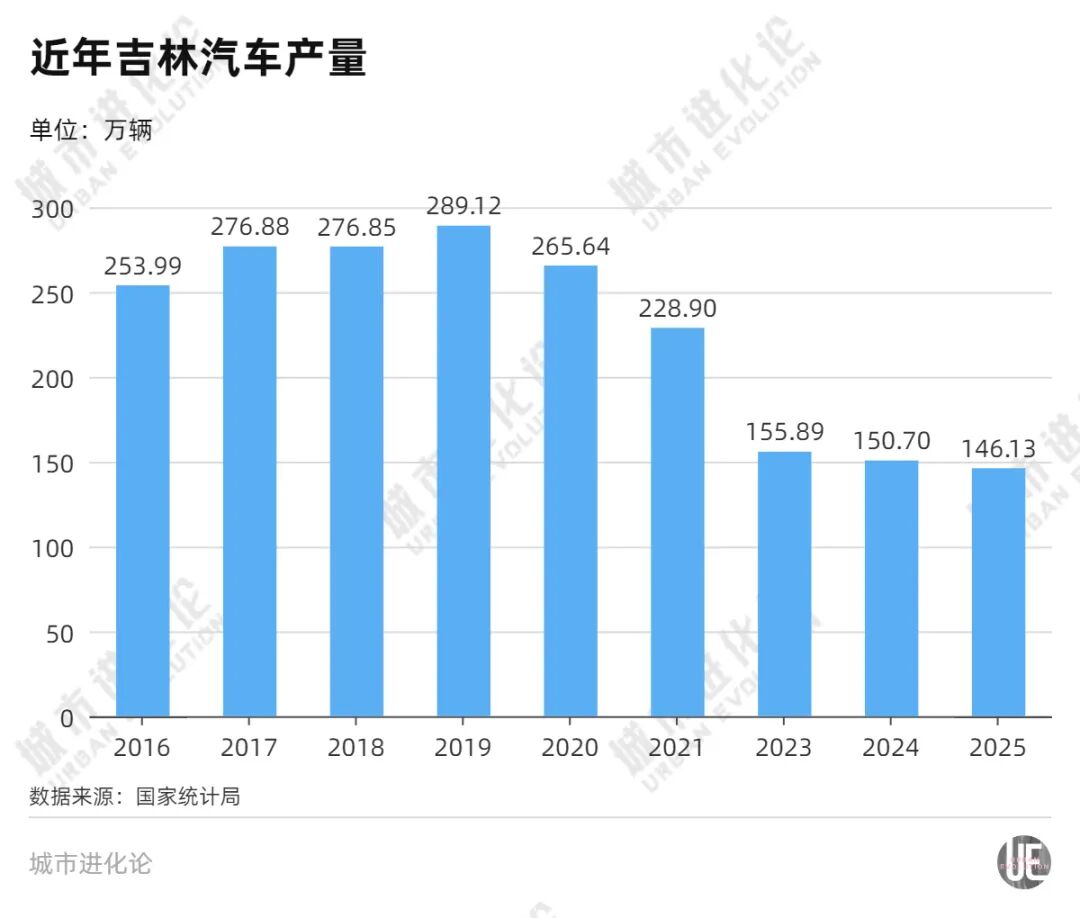
Back in 2020, Jilin ranked second in the country with an automobile output of 2.6564 million units, second only to Guangdong; by 2025, this figure was almost "halved" to 1.4613 million units, and its ranking fell out of the top ten in the country to 13th. In just 5 years, Jilin's automobile output has dropped by more than 1 million units, making it one of the major automotive provinces with the largest drop in ranking.
While the output has dropped significantly, the pace of industrial transformation is also relatively slow.
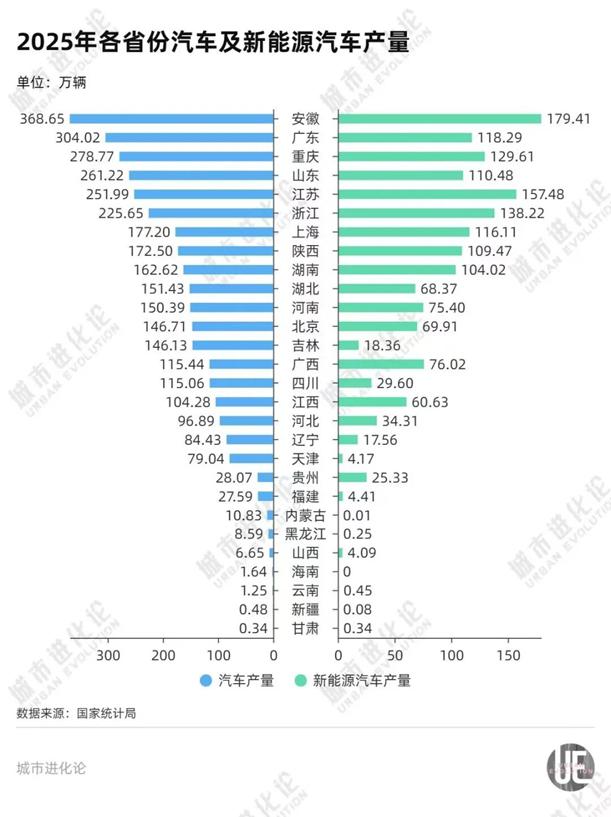
In 2025, Jilin's new energy vehicle output was only 183,600 units, accounting for 12.6% of the province's total automobile output, far lower than the national level of 47.5%. In the same period, the proportion of new energy vehicles in major automotive provinces such as Shanghai and Anhui has reached as high as 50%~70%. Even Guangdong, which is also a major hub for traditional fuel vehicles, has a new energy vehicle output proportion (38.9%) far higher than that of Jilin.
The local authorities have not lacked reflection on this.
According to public reports, in June this year, the Changchun Municipal Bureau of Industry and Information Technology released the "15th Five-Year Plan for the Development of Changchun's Automobile Industry (Draft for Comment)", which directly pointed out that Changchun's complete vehicle industry has long shown a pattern of FAW's "absolute dominance", but FAW's sales have continued to decline in recent years, and its sales volume in 2025 was even lower than the level five years ago. The drastic fluctuations in production and sales have had a significant impact on the city's industrial economy. At the same time, FAW lags behind in the new energy track, with a large gap from the national average level.
The document also rarely mentioned that FAW "may face the pressure of strategic restructuring of central enterprises in the future", and it needs to introduce more than one new energy complete vehicle enterprise before 2030.
In this document, Leapmotor quietly appeared on the list of enterprises for in-depth cooperation.
02
Mutual Benefit
Against this background, the cooperation between FAW and Leapmotor goes far beyond the commercial significance.
Sorting out public information shows that the cooperation relationship between the two sides has escalated rapidly in the past year or more.
On March 3, 2025, the official website of the enterprise released news that FAW is opening a new chapter of global development with the transformation strategy of "All in New Energy". On the same day, FAW and Leapmotor held a signing ceremony for the "Memorandum of Understanding on Strategic Cooperation" in Changchun, clarifying that they will carry out strategic cooperation in the field of new energy vehicles, and at the same time "further explore the feasibility of deepening capital cooperation".
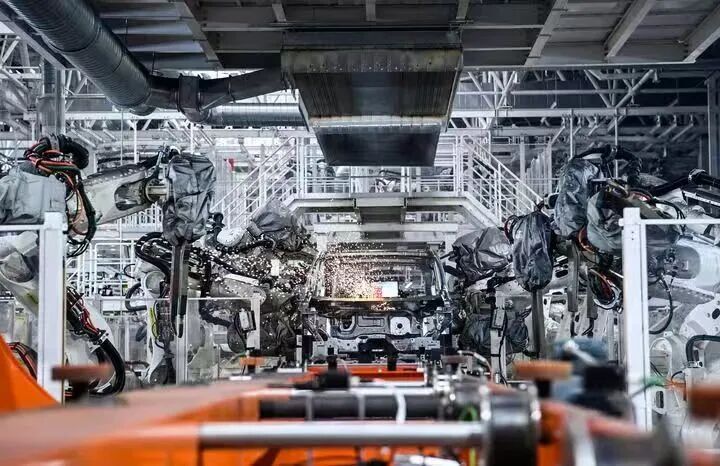
Image source: Xinhua News Agency
Only 20 days later, Leapmotor won the bid for the technology development project of a Hongqi model; in April 2025, Leapmotor announced that it would provide Hongqi with an electric vehicle platform for overseas markets; in August of the same year, when Leapmotor released its semi-annual report, the first cooperative model of the two sides was launched.
On December 28, 2025, the capital cooperation was officially implemented. On that day, the two sides held a signing ceremony, where FAW subscribed for about 74.83 million domestic shares of Leapmotor through the issuance of additional domestic shares, with a transaction amount of about 3.744 billion yuan. After the transaction, FAW held about 5% of the shares and became an important strategic shareholder of Leapmotor. This is regarded as a landmark event for a central state-owned automotive enterprise to make a strategic investment in a new car-making force for the first time.
In August this year, the cooperation between the two sides was fully upgraded. According to the latest agreement, the scope of cooperation has expanded from new energy vehicles to ten major fields including capital cooperation, new energy complete vehicles, intelligent driving, powertrain, power batteries, intelligent chassis, body process equipment, lightweight components, embodied intelligent robots, and finance.
For this cooperation, FAW positioned it as "re-upgrading of strategic symbiosis", which speaks volumes for its high attention. Some comments point out that at this stage, the relationship between the two sides has gone beyond the general sense of "strategic cooperation". Capital cooperation and financial services provide long-term connections, covering core value links such as complete vehicles, intelligent assisted driving, and powertrain, process equipment and lightweight components point to manufacturing efficiency, and embodied intelligent robots extend to potential new scenarios.
Further, with three signings within 17 months, from "handshake" to "equity participation" and then to "symbiosis", every step has yielded substantial results. In the industry's view, this is a mutually beneficial strategic cooperation.
For FAW, China's oldest automotive "national team", what it urgently needs at the moment is Leapmotor's electrification and intelligent technology, as well as a rapid growth model that has been verified by the market.
On the day of this signing ceremony, Leapmotor released its 2026 semi-annual financial report:
In the first half of the year, global sales reached 356,000 units, a year-on-year increase of 60.8%; operating revenue reached 38.11 billion yuan, hitting a record high for the same period; net profit was 210 million yuan, realizing profitability for three consecutive half-years; overseas exports reached 96,000 units, a year-on-year increase of 372.6%, exceeding the total export volume of 2025; in July, Leapmotor's global sales reached 101,000 units, a year-on-year increase of 102.0%, making it the first new energy vehicle brand to exceed 100,000 units in monthly delivery...
Against the background of the accelerated reshuffling of the whole industry, Leapmotor's performance can be described as "skyrocketing". It should be noted that this dark horse new energy vehicle enterprise did not achieve full-year profitability for the first time until 2025. In the same year, it delivered 597,000 new cars, ranking first in the sales of Chinese new energy vehicle brands. This is undoubtedly an important confidence for it to cooperate with FAW.
What Leapmotor needs, in addition to capital, is the central enterprise brand endorsement and manufacturing heritage accumulated over the years by FAW, one of the three major central state-owned automotive groups in China. Some institutions analyze that the deepening cooperation between the two sides helps to enhance the certainty of Leapmotor's long-term development and provide important industrial support for the enterprise's growth.
03
More Possibilities
One detail is that the visit of the Secretary of the Jinhua Municipal Party Committee has made the strategic logic of this cooperation more complete.
Leapmotor is headquartered in Jinhua, and its founder Zhu Jiangming is from Yiwu. The Jinhua delegation's trip, on the surface, is the "hometown government" supporting the enterprise, but the profound meaning behind it is worthy of attention.
For Jilin, Jinhua is the birthplace of Leapmotor's "chain leader" model, and also the best sample to understand Leapmotor and even the new energy industry model.
In recent years, in the industrial upgrading of Jinhua from "hometown of hundreds of crafts" to "intelligent manufacturing highland", the new energy automobile industry, as the first of the "ten key industrial chains", plays a pivotal role. Data shows that in 2025, Jinhua's new energy automobile industrial chain achieved an output value of 177.87 billion yuan for enterprises above designated size, gathering more than 1500 related enterprises in the industrial chain.
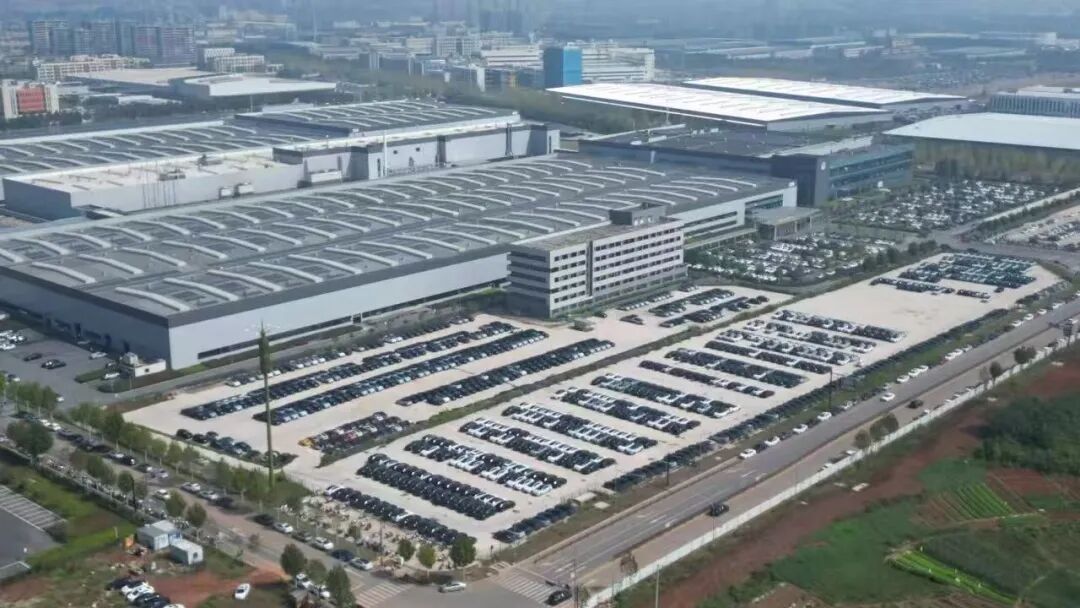
Image source: Jinhua Official Account
Among them, in the Jinhua Development Zone with Leapmotor as the chain leader, dozens of core supporting enterprises have built a complete supply chain from batteries and electric drives to seats and car lights, forming a well-known "five-minute industrial circle" with a local supporting procurement rate of over 60%.
Such "Jinhua experience" is exactly the lesson that Jilin urgently needs to catch up with in the new energy vehicle track.
A previous survey and research released by the Development Research Center of the Jilin Provincial People's Government shows that the global automotive industrial chain is accelerating its restructuring, and Jilin's automotive industry is also in the process of adjustment, featuring prominent driving force from complete vehicles, lagging development of spare parts, low penetration rate of new energy vehicles, and shortcomings in the automotive industrial chain.
In the part of "bottleneck problems", it is specifically mentioned that the development of the complete vehicle and spare parts industry is unbalanced, the spare parts industrial chain is short with low added value, the new energy vehicle industry is small in scale, and there is a serious lack of links in core segments.
Therefore, the deepening cooperation between FAW and Leapmotor carries the expectations of multiple parties.
According to local Jilin media reports, the Secretary of the Jilin Provincial Party Committee mentioned in the above meeting that Jinhua has carried out in-depth cooperation with Siping, Changchun and other places, yielding fruitful results in new energy vehicles, rail transit and other fields.
During this northern trip, the Jinhua delegation not only attended the signing ceremony between FAW and Leapmotor, but also went to Changchun and Siping for study and inspection from August 23 to 25.
An important background is that in 2017, the General Office of the State Council issued the "Work Plan for Pairing Cooperation between Some Provinces and Cities in Northeast China and Eastern China", clarifying the pairing cooperation between three provinces and four cities, and thus Jilin and Zhejiang provinces established a pairing cooperation relationship.
Since then, the two sides have frequently joined hands to promote industrial development and project construction. During the "14th Five-Year Plan" period, more than 5000 new market entities of Zhejiang enterprises in Jilin were added, and the two provinces signed a total of more than 350 industrial cooperation projects with an agreed capital of nearly 150 billion yuan, and the paid-in capital exceeded 59 billion yuan.
According to public reports, during the "15th Five-Year Plan" period, Jilin-Zhejiang pairing cooperation will focus on six key areas including jointly cultivating new engines for the development of advantageous industries and promoting new breakthroughs in the integrated development of scientific and technological innovation and industrial innovation. In terms of strengthening the cooperation of the equipment manufacturing industrial chain, it is clearly mentioned that "promote the transformation of the traditional automobile industry to new energy intelligent connected vehicles, and jointly cultivate future industries such as embodied intelligence".
This coincides with the key points of the strategic cooperation between FAW and Leapmotor.
From this perspective, the joint development of the automotive enterprises in the two places is also the in-depth advancement of Jilin-Zhejiang cooperation from the "provincial framework" to the "city-level implementation".
The cooperation space has been opened, but the time window is shrinking rapidly. Can this traditional major automotive province standing at the crossroads turn the tide against the wind?