BAT is giving its AI business a complete overhaul.
Recently, new developments from major internet giants have been emerging continuously.
Alibaba plans to issue new shares to raise 80 billion Hong Kong dollars, marking its first launch of new share placement since its dual primary listing on the Hong Kong Stock Exchange in 2019; ByteDance adjusted the organizational structure of its AI business, merging the Feishu business into Doubao; plus the purchase of computing power cards, Tencent has spent nearly 100 billion yuan on AI in one quarter.
After two years of exploration, AI has become an undisputed future for the technology and internet sector. From capital investment, technology R&D, product application to organizational structure, major tech giants are accelerating their migration to AI, and every link is "dismantling the old and building the new".
Everyone is doing the same thing: making AI more independent instead of attaching it to the old system. The tough battle has already begun, and even the big giants no longer have the leeway to adopt the "horse racing" strategy leisurely or seize the advantage after others, leaving only one path to move forward.
Burning cash in exchange for "certainty"
A few years ago, major tech giants only made tentative layouts in the AI field, but the outbreak of artificial intelligence began to push them to accelerate their pace. By 2026, the AI competition among major giants is no longer just "empty slogans", but has escalated into a fierce hand-to-hand combat.
All participants share the highly consistent goal of building a new moat in the AI era and gaining irreplaceable "certainty". To build a new moat, substantial investment of real money is inevitable.
Let's start with Alibaba.
In February 2025, Alibaba announced that it would invest 380 billion yuan in the construction of cloud and AI hardware infrastructure in the next three years. By the end of the second quarter of 2026, the cumulative investment had reached about 190 billion yuan, and the investment speed is accelerating continuously.
In its Q2 financial report, Alibaba's capital expenditure jumped from more than 20 billion yuan in the previous quarter to 67.7 billion yuan, a year-on-year surge of 75%. The cost is also very intuitive: in the second quarter, Alibaba's free cash flow turned negative, with the net outflow expanding to 44.67 billion yuan.
Therefore, Alibaba made a decision to issue new shares to raise 80 billion Hong Kong dollars. In recent years, Alibaba has also been actively selling non-core assets, for example, it recently sold the game brand Lingxi Interactive Entertainment for 10.1 billion yuan.
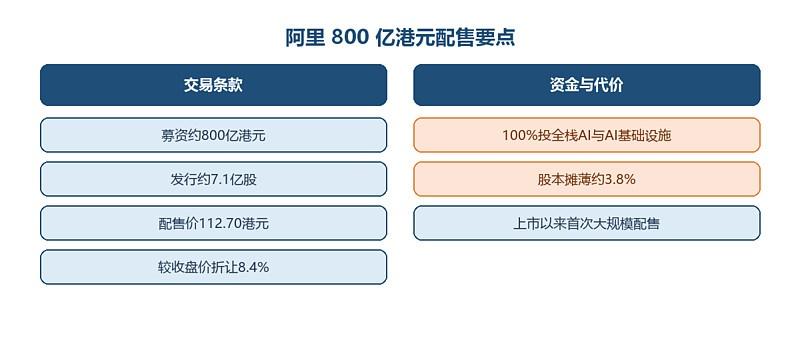
Alibaba is not short of cash on its books. By the end of June, Alibaba's cash and liquid investments amounted to about 474.5 billion yuan, but it still chose to raise funds through share placement, which fully shows that AI investment not only brings capital pressure, but also monetization pressure. Rather than explaining the return on AI investment to the market alone, it is better to let investment institutions collectively believe in this future. Wu Yongming judged that the current capital investment can be recovered within three years. There is pressure, but Alibaba has never thought of slowing down.
ByteDance, which started its layout later, has made even more aggressive investments.
In May this year, the *South China Morning Post* cited reports from people familiar with the matter that ByteDance had raised this year's capital expenditure from 160 billion yuan last year to 200 billion yuan (about 30 billion U.S. dollars), while the figure reported by Bloomberg is even more staggering, with the maximum expected to reach 70 billion U.S. dollars.
Bloomberg reported that ByteDance's capital expenditure is mainly used for the construction of data centers and other AI infrastructure, and the funds mainly come from the company's 2025 profit reserve. However, ByteDance has not given a positive response to these reports.
But the pressure still exists. In April this year, multiple media reported that ByteDance's net profit under the IFRS caliber plummeted by about 70% in 2025. Li Liang, Vice President of Douyin Group, clarified that this figure under the International Accounting Standards cannot reflect the real operating situation.
Since ByteDance is still not listed, the market's concerns have not been directly reflected in the stock price. However, the reference price of its old share transactions in the secondary market has risen from 480 billion U.S. dollars in November last year to 550 billion U.S. dollars in February this year.
Profits are thinning, but the valuation is getting more expensive. The market is also betting that ByteDance can turn AI into a new growth engine.
Tencent is the most "restrained" investor among the three, but it has also begun to feel the urgency.
In 2025, Tencent's capital expenditure was only 79.2 billion yuan. But in the first quarter of this year, capital expenditure surged to 31.9 billion yuan, a year-on-year increase of 16%, and skyrocketed to 52.8 billion yuan in the second quarter. The total in the first half of the year reached 84.72 billion yuan, exceeding the total of last year.
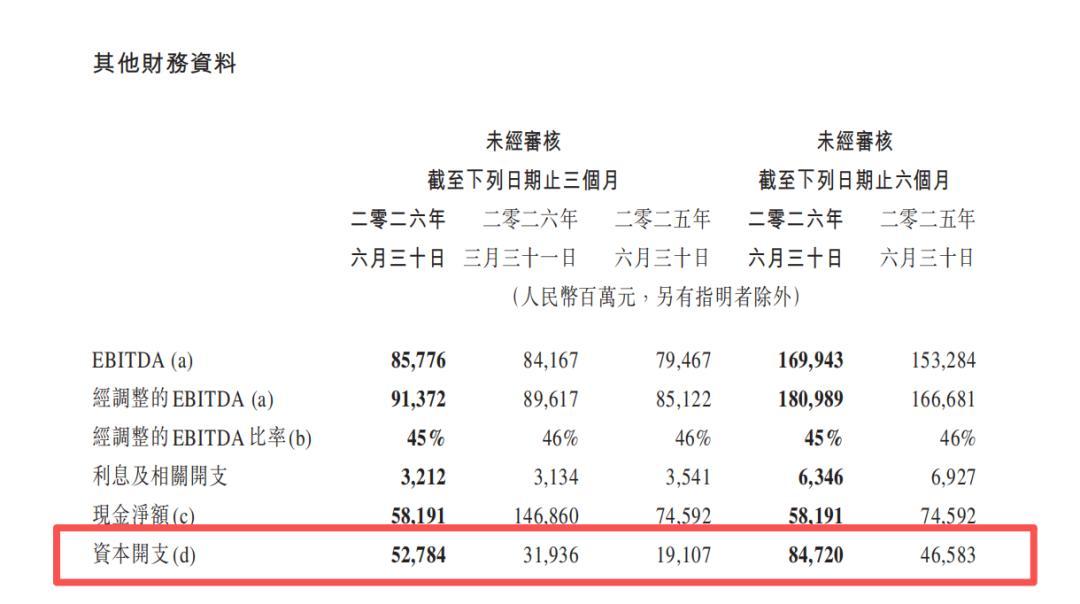
(Figure: Tencent's 2026 Q2 Financial Report)
Under the huge expenditure, Tencent's free cash flow in the second quarter also turned negative for the first time since its listing, reaching -13.8 billion yuan. However, Tencent's net cash flow from operating activities was 52.7 billion yuan, and after excluding capital expenditure, the free cash flow was 37.6 billion yuan, which remains healthy.
Martin Lau, President of Tencent, explained that the company's AI investment is mainly focused on AI infrastructure. In the worst case, these infrastructures can also be leased out through Tencent Cloud, and the company will dynamically adjust the investment scale.
From tens of billions to hundreds of billions of yuan, after the major tech giants have increased their investments layer by layer, the "AI cash-burning war" has gradually evolved into a final that only a few enterprises can participate in. In the face of sunk costs, no one will easily loosen their grip first.
AI Business Starts to "Go Independent"
The organizational structure, which deserves more attention than capital investment, can better reflect a company's strategic determination.
In the past two years, major tech giants have launched a talent war. In 2023, the annual salary of top AI researchers was still at the million-yuan level; by 2026, ByteDance poached Guo Daya from DeepSeek, and external rumors say his annual salary is "nearly 100 million yuan".
We will not discuss the authenticity of the salary for now, but it is certain that a sufficiently excellent technical talent can help enterprises take the lead in seizing a favorable position in the AI competition.
Tencent is a typical case.
In December 2025, Tencent announced that Yao Shunyu, a former OpenAI researcher, would serve as "Chief AI Scientist", reporting directly to President Martin Lau, and concurrently serve as the head of the AI Infra Department and the Large Language Model Department.
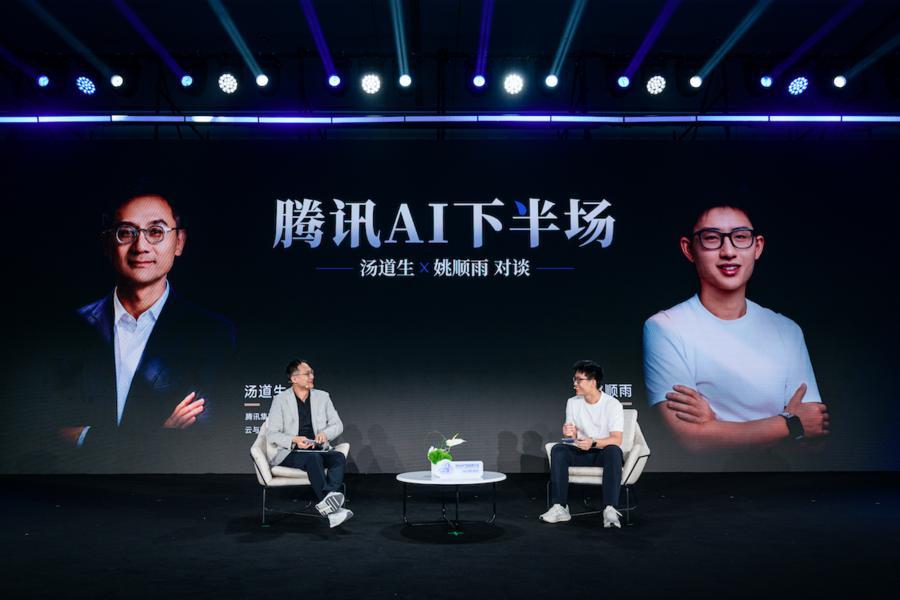
After joining Tencent, Yao Shunyu gradually integrated Tencent's large model department. Under his leadership, Tencent newly established three core departments: AI Infra Department, AI Data Department and Data Computing Platform Department. In March, Tencent revoked AI Lab, and some personnel were merged into the Hunyuan team to report to him; in July, the Hunyuan Multimodal Department and the Large Language Model Department were merged to form the Basic Model Department, which is uniformly managed by him.
The effect is also remarkable. Less than four months after Yao Shunyu joined the company, he launched Hunyuan Hy3, which uses smaller activation parameters to achieve performance close to or even exceeding some flagship models, delivering an impressive report card.
At the same time, after trying a series of AI applications such as Yuanbao and Yuanbao Pai, Tencent AI has also entered the period of business realization. The monthly PC-side visits of the desktop office Agent WorkBuddy rank first among similar domestic products.
This also triggered a new round of transformation at ByteDance.
In July, ByteDance adjusted the organizational structure of its AI business, integrating the Feishu product team and the Doubao product team to form a new Doubao product team; integrating the Feishu GTM team and the Volcano Engine team to form a new GTM organization called "Creativity Service Platform".
ByteDance split Feishu into two parts. Even though it was once a product that ByteDance placed high hopes on, it has to make way for AI.
ByteDance's intention is very clear: to eliminate overlapping parts and re-aggregate scattered capabilities — Doubao serves as the C-end entry, Feishu lands on the B-end, Volcano Engine is responsible for computing power infrastructure, and the model capability is handed over to the Seed team.
In the recent all-hands meeting, ByteDance also clarified the transformation of its AI strategy: maintain the competitive advantages of Doubao and Seedance, and shift the focus of its AI strategy to the ToB productivity track.
Alibaba's organizational restructuring took longer and brought more obvious turbulence.
After Lin Junyang, head of Qwen, left his post in March, Alibaba carried out four organizational adjustments.
In March this year, Alibaba established the ATH Business Group, integrating the Tongyi Lab, Qwen, Wukong, MaaS and innovative businesses, which is taken over by CEO Wu Yongming;
On April 8, Tongyi Lab was upgraded to the Tongyi Large Model Division, and Zhou Jingren no longer served as CTO of Alibaba Cloud, focusing full-time on model business;
In June, the Tongyi Large Model Division and the Future Life Lab were merged to form the Token Foundry Division, which is managed by Wu Yongming.
In August, Alibaba adjusted its structure again, dividing the reportable segments into four sectors: E-Commerce Group, AI Cloud and Computing Power Services, AI Lab and Applications, and "All Others". AI has become an independent sector, juxtaposed with the cash cow e-commerce business and the second growth curve Alibaba Cloud.
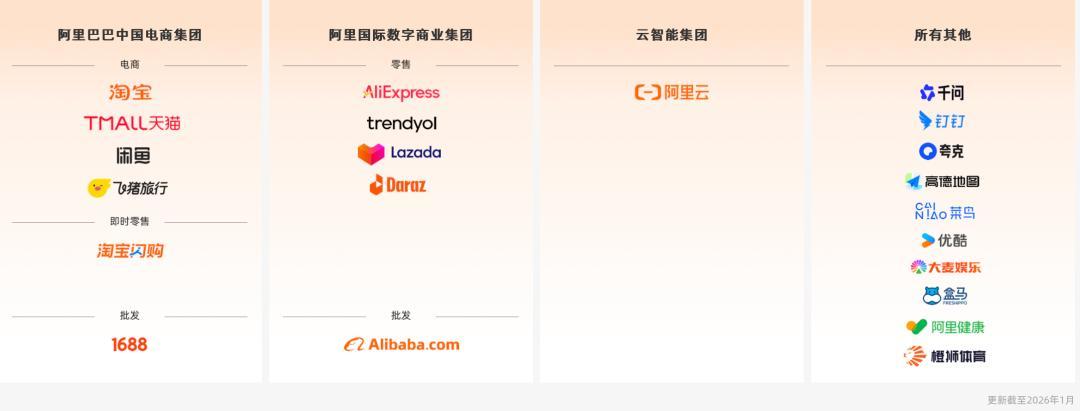
This series of actions all emphasize the importance of AI business.
Although the paths are different, the adjustments of the three major giants share one thing in common — making the AI business "go independent".
From the initial tentative launch of AI applications, to empowering the main business through AI, and now to being promoted to an independent business sector, the major giants need to prove that AI will lead them into a new growth cycle.
Major Tech Giants Are No Longer the Protagonists
In the current earnings season, all major tech giants are under great pressure.
In the second quarter, the total capital expenditure of Alibaba and Tencent exceeded 120.4 billion yuan, about 2.08 times that of the same period last year. The total outflow of free cash flow reached 58.47 billion yuan, and the growth rate of capital expenditure has far exceeded the growth rate of operating cash flow.
The reaction of the capital market is very direct. Since the beginning of this year, the share prices of Alibaba and Tencent have continued to decline. After the announcement of Alibaba's share placement news, its share price plummeted by more than 8%.
The underlying message of the market is: neither the model nor revenue can be neglected.
Alibaba's route is the most stable, which realizes the monetization of computing power and cloud services first.
At present, "selling computing power" is the AI business model that the capital market can most easily understand. Alibaba Cloud itself is also the largest public cloud service provider in China. The platform can "pan for gold" while "selling water", with a very clear profit model.
In the second quarter, the revenue of Alibaba's newly divided "AI Cloud and Computing Services" reached 48.437 billion yuan, a year-on-year increase of 45%; the revenue from external customers also increased by 45%, hitting a new high in 22 quarters; among them, the revenue of AI-related products reached 12.376 billion yuan, maintaining a triple-digit year-on-year growth for the 12th consecutive quarter, with ARR exceeding 49.5 billion yuan, and its proportion in Alibaba Cloud's external commercial revenue rose to 35%.
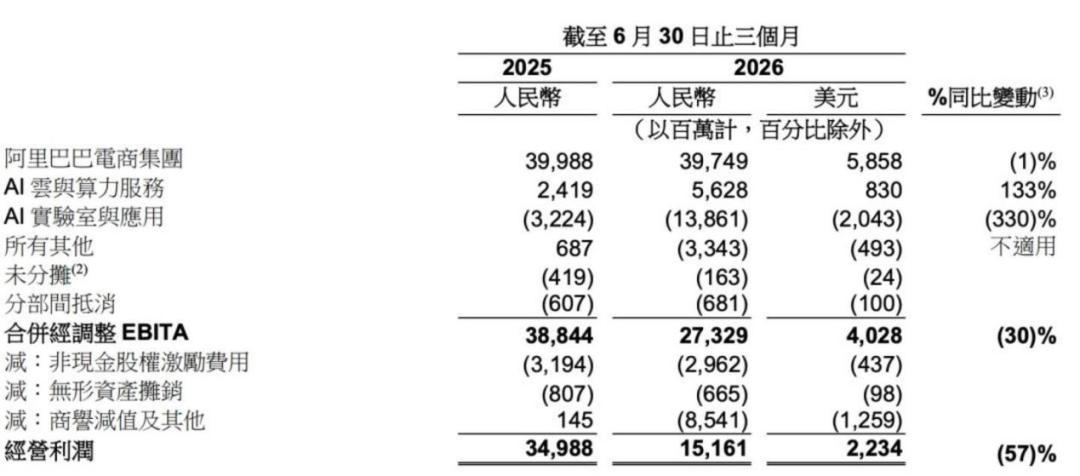
(Figure: Alibaba's 2026 Q2 Financial Report)
ByteDance is moving from C-end to B-end to make AI more profitable.
The integration of Feishu into Doubao is an obvious move.
On August 25, Doubao officially released the Agent product and brand for productivity scenarios — Doubao Work. The product is deeply connected with Feishu. After users log in with their Feishu accounts, Doubao Work can inherit enterprise knowledge and work context within the scope of permissions, call information such as chat records, documents, meeting minutes, and schedules, and complete work with the help of tools.
ByteDance tries to get the results of AI office faster with the help of Doubao, which has 345 million monthly active users.
Tencent chooses to find the answer internally.
Although cloud vendors are the most certain business model in the AI era and Tencent is also increasing its investment in AI infrastructure, Martin Lau emphasized that Tencent's computing power will give priority to meeting the needs of self-developed models and applications, and the remaining part will be leased out.
In the second quarter, AI has a significant driving effect on Tencent's business. The revenue from marketing services reached 43.565 billion yuan, a year-on-year increase of 22%, about 2.7 times the industry average.
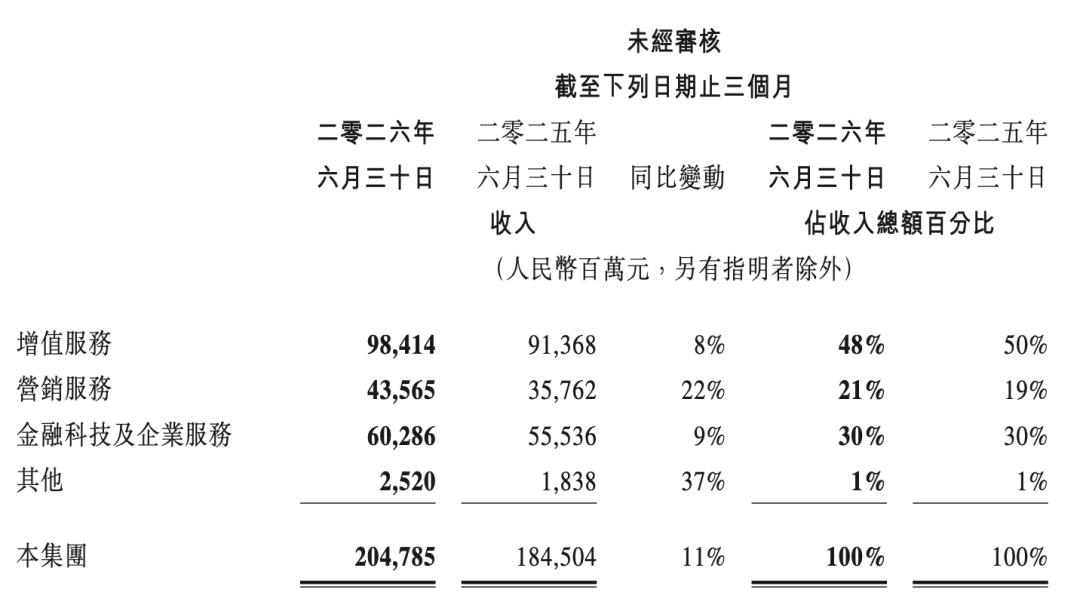
(Figure: Tencent's 2026 Q2 Financial Report)
Judging from WorkBuddy, the huge traffic pool composed of 1.3 billion users, as well as its advantages in content, payment and games, make Tencent more keen in product insight.
However, these are more like the previous generation players struggling to change their swimming postures on the beach under the tide of the times.
In the mobile internet era, major giants were obsessed with scale effect and network effect, and the technology itself was