Hesai and RoboSense are moving into the robotics space amid intense competition, have they made any profits?
Robots have become a hot trend, and numerous companies are flocking to this track, with Hesai and RoboSense, two LiDAR vendors, being no exception. The two companies have successively released their 2026 semi-annual reports, which offer a window to observe the progress of their robotics businesses.
In the first half of this year, the sales volume of ADAS LiDAR from both companies nearly doubled. Hesai sold 839,300 units, up 86.7% year on year, accounting for about 76% of the company's total sales; RoboSense sold 436,600 units, up 98% year on year, making up around 61% of its total sales.
However, as LiDAR is adopted in more affordable vehicle models, product prices continue to decline. Hesai disclosed that the revenue brought by increased delivery volume was partially offset by the drop in average selling price. RoboSense was also affected by rising raw material costs.
The price pressure is also reflected in gross margin. In the first half of the year, the gross margins of both companies declined year on year. Although operating cash flow improved, it still remained a net outflow.
This also explains why they are targeting the robotics sector, rushing to expand their product lines to robot components beyond LiDAR.
The robotics story is extremely popular, but the stock performance of the two companies is mediocre. As of August 27, Hesai has a market value of about 22 billion Hong Kong dollars, 2.4 times that of RoboSense (9 billion Hong Kong dollars). Considering the impact of Hesai's share split in July, on the forward-adjusted basis, Hesai's share price has fallen by about 34% since the start of this year, while RoboSense's share price has dropped by around 49%.
How much imagination the robotics sector can bring to LiDAR companies ultimately depends on how much extra profit these orders can actually generate for them.
01. Robotics LiDAR sales are rising, but profits fail to keep pace
The robotics business first changed the shipment structure of the two companies.
In the first half of this year, Hesai sold 260,700 robotics LiDAR units, up 165.3% year on year, accounting for about a quarter of its total sales; RoboSense's sales of LiDAR for robotics and other sectors reached 282,600 units, up 510.4% year on year, with the proportion approaching 40%.
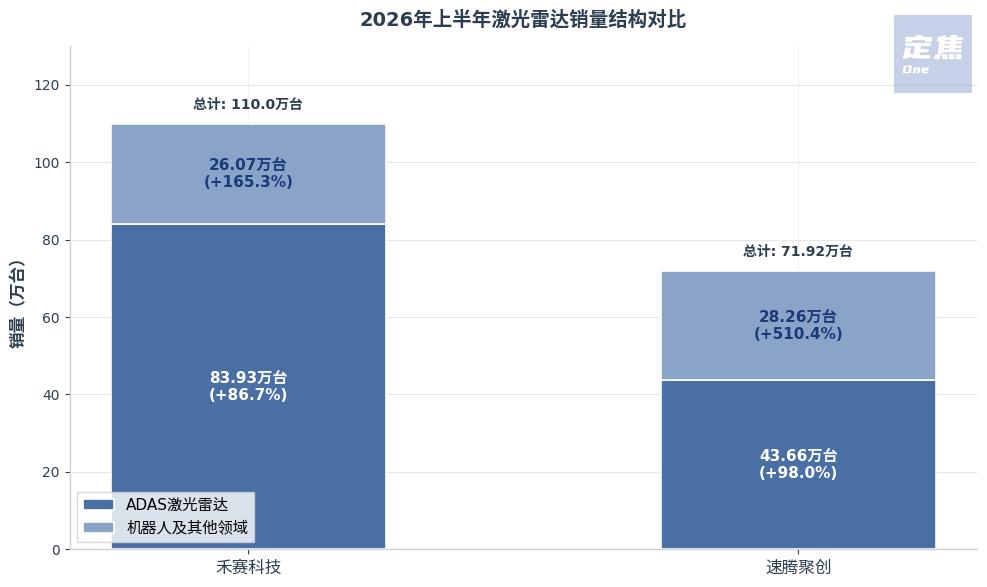
The proportion of robotics LiDAR is increasing, but the automotive business is still the main market for both companies. In China's passenger vehicle installation market, Hesai takes a more leading position. According to Gasgoo Automotive Research Institute, in the first half of 2026, Hesai's LiDAR installation share reached 34.2%, ranking first; RoboSense held a 14% share, ranking fourth after Huawei and Innovusion.
The shipment structure has changed, but revenue growth fails to catch up.
From the overall perspective of the two companies, Hesai's LiDAR sales volume increased by 100.8%, while the revenue from LiDAR products rose by 23.7%; RoboSense's LiDAR sales volume increased by 169.6%, and its product revenue grew by 32.9%.
The two companies do not disclose revenue by specific product, so it is impossible to calculate the unit price of robotics LiDAR accordingly. Given that both companies have disclosed the decline in average selling price, it is confirmed that the entire LiDAR industry is still facing price pressure.
Hesai does not separately disclose the revenue and gross margin of robotics LiDAR. The financial report only proves that this part of products have been sold in larger volumes, but it cannot show how much revenue and gross margin this segment has specifically contributed.
RoboSense's disclosure is more detailed. In the first half of this year, the robotics business has contributed nearly half of the product revenue, and has become the main source of product gross margin. The company also stated that this business segment contributed almost all of the revenue increment in the first half of the year.
Based on this statement, although RoboSense's ADAS LiDAR sales volume increased by 98%, the corresponding revenue increment may be relatively limited.
Apart from revenue, the gross margins of both companies are also declining.
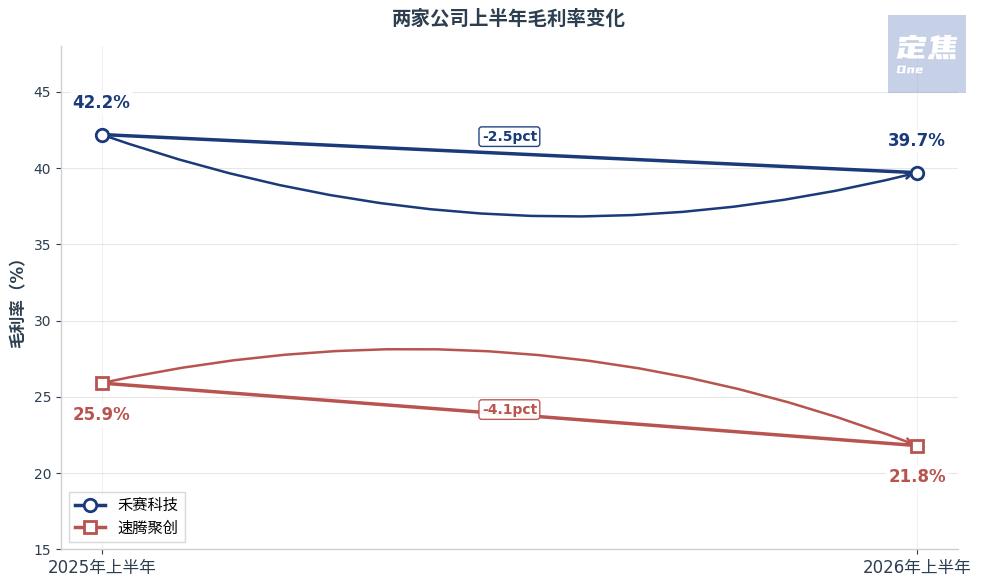
RoboSense stated that the gross margin of its robotics business remains at a relatively high level, but the company's overall gross margin still dropped from 25.9% to 21.8% in the first half of the year. According to the financial report, from RoboSense's overall results, the gross margin increment brought by the robotics business has not yet offset the impact of falling average selling price and rising raw material costs.
Hesai's gross margin also decreased from 42.2% to 39.7%. The company explained that the main reason was the rising proportion of revenue from products with lower gross margins.
Moving on to the profit statement, the problems faced by the two companies are different.
Hesai achieved a net profit of 88.87 million yuan in the first half of the year, up 234.9% year on year. However, at the consolidated operating level, the company still recorded a loss of 6.4 million yuan.
From the perspective of business structure, Hesai's core LiDAR business has already been profitable. In the first half of the year, the LiDAR business achieved an operating profit of about 108 million yuan, while the SGI strategic growth business (spatial intelligence, robotic actuators, etc.) is still in the investment period, with an operating loss of around 115 million yuan. The profits earned by the LiDAR business are basically offset by the losses of the new business.
The operating level is close to break-even, but the final net profit of 88.87 million yuan mainly comes from interest and investment income. In the first half of the year, Hesai's net interest income and investment income totaled about 142 million yuan; after deducting about 47.4 million yuan of exchange loss, it contributed around 95 million yuan, which is the majority of the final net profit.
RoboSense faces greater pressure. In the first half of the year, the company's operating loss narrowed from 197 million yuan to 172 million yuan, but this figure includes about 73.5 million yuan of other income, which mainly comes from the sale of part of the equity in an associated company and exchange gains. This profit or loss item was close to zero in the same period of last year. Calculated on the same caliber, after excluding other income or net loss, RoboSense's operating loss expanded from about 197 million yuan to about 245 million yuan. Its net loss also increased by 7.6% year on year to 160 million yuan.
Both companies are increasing their R&D investment, part of which is allocated to robotics and related new products. In the first half of the year, Hesai's R&D expenses reached 436 million yuan, while its gross margin in the same period was 611 million yuan, which can still cover the R&D expenses. RoboSense's R&D expenses were 346 million yuan, but its gross margin was only 222 million yuan, which means its R&D expenses alone are about 124 million yuan higher than the total gross margin of the company.
From the perspective of profit results, the two companies are in different stages. Hesai's core LiDAR business has been profitable, while its new business is still in the investment period; RoboSense's robotics business has changed its revenue structure, but its overall gross margin is still declining, and its operating loss after excluding other income is also expanding.
02. Competing in the robotics sector, LiDAR alone is far from enough
At present, the revenue of both companies still mainly comes from LiDAR. If they only sell LiDAR, the revenue generated by a single robot is limited, so they have expanded their product lines to more robot components.
LiDAR is responsible for ranging and contour recognition, while robots need spatial cameras, tactile sensors, joints and power modules to complete grasping and operation tasks.
Hesai has laid out spatial cameras and power modules, while RoboSense has further expanded to spatial cameras, tactile sensors and joint modules. Taking humanoid robots as an example, the per-unit usage of joints and power modules is usually higher than that of LiDAR. After the product lines are fully deployed, the two companies can obtain more revenue from robots.
The accumulated customer relationships of the two companies, as well as their capabilities in chips, optics, precision manufacturing and supply chain, can help new products enter the testing and procurement process faster. However, these sectors already have existing suppliers, so Hesai and RoboSense still need to re-prove their competitiveness in terms of price, performance and delivery capability.
Judging from the sales progress of new products, Hesai is moving faster at present.
In the first half of this year, Hesai's SGI business recorded revenue of about 44.94 million yuan for the first time, which mainly comes from power modules, accounting for less than 3% of the company's total revenue. By the end of the second quarter, more than 10,000 sets of power modules have been delivered, and the products have expanded from dexterous hands to full-body joints.

Source / Hesai official website
Hesai's spatial intelligence product Kosmo includes spatial cameras, algorithms and cloud services. The product delivered its first batch of prototypes in July, and is expected to start recognizing revenue in the third quarter. The company also raised this year's revenue target for the SGI business from 100 million yuan to 200 million to 300 million yuan.
This business segment has started to generate sales, but the scale is still small. Whether the full-year target can be achieved depends on the delivery speed in the second half of the year.
Hesai also set targets for the next stage. The company plans to make the SGI business generate about 100 million US dollars in revenue in 2027, and strive to achieve break-even in that year.
RoboSense's situation is different. At present, its robotics business revenue mainly comes from LiDAR. As disclosed in the conference call, the three new products including spatial cameras, tactile sensors and joint modules will contribute a total revenue of about 100 million yuan in 2027. This target only covers the three new products, and the caliber is different from Hesai's target covering the entire SGI business, so their scales cannot be directly compared.
According to the company's disclosed plan, spatial cameras will start delivery at the end of the third quarter; the first enterprise-level project of tactile products will be delivered at the end of September, and enter mass production in the fourth quarter; the joint modules have received the first batch of 10,000-level procurement demands, and are scheduled to be delivered in batches in the fourth quarter.
When Hesai and RoboSense went public, the most popular story was autonomous driving. Their logic was that the more popular intelligent driving becomes, the more LiDAR units will be sold. Later, LiDAR was indeed widely adopted in vehicles, and the sales volume rose. However, product prices kept falling, and gross margin and cash flow failed to keep pace.
In the robotics market, a practitioner focusing on the robotics industry chain said that after the product categories increase, the positions of the two companies in the robotics industry chain have not changed fundamentally. They are still upstream component suppliers, and their orders depend on the sales volume of complete robot units, technical solutions and procurement prices.
It is no longer easy to raise valuations only through product planning. Going forward, the market will focus on whether new products beyond LiDAR can generate scalable revenue, and convert it into gross margin and operating cash flow.
This article is from the WeChat official account "Dingjiao" (ID: dingjiaoone), written by JIN Yufan, edited by WEI Jia, and published with authorization from 36Kr.