Hollywood has made peace with ByteDance. Since the wave of AI videos cannot be stopped, they will make money together.
In February this year, when Seedance 2.0 was just released, the Motion Picture Association of America (MPA) took a very uncompromising stance towards ByteDance. It first publicly demanded that ByteDance stop all infringing activities related to Seedance 2.0, then sent a cease-and-desist letter directly a week later, requiring the company to strengthen copyright protection. At that point, the two sides were just one step away from taking the dispute to court.
ByteDance obviously also realized that its initial AI video model did not properly handle copyright issues. It quickly restricted the output of infringing content by setting up content fences and other measures, which even once affected the output of normal non-copyright-infringing content, drawing a lot of complaints from netizens.
Image source: Leikeji
There is no need to think that ByteDance overreacted. After all, behind the MPA it faced are a group of Hollywood giants holding the world's top film and television assets, including Disney, Sony and Paramount. Considering their IP resources and influence, a head-on confrontation is obviously not a good idea.
However, just when everyone thought the incident would end up in court, ByteDance and the MPA suddenly announced that the two sides had signed a memorandum of understanding, and would establish an intellectual property protection framework around generative AI models such as Seedance and Seedream.
The MPA's official website even described this cooperation as a "global agreement" reached by the two sides on intellectual property protection for AI video and image models. Given that models such as Seedance are already the absolute main force in the current AI video market, the MPA's statement is not inaccurate.
The most surprising part of the whole incident is why the MPA changed its attitude so quickly? Half a year ago, it would directly issue a "lawyer's letter warning" at the slightest disagreement, but half a year later it was ready to sit down and "talk properly". Leikeji found that if you have been following the AI video industry, you will find a fact: AI video technology is really impossible to block completely.
Hollywood is forced to embrace AI, because it can no longer be blocked
From the perspective of companies like Disney, it is completely understandable to remain vigilant about AI. After all, IP is the core foundation for their survival. To extend the copyright term, companies like Disney even spent huge sums of money lobbying the US government to revise the copyright act into a form that is favorable to them.
Therefore, they are very cautious about every authorization they grant, for fear that partners will cause some trouble that damages the value of their IP. Under such circumstances, AI video gives almost all users "equal" creative capabilities. They can easily create hyper-realistic visual effects and apply them to various videos, and the content of these videos is completely "uncontrollable".
Image source: pexels
After Seedance 2.0 was launched, the MPA made it clear that a large number of generated content featuring well-known movie characters and story elements appeared on the platform, and demanded that ByteDance add more protection measures. At this year's CinemaCon, MPA Chairman Charles Rivkin still took a tough attitude when talking about AI, emphasizing that AI can be a creative tool, but copyright protection will not be compromised.
Therefore, if Hollywood used to resist AI videos creating content based on their IP, now it has turned to wanting to control the output of IP content, which is back to the state they are most familiar with: "IP authorization — content output — review — release".
At present, if ByteDance and Hollywood continue to promote cooperation in the follow-up, it is very likely to adopt the cooperation model between OpenAI and Hollywood in previous years, that is, to separately authorize character IP, peripheral IP related to characters and scene content. It can be seen that IP is not unusable, but it requires payment (however, less than a month after the cooperation agreement was signed, OpenAI announced that it would suspend the development of Sora, and shut it down completely this year, which was a big blow to Hollywood).
Looking back now, it is also possible that because of this "precedent", Hollywood adopted a more cautious attitude towards the "olive branch" extended by ByteDance. When cooperating with OpenAI before, Disney even promised to invest 1 billion US dollars. This kind of deal that gives out IP authorization and pays money at the same time is rare for Disney in the past few decades (in the end, because Sora was shut down, the investment was not actually implemented).
Image source: pexels
However, ByteDance's Seedance currently looks quite reliable, and it is also one of the few AI video models that have been officially put into commercial operation. In June this year, ByteDance's Volcano Engine launched the Volcano Ark Copyright Commercialization Platform, and reached a cooperation with Stephen Chow's High Group, obtaining the copyright authorization for the three films *King of Comedy*, *The God of Cookery* and *CJ7* in AI video creation scenarios.
Moreover, for content companies, as long as they can control the video content and avoid overly "out of line" content, authorizing IP to AI video models brings more advantages than disadvantages. They can not only collect additional authorization fees, but also "free ride" on the creativity of a large number of creators, which kills two birds with one stone.
Celebrities are trying to sell their "younger self" to AI
Of course, the formal cooperation between Hollywood and ByteDance may still be in the making, but on the other side, ByteDance has already made new breakthroughs. Led by Volcano Engine, it has successfully negotiated the image authorization of some celebrities. To be honest, this part is more worthy of attention.
I believe many readers have seen the AI short film *Shadow* launched by NetEase's *Tianxia* some time ago. The heroine image in the film is sampled from Joey Wong's classic movie image (the character Xue Qianxun played by Joey Wong is a top-level childhood goddess). It is somewhat emotional to see the famous star who has retired from the entertainment industry for 22 years return to the screen in this way.
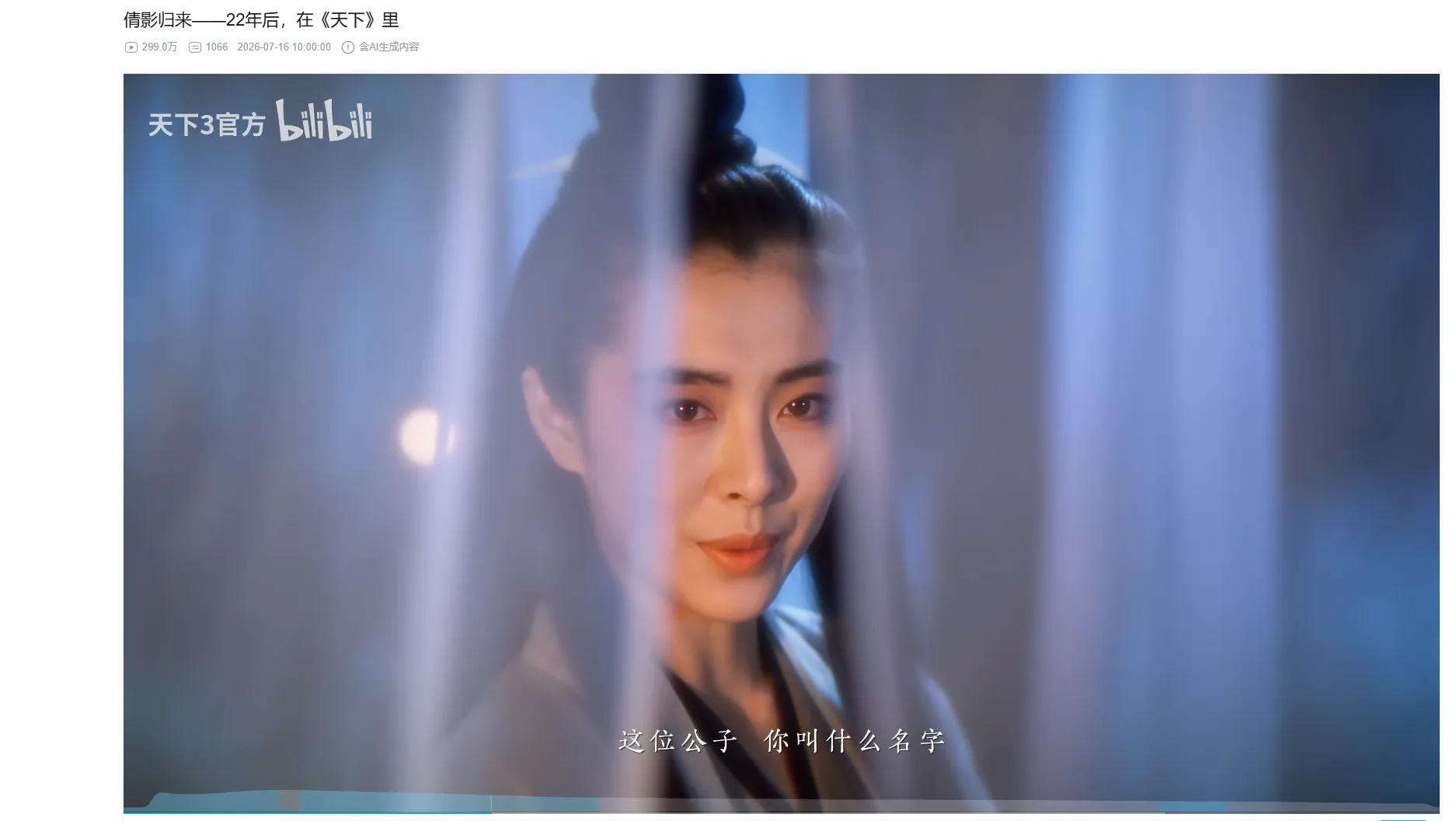
Image source: Bilibili
After officially confirming that she authorized her personal image to Volcano Engine, Joey Wong specifically responded to this cooperation and put forward her own point of view: "We are using AI, not being used by AI."
In the view of Leikeji, this sentence perfectly illustrates the difference between celebrity AI authorization and the previous "AI face swap". In the past, when people talked about AI face swap, most of the time it was negative, such as "fraud", "spoof videos" and so on, which made many celebrities extremely cautious about AI image authorization.
However, if some people start to test the water and get real benefits from it, the situation will be different. Take Joey Wong as an example. Although she was already a top star in the 1990s, her subsequent career development almost stagnated. Logically, such a star can hardly find other development paths except for doing live streaming marketing to earn money from fans' nostalgia.
But AI video models are different. They can bring the celebrity's most peak image back to the public's view, which is also the image most recognized by old fans. Even if it is to earn "nostalgia money", it is definitely more useful than appearing in front of the public with a face that even fans feel "strange" two or three decades later, and it may even attract new fans.
Therefore, for these movie stars who have retired for many years, there is no pressure at all for them to grant AI image authorization. But besides Joey Wong, Lawrence Ng also announced his AI image authorization, which surprised many industry insiders.
After all, compared with Joey Wong who has retired for many years, Lawrence Ng has always been active in the film and television industry, and his popularity has begun to pick up in the past two years. For him, AI image authorization may be more out of the idea of wanting to "see his younger self reappear".
Image source: pexels
From a personal point of view, Leikeji does not dislike this kind of authorization. After all, it is a good experience to see the stars we once liked active on the screen again, as long as there are no large number of abstract video contents (now I suddenly understand Hollywood's concerns).
Moreover, from the perspective of the industry, if more and more actors start to sell their AI image authorization in the future, it may directly change the current situation of the entire actor industry. In the past, if an actor created a classic image, he might rely on this image to make a living for a few months or one or two years, and no one would remember it after the popularity faded. But in the future, a classic image may become an "old IP" active in various videos for decades to come.
However, some netizens have raised a concern: AI technology is developing too fast. The work that could not be undertaken due to schedule conflicts and other reasons in the past can now be handed over to AI to act as a "stand-in", so that the AI images of top stars will occupy more and more screen space, making it difficult for new actors to get opportunities.
Leikeji can't make too many comments on this, after all, it is not very familiar with the entertainment industry. But from the perspective of IP, AI video also gives ordinary people the ability to create their own personal IP. For example, "Gu Gu Ga Ga", which is very popular on both Douyin and Bilibili, was originally a derivative mascot of a comic, but with the promotion of AI video, it has become one of the most popular two-dimensional IPs this year.
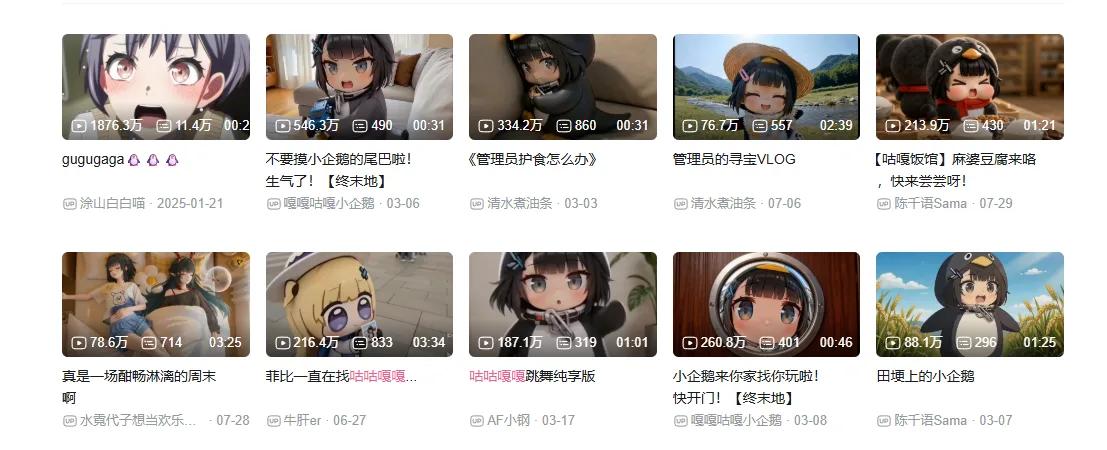
Image source: Bilibili
Moreover, netizens have drawn a set of IP pedigree based on the "Gu Gu Ga Ga" images from different creators, among which creators with strong technical strength and interesting plots have significantly higher traffic than those who follow the trend. Therefore, personally, this actually gives creators or actors with real strength more chances to succeed, after all, the real era of "personal creation" is coming.
ByteDance is hoarding copyrights, which is the cornerstone of AI video commercialization?
Back to the issue of copyright, in recent months, everyone can find that ByteDance has been promoting copyright cooperation with content manufacturers, and it has become one of the AI video platforms with the largest copyright scale at present. So the question is, why did ByteDance start to accelerate the negotiation of IP copyright?
Leikeji believes that the reason is very simple: ByteDance needs copyright as a moat. For both platforms and creators, copyright is the best tool to attract audiences with half the effort, and it is also the core of monetization. The more copyrights you own, the more voice you will have in the future competition of AI video platforms.

Image source: pexels
Moreover, the momentum of open source AI video models has been growing in the past two months. In the past, AI video models required professional computing cards to run, and the price of professional computing cards was unaffordable for ordinary people. But after multiple rounds of iteration, repeated distillation and compression, even entry-level graphics cards priced at two to three thousand yuan can run AI video models now.
Of course, the generation speed and quality are definitely not comparable to formal models such as Seedance, but the huge cost advantage offsets this problem to a certain extent. Therefore, formal AI video platforms must show advantages completely different from open source models to continue to attract users, and this advantage is naturally "copyright".
For example, for creators, if you want to make commercial AI videos for an enterprise, you must have compliant copyright authorization, otherwise the money you get may not be enough to pay for compensation. Therefore, although everyone is still "entertaining themselves" at this stage and does not feel the need for copyright, when AI video truly enters the commercialization stage, copyright will become one of the core considerations for users to choose platforms.
Moreover, when AI video platforms start to collect a large number of copyrights in a centralized manner, it actually means that AI video is only one step away from real commercialization. No one knows who will be the first to break through this critical point, is it Keling? Or Jimeng?
This article is from Leikeji, and is authorized for release by 36Kr.