The AI commercialization progress bar in iFLYTEK's interim report
Author | Wang Yi
Cover Source | Image provided by the enterprise
On the evening of August 20, iFlytek released its 2026 interim report.
The financial report shows that the company achieved a revenue of 116.23 billion yuan in the first half of this year, with a year-on-year increase of 6.52%; the net profit attributable to shareholders recorded a loss of 204 million yuan, narrowing the loss by 14.68% compared with the same period of last year. Meanwhile, the company's total sales repayment in the first half of the year reached 118.96 billion yuan, and the operating cash flow turned positive in the single quarter of Q2 this year.
On the surface, the revenue growth rate shows positive growth, while the profit side is under short-term pressure, and the cash flow has seen marginal improvement. However, behind the seemingly contrasting financial data, what deserves more attention is the marginal changes in the company's revenue structure, AI commercialization model and operating quality.
At present, the large model track is shifting from the competition of technical capabilities to the speed of industry implementation. With years of continuous in-depth research on large model technologies, iFlytek has begun to realize performance along the paths of open platforms, MaaS, industry agents and AI terminals. It can be seen that the key of the information disclosed in this interim report is not only how much money and profit the company made in the first half of the year, but that iFlytek is moving from the stage of high-intensity investment in large models to the climbing stage of realizing the value of AI business.
Business structure upgrading drives revenue growth
One of the core driving forces of the company's revenue growth in the first half of the year comes from the active business structure adjustment.
From the three ends of G, B and C, the company continues to follow the core business strategy of "prioritizing the G-end, deepening the B-end, and strengthening the C-end". Among them, the G-end revenue in the first half of the year decreased by 2.65% year-on-year, which is due to the active contraction of some traditional project-based businesses with low gross profit and heavy delivery. At the same time, the combined revenue of B-end and C-end businesses has accounted for 76%, with a year-on-year increase of about 10%, becoming the main driving force for the company's revenue growth.
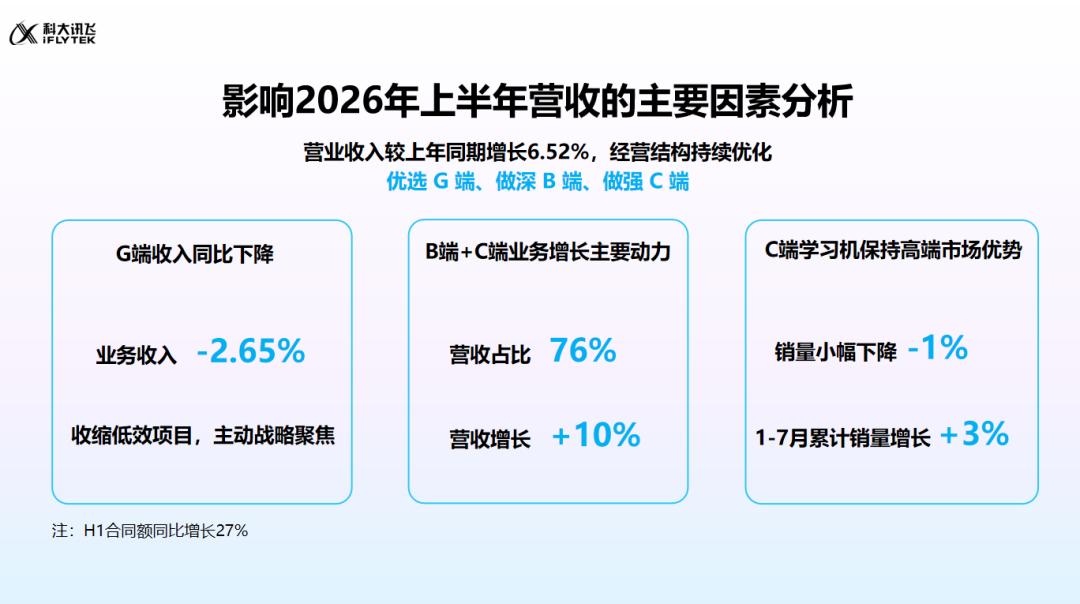
Figure: Main factors affecting iFlytek's revenue in the first half of 2026;
Source: materials from the company's performance briefing, 36Kr
The change of the revenue structure in the above caliber means that iFlytek is not simply pursuing revenue scale, but reducing its dependence on some project-based businesses, and the focus of revenue growth begins to tilt to the B-end and C-end with greater performance elasticity. In the long run, the importance of this structural change is far higher than the short-term revenue growth rate itself: the increase in the proportion of B-end, C-end and operation-based businesses is also expected to enhance the sustainability of revenue and the quality of operating cash flow.
This change is even more obvious from the business caliber disclosed in the financial report. In the first half of the year, the open platform achieved a revenue of 3.705 billion yuan, with a year-on-year increase of 36.01%, and the revenue proportion rose to 31.87%, which has exceeded smart education and become the company's largest source of revenue; at the same time, the gross profit margin of the open platform increased by 3.63 percentage points year-on-year to 20.21%. In addition, the revenue of smart healthcare and smart vehicles increased by 58.56% and 20.46% year-on-year respectively, which are important marginal growth points of the company's performance.
In the past, the business value of the open platform was more reflected in AI capability interfaces and developer ecology; after entering the era of large models, under the guidance of MaaS construction and agent industrialization strategy, its core business model has gradually extended to MaaS platforms, model calls, Token services and enterprise AI infrastructure and other fields.
In the first half of this year, the revenue of iFlytek's large model API and MaaS platform services increased by about 70% year-on-year, and the platform has formed a two-wheel drive model of "API economy + large model Token economy"; as of the end of June this year, the number of AI developers on the platform exceeded 11.5 million, of which more than 3.2 million are large model developers, and the scale of the developer ecology continues to lead the industry.
This actually means that iFlytek's AI commercialization is entering a new stage: the business model is gradually migrating from the traditional project system to the "platform + operation + AI service" model, and AI capabilities have begun to gradually realize performance, with positive expectations for future performance growth.
The expansion of the scale of operation-based businesses and the continuous improvement of operating quality also appear in traditional advantageous businesses represented by education. Although the revenue of education business decreased by 1.16% year-on-year in the first half of the year, the contract amount increased by 45% year-on-year, and a large number of contracts are still in the stage of delivery and acceptance. At the same time, the intelligent marking machines have covered more than 5,000 schools. With the large-scale deployment of marking machines, the continuous operation service for homework achieved a revenue of about 320 million yuan in the first half of the year. In addition, the sales volume of iFlytek AI learning machines in the first half of the year was affected by factors such as the price increase of chips/storage and periodic shortage of supplies, which failed to meet expectations, but the sales volume of iFlytek AI learning machines rebounded rapidly in July, and the sales volume in that month increased by more than 30% compared with the same period.
Short-term profit pressure to consolidate the AI technology foundation
In contrast to the structural improvement on the revenue side, the company's profit side is under short-term pressure. However, from the decomposition of the income statement, the main reason for the expanded loss is not the deterioration of core business, but that the company is still in the stage of high investment in large models and new businesses.
The profit pressure is closely related to the further increase of R&D investment intensity; in the first half of 2026, the company's R&D investment reached 3.007 billion yuan, with a year-on-year increase of 25.73%.
Sales expenses also remain at a high level; the company's sales expenses in the first half of this year were 2.285 billion yuan, with a year-on-year increase of 9.52%; the promotion expenses for intelligent marking machines, image cloud, AI glasses and overseas businesses exceeded 100 million yuan.
At the critical stage of iFlytek's business transformation, the core significance of maintaining a high level of R&D investment is to consolidate the AI technology foundation and provide support for subsequent performance realization.
The company's core technical progress in the first half of this year includes: releasing the Spark X2 large model with comprehensively upgraded general capabilities; releasing X2-Flash and opening APIs, which further reduces the cost of Agent applications while improving the capabilities of agents and coding, laying a foundation for the continuous commercialization of MaaS and Token economy; releasing the multimodal large model X2-VL, which further expands the boundary of model capabilities.
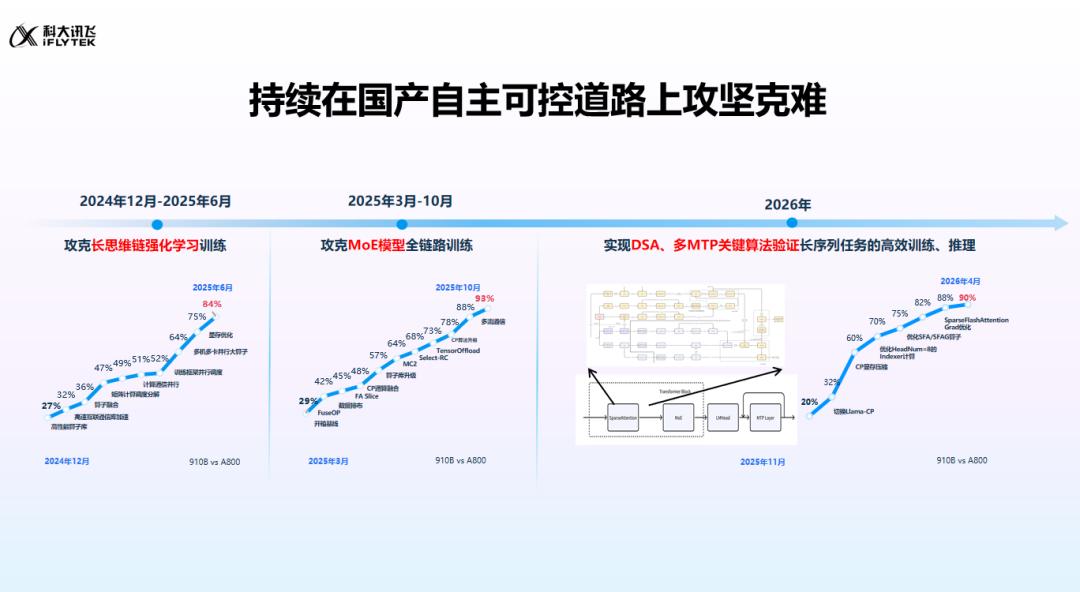
Figure: Progress of full-stack optimization of domestic computing power for iFlytek's large model;
Source: materials from the company's performance briefing, 36Kr
More importantly, the path between the company's technical capabilities and commercialization is gradually becoming clear. Especially with the continuous strengthening of model capabilities, the ability to embed models into real business scenarios and create economic value is the core variable that will truly widen the gap between enterprises in the next stage. At present, iFlytek has formed a complete commercialization path of model-platform-agent-terminal application.
Moreover, under the company's two-wheel drive model of "API economy + large model Token economy", the AI business has begun to realize performance, indicating that the company's large model application has gradually entered the value realization stage from the capability verification period. From a deeper level, the short-term pressure on the profit side and the growth of AI business are actually two sides of the same coin: the former mainly reflects the current R&D investment intensity; the latter indicates that the previous R&D investment has gradually begun to generate commercial returns.
Cash flow improvement and operating quality enhancement
In terms of cash flow, although the company's operating cash flow expenditure increased in the first half of the year, the positive operating cash flow in the second quarter released a more positive signal.
According to the information disclosed at the company's performance meeting, the cash outflow from operating activities increased by 1.98 billion yuan year-on-year in the first half of this year; among them, the strategic stockpiling of storage chips and other materials increased by 626 million yuan year-on-year, and the concentrated maturity of acceptance bills increased by 423 million yuan year-on-year. These two factors explain most of the incremental cash flow expenditure in the first half of the year.
At the same time, the sales repayment in the first half of the year reached 11.896 billion yuan, an increase of 1.535 billion yuan year-on-year, and the sales repayment rate further increased to 102%. In other words, the current cash flow pressure is more reflected in the rhythm of supply chain stockpiling and strategic investment, rather than the deterioration of operating quality. The actual improvement of repayment ability is an important support for the marginal improvement of the company's operating cash flow in the single quarter of the second quarter.
This point also cross-verifies with the change in revenue structure that the company actively contracted some inefficient G-end projects and increased the proportion of B-end, C-end and operation-based businesses. With the increase of the revenue proportion of the open platform, and the continuous growth of new businesses such as MaaS and large model APIs, the company's core business model has gradually changed from project-driven to operation-driven, and this structural change is also conducive to the improvement of the company's cash flow in the future.
Summary and Outlook
It can be seen that the contrast on the financial side essentially reflects that iFlytek is in a stage where business transformation and high investment proceed in parallel. On the one hand, the business structure is accelerating to migrate to the B-end, C-end and operation-based services, coupled with the continuous improvement of repayment ability, which is expected to further improve the revenue quality and cash flow level; on the other hand, behind the short-term profit pressure, there is high-intensity investment on the R&D side, and consolidating the technology foundation is also the cornerstone to guarantee future performance growth.
From the industry perspective, in the past three years, the core of competition among large model enterprises was more about technical capabilities and model iteration. Enterprises need to continuously invest in computing power, talents and R&D to get the ticket to enter the next stage of competition; after entering 2026, the core problem of the AI industry has gradually shifted from "whether the model can be developed" to "whether the model can truly generate revenue and profits".
iFlytek's advantage lies in that after years of accumulation and precipitation in industries such as education, medical care, automobiles and C-end businesses, the company already has a wealth of real business scenarios. The revenue growth of open platform large model APIs and MaaS, the revenue growth of smart healthcare and smart vehicles, and the gradual volume release of enterprise agents all indicate that the technical capabilities of the company's large model have begun to realize commercial value, which is exactly in line with the current industry trend.
As the revenue of the company's AI business is climbing and the expense expenditure also maintains high intensity, the short-term profit actually bears a large number of upfront costs generated by R&D, infrastructure construction and new business expansion at the same time. Therefore, the price-earnings ratio that simply takes the current performance as the core cannot fully reflect the multiplier effect of the AI business in the future, and its explanatory power is relatively limited.
The key to determining the company's valuation in the next stage is still whether business transformation and R&D investment can be continuously converted into revenue from MaaS, Token, industry agents and AI terminals, and finally form verifiable profits and cash flow. The corresponding core highlights are: whether the AI business can continue to maintain high growth, whether the revenue proportion of operation-based businesses can continue to increase, and whether R&D investment can eventually be converted into higher return on capital and other aspects.
From this perspective, the 2026 interim report is more like a phased turning point - iFlytek is still in the investment cycle, but the AI business has begun to realize performance. As the company's model capabilities are further implemented into specific application scenarios, what will truly determine the company's value in the future will no longer be only the technical capabilities and ranking position of the Spark large model on the leaderboard, but whether it can continuously enter real businesses and convert technical advantages into large-scale and sustainable commercial returns.