Mass-producing millionaires, 450 listed companies are going all out to dole out huge sums of money.
Abstract: Controversy and wealth are sometimes separated by a thin line.
"Equity incentive is a lot like love: it sounds wonderful, but there's nothing left for you when it's your turn." This self-mockery from a tech company employee on Maimai hits the hottest wealth-creation narrative in the current tech circle: on one hand, the news that 124 Cambricon employees got an average of 5.57 million yuan each has gone viral overseas; on the other hand, four more STAR Market semiconductor companies have disclosed their incentive progress collectively on August 24... From real estate to the internet, then to AI, industry trends keep shifting. The wealth of the previous generation is recorded on property ownership certificates, while the fortune of this generation is tied to the access terms of their work badges and options.
The AI wealth-creation train has already set off. Inside and outside the window, some people get millions of stocks, while others haven't even touched the ticket.
Has the "Wealth Era" for engineers begun?
Since its listing, Unitree Robotics has seen its stock price fall for several consecutive days. It opened 0.23% lower again today, at 598 yuan per share as of press time.
Compared to the 1100 yuan per share peak hit on its first trading day, the stock has dropped by 46%. For some Unitree employees, this means a very realistic problem: the wealth that was swelling in their accounts just a few days ago has shrunk by nearly half.
This is probably the most vivid wealth lesson in the tech industry this year.
On Unitree Robotics' first listing day, as its stock price surged sharply, 11 employees who had completed the exercise of their options once held stock worth an average of 500 million yuan per person. The Shanghai Yuyi employee shareholding platform before the company's IPO holds 10.94% of the shares, with a maximum market value of about 48.6 billion yuan during the trading session.
But the capital market didn't give these engineers much time to get used to the feeling of being "wealthy". Four trading days later, the stock price was cut in half. The wealth didn't disappear, it just quickly changed from a somewhat exaggerated number to another number.
Unitree is not an isolated case. Phoenix Tech has noticed that more and more tech companies are starting to talk about the future with their employees through equity.
At the end of last month, Cambricon planned to grant 5 million restricted shares to 945 employees, covering 85.37% of its total 1107 employees, at a grant price of 750 yuan per share. Calculated based on the closing price of 1128 yuan on the announcement date, the total value of these shares is about 5.64 billion yuan. Among them, 6 senior executives each got 60,000 shares, with an average book floating profit of about 22.68 million yuan per person. If calculated on average for the remaining shares, the other 939 employees correspond to a book floating profit of about 1.47 million yuan per person.
The 124 employees who received the earlier round of incentives were granted a total of 597,600 shares at a grant price of only 75 yuan. Estimated based on the stock price at that time, the total value exceeded 690 million yuan, with an average equity of about 5.57 million yuan per person.
Another company, InnoLight, has been implementing equity incentives continuously since 2017, and is currently mainly executing the 2023 Phase III and 2025 Phase IV restricted share incentive plans.
Among them, the first vesting of the reserved part of the Phase III restricted share incentive plan implemented in June this year: 69 core employees vested a total of 324,500 shares at a vesting price of 35.16 yuan per share. Calculated at the stock price of about 1280 yuan at that time, the market value of this batch of shares is about 415 million yuan, while the original cost to obtain these shares was only about 11.41 million yuan, with a total floating profit of about 400 million yuan. The average book floating profit per person exceeded 5.8 million yuan, with a floating profit multiple of over 35 times.
In other words, every 1 yuan invested in share purchase cost back then has now become a market value of about 36 yuan, of which about 35 yuan is floating profit.
According to incomplete statistics from Phoenix Tech, by the end of June this year, the Phase III and Phase IV incentives of InnoLight covered a total of about 803 employees, involving a stock market value of nearly 2 billion yuan.
In addition, the restricted share incentive of Advanced Micro-Fabrication Equipment Inc. China covers 3061 people, accounting for 97.3% of the total number of employees, which is almost equivalent to full employee shareholding.
From Unitree, Cambricon, InnoLight, to Huahai Qingke, Montage Technology, and then to BiWin Storage, Advanced Micro-Fabrication Equipment Inc. China... from robotics, AI chips, to optical modules, then to semiconductor equipment and storage, if there were only a few companies doing this, it would easily be regarded as a special treatment for star enterprises. But Wind data shows that nearly 450 A-share companies have disclosed equity incentive plans since the beginning of this year, a year-on-year increase of 27.56%.
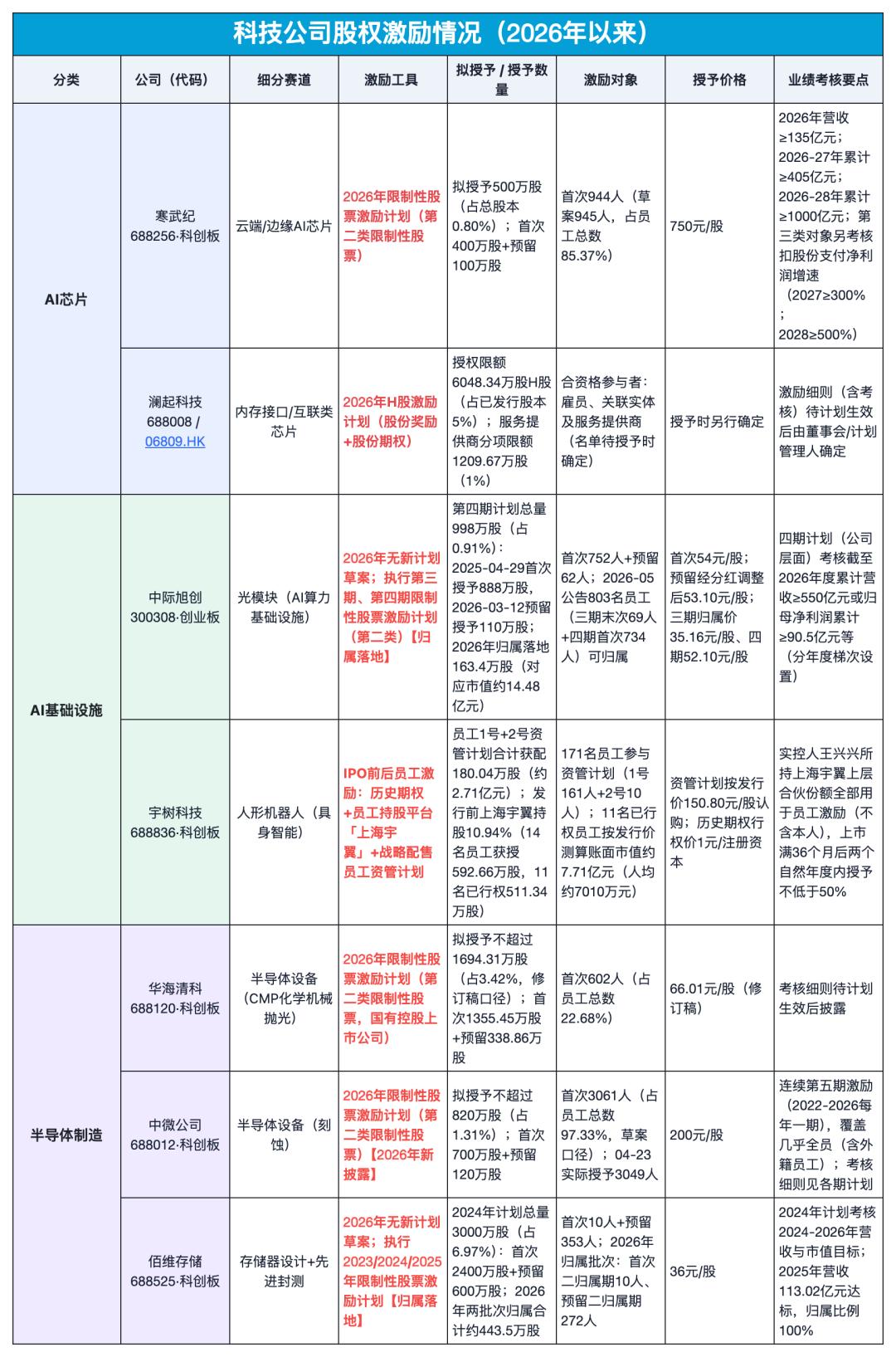
Figure 1 | Incentives provided by tech companies to employees in 2026, data source: announcements of listed companies, prospectuses and media reports
In addition, public information shows that by the end of 2025, the penetration rate of equity incentives among listed companies in the tech sector was about 73.6%, far higher than the 58.8% figure for the overall A-share market. This means that this is no longer an accidental phenomenon of a few star companies, but a structural change taking place in the talent compensation system of Chinese tech companies.
In the past, the wealth source of outstanding Chinese engineers was mainly salary plus year-end bonus; now it is increasingly becoming salary plus bonus plus stocks/options.
And when industries such as AI, robotics and semiconductors see massive valuation revaluation, the equity part has started to generate real wealth.
The first to get rich may not be the smartest people
If you dig out the equity incentive lists of these tech companies, you will find a very interesting detail:
Apart from directors, supervisors and senior executives, the people who actually get the stocks are not engineers in the general sense, but more accurately, core technical personnel, technical backbones, business backbones and middle-level managers.
For example, in the restricted share incentive plan disclosed by Cambricon in 2026, the first batch of grantees include core technical personnel, business backbones and other personnel that the board of directors deems need to be incentivized;
A large number of technical and R&D personnel also participated in the employee shareholding arrangement of Unitree before its listing. According to documents such as the prospectus, 12 of the incentivized employees came from the R&D department, 2 from the sales department and 2 from the production department respectively. Among the IPO employee asset management plans, the participants of No. 1 asset management plan are mainly technical supervisors, R&D, production, marketing and sales backbones.
The reserved grant list of the Phase IV restricted share incentive plan disclosed by InnoLight in March this year is more straightforward: among the 62 grantees, there are no company executives, and they are mainly core business or technical post personnel and middle-level managers. The company granted 1.1 million restricted shares to these 62 people at a grant price of 53.10 yuan per share. Even calculated based on the latest stock price after the fall, the market value of this batch of shares is close to 1 billion yuan.
In other words, in the same tech company, "engineers" are not a unified wealthy group. Some get stocks, some only get salaries; some get tens of thousands of shares at a time, while some may have worked for many years without being included in the incentive list.
So here comes the question: why don't companies distribute the shares equally to everyone?
The answer can be seen from the list of the incentive plans: stocks are preferentially allocated to the people that the company considers more important.
This also gives equity incentives a new function — in the past, companies mainly priced employees through salaries and bonuses; now the number of shares itself has become a price tag.
And this price is not realized all at once.
Taking restricted shares as an example, after employees get the shares, they usually have to go through several years of vesting periods. The Phase III restricted share incentive plan of InnoLight follows this rule: the first granted part is divided into multiple vesting periods, and employees need to meet the company's performance and personal performance conditions to gradually obtain the corresponding shares. In March 2026, the company announced that 99 incentive objects met the conditions for the second vesting period of the first granted part of Phase III; at the same time, 5 employees had their unvested shares invalidated due to resignation.
This means that there are still several thresholds between stock options and real wealth: the company's stock price has to rise, the employee has to stay, and the vesting conditions have to be met.
The experience of Chen Hao, a former employee of Xiaohongshu, pushed this matter to another direction.
Chen Hao joined Xiaohongshu in 2022, taking a position related to commercialization. In December 2023, he was terminated by the company, when his part of the options were about to vest. After that, he had a dispute with Xiaohongshu over the options issue and kept safeguarding his rights.
In early 2026, the dispute that lasted for more than two years came to a result. Public reports show that Xiaohongshu finally compensated Chen Hao about 850,000 yuan, of which about 661,500 yuan was related to the option dispute, plus compensation for illegal termination of the labor contract and other expenses.
It is worth noting that when this dispute once again attracted nationwide attention, Xiaohongshu was at a critical stage of its listing process.
The same is true in the tech industry. On December 23, 2024, Dobot landed on the Hong Kong Stock Exchange as "the first collaborative robot stock". But just one year after its listing, Dobot turned to the A-share market, launched the A-share listing guidance filing, and successfully reached the step of disclosing the meeting notice. On the fifth day after the Shenzhen Stock Exchange disclosed the meeting notice, Song Tao, co-founder, former executive vice president and COO of Dobot, issued a real-name report, claiming that Dobot and its founder Liu Peichao had major equity defects and omissions in the A-share prospectus. The underlying dispute is also related to equity incentives. In 2015, Song Tao quit his job at Huawei with an annual salary of millions of yuan and joined Dobot. In 2017, Song Tao signed an "Equity Grant Agreement" with Dobot, agreeing that Song Tao would be granted equity corresponding to 3.8% of the company's total share capital, held indirectly through the employee shareholding platform. But this wealth led to a dispute in the following years. Song Tao's biggest doubt is that his options were continuously diluted under non-compliant circumstances, and he believes that Dobot was non-compliant in information disclosure.
Disputes related to options abound. Liang Jun, former CTO of Cambricon and former chief SoC architect of HiSilicon Kirin, announced on WeChat Moments that he had filed a lawsuit against Cambricon after leaving the company, claiming compensation for equity incentive losses of as high as 4.287 billion yuan.
There is often only a thin line between controversy and wealth.
For employees, on one hand, there are options that may appreciate significantly as the company goes public, on the other hand, there are practical problems such as how to deal with options after leaving the company and whether unvested equity can be realized.
A stock option, when only written in the incentive plan, is still a piece of paper wealth. It can only become a number in your account when the company goes public, the stock price rises, and the vesting conditions are met.
Therefore, the equity incentive lists of tech companies actually hide another list: who has been selected, who is still at the game table, and who left before the shares become truly valuable.
The first to get rich may not be the smartest one, but it is often the one who picked the right position and happened to stay.
This article is from WeChat Official Account "Phoenix Tech", author: Lu Chunfeng, published with authorization from 36Kr.