NVIDIA Quantifies the Supply-Demand Gap for the First Time, Locking in 70% Growth for FY28 and Beyond in Advance
Revenue growth for the next fiscal year (FY28) will surge 70% year-on-year!!
This is the most exciting guidance for investors in NVIDIA's latest earnings report.
It is worth noting that Jensen Huang, who used to provide guidance on a quarterly basis, has for the first time released full-year performance guidance one year in advance. This not only reflects extreme confidence in future certainty, but also represents precise management of market expectations.
The "harsh quantification" of the supply-demand gap: The planet's physical production capacity is slowing down the pace of AI
The market previously generally expected NVIDIA's revenue growth rate for FY28 to fall between 44% and 45%, and the official 70% guidance has far exceeded the most optimistic model of the buy side.
Goldman Sachs also quickly adjusted its forecast after the market close: Expected revenue in 2028 will approach 955 billion US dollars, 20.9% higher than the previous forecast of 790 billion US dollars.
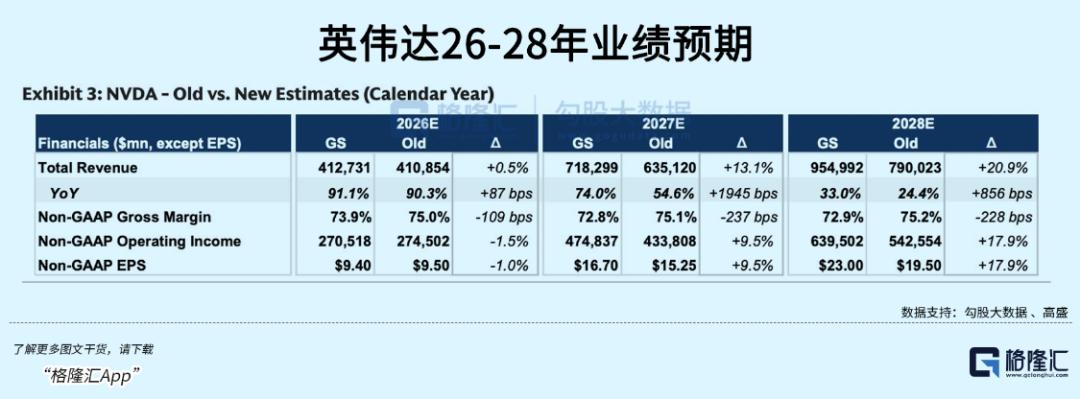
In addition, NVIDIA has for the first time quantified its "supply-demand gap" to the world in percentage terms:
The real demand growth rate in the current end market exceeds 100%, while the supply guidance is set at 70%, which means NVIDIA has to actively postpone or abandon nearly one-third of its potential revenue.
The hard constraints of the physical world: The current growth bottleneck is no longer orders, but advanced wafer manufacturing, high-bandwidth memory (HBM), transformers, data center land, and the all-critical power supply. This all-round supply chain tension will remain locked in and continue at least until the end of FY28.
Accelerated iteration of the money printer: The next-generation Vera Rubin architecture has officially entered mass production and shipment, and will contribute 20% of data center business revenue in the next quarter.
The more critical indicator is the monetization capability per watt — the revenue opportunity per gigawatt (GW) has jumped from 25 billion US dollars in the Blackwell era to 40 billion US dollars.
Deep game of gross margin: Extreme pricing power hedges against memory inflation
The only indicator in the earnings report that has drawn attention from some short sellers is the short-term fluctuation of gross margin: It recorded 75% in Q2, but is expected to dip to the bottom range of 71%~72% in Q4.
In traditional cycle theory, a decline in gross profit at the scale of hundreds of billions is usually regarded as an alarm for cost runaway.
However, the management openly admitted the irrational surge in the prices of HBM and other memory products, and has taken countermeasures:
Passing cost increases downstream through price hikes: NVIDIA has clearly announced that a new round of price increase plans for customers has been finalized, and will take full effect in FY28Q1 — previous reports said that the price of servers based on the Vera Rubin and Grace Blackwell architectures will rise by more than 15% in early 2027.
Completion of the computing power landscape: Full-scale advancement from GPU hegemon to the high-end CPU hinterland
If the GPU is the sharp sword for NVIDIA to dominate the AI era, then the CPU is the moat for it to devour the computing hinterland of traditional data centers.
In this earnings report, a highly strategic turning point has been established: NVIDIA's independent server CPU business is ushering in an explosive inflection point, officially rising from a "supporting accessory" to a pillar-level high-end computing track.
Performance explosion and doubling guidance: In the past 12 months, Grace CPU has cumulatively contributed more than 5 billion US dollars in revenue; with the official production of the next-generation Vera CPU, the management clearly guides that the revenue of the CPU business in FY28 will achieve a growth of more than double, rapidly penetrating into the core hinterland of traditional x86 chip giants.
Full-stack binding of top cloud vendors: The strongest endorsement comes from actual orders from hyperscale cloud vendors. Amazon AWS has finalized the purchase of up to 2 million NVIDIA high-end GPUs between 2027 and 2028 (FY27Q2 to FY29Q2), all of which are deeply deployed in clusters with Vera CPU. This large-scale "CPU+GPU" bundled penetration has eroded the slot survival space of external general-purpose processors.
From single-point computing power to full-stack system pricing: Along with the extremely fast ramp-up of the Vera Rubin architecture (which will contribute 20% of revenue in the next quarter, and the revenue monetization efficiency per gigawatt jumps from 25 billion US dollars of Blackwell to 40 billion US dollars), Vera CPU is no longer just a general-purpose computing node, but a "system-level organ" tightly integrated with self-developed Ethernet (Spectrum-X), NVLink and GPU.
By transmitting the intergenerational computing power crushing advantage of GPUs to the CPU architecture, NVIDIA is rewriting the underlying definition of data centers — it is no longer just an AI accelerator card provider, but through its self-developed CPU and system-level architecture, it is launching a full-dimensional replacement storm for the entire supercomputing and general cloud infrastructure.
The "hidden leverage" in the balance sheet: From hardware sales to the AI "central bank"
If you look past the tens of billions of profits on the surface, a set of figures disclosed in the CFO's comments truly reveals how NVIDIA uses its own scale to reshape the global AI industry chain.
The business model here has undergone a qualitative leap — NVIDIA is playing the role of a "super capital hub" and "capacity operator" for the entire AI industry:
Hundreds of billions-level supply chain choke point (upstream): NVIDIA's supply chain and capacity procurement commitments have surged by 160 billion US dollars quarter-on-quarter, reaching a staggering total of 279 billion US dollars, and the increment is "mainly from memory". With nearly 300 billion US dollars in capital commitments, Jensen Huang has locked the supply of wafer and high-end memory capacity until 2029.
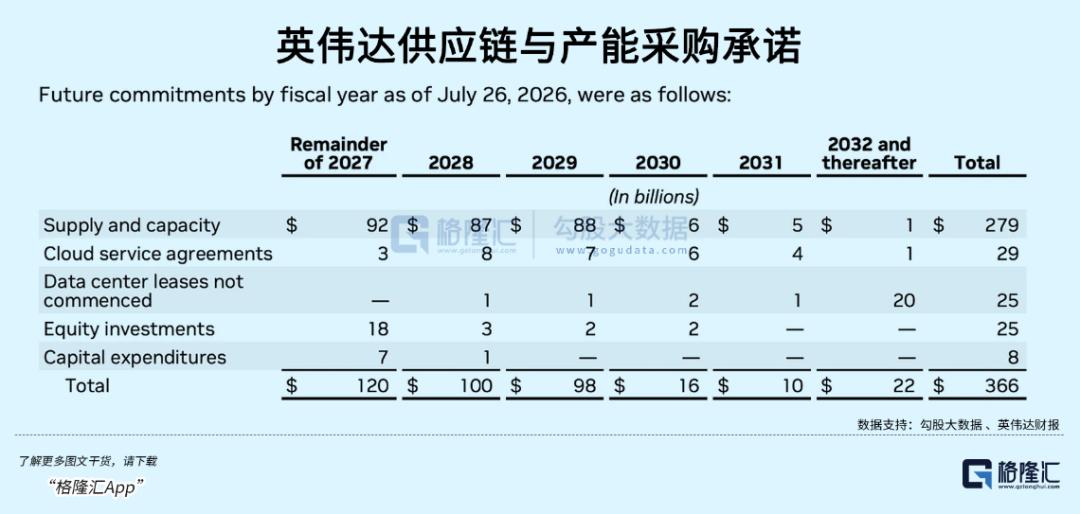
Dual-track betting on data center infrastructure: With 29 billion US dollars in cloud service commitments and 25 billion US dollars in self-owned data center leases on its balance sheet, NVIDIA is building a physical foundation for top-level computing throughput.
Reshaping the NeoCloud ecosystem (downstream): NVIDIA holds another 36 billion US dollars in AI cloud agreements and 20 billion US dollars in data center leases, and clearly guides that these capacities will be redistributed to third parties.
In essence, NVIDIA uses its own credit endorsement and customer resources to deliver certain orders and capacities to emerging computing power cloud vendors such as Nebius and CoreWeave, building a "computing power direct legion" independent of traditional large cloud vendors.
Collection cycle and new revenue sharing: Days Sales Outstanding (DSO) has been extended to 60 days, and the management has deeply bound cutting-edge AI laboratories and NeoCloud partners through the innovative model of "minimum revenue guarantee + excess rent sharing".
This has gone far beyond the simple sale of semiconductor chips. NVIDIA uses nearly 300 billion US dollars in procurement commitments to suppress the upstream supply chain on the left, and uses 56 billion US dollars in cloud and leasing resources to restructure the downstream ecosystem on the right. It is using its own balance sheet and industrial credit to build a capital and ecological high wall that no competitor can break through at a single point.
Paradigm shift: "Computing power equals revenue" in the Agentic AI era
Jensen Huang repeatedly emphasized a fundamental logic on the conference call: AI has ended the old era of "proof of concept and document retrieval", and has officially entered a productivity realization cycle driven by AI Agents.
Exponential explosion of workloads: Running an AI Agent with planning, tool calling and reflection capabilities consumes 15 to 100 times more inference computing power for a single task than traditional human prompts.
Computing power commitments from top customers: Amazon has locked in 2 million NVIDIA high-end chips between 2027 and 2028; OpenAI has partnered with SoftBank Energy to lock in a 4.25 GW exclusive campus, and promised to deploy up to 12 GW of NVIDIA computing clusters by 2030.
Under the logic that computing power is equivalent to the next generation of commercial monopoly rights, every model iteration and product launch of cutting-edge technology companies is directly converted into astronomical figures on NVIDIA's order flow.
This earnings report is not the end of the carnival cycle, but a watershed for AI infrastructure to advance into deep waters. NVIDIA has drawn a deterministic bottom line for the next year with its 70% growth guidance, and at the same time, with full control over power, production capacity and capital leverage, it has set an extremely high and almost insurmountable physical barrier for the global AI computing power competition.
Disclaimer: The copyright of this article belongs to the research team of Beijing Gelonghui Investment Consulting Co., Ltd. (Duan Yuehan: A0160625050003). This report is produced based on the principles of independence, objectivity, impartiality and prudence. All information is sourced from public materials and collected, abstracted and edited legally, reasonably and appropriately.
Stock market investment carries risks, caution is advised before entering the market. Any investment recommendations in this article shall not be used as the basis for your investment transactions. You must make independent investment decisions and bear your own risks. Any unit or individual that without permission from the company, arbitrarily publishes, reproduces, disseminates, or publishes or reposts this article on the Internet will be deemed as infringement, and the company will pursue legal liability for such infringement in accordance with the law.
This article is from the WeChat Official Account "Gelonghui Finance Hotspot" (ID: glh_finance), author: Gelonghui Editor, 36Kr is published with authorization.