Where does SenseTime's 600 million yuan profit come from?
SenseTime has finally achieved profitability, but how high-quality is this profit?
On the evening of August 16, SenseTime announced its first profit forecast in nearly five years since its listing, expecting to record a profit of 500 million to 700 million yuan for the period in the first half of the year. Among the two listed companies of the "AI Four Dragons" (SenseTime and CloudWalk Technology), SenseTime took the lead in turning losses into profits. The next day, the company's share price closed up 8.9%.
Ten days later, the official interim report was released. SenseTime's revenue reached 2.911 billion yuan, a year-on-year increase of 23.4%; the profit for the period was 617 million yuan, while it lost 1.489 billion yuan in the same period last year. After the market opened on August 27, SenseTime's share price fell back by 2.7%. As of press time, the intraday low was HK$1.42, with a market value of HK$60.37 billion.
On paper, SenseTime has achieved an important turning point since its listing. However, this profit does not entirely come from its main business.
In the first half of the year, SenseTime recorded 2.127 billion yuan in other gains, mainly from the rise in fair value of investments and the disposal of subsidiaries. After excluding items such as partial valuation changes and equity incentives, SenseTime's adjusted net loss still stood at 386 million yuan.
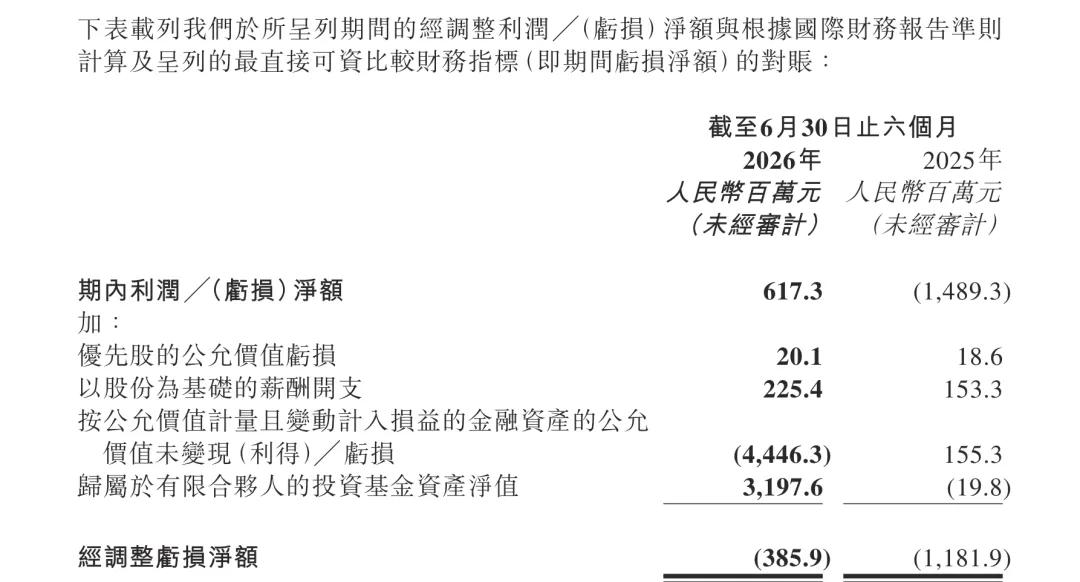
Comparison of SenseTime's profit for the period and adjusted net loss, Source / SenseTime 2026 Interim Report
SenseTime's main business is also improving. Revenue growth and expense reduction have driven the narrowing of adjusted losses, but if costs such as depreciation and amortization are included, there is still a long way to go before achieving stable profitability at the main business level.
This may also be the reason why the capital market remains cautious. Over the past year, SenseTime's share price has fallen by more than 20%. Roughly converted at the RMB to USD exchange rate, SenseTime's revenue in the first half of this year is about 3.5 times that of MiniMax (US$117 million); SenseTime's gross margin (41.4%) is more than twice that of MiniMax (17.9%). But as of August 26, SenseTime's market value is only about 60% of that of MiniMax (HK$105.8 billion).
Larger revenue scale but lower market value cannot be simply attributed to market undervaluation. The two companies are at different stages, and the indicators the market pays attention to are also different. An investor focusing on large models told "Dingjiao One" that the market values MiniMax more for its growth, and values SenseTime more for its efficiency.
SenseTime has made generative AI its main source of revenue, and has built a full-stack system covering computing power, models and applications. The market is concerned about whether this heavier model can turn revenue into stable profits and cash after the large model industry starts to calculate revenue and costs.
01. Book profit of 600 million yuan, main business reduces losses
To judge the quality of this profitability, we need to look at it in two steps: first, see what constitutes the 617 million yuan of book profit, and then see why it still lost 386 million yuan after adjustment.
The most influential item is the "net other gains" of 2.127 billion yuan. Among them, the sale of subsidiaries brought 521 million yuan in gains; after deducting the portion attributable to limited partners of the fund, the unrealized fair value gain of financial assets was about 1.249 billion yuan.
However, the adjusted caliber does not exclude all 2.127 billion yuan of other gains. The difference of about 1 billion yuan between the two profit calibers mainly comes from excluding 1.249 billion yuan of unrealized fair value gains, and adding back items such as share-based payment and fair value loss of preferred shares.
Part of these gains is related to the "1+X" restructuring promoted by SenseTime.
SenseTime keeps large models and visual AI within the listed entity, while businesses such as intelligent vehicles, AI chips, healthcare, and robotics are gradually independently financed.
After some "X" businesses are no longer consolidated, the revenue of "X" innovative businesses in the first half of the year decreased by 18.6% year-on-year to 87 million yuan. However, equity disposal and valuation changes will still be included in the income statement, but such gains will be affected by financing, valuation and equity transactions, and the amount is unstable. The unrealized fair value gains among them are only book value appreciation.
In the first half of this year, the improvement of SenseTime's main business is mainly reflected in the increase in gross profit and the decrease in expenses.
First look at gross profit. In the first half of the year, SenseTime's gross profit reached 1.206 billion yuan, a year-on-year increase of 32.9%, faster than the revenue growth rate; the gross margin increased from 38.5% to 41.4%. The financial report attributes the increase in gross margin mainly to the contribution of the generative AI business. However, SenseTime did not disclose the separate gross margin of each business.
Expenses are also declining. R&D expenditure decreased by 17.1% year-on-year to 1.756 billion yuan, the main reason given in the financial report is the reduction of employee welfare expenditure; administrative expenditure decreased by 13.2% to 518 million yuan, mainly affected by the reduction of operating costs of office premises; sales expenditure remained basically flat.
This round of expense reduction is related to SenseTime's organizational adjustment. From the end of 2021 to the end of 2025, the number of employees of the company dropped from 6113 to 2472, a reduction of about 60%. In the first half of this year, the number of SenseTime's employees rebounded slightly, and there are 2668 employees in total now, an increase of 196 compared with the end of 2025.
After the gross profit increased and expenses decreased, SenseTime's adjusted loss narrowed by 67.3% year-on-year. The adjusted EBITDA turned from a loss of 540 million yuan in the same period last year to a profit of 385 million yuan.
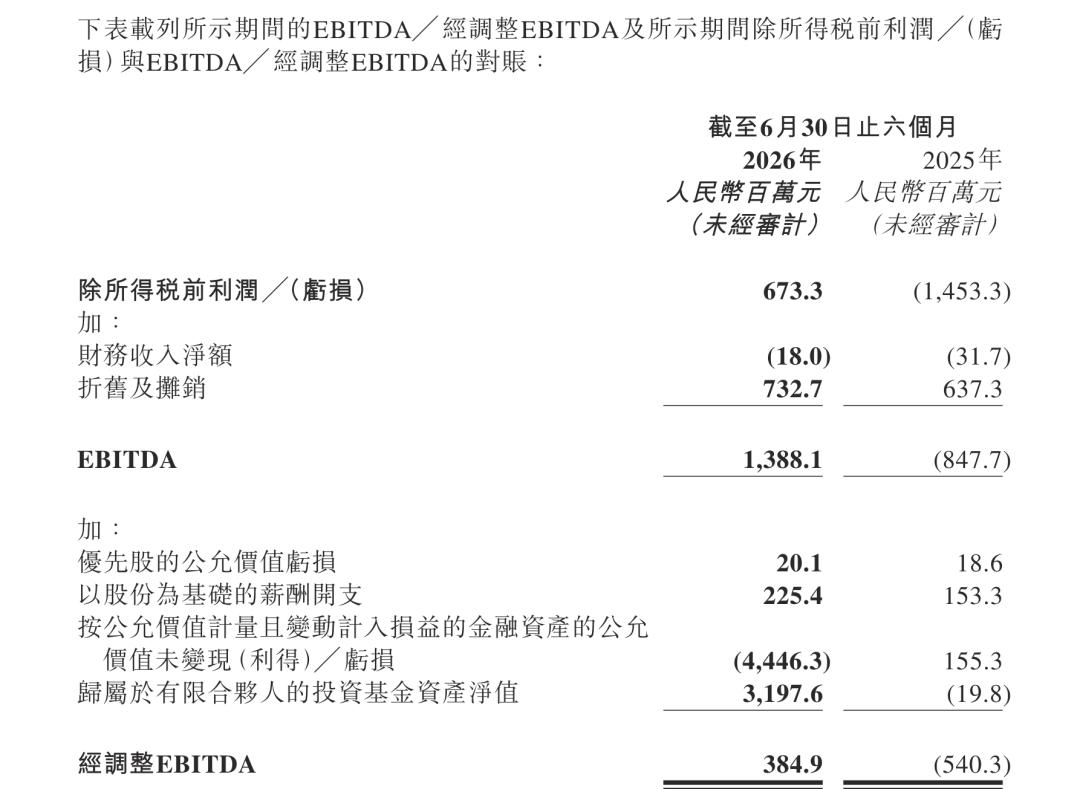
SenseTime's Adjusted EBITDA , Source / SenseTime 2026 Interim Report
Adjusted EBITDA excludes valuation changes, equity incentives and other items, and does not account for depreciation and amortization. The turning positive of this indicator means that without counting these items, SenseTime's revenue has been able to cover the corresponding operating costs and expenses.
SenseTime builds its own computing power infrastructure, so the depreciation cost cannot be ignored. In the first half of the year, the group's total depreciation and amortization amounted to 733 million yuan, which is one of the important reasons why the adjusted EBITDA has turned positive while the adjusted net profit is still negative.
The income statement has improved, but cash has not kept pace synchronously. In the first half of the year, SenseTime's net cash outflow from operating activities was 764 million yuan, compared with a net outflow of 639 million yuan in the same period last year. The company explained that the improvement brought by the reduction of operating losses was offset by the increase in working capital demand, one of the reasons being the customer collection time.
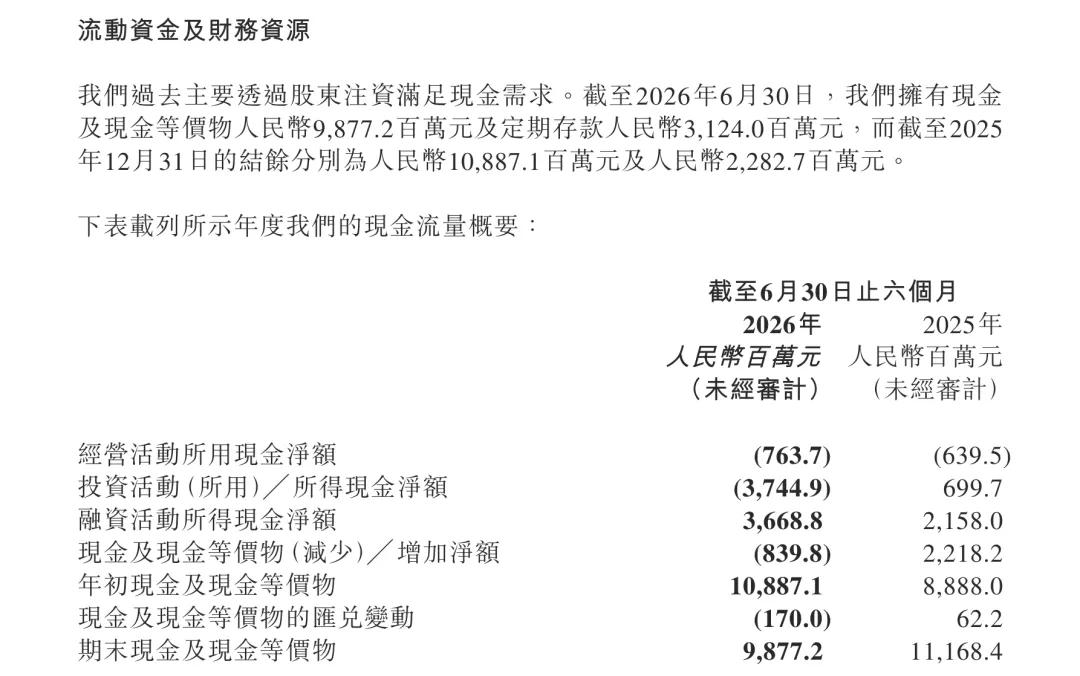
SenseTime Cash Flow Summary and Capital Status, Source / SenseTime 2026 Interim Report
As of the end of June, SenseTime's net trade receivables reached 3.763 billion yuan, an increase of 1.253 billion yuan compared with the end of 2025. Some of the recognized revenue has not yet been received, which has dragged down operating cash flow.
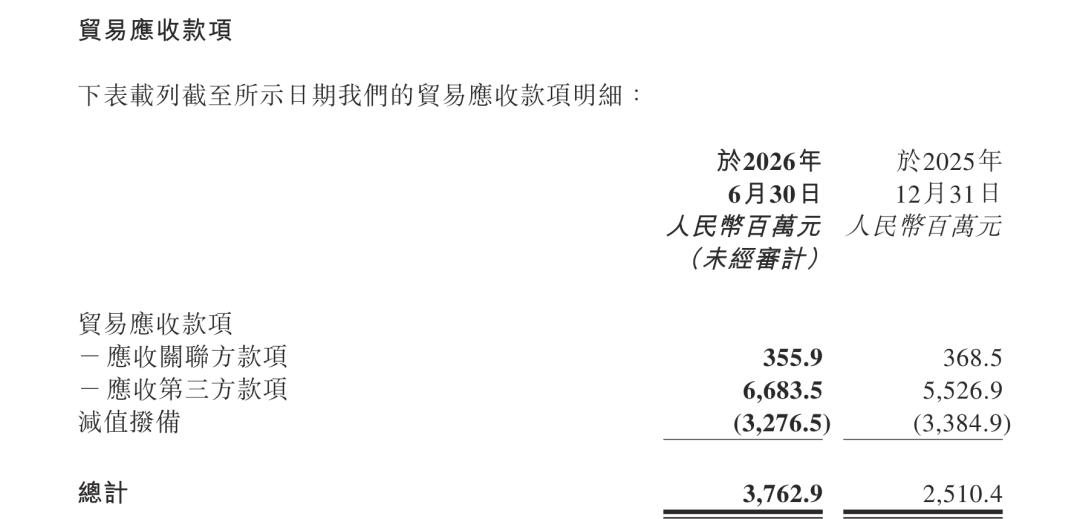
SenseTime Trade Receivables , Source / SenseTime 2026 Interim Report
SenseTime currently holds 9.877 billion yuan in cash and cash equivalents, plus 3.124 billion yuan in time deposits, so the capital is not tight for the time being. At the same time, the net cash outflow from investment activities in the first half of the year was 3.745 billion yuan, and financing activities brought a net inflow of 3.669 billion yuan, the latter mainly from share placement and capital injection by limited partners of the fund.
This is SenseTime's current capital status: operating losses are decreasing, but computing power construction and financial asset investment are still consuming cash, and a large part of capital supplement still comes from external financing.
02. Large models become main business, next step depends on return on computing power
Whether the main business can continue to move towards profitability depends on the generative AI business in the next step.
A few years ago, when people mentioned SenseTime, the first thing that came to mind was face recognition and computer vision. Now, the company's revenue focus has shifted to large models and computing power services.
In the first half of this year, SenseTime's generative AI revenue reached 2.327 billion yuan, a year-on-year increase of 28.2%, accounting for 79.9% of total revenue. Visual AI revenue was 497 million yuan, accounting for 17.1%; the "X" innovative business accounted for only 3%.
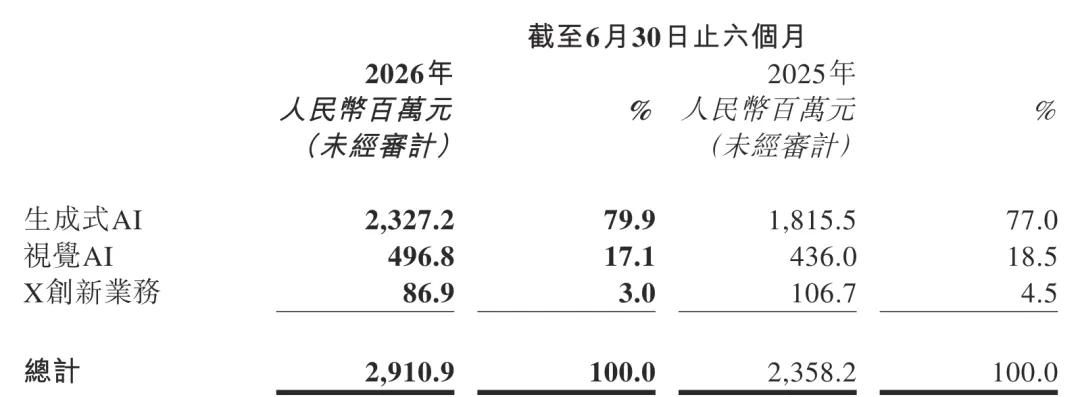
SenseTime's Revenue Sources, Source / SenseTime 2026 Interim Report
From the perspective of revenue structure, SenseTime's transformation to generative AI has been basically completed. Now the listed entity is closer to an AI platform composed of computing power, foundation models and Agent applications: the bottom layer provides computing power, the middle layer develops and provides foundation models, and the upper layer enters specific scenarios through Agent products such as Little Raccoon, Seko, and Kap.
After the business focus shifted, the new problem SenseTime faces is the slowdown of growth. In the first half of 2025, the generative AI business increased by 72.7% year-on-year, and the growth rate in the first half of this year dropped to 28.2%.
The situation of MiniMax is different. In the first half of this year, MiniMax's revenue increased by 283.1% year-on-year, R&D expenditure increased by 138.8%, and the adjusted net loss further expanded, which is still in the stage of simultaneous expansion of revenue and R&D investment.
The aforementioned investor said that the two companies are at different stages, and the market's criteria for measuring them are different: MiniMax needs to prove that its rapid growth can continue; while SenseTime needs to prove that its existing revenue can be sustained, gradually cover computing power and R&D investment, and finally generate profits and cash.
SenseTime's first disclosed RR (Recurring Revenue) can be used to observe the sustainability of revenue.
In the first half of the year, SenseTime's RR reached 1.145 billion yuan, a year-on-year increase of 124.4%, accounting for 39.3% of total revenue; the proportion was 21.6% in the same period last year.
According to the financial report, RR is "revenue based on effective contracts during the reporting period and with continuous renewal attributes". In short, SenseTime's cooperation with customers is shifting from one-time project delivery to continuous services, and further integrating into customers' workflows. The higher the proportion of such revenue, the easier it is to predict future revenue in general. However, RR is not equivalent to the annual recurring revenue of SaaS companies, nor does it mean that customers will definitely renew their contracts after the contract expires.
Another indicator that needs to be observed in combination is the Token call volume.
As of the financial report release date, the total computing power operated by SenseTime reached 48,000 P. In July 2026, the average daily Token service volume exceeded 2.4 trillion, a year-on-year increase of about 22 times. In addition to serving its own models, SenseTime also provides services for 4 external foundation model vendors.
The rapid increase in call volume indicates that more tasks are running on SenseTime's platform; but the price, computing power consumption and gross margin of different services vary greatly, and the number of Tokens itself cannot indicate whether the business is profitable. To judge whether these calls can be converted into profits, we also need to look at the cost of the full-stack model.
From the group's caliber, SenseTime's cost of sales in the first half of the year was 1.705 billion yuan. Among them, hardware costs and project subcontracting service fees were 1.152 billion yuan; AIDC-related depreciation and operating costs totaled about 529 million yuan, compared with about 167 million yuan in the same period last year.
