After going public, Wang Xingxing has to repeatedly explain what Unitree "is not yet".
In the group photos of Wang Xingxing, "not smiling" is not a rare sight.
Backstage at the 2025 CCTV Spring Festival Gala, he rested one hand on a robot and gave a thumbs-up with the other, still looking solemn. On June 19, 2026, when taking a group photo with foreign guests, the other party smiled at the camera while he did not. When attending the 2026 World Artificial Intelligence Conference on July 17, he took a selfie in front of the blue backdrop with a similar expression: looking straight at the camera, with the corners of his mouth pressed down.
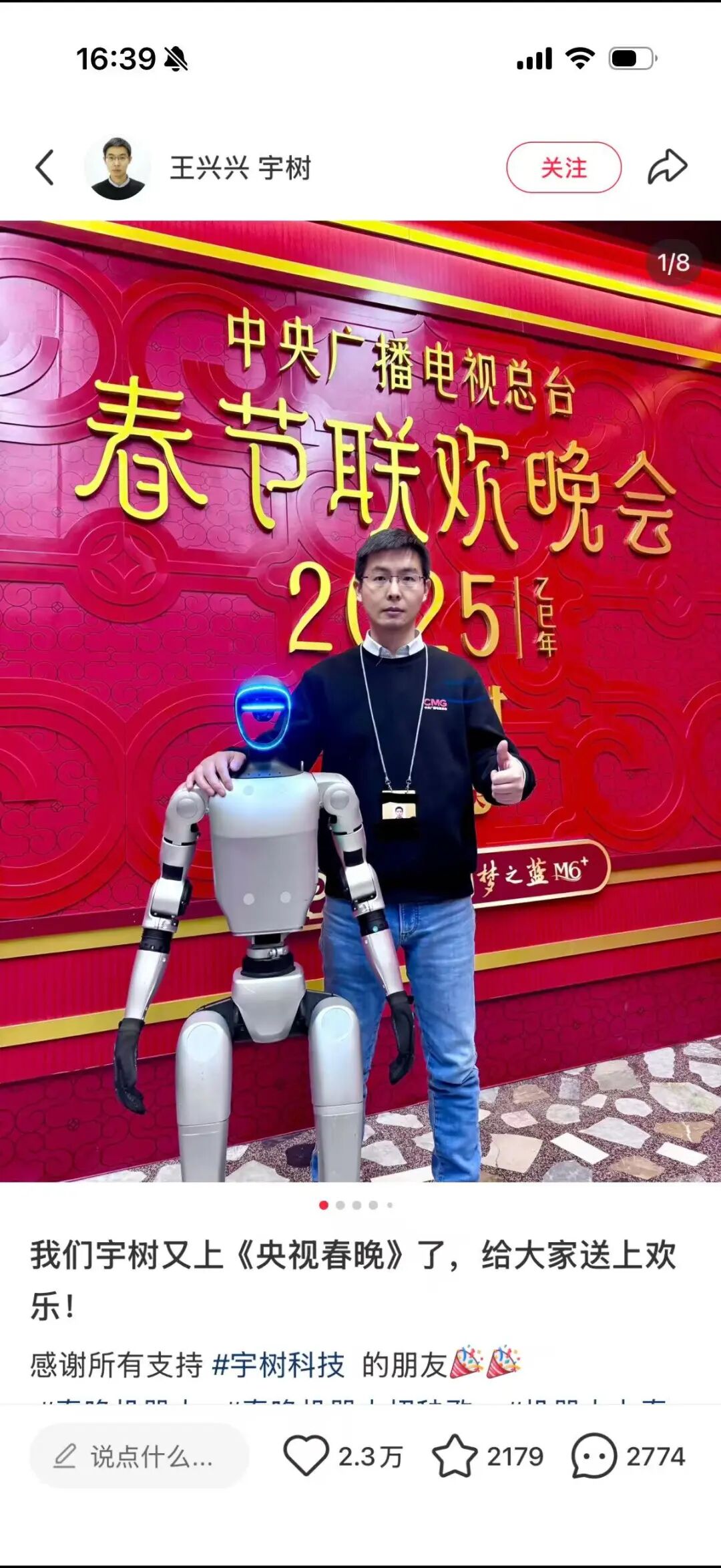
Screenshot of relevant Xiaohongshu account
On August 19, Unitree Robotics was listed on the Science and Technology Innovation Board at the Shanghai Stock Exchange, and Wang Xingxing's on-site group photos from the event circulated online. In front of the red backdrop, leaders, guests and representatives of intermediary agencies stood in several rows. Wang Xingxing, wearing a red scarf, joined the group photo, with an expression still similar to his past ones.
However, this time his expression was given new "captions": "He didn't smile the whole time", "Looks like an ordinary office worker who just came to work", "Why the cold face".
The issue price was 150.80 yuan. On the first day of listing, Unitree opened at 1100 yuan, corresponding to a market value of about 444.9 billion yuan; it closed at 845 yuan, up 460.34%, with a total market value of about 341.8 billion yuan.
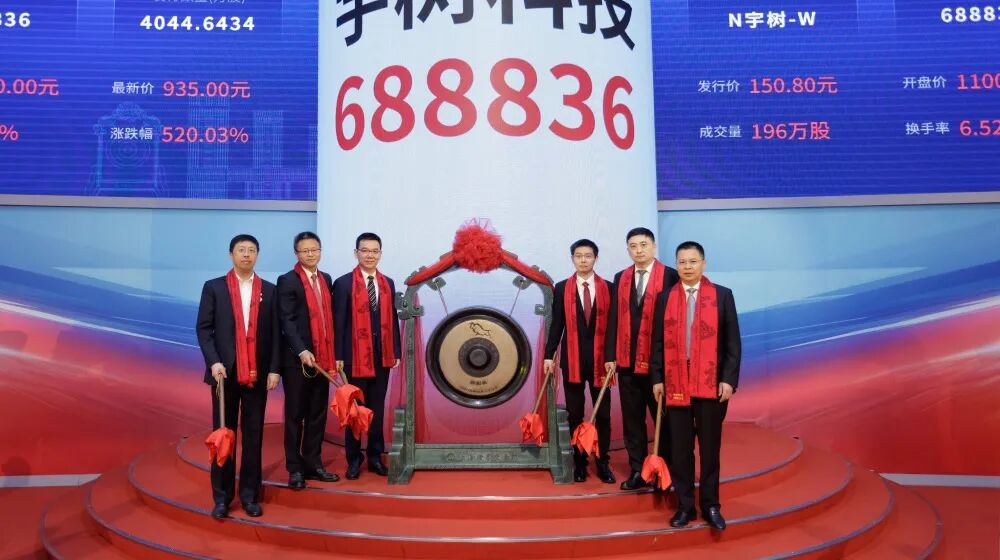
In the following five trading days, Unitree's share price fell continuously. As of the close on August 26, Unitree closed at 591.53 yuan, down 46.22% from the intraday high of 1100 yuan on the first day of listing; its total market value was about 239.3 billion yuan, about 205.7 billion yuan less than the intraday high.
The figures are clear, but there is no standard answer to explain his expression. Why didn't he smile? Is he not optimistic about the prospect? Under great pressure? Or for other reasons?
Over the past decade, what Wang Xingxing has done more often is to explain "what Unitree is". For example, why the electric-driven quadruped robot is worth developing, why robots can become commercial products, and why the company expanded from quadrupeds to humanoid robots. After listing, he has to repeatedly explain another thing: a robot that can move and be sold does not mean it can already work stably.
What is he implying
Within 24 hours after listing, multiple on-site scenarios pointing to different problems were compressed into one single question: what on earth is Wang Xingxing implying?
On the morning of August 19, at the Shanghai Stock Exchange.
After the listing ceremony, Wang Xingxing was pressed for his opinion on the opening performance. He only said "sorry" and made no comment on the share price. In other on-site videos, he mostly looked calm, and once bowed his head to check his mobile phone when leaving.
Subsequently, topics including "Why Wang Xingxing did not smile the whole time when striking the listing bell" and "Wang Xingxing looked calm like an ordinary office worker on Unitree's first listing day" spread on multiple platforms. He did not comment on the share price, but the camera footage was taken as the answer by the public.
At the listing appreciation dinner, Wang Xingxing first publicly proposed the concept of "Self-Evolution 1.0 for Physical AI Robots".
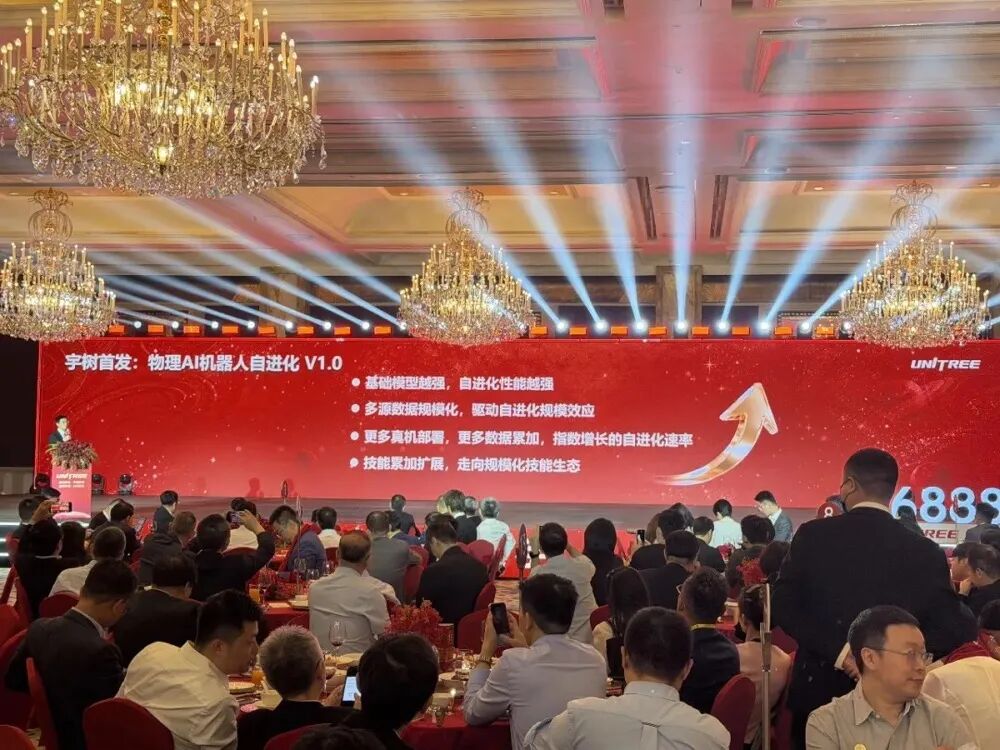
According to reports from GeekPark, he envisions that AI can retrieve academic papers and open-source codes to generate training programs, conduct trial and error in a simulation environment, and then deploy the programs to real robots, with the model and humans making joint evaluations and the results fed back continuously. The goal is to enable the skills acquired by one robot to be saved and reused.
In less than 24 hours, another on-site scenario emerged.
The next morning, on August 20, at the "Application-driven" main forum of the 2026 World Robot Conference held in Yizhuang, Beijing, Wang Xingxing delivered a keynote speech. In the speech, he did not expand the listing story, but split the commercialization bottleneck of humanoid robots into two points: the operation efficiency is still lower than that of human workers, and robots still need to be retrained when facing completely new tasks and scenarios.
He positioned the "ChatGPT moment" of embodied intelligence in the future.
He judged that it may take 2 to 3 years if the progress is fast, and 5 years or even 10 years if it is slow. The acceptance standard is that after entering any unfamiliar environment or ordinary family, the robot can complete about 80% of the tasks only through voice or text instructions.
Quite a part of this speech was used to explain what robots still cannot do.
For example, the efficiency of simple assembly is still lower than that of human workers; for new tasks, it is often necessary to recollect data and retrain the model; after special training in a fixed scenario, the success rate can be close to 100%, but it will drop significantly after the items and environment are changed; when the model output is applied to the real robot, there will still be errors of the last few centimeters or millimeters.
Of course, he did not only talk about problems and difficulties. Wang Xingxing judged that the alignment between the model and the real world will eventually be solved, and the progress in the next ten years may even be faster than expected today.
On the very day of the speech, many discussions quickly linked his technical judgment with the share price performance. On that day, Unitree opened at 790 yuan and closed at 687 yuan, down 18.70%.
Under the background of high valuation and low circulating share capital, technical judgments are easily packaged as price signals.
Calculated based on the lower value before and after deducting non-recurring gains and losses in 2025 on the diluted basis after issuance, the static P/E ratio corresponding to Unitree's issue price is 219.23 times; as of August 5, 2026, the average static P/E ratio of the general equipment manufacturing industry is 38.56 times. The unrestricted circulating shares for this listing account for about 7.44% of the total share capital, and there is no limit on the price fluctuation range in the first five trading days.
The prospectus reminds that the industry is still in its early stage. If technological evolution, cost reduction or application expansion falls short of expectations, industry attention may decrease and market demand may fluctuate.
Wang Xingxing is explaining the industrial positioning, but what the current market cares more about is whether these technical boundaries will become the boundaries of Unitree's share price.
Over the past decade, he has been explaining what Unitree is
In his opinion, being able to move does not mean being able to work stably; being able to mass produce and sell does not mean having become a general labor force; success in fixed scenarios does not mean being able to complete tasks after entering unfamiliar environments.
Looking back, this kind of boundary did not suddenly appear after the listing.
Over the past decade, his public expressions have always updated the acceptance criteria along with the improvement of product capabilities: first prove that the electric-driven quadruped robot can move, then prove that the robot can become a commercial product, then explain why it is necessary to turn to humanoid robots, and finally push the problem to the level of completing unfamiliar tasks.
To understand this change, we have to go back to the time when Wang Xingxing first brought the quadruped robot to the public stage.
On August 3, 2015, at the Shanghai Science and Technology Museum, Wang Xingxing, who was a second-year postgraduate student majoring in mechanical engineering at Shanghai University, participated in the International Intelligent "Star Innovator" Competition with XDog. XDog is about 40 cm high, driven by motors, with an R&D investment of about 20,000 yuan. It finally won the second prize and got a bonus of 80,000 yuan. He envisioned that it could be used for running companion, express delivery, and even guide dogs for the blind in the future.
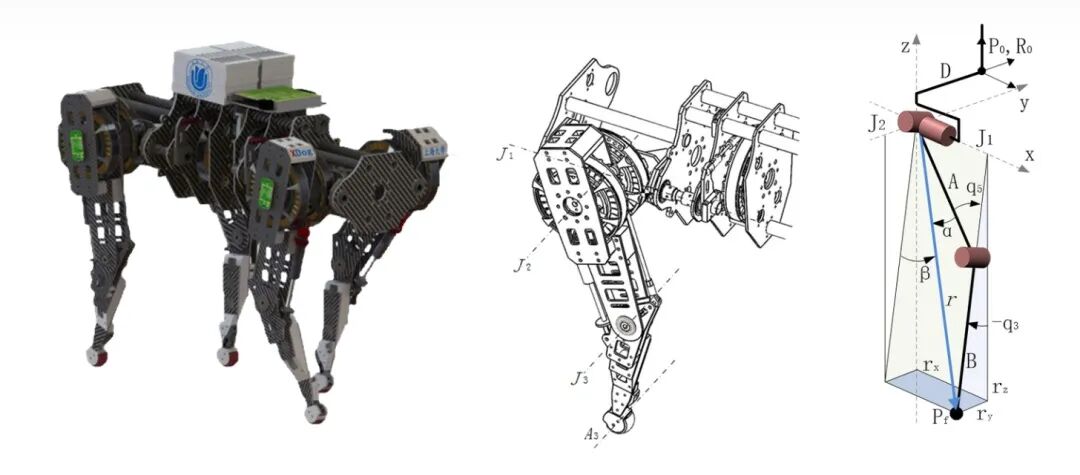
Source: Screenshot of Wang Xingxing's Zhihu account
Running companion and express delivery were only visions at that time. Back then, progress was very easy to see: whether the machine can move, whether the cost can be reduced, can be known as long as XDog is placed on the stage.
In an interview that took place around 2020 and was not sorted out and made public until 2025, Zheng Juncong, Managing Partner of Vertex Ventures, asked Wang Xingxing what he had learned from his short work experience at DJI. Wang Xingxing talked about DJI's internal environment, R&D rhythm, management methods and brand building, and then said that Unitree is very similar to "DJI's rhythm ten years ago".
But he immediately added a limitation: both companies "have become top players in a segmented industrial chain", and Unitree was committed to becoming the world's leading quadruped robot company at that time.
In the same interview, Wang Xingxing also said that Unitree will solve problems based on real demands, first serve relatively simple markets such as education, individual consumers and technology companies, and then iterate from delivery practices.
Here, "DJI" provides a reference that the market can understand more easily for Unitree: how a complex hardware company accumulates technical capabilities into products.
Wang Xingxing once also deduced product progress into user outcomes. In November 2021, he judged that robotic dogs would be fully integrated into ordinary people's lives in the next two years.
The two-year period of this judgment expired in November 2023. As of the disclosure of the final prospectus, Unitree's publicly announced sales volume and application structure still do not separately list the purchase volume and usage frequency of ordinary families, so it is impossible to verify from public data whether "fully integrated into ordinary people's lives" has been realized. In the meantime, the company has migrated the capabilities accumulated from quadruped robots to another product form.
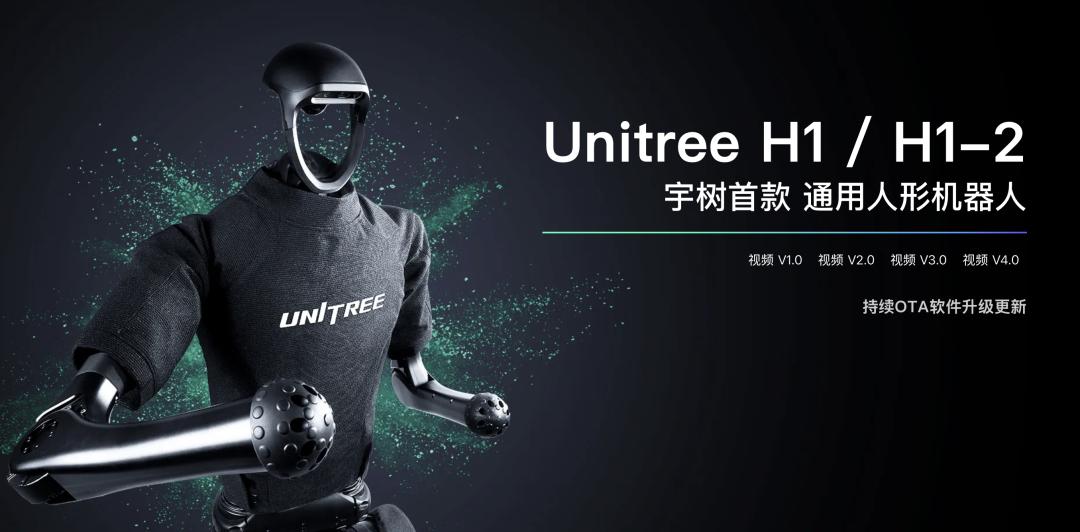
According to Wang Xingxing's later recollection in an interview with LatePost, Unitree launched the humanoid robot H1 in February 2023, with only 3 full-time team members at the initial stage, and reused a large number of hardware, software and control algorithms of quadruped robots. Half a year later, H1 was publicly released. He mentioned that the direct driving factors were the progress of AI and Musk's entry into the humanoid robot track; the technical accumulation of quadruped robots made this transformation completed quickly.
On August 18 of the same year, at the Humanoid Robot Forum of the World Robot Conference in Yizhuang, Beijing. Wang Xingxing said on the one hand that general humanoid robots have "crossed the chasm" at the technical level; on the other hand, he said that the existing general large models have "almost zero" cognition of the physical environment, and new models are needed.
The two sentences correspond to two thresholds. The first sentence explains why it is worth entering the humanoid robot track, and the second sentence shows that entering the track does not mean that general tasks have been solved.
It only took half a year for H1 from project establishment to release, but making it understand a sentence and finish the work in an unfamiliar room requires another type of model.
In an interview during the 2024 World Robot Conference (the relevant content was published in February 2025), Wang Xingxing said that after adding AI to robots, there are still problems such as slow speed, poor precision, and few types of work that can be done, the human efficiency in industrial scenarios is lower than that of human workers, and it is difficult to run a commercial closed loop.
On November 5, 2025, at the sub-forum of "Humanoid Robot Innovation, Development and Cooperation" of the Hongqiao International Economic Forum of the China International Import Expo (Shanghai) National Convention and Exhibition Center, Wang Xingxing gave his judgment again. He proposed "two 80%": robots need to enter about 80% of unfamiliar scenarios and complete about 80% of tasks only through voice or text instructions, to cross the critical point of embodied intelligence. At that time, he said that he hoped that some company or laboratory could achieve this effect "next year or the year after".
The threshold is still the same, but the timetable is moving forward.
On March 29, 2026, at the China Internet Media Forum, he again defined the "ChatGPT moment" as robots completing about 80% of tasks only through instructions in unfamiliar scenarios, and predicted that it would take another two to three years.
By July, the time interval given by the Time interview expanded to 2 to 10 years. The day after listing, he split it again: it may take 2 to 3 years for fast progress, and 5 to 10 years for slow progress.
When a cutting-edge technology company is not yet understood, the founder needs to provide imagination for it, but when imagination runs faster than products, he needs to draw boundaries for it. In the early stage, Wang Xingxing needed to prove that robots are not just toys, and now he needs to prevent the outside world from equating sports capabilities, sales volume and general intelligence into the same thing.
Robots have been sold, but general labor force has not been delivered yet
Unitree has fulfilled a very important part of its promise.
In 2025, Unitree sold 5215 humanoid robots, with a shipment volume of 5511 units; the main business revenue reached 868 million yuan, accounting for 51.78% of the main business revenue, exceeding the revenue of quadruped robots for the first time.
This set of data proves that Unitree has promoted humanoid robots from prototypes to mass production, delivery and revenue recognition. Humanoid robots have become commercial products, not just technical demonstrations.
Who the products are sold to draws another line for the degree of fulfillment.
Unitree's reply to the second round of inquiry from the Shanghai Stock Exchange shows that from January to September 2025, among the revenue of humanoid robots, the proportion of scientific research and education, commercial consumption and industrial application was 73.60%, 17.39% and 9.01% respectively.
According to Unitree's preliminary statistics, from January to September 2025, the total