12 million pillows were sold in the first half of the year, and leading hotel giants have long stopped relying on "room rates" to generate profits.
These days, hotel operators have long stopped relying on the tiny profits from your one-night stay to make money. The two industry giants are thriving respectively with "passive income" (in the physical sense) and the "franchise magic trick" (in the financial sense) — so all the money they earn isn't even coming from the hundreds of yuan in room rates guests pay for a hotel stay?
These days, hotel operators have long stopped relying on the tiny profits from your one-night stay to make money.
Do you think Atour is in the business of selling hotel rooms? The brand has sold 12 million pillows, with pillow and quilt sales making up 40% of its total revenue. Its hotel rooms are in fact immersive experience showrooms for its retail products: guests get interested in the products after one night's stay, and will directly place an order for the pillow after two nights' stay.
Do you think Huazhu is just running a hotel chain? In fact, the brand opened 498 new stores in a single quarter, and only paid for the investment of 1 store itself, while all the rest are joined by franchisees, keeping its operation extremely asset-light.
The two industry giants are thriving respectively with "passive income" (in the physical sense) and the "franchise magic trick" (in the financial sense) — so all the money they earn isn't even coming from the hundreds of yuan in room rates guests pay for a hotel stay?
1. Atour, the pillow and quilt wholesaler delayed by its hotel business
In this year's half-year financial report, the pillow and quilt business has become the core pillar of Atour's revenue.
In 2022, Atour's retail revenue (mainly pillows and bedding) was only 254 million yuan, accounting for 11.22% of its total revenue; by 2025, this figure soared to 3.67 billion yuan, accounting for 37.5% of its total revenue; in the first half of this year, the proportion of retail revenue further jumped directly to 41%.
In just four years, the figure has nearly quadrupled and is still growing at an accelerating pace. Retail revenue in the second quarter rose 63.2% year on year, and Atour's management directly raised its full-year growth target to 40%, fully demonstrating its strong confidence in the growth of the retail business.
By the end of the second quarter, the cumulative sales volume of the Deep Sleep Memory Pillow Pro series exceeded 12 million units, and the Deep Sleep Temperature Control Quilt Pro 3.0 drove the GMV of the quilt core category to increase by more than 80% year on year.
New products such as fitted sheets and loungewear are also gaining momentum. Atour, which started its business with a few hit products like pillows and quilts, is gradually moving towards a more complete sleep product portfolio, trying to create an "Atour-style" home lifestyle.
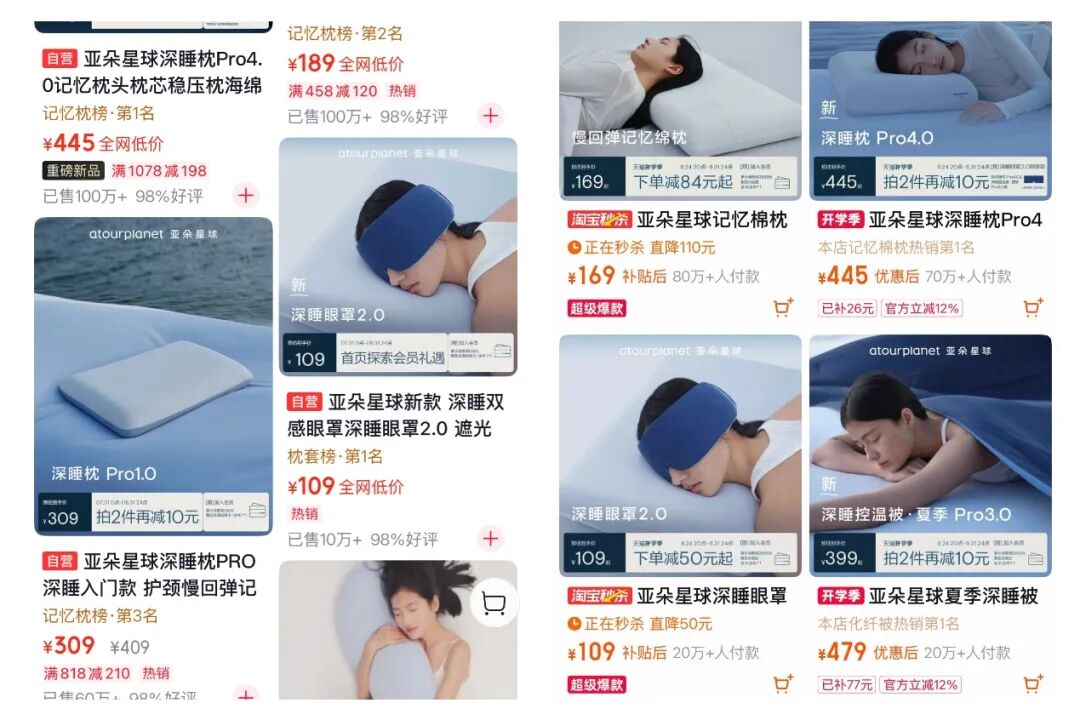
▲
However, it is true that the retail business is profitable, and it is also true that a huge amount of money is spent on buying traffic.
In the second quarter of this year, Atour's sales and marketing expenses reached 606 million yuan, up 54% year on year, and the cost of its retail business rose by 70%. The sales expense ratio increased from 6.2% in 2022 to 13.5% now, which means that for every 100 yuan of sales, 13.5 yuan is spent on purchasing traffic.
In addition, when it comes to the pillow itself, its cost structure is very interesting.
According to a report from Southern Weekly, Atour's pillows are produced by OEM factories in Dongguan, Guangdong, and the purchase price for franchisees is only 17% to 35% of the retail price. Some franchisees have disassembled the second-generation deep sleep pillow and found that it is just a piece of sponge with good resilience. This also explains why the gross profit margin of Atour's retail business has been rising all the way, from 37% in 2021 to over 50% in 2024, reaching 53.3% in the second quarter of 2026, and 51.4% in the second quarter of 2026.
But on the other side of the high gross profit margin, the technical threshold and barrier of the bedding industry are not high, and Atour Planet is facing more and more competitors.
For example, Huazhu has launched the M1 and M3 memory pillows, with the M1 priced at 269 yuan and the 12cm version of M3 Plus priced at 369 yuan, 30 yuan cheaper than Atour's products. Some stores of brands including All Seasons and Orange are also selling pillows, and Lanxu under the Kaiyuan Group is also engaged in the bedding business.
When more and more hotels start selling pillows and other bedding products, how long can Atour's first-mover advantage last? What will it rely on to build a solid "moat" for its retail business in the next stage?
Let's look back at Atour's core hotel business. In the second quarter of this year, Atour's overall RevPAR (Revenue Per Available Room) increased slightly by 0.7%, with the average room rate reaching 437.9 yuan, up 1.2% year on year.
However, for mature stores that have been open for more than 18 months, their RevPAR was 336.8 yuan, down 3% year on year. The average room rate in the second quarter was 424.6 yuan, down 1.7% year on year, and the occupancy rate also dropped by 0.8 percentage points.
New stores and high-priced products are supporting the overall performance, which seems stable on the whole, but the data of old stores shows that the returns of stock mature franchisees are shrinking, and there is always a ceiling if the gap is filled by opening new stores for a long time.
In particular, among Atour's 2175 stores, 2156 are franchise stores, almost all of which are invested by other people. However, franchisees not only have to bear the hotel construction cost, franchise fee and management fee, but also have to purchase pillows as required by the headquarters. These pillows are sold by the retail team directly under the headquarters, so the bulk of the profits go to the group, and the store employees even have to take on the KPI of bedding sales.
The headquarters uses the franchisees' venues, passenger flow and display space to divert traffic to its own "Atour Planet", with the cost borne by the stores and the profits going to the group.
Is the account of this benefit distribution clear?
2. Huazhu: Light for itself, heavy for franchisees
Huazhu Group's total revenue in the first half of the year was 13.117 billion yuan, up 11.0% year on year, with a net profit of 2.394 billion yuan. However, while the revenue saw double-digit growth, the net profit remained almost unchanged. The overall indicators are improving, but the performance of existing stores continues to decline.
To break it down, Huazhu's revenue from management, franchising and licensing business in the first half of the year was 6.592 billion yuan, up 22.9% year on year, accounting for 50.4% of the total revenue, and has become the main revenue source for two consecutive quarters. However, Huazhu's self-operated business has shrunk significantly. Since the second quarter of 2024, it has declined year on year for 8 consecutive quarters, and the revenue from directly operated and leased stores has shrunk to 4.9% year on year.
By the end of June, Huazhu had more than 13,000 hotels worldwide, 93% of whose rooms are under management, franchising and licensing models, and self-operated stores only account for 7%. Meanwhile, the hotel operating costs only increased by 7.4%, far lower than the revenue growth rate.
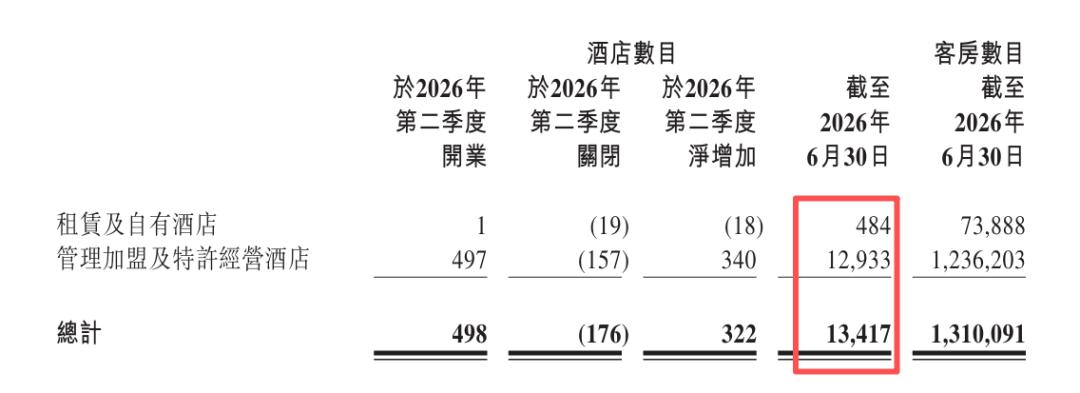
It is not hard to see from this change in business model that Huazhu is shrinking heavy assets such as leased and self-owned stores to go fully "asset-light". Its entire profit logic has changed: it no longer makes money from room rates, but from light-asset income such as brand and management fees, which is the confidence for Huazhu's management to raise its full-year guidance against the market trend.
But if the hotel operation becomes more asset-light, will there be more guests staying in the hotels?
In the second quarter of this year, the overall occupancy rate of Huazhu's hotels dropped from 81.0% in the same period last year to 79.8%, declining year on year for 6 consecutive quarters. The number of available rooms increased by 12.7% year on year, but the number of paying guests did not increase synchronously.
In other words, the revenue growth does not come from more staying guests, but is supported by "new stores raising the average price".
The "asset-light" model does allow Huazhu to expand rapidly, but who is bearing the pressure behind it? The franchisees.
In the second quarter, the room rate of Huazhu's directly-operated stores was 86 yuan higher than that of franchise stores, the occupancy rate was 3.2% higher, and the revenue per available room was 81 yuan higher. Throughout the whole year, the occupancy rate of directly-operated stores can be 3 to 4 percentage points higher than that of franchise stores.
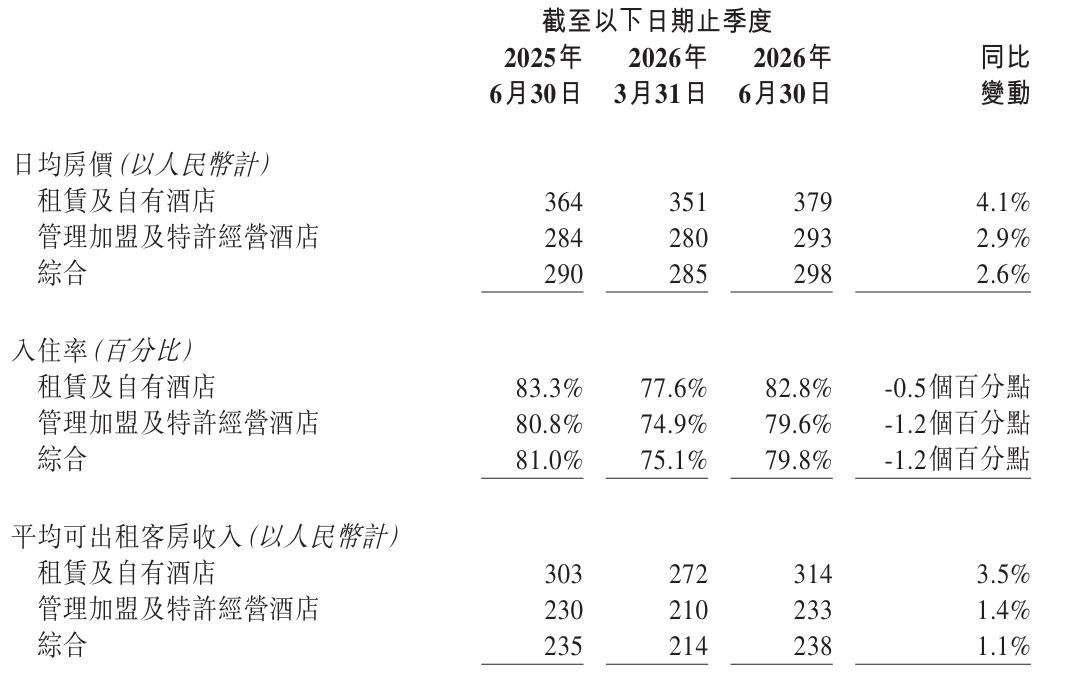
In short, the business of franchisees may be more difficult than that of directly-operated stores.
Franchisees want to raise prices, increase occupancy rate and revenue per available room, but the premise is that they have to pay for the cost of store upgrades themselves. If they do not upgrade, their stores may be removed from the recommended traffic pool, or even be closed down.
This year, Huazhu plans to close 600 to 700 stores throughout the year, and 176 stores have been closed in the second quarter, 157 of which are franchise stores.
In the second quarter of this year, the occupancy rate of Huazhu's China region was 79.8%, down 1.2 percentage points year on year, declining year on year for 8 consecutive quarters, which is mainly driven by the 1.2 percentage point year-on-year drop of franchise-related hotels.
According to public data, more than 65% of Huazhu's reservations are made through the central reservation system, and franchisees will be charged 8% for each order through the system, plus management fees, service fees, system usage fees, membership registration fees and other charges. According to public reports, the comprehensive commission rate is estimated to exceed 12%.
Therefore, it is not hard to find that Huazhu's asset-light "weight reduction" ecosystem does not seem to bring more consumers. The asset-light model will not be regarded as a real success until the franchisees can truly operate easily.
3. Three paths beyond hotel rooms
Under the general market environment of excess supply and weak room rates in the hotel industry, it is really not easy for listed hotel groups to stabilize their performance or even pursue growth.
Atour develops new retail by selling pillows, Huazhu focuses on asset-light operation by expanding franchising business, and BTG Hotels (which has not released its financial report yet) targets the mid-to-high-end market. Essentially, they all follow the same logic: room revenue is only the entry point, and the real profit must come from other businesses.
Therefore, all players must find their second growth curve.
We can clearly see that neither Atour nor Huazhu puts all their eggs in one basket. Instead, they gather resources to core brands and actively seek new growth drivers.
On the basis of maintaining its core hotel business, Atour has made its pillows a huge hit product.
In the first half of this year, Atour's retail revenue reached 2.646 billion yuan, while the revenue of its franchised hotel business was 3.293 billion yuan, with the gap narrowed to about 650 million yuan. The gap in the second quarter was even smaller: the retail revenue was 1.575 billion yuan, the revenue of the franchised hotel business was 1.725 billion yuan, and the revenue gap was only 150 million yuan. According to this trend, it is only a matter of time before the retail business surpasses the franchised hotel business in revenue.
Huazhu's management even publicly emphasized the importance of the second growth curve: "The franchise model is still the core driving force for the group's growth, and we will continue to promote high-quality expansion." In the first half of this year, Huazhu's revenue from management, franchising and licensing hotels reached 6.592 billion yuan, accounting for 50.3% of the total revenue, becoming the largest revenue source of the group.
Secondly, the mid-to-high-end market is the last remaining profit space.
The economy hotel segment has already become a red ocean, with price wars so fierce that no one can make decent profits; the investment return cycle of high-end hotels is too long for ordinary players to afford. The mid-to-high-end market has instead become the only track where players can still make decent profits easily.
Since last year, leading hotel groups have all turned to this track, and the number of signed mid-to-high-end brands has been rising rapidly — the "2025 Annual Report on the Signing of Mid-to-High-End Brand Hotels in Mainland China" shows that 767 mid-to-high-end hotels were signed in 2025, up 14% year on year.
The RevPAR of Atour's "Yeye" series exceeds 450 yuan, and that of its SAVHE brand even exceeds 1000 yuan; Huazhu does not rest on its laurels of Hanting and All Seasons. Its brands including Blossom House, Steigenberger and Songpin also charge room rates close to four figures. In the first half of the year, it also launched the "All Seasons Grand View" cultural initiative, trying to tap into the mid-to-high-end market with oriental aesthetics. BTG Hotels opened 430 new mid-to-high-end stores last year, accounting for 42.3% of the total room volume, but contributing 60.6% of the total revenue. BTG Hotels also stated that by the end of 2026, the proportion of mid-to-high-end rooms will exceed 45%.
At present, the mid-to-high-end market is exactly at the golden point of "better quality than budget hotels, less burden than five-star hotels", with considerable profits, replicable operation models and high recognition from franchisees.
Finally, are there still profit opportunities in the sinking market?
Ji Qi once said that the hotel business should be redeveloped, with the sinking market as the core focus.
Huazhu can get 13,000 franchisees to hang its brand signboards and accept management fees, CRS fees, supply chain procurement fees and store manager dispatch commissions, which is indeed impressive. For valuable hotel brands today, what they sell is not the brand name itself, but the reservation capability, membership system, operation standards and continuous management services.
The opportunities in the sinking market are obvious:
The penetration rate of chain hotels in county-level markets is only about 10%, while that in first-tier and second-tier cities has reached 65%; in 2025, the RevPAR of cities at the fourth tier and below increased by 23.07% year on year