AI Revenue Exceeds Half of Total for the First Time, Targeting Dual Primary Listing: Baidu Aims to Be the "First Full-Stack AI Stock"
Many people still regard Baidu as a traditional internet search company, but half of its revenue already comes from AI business.
A change in its listing status on the Hong Kong Stock Exchange could directly expand its valuation imagination space to nearly three times the previous level.
Whether ordinary investors can share the AI dividend through the Stock Connect program will be answered by this capital move.
On August 27, Baidu Group announced on the Hong Kong Stock Exchange that it voluntarily converts its secondary listing status on the Hong Kong Stock Exchange to primary listing, which will take effect on September 1, 2026. From the effective date, Baidu will have dual primary listings on both the Hong Kong Stock Exchange and Nasdaq.
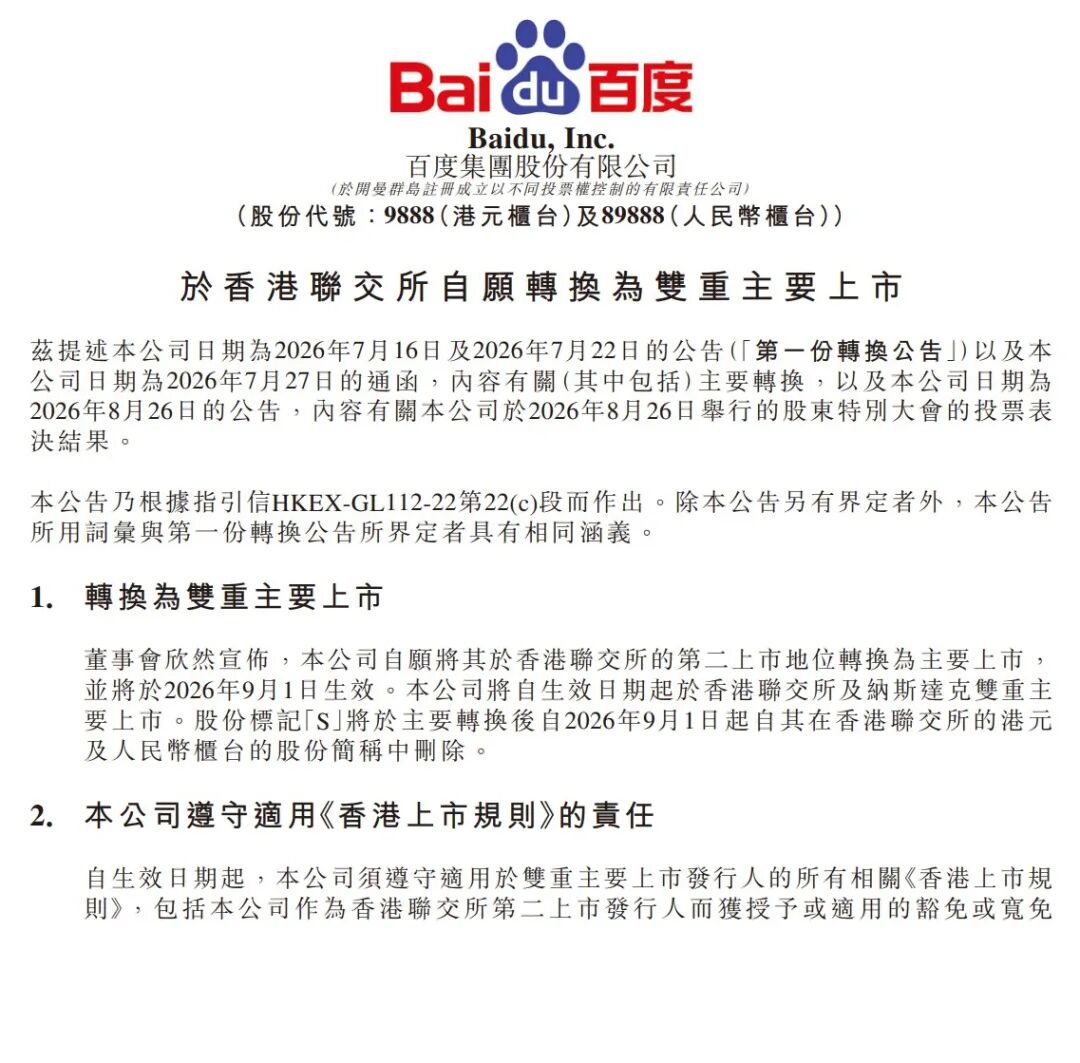
After the completion of the conversion, Baidu will be dual primary listed on both Nasdaq and the Hong Kong Stock Exchange, becoming one of the rare technology enterprises in the two markets that have completed the full chain of "chip, cloud, large model, AI application, autonomous driving", and has won a new label: "The First Full-Stack AI Stock".
Many ordinary readers' first reaction when seeing terms like "dual primary listing" and "full-stack AI" is that they are a bunch of professional jargon that they cannot understand and feel far away from their daily life. But this matter is actually closely related to ordinary investors: once included in the Stock Connect program, mainland individual investors can directly trade Baidu's Hong Kong shares without opening a Hong Kong stock account.
Let's start with a simple explanation of the concepts: in the past, Baidu was a "secondary listing" company in Hong Kong.
To put it simply, its primary listing venue was Nasdaq in the US stock market, and the Hong Kong stock market was only a backup trading venue.
The "dual primary listing" means that Hong Kong has been upgraded to a primary listing venue at the same level as Nasdaq, with independent supervision and equal status on both sides.
In this conversion, Baidu will not issue new shares or raise financing. In short, this is not a move that the company is short of money to seek capital from the market. As of the end of June 2026, Baidu's cash and total investment amounted to 283.1 billion yuan, and its operating cash flow has been positive for four consecutive quarters.
Since Baidu is not short of money, why bother to change its listing status?
Baidu's CFO put it plainly: to expand the investor base, improve stock liquidity, and allow Asian investors, especially mainland investors, to better understand Baidu, which follows the "AI First" strategy. Calculated according to the existing rules, after the completion of the dual primary listing, Baidu is expected to be included in the Stock Connect program as early as the week of September 7. On that day, mainland southbound capital can directly trade Baidu's Hong Kong shares.
In the past, a total of 12 Chinese enterprises including Alibaba and NetEase have completed dual primary listing and been included in the Stock Connect program. Historical data shows that 30 days after these companies were included in the Stock Connect program, they received an average of 15% to 20% of additional holdings from southbound capital. Since 2022, Chinese internet companies that have converted from secondary listing to dual primary listing include Bilibili, Alibaba and NetEase. All of their stocks rose on the first trading day after being included in the Stock Connect program, with the maximum closing increase of 10.66%. Morgan Stanley previously estimated that after Alibaba was included in the Stock Connect program, it received about 12 billion US dollars of capital inflow in half a year.
A large amount of mainland capital that has a better understanding of China's AI industry chain will directly change the market's valuation benchmark for Baidu. For a long time in the past, overseas capital markets were used to valuing Baidu as an "internet advertising company". Investors would look at a consolidated income statement and price the entire group with the traditional PE price-earnings ratio.
But today Baidu's business is far more than search advertising. Kunlunxin develops domestic AI chips, Intelligent Cloud outputs computing power infrastructure, ERNIE large model provides model capabilities, Baidu Mate and Kuku AI develop AI office products that ordinary people use every day, and Apollo Go provides autonomous driving travel services. Each business segment has completely different growth stages, profit models and benchmarking companies. When they are all included in one single financial statement, the AI assets are easily undervalued.
This is also the true meaning of "full-stack AI". It does not simply mean a large number of businesses, but the formation of a complete chain that can empower each other, which Baidu calls "Chip-Cloud-Model-Agent". Kunlunxin produces computing power chips, Intelligent Cloud packages computing power and sells it to all walks of life, the large model acts as the brain, and various upper-layer AI intelligent agent applications for individuals and enterprises are developed, even spawning autonomous driving travel services like Apollo Go.
Each layer can conduct independent external business, while reusing technologies internally to reduce overall costs. This is why only Google and Baidu in the world have completed this full chain.
The financial report data has shown the landing results. In the second quarter of 2026, Baidu's general business revenue was 25.2 billion yuan, of which AI business revenue accounted for 50%, and has exceeded 50% for two consecutive quarters.
AI is no longer a money-burning R&D project, but has become a revenue source that supports half of the business. By segment, AI cloud infrastructure recorded a quarterly revenue of 7.3 billion yuan, with the GPU cloud computing power business surging 283% year on year; the AI application segment generated a revenue of 2.5 billion yuan, the MAU of Baidu Mate increased by more than 1000% month on month, the monthly active users of Kuku AI Office exceeded 25 million, and Miaoda took 33.4% of the market share in the AI no-code application track; AI native marketing services generated a revenue of 2.6 billion yuan, and multiple AI business lines have achieved commercial closed loops.
In real life, this set of technologies has penetrated into many scenarios. Financial banks run their businesses on the domestic computing power of Kunlunxin; 80% of central state-owned enterprises have adopted Baidu Intelligent Cloud, and State Grid uses AI agents to reduce equipment inspection time from 2.5 hours to 45 minutes; ordinary employees can use Kuku AI and Baidu Mate to generate PPTs and process spreadsheets; people in Dubai can take fully driverless Apollo Go taxis, and autonomous driving tests have also been launched in Hong Kong and London. AI is no longer a concept in the laboratory, but has become products and services that ordinary people and enterprises are actually using.
The business has achieved solid growth, but the old valuation system cannot keep up. Therefore, the capital market is now discussing SOTP sum-of-the-parts valuation. To put it simply, instead of treating Baidu as a vague large company, we should calculate the value of each business segment separately: search advertising, Baidu Intelligent Cloud, Kunlunxin, Apollo Go, AI applications, plus the cash assets in hand, evaluate each part's value and sum them up. According to institutional estimates, with this sum-of-the-parts valuation method, Baidu's market value under the optimistic scenario is about 1.01 trillion Hong Kong dollars, which is nearly three times higher than the current market value.
Of course, this is only a potential target estimated by institutions, which does not mean that the stock price will definitely rise to this level. The realization of valuation requires two prerequisites: first, the dual primary listing is completed, Baidu is smoothly included in the Stock Connect program, and mainland capital can participate in trading smoothly; second, all AI businesses continue to maintain commercial growth, and Kunlunxin, Intelligent Cloud and Apollo Go continue to deliver good performance results.
The capital market has already seen pre-emptive moves of funds. According to the 13F position documents, the fund under the legendary investor Stanley Druckenmiller established a new position in Baidu's ADR in the second quarter; hedge fund manager David Teiger also increased his holdings of Baidu at the same time. Overseas professional funds have begun to re-examine Baidu's AI value.
Many people will ask, what does the title of "The First Full-Stack AI Stock" actually mean?
Its significance is more than a capital story. In the past, many domestic AI companies only focused on a single point: some only developed large models, some only developed applications, and the underlying computing power chips relied on external procurement. The full-stack layout of "Chip-Cloud-Model-Agent" means that from the most underlying chips to the AI tools in the hands of ordinary people, the entire chain is independently controllable. For enterprise customers, they do not have to worry about the "supply bottleneck" of underlying computing power; for ordinary users, they can see more AI office products, AI tools and autonomous driving services with lower prices and better experience.
Back to the dual primary listing itself. Baidu did not take this opportunity to issue additional shares for financing, which shows that its demand is not to raise money, but to change to a new evaluation system. In the past, the US stock market was more familiar with the logic of internet advertising, while mainland investors brought by the Stock Connect program have personally used Baidu's AI products, and recognize the industrial value of domestic chips, AI cloud and autonomous driving more.
Of course, risks exist objectively: the competition in the AI industry remains fierce, and new players in the large model track are emerging in endlessly; Kunlunxin and Apollo Go are still in the rapid growth stage, and the commercialization speed is uncertain. The revaluation of the capital market will not be completed immediately after the announcement, and it requires performance to be realized step by step.
In summary, this dual primary listing is essentially the resonance of two events: on the one hand, Baidu's AI business revenue has accounted for half of the total, and technologies and products have been widely deployed; on the other hand, the capital market has opened a new channel, allowing investors who are more familiar with China's AI industry to participate in pricing.
In the future, when people look at Baidu, they can no longer use the old perspective of a search engine. The value of an AI company depends on the underlying computing power infrastructure, the capability of large models, but more importantly, whether AI can be truly turned into accessible products and tangible revenue. Dual primary listing is just a starting point, and the trillion Hong Kong dollar market value is only a market observation anchor. The real answer will be given by the subsequent business performance results.
This article is from the WeChat Official Account "Jiemian News", and is published by 36Kr with authorization.