Hidden Unicorns | Having expanded its business scope from mobile phone cameras to the vision base solutions for Unitree and Ecovacs, this imaging supplier registers an annual revenue of 2 billion yuan.

Image source / the company
This article is about 3200 words, with an estimated reading time of 7 minutes
Author丨Ou Xue
Editor丨Yuan Silai
When United Imaging's revenue reached 2 billion yuan, the outside world still knew little about this company.
In 2014, when Zhang Feng just founded United Imaging, he was engaged in a business that he thought was "relatively simple" — mobile phone camera modules.
He had been in the mobile phone industry for many years, experiencing the complete cycle from branded products to white-label products, then to operator-customized products, and finally back to branded products, so he chose to start from the field he was most familiar with. He was also very clear that this was a "relatively simple matter with low entry barriers."
For a long time, United Imaging operated stably as a supplier to leading mobile phone brands. But as a veteran of the industry, Zhang Feng was well aware of the fierce competition in the mobile phone supply chain. Even in 2016, when the smartphone market was at its peak, Zhang Feng began to ponder a question: How long can the profit margin of mobile phones be maintained?
"I am very clear that in the later stage, the value of the entire mobile phone industry chain will get lower and lower," Zhang Feng's judgment was straightforward. The bargaining power is entirely in the hands of upstream brands. As a small supplier, United Imaging has little say.
About two years after starting his business, Zhang Feng began to explore emerging markets. He kept thinking about where else vision modules could be applied. By 2017 and 2018, Zhang Feng had a general idea and started to take action, determined to move United Imaging out of the mobile phone value network.
Zhang Feng knows that his capability boundary is limited to the vision track. No matter how the product form extends, it will eventually converge within the capability framework based on vision.
In 2018, United Imaging stepped into the first key track — cleaning robots, and became a key supplier of sensors for Ecovacs' sweeping robots. "Sweeping robots were not as popular as they are now, but I saw a market of at least 100 billion yuan," Zhang Feng recalled.
In 2021, Zhang Feng started to cooperate with Unitree, which was very small at that time. At present, robot-related businesses account for nearly one-third of the company's total revenue, covering more than half of the leading robot customers. In 2025, United Imaging's total annual revenue reached about 2 billion yuan.
Recently, United Imaging has completed a new round of financing of several hundred million yuan. This round of financing is jointly participated by industrial capital and market-oriented institutions, including Dunhong Asset, Hangzhou Embodied Intelligence Industry Fund, Fuyang Industrial Investment, and Zhifang Capital.
Even with certain achievements, Zhang Feng compares United Imaging's current development stage to "attending primary school." In his view, the first ten years were more like groping forward. Although the company achieved profitability in the early stage and its revenue scale gradually grew, it always lacked a clear strategic direction. It was not until a few years ago that he felt he had truly entered the entrepreneurial state.
It took United Imaging 12 years to grow from a camera module factory to a provider of visual infrastructure for AI and embodied companies. With its acumen, it has secured a favorable position in the current technology wave in advance.

Seize those startups
After being tempered in the mobile phone market, Zhang Feng is very clear that although binding large customers can bring a safety net, it also puts his own destiny in the hands of others. He would rather spend more energy cooperating with innovative companies that seem to have low marginal benefits.
They have contacted tens of thousands of small and medium-sized innovative companies, covering entrepreneurially active regions such as West America, China, and South Korea.
Most of these innovative companies come to them for prototype development. "Due to the development of AI, many ideas need to be turned into a first-generation prototype to show to investors, so the demand is very strong."
To meet this demand, United Imaging has built "prototype development" into a service line, internally called "agent." From PRD and code output to BOM output, all are self-developed. "Input semantics, output code." The back end is combined with manual links and global delivery to form a reusable service chain.
Zhang Feng compares this mechanism to a funnel model: after expanding the access scope, a screening mechanism is set up. Once a large case is found, the team will quickly follow up, and even set up a dedicated product line directly. At present, the company has seven to eight product lines.
Zhang Feng cited a case from this year. A leading electric scooter company in the United States came to them. Due to government policy requirements, new vehicles need to be intelligently upgraded, including functions such as pedestrian detection and safety reminders. The requirements are clear: two cameras, an AI box, a set of algorithms, and a series of engineering problems such as waterproofing, dustproofing, shockproofing and connection methods need to be solved.
"What the customer wants is end-to-end capability, while other suppliers can only do part of it." Therefore, United Imaging won the order at the first negotiation. It can demonstrate the full link clearly, with full-stack self-development of hardware, algorithms, connections and structural parts. This order was finally settled at more than 20 million US dollars, which is the largest one in the company's history.
This end-to-end capability is based on the foundation laid in the manufacturing sector in the first ten years. 36Kr Hard Krypton learned that United Imaging has a 20,000-square-meter factory in Shenzhen, a 25,000-square-meter factory in Weihai, a base in Vietnam, as well as a complete imaging laboratory and NPI capability.
The product logic of United Imaging today is completely different from the early "selling modules" model.
In the early stage, United Imaging entered the smart terminal and smart home sectors with vision modules. In 2018, it laid out the sweeping robot track, and now it is one of the largest suppliers of vision solutions for sweeping robots, lawn mowers and pool cleaning robots in China, with customers including Ecovacs, Narwal, Dreame, Ninebot, etc.
In recent years, the company has upgraded to AI vision, combining edge AI and scene understanding. Since 2021, it has expanded to the robot and AI hardware track, and has now become a leading supplier in the fields of embodied intelligence, humanoid robots and AI hardware, with customers covering Unitree, Zhifang, Zibianliang, Rokid, etc.
At present, the industry is moving from single-point perception to multi-modal understanding. The company's vision solutions have also been upgraded from standard module delivery to system engineering covering optics, algorithms, SoC adaptation and large-scale manufacturing, to meet the needs of various robots in spatial perception, obstacle avoidance navigation and end-side deployment.
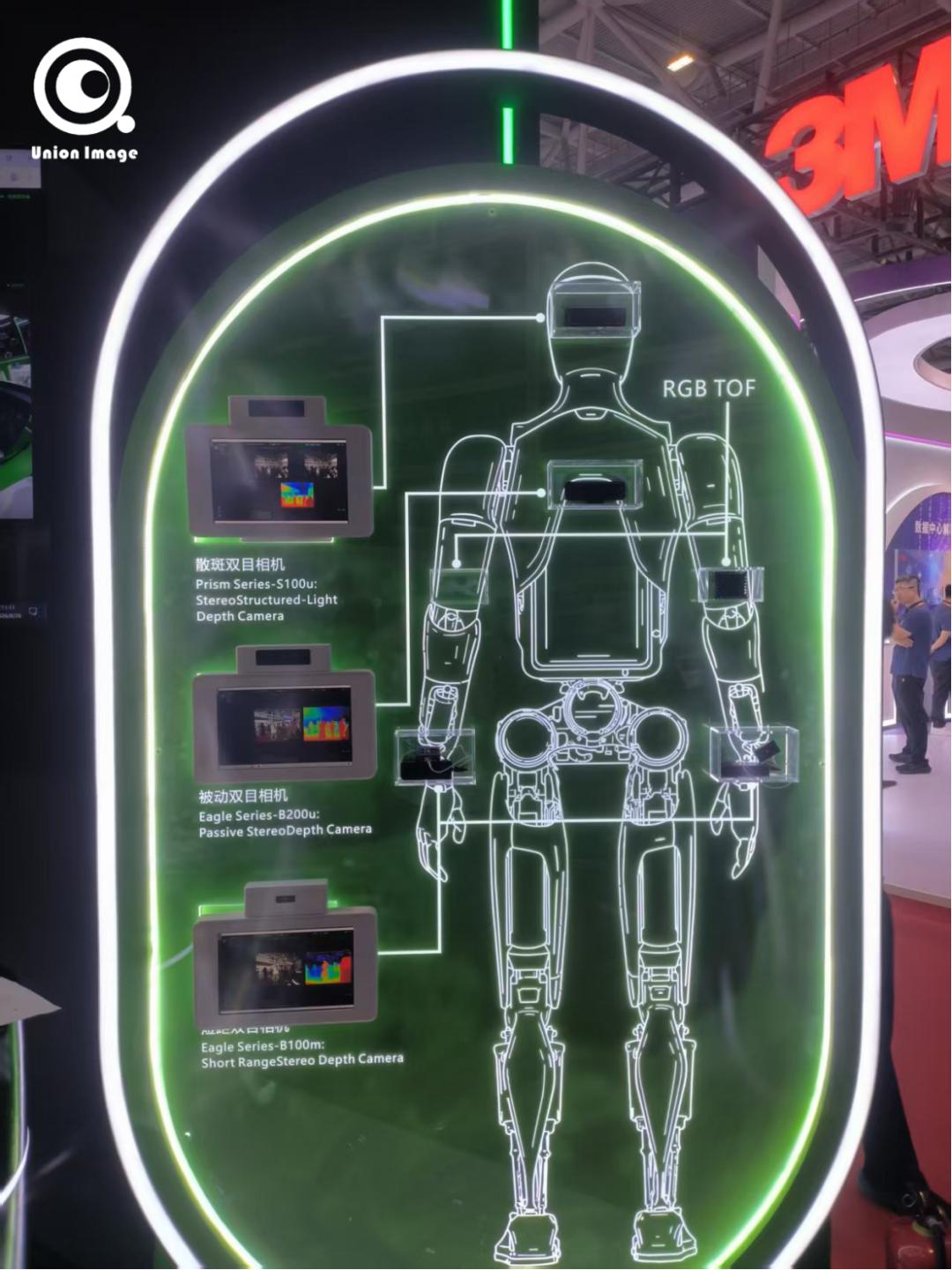
Display of the company's products applied in humanoid robots (Image source / the company)
Zhang Feng told Hard Krypton that he now uses two dimensions to narrow the business boundary: in terms of categories, vision is the main focus, and audio is the auxiliary; in terms of technology stack, the hardware includes different types such as binocular, 3D, high-speed interface, and USB interface, and the algorithms include specific solutions such as CNN, pan-tilt control, and anti-shake.
At present, United Imaging has hundreds of SKUs, which are expected to exceed 1000 by the end of the year.
Zhang Feng regards these as the "compound interest effect". More product lines and more technology stacks accumulate more successful cases; successful cases lead to more successful cases. Prototypes can be transformed into mass production, and standard products from independent stations can also be transformed into mass production, and the operation speed is getting faster and faster.

Bet on AI
If the "funnel model" is the commercial innovation of United Imaging, the technical route is the fundamental reason for its rapid breakthrough in the robot vision track.
United Imaging's shortcomings are similar to many hardware companies: it does not have top-level scientific research innovation. In his view, it is unrealistic to compete with established players on traditional algorithms, "you can never keep up, they will always have more orders than me." So United Imaging chose another path: skip traditional algorithms and directly use AI to achieve technological breakthroughs.
This is most evident in the two product lines of depth cameras and industrial cameras.
In the field of depth cameras, the leading domestic player is Orbbec, which follows the traditional algorithm route and has accumulated a large amount of scene data for more than ten years. United Imaging does not have such accumulation, so it simply bets directly on deep learning.
Hard Krypton learned that the depth camera of United Imaging has excellent imaging performance in outdoor sunlight, low-texture planes, black mirrors and strong reflection scenes. The results show that the Eagle series can still output depth information significantly better than comparable products under complex lighting, weak texture and high reflection conditions.
For different installation positions such as robot chassis, head, torso, wrist and end effector, their products can match different baseline, FOV, frame rate and cost ranges. The core of this idea is to integrate optics, structure, sensors and flexible manufacturing teams into a deliverable system.
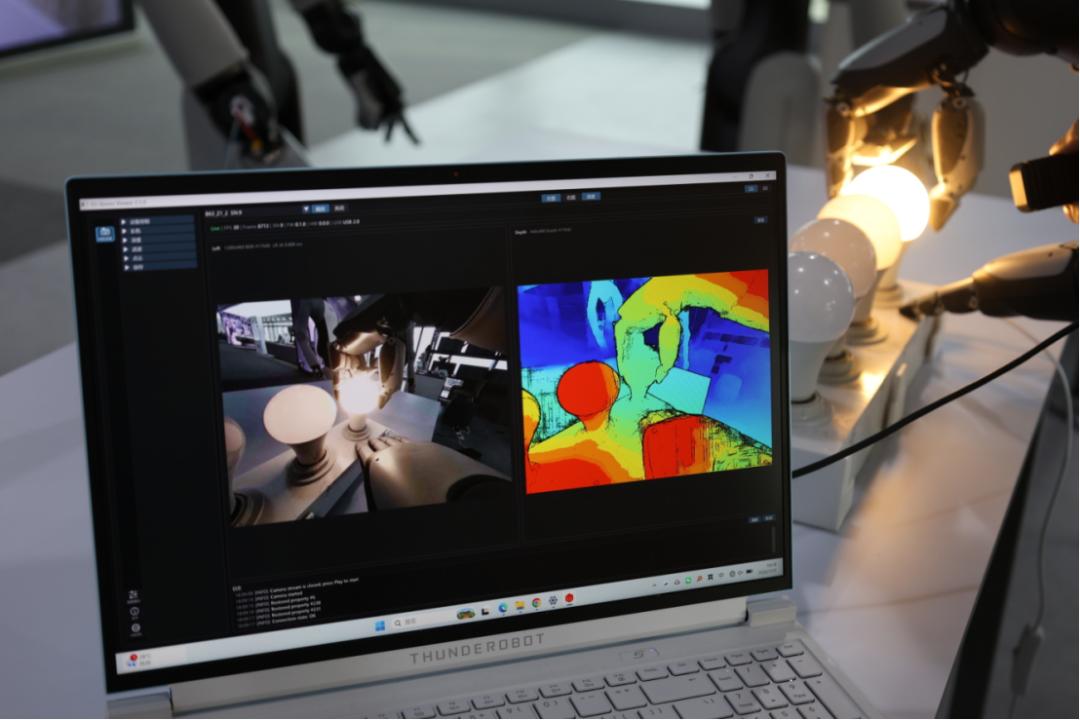
Depth camera: the visual base of embodied robots (Image source / the company)
Similarly, for industrial camera products, Zhang Feng explicitly requires that all of them must have end-side AI capabilities. "If there is no end-side AI, or the customer does not accept the AI solution, we will not do it."
The difference between the two technical routes is also intuitive: traditional algorithms rely heavily on engineers to manually adjust parameters and write rule patches for each abnormal scenario one by one; deep learning is data-driven for self-iteration, with stronger generalization ability.
The price is that the early R&D cycle is long. Zhang Feng revealed that the algorithm team spent nearly a year and a half to reach the level of Orbbec's traditional algorithm. But once this threshold is crossed, the subsequent iteration speed and scene adaptability will be completely different, and the energy consumption will be lower. This is a path that is slow in the early stage but has long-term imagination space.
In addition to adding AI capabilities, Zhang Feng also wants United Imaging to go directly to the uppermost reaches of the AI industry chain to deploy the data collection link. But he does not touch data or sell data, but serves data companies, sells equipment, and provides collection solutions.
On August 18, 2026, United Imaging and 5i Visions jointly established AperData and released data collection infrastructure. The hardware covers three perspectives: head-mounted AperEgo (first-person panoramic collection, the total horizontal field of view of four eyes exceeds 270°), wrist camera AperWristCAM, and gripper collector AperFinger (integrating six dimensions including vision, depth, and force sense). On the software side, AperOS connects the whole process from collection, quality inspection, processing, calculation to dataset delivery.
The difference between this solution and the traditional method is that the quality inspection is moved forward to the collection end. Clarity, exposure, frame loss rate, and multi-channel synchronization are all checked immediately on the end side, invalid segments are directly filtered out on the end side, and valid data is then uploaded. This greatly reduces the transmission and storage cost of invalid data.
Since its release, AperData has received more than 10,000 sets of orders. The first batch of mass production will be delivered at the end of August, with a launch price of 5100 yuan per set.
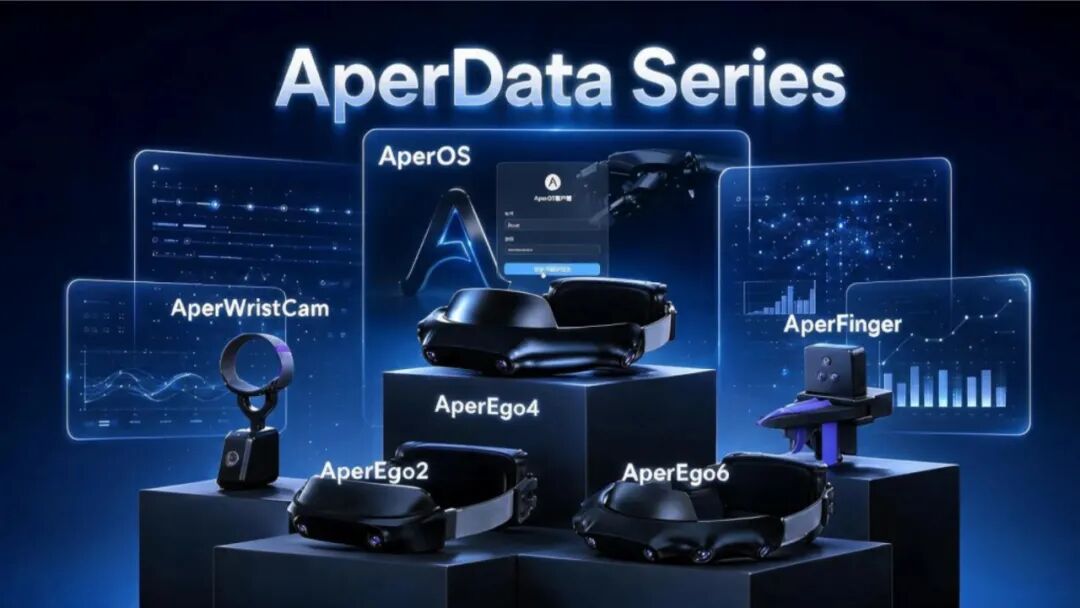
The company's embodied robot data collection equipment (Image source / the company)
United Imaging is no longer the small supplier at the low end of the smile curve. The key to its successful transformation comes from Zhang Feng's determination. He dares to leave the comfort zone and invest the hard-earned funds in innovative businesses.
Looking back, the question Zhang Feng raised in 2016 — how long can the mobile phone "value network" last — is more acute now. But no matter how the cycle of hardware products fluctuates, as a underlying technology, vision capability will always find a new application carrier to carry its value. United Imaging just found its own position at this transformation node.