Is YMTC the second CXMT?
The largest IPO in the history of the STAR Market is coming.
Recently, the official website of the Shanghai Stock Exchange shows that the IPO application of Yangtze Memory Technologies Co., Ltd. on the STAR Market has been accepted, with a planned fundraising of 33 billion yuan, exceeding Changxin Technology's 29.5 billion yuan and setting a new record for the planned fundraising scale on the STAR Market.
Changxin Technology, which went public a month ago, had an issue price of 8.66 yuan per share, corresponding to an issued market value of about 579.2 billion yuan. It closed at 49 yuan per share on the first day of listing, with a corresponding market value reaching 3.28 trillion yuan, firmly ranking first in the A-share market by market capitalization.
As a leading domestic memory manufacturer, is Yangtze Memory the second Changxin Technology?
Different Tracks
Both leading domestic memory players, Yangtze Memory and Changxin Technology were founded in 2016, adopt the IDM (Integrated Device Manufacturing) business model, and have no controlling shareholder or actual controller.
However, there are obvious differences between the two in key dimensions.
From the perspective of technical routes, according to the prospectuses of the two enterprises, Changxin Technology focuses on DRAM (Dynamic Random Access Memory), which requires periodic refresh to maintain stored data, loses data immediately after power-off, and is mainly used as the running memory of electronic devices to undertake the temporary data read and write functions of the system. Yangtze Memory focuses on NAND Flash, which can retain data for a long time after power-off, supports repeated erasure and writing, and is widely used in large-capacity scenarios such as solid-state drives, embedded storage, and removable storage.
Tian Lihui, a professor of finance at Nankai University, told China News Network that the two companies have divergences in both track genes and capital narratives, and the most essential difference lies in their technical routes and industrial ecological niches.
The gap in the volume of the tracks where the two companies are located is also very obvious.
According to the May 2026 forecast of TrendForce, a world-renowned semiconductor and memory industry research and consulting institution, the global DRAM market output value will be about 618.7 billion U.S. dollars in 2026, and NAND Flash will be about 270.6 billion U.S. dollars, with the former being 2.3 times the latter. In 2027, DRAM is expected to increase to 903.3 billion U.S. dollars, and NAND Flash will be about 379.4 billion U.S. dollars, with the gap still widening.
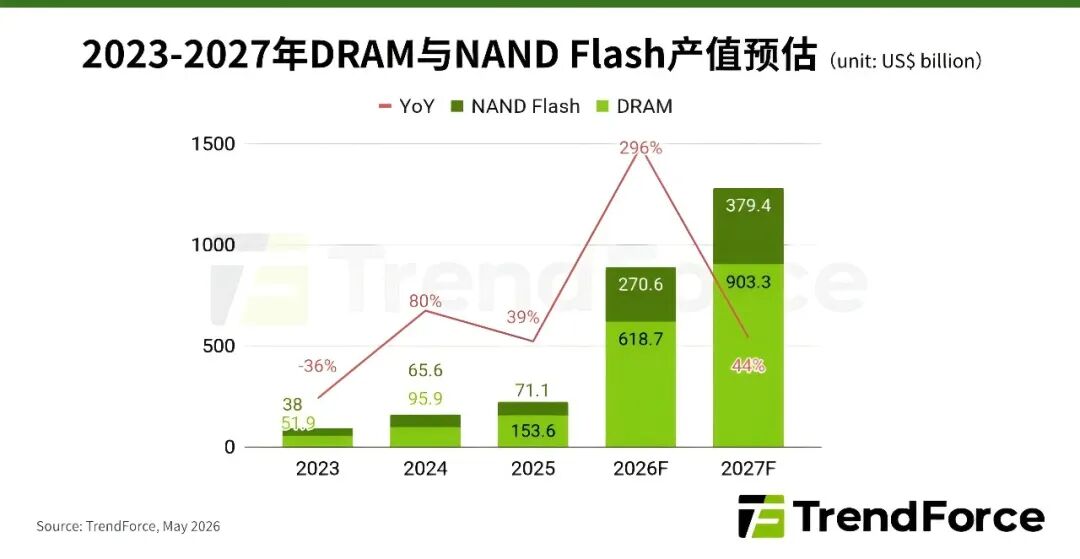
Image source: Official website of TrendForce
From the perspective of competition pattern, according to Omdia data cited in Changxin Technology's prospectus, calculated based on sales revenue, the global DRAM market share of Samsung Electronics, SK Hynix, and Micron Technology in 2025 was 33.96%, 34.48% and 23.41% respectively, with a combined share of over 90%. Changxin Technology ranked fourth with a 7.67% market share. The prospectus states that Changxin Technology is China's largest, most technologically advanced, and most comprehensively laid out DRAM integrated R&D, design and manufacturing enterprise.
Yangtze Memory's global competitors include five leading players: Samsung Electronics, SK Hynix, Kioxia, Micron Technology and Western Digital.
According to the latest Memory and Storage Market Tracker Report for the second quarter of 2026 released by Counterpoint Research, Samsung maintained its lead with a 25% shipment share, followed by SK Hynix with 22%. Yangtze Memory jumped to the third place with a 14% market share, slightly surpassing Kioxia, while Micron ranked fifth.
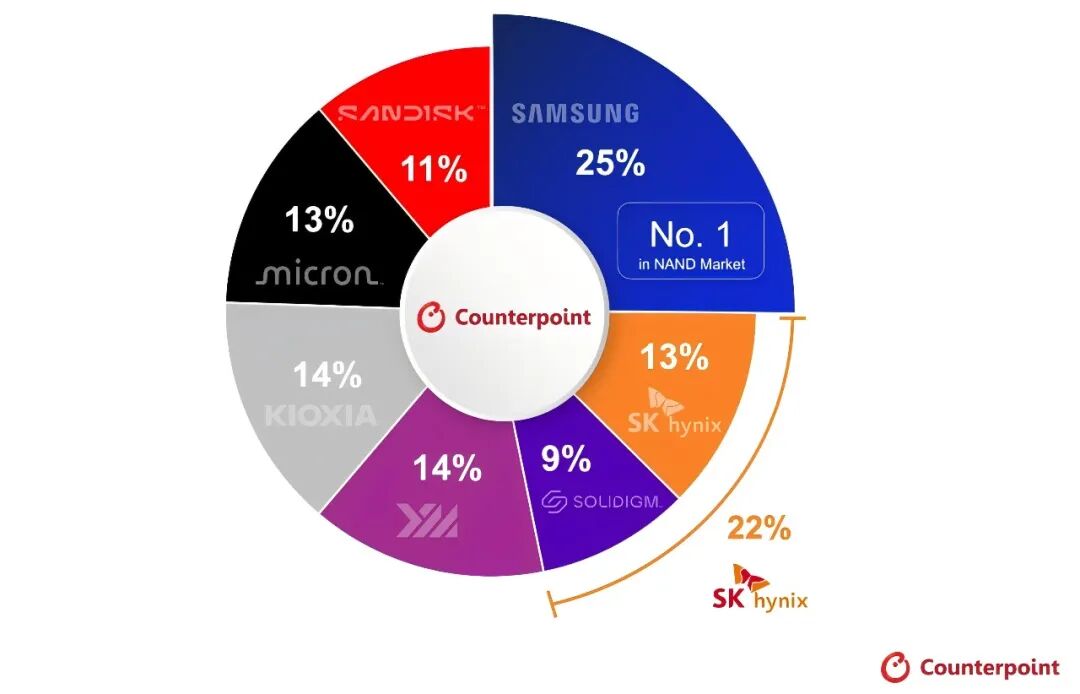
NAND Shipment Market Share in Q2 2026 Image source: Official website of Counterpoint
However, Counterpoint Research also pointed out that shipment volume does not directly translate into revenue. Although Yangtze Memory ranked third in shipment volume this quarter, it ranked fifth in revenue, lagging behind Micron and Kioxia, because its product portfolio is still concentrated in consumer-grade applications, and the proportion of high-unit-price data center enterprise-level SSDs (Solid State Drives) is relatively low.
Tian Lihui pointed out that the global DRAM market that Changxin Technology focuses on is highly monopolized by Samsung, SK Hynix and Micron. As the world's fourth largest supplier and the only domestic DRAM IDM enterprise in China, Changxin Technology is endowed with a scarcity premium for breaking the monopoly. In contrast, Yangtze Memory's main business NAND Flash focuses on long-term data storage, with relatively lower technical barriers, a lower profit margin ceiling, and a relatively dispersed global competition pattern.
Can the Myth Be Replicated?
On July 27, on the first day of Changxin Technology's listing, its market value soared from 579.2 billion yuan at issuance to 3.28 trillion yuan, an increase of more than 5 times. Can this myth repeat itself on Yangtze Memory?
According to the prospectus, the number of shares issued by Yangtze Memory this time accounts for 10% to 12% of the total share capital after issuance. Calculated based on its current fundraising amount, the corresponding valuation of the company is about 275 billion yuan to 330 billion yuan.
In Tian Lihui's view, the probability that Yangtze Memory replicates the skyrocketing trend of Changxin Technology on the first day of listing is extremely low, and its IPO may face structural cold reception.
He pointed out that when Changxin Technology went public, the AI memory logic was at its peak, and overseas funds were frantically snapping up shares. At present, the memory sector has fallen by nearly 30% from its high point, and the market risk appetite has decreased significantly.
In terms of performance, Yangtze Memory delivered a bright performance in the first quarter of 2026, with revenue of 47.042 billion yuan, and attributable net profit of 33.379 billion yuan. Its single-quarter profit was higher than Changxin Technology's 24.762 billion yuan. The prospectus shows that the average unit price of Yangtze Memory's NAND Flash products in the first quarter rose by 172.72% compared with the whole year of 2025, and the gross profit margin of NAND Flash products rose from 36.66% for the whole year of 2025 to 78.73%.
According to the report released by TrendForce on July 30, memory demand in 2027 will still be dominated by AI applications. Due to the continuous capacity squeeze of DRAM by HBM (High Bandwidth Memory) and strong demand for AI Servers, the procurement momentum for memory used in CPUs (Central Processing Units) and HBM continues to increase, the market will maintain a tight supply pattern, and the price trend will be strong. With the concentrated release of new production capacity and the continuous weakening of terminal consumer demand, the supply of NAND Flash will tend to be loose in the second half of 2027, and the price may face correction pressure.
In terms of fundamentals, Tian Lihui believes that the profitability of Yangtze Memory in the first quarter is comparable to or even slightly better than that of Changxin Technology, but its scarcity and strategic value in the AI industrial chain are not as good as DRAM and HBM. The key game lies in whether a reasonable pricing can be given in the inquiry process. If the issuance valuation is too aggressive, the pressure of share price falling below the issue price at a certain time after listing cannot be ruled out; if the pricing leaves a sufficient safety margin, it may instead gain recognition from rational funds during the market cooling period.
Li Guoping, a professor at Central University of Finance and Economics, told China News Network that the impact of sentiment on a company's value is short-term. In the long run, fundamentals are the determinant of a company's value. Whether Yangtze Memory's market value can surpass that of Changxin Technology ultimately depends on its subsequent performance and whether it can make breakthroughs in the HBM field.
In Li Guoping's view, there is no big difference in the market positions of Yangtze Memory and Changxin Technology in China. Although their products are different, their long-term investment values are comparable. Although the current memory sector has corrected, market sentiment is still relatively high, so the risk of Yangtze Memory's IPO being cold-shouldered should not be great.
This article is from the WeChat official account "China News View" (ID: jwview), written by Xie Jingwen, edited by Li Xiaoxuan, and published by 36Kr with authorization.