MiniMax's ARR has surged by 500% and its token volume has skyrocketed by 2000%, which is exactly the Agent dividend, isn't it?
Is this still the MiniMax I know?
Its growth speed and commercialization capability are incredibly strong!
According to MiniMax's latest disclosed data, as of August this year, the company's ARR (Annual Recurring Revenue) has exceeded 800 million US dollars. Back in February this year, the ARR announced by MiniMax was only 150 million US dollars.
Corresponding to the financial statement data, this growth has been reflected in the actual revenue level:
In the first half of 2026, MiniMax's revenue reached 116.6 million US dollars, a year-on-year increase of 283.1%; its half-year revenue has already surpassed the full-year revenue of 79.04 million US dollars in 2025; the revenue of Q2 increased by over 80% month-on-month compared with Q1.
However, what is more notable than the expansion of revenue scale is that MiniMax's revenue structure is changing rapidly:
In the first half of this year, the proportion of MiniMax's B-end revenue reached 63.4%, and further rose to 80% by August; in comparison, the B-end revenue of MiniMax in 2025 only accounted for about 30%.
It can be seen that MiniMax's growth focus has rapidly shifted from C-end products to enterprises and developers.
Revenue tripled, B-end becomes the main growth engine
First, look at the revenue level.
In the first half of 2026, MiniMax's revenue reached 116.6 million US dollars, surged 283.1% year-on-year, the revenue in only half a year has exceeded the full-year revenue scale of 79.04 million US dollars in 2025.
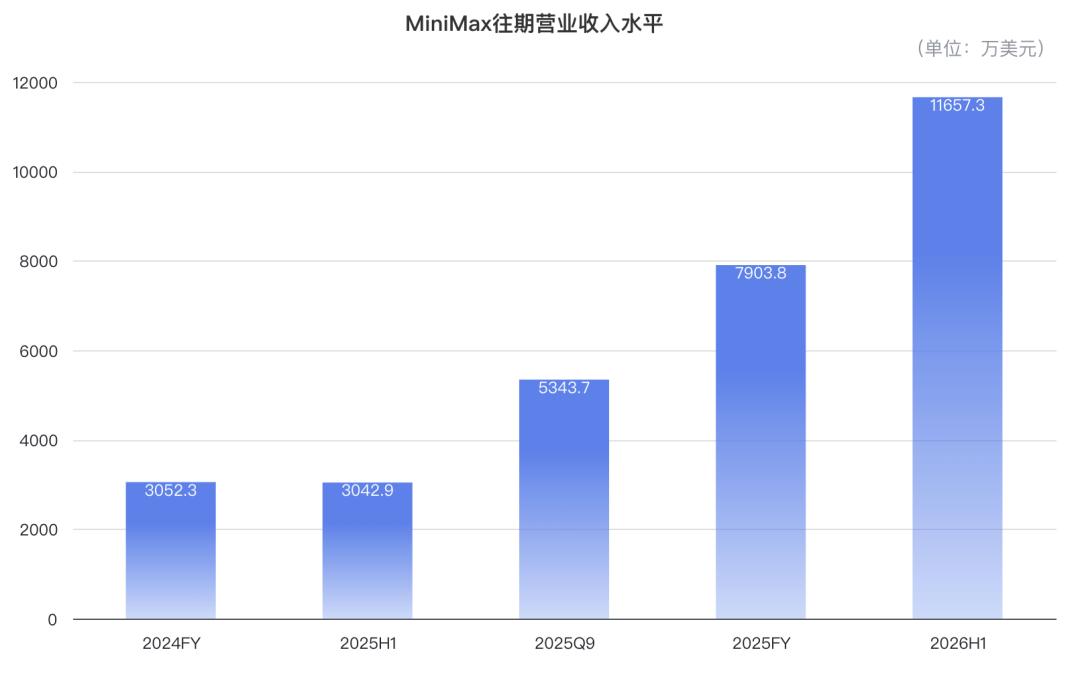
Moreover, the growth is not limited to the year-on-year caliber. In the second quarter of this year, MiniMax's revenue continued to increase by 81.8% quarter-on-quarter compared with the first quarter.
If we break down the data further, the change is more obvious in the revenue structure.
In the first half of 2026, MiniMax's revenue from open platform and other AI enterprise services reached 73.93 million US dollars, a year-on-year surge of 703.1%; the proportion of this part of revenue in the total revenue also increased from 32.8% for the whole year of 2025 to 63.4% in the first half of this year.
Calculated based on the semi-annual report data, compared with the first half of 2025, MiniMax's total revenue in the first half of 2026 increased by about 86.14 million US dollars, of which about 64.72 million US dollars came from the open platform and enterprise services.
That is to say, about three quarters of the new revenue comes from the B-end.
This means that MiniMax's C-end products that were previously more easily perceived by the public, such as Talkie and Hailuo AI, can no longer fully summarize the company's commercialization structure.
However, this change does not come from the contraction of the C-end business.
In the first half of 2026, the revenue of MiniMax's AI-native products still reached about 42.64 million US dollars, a year-on-year increase of 100.9%.
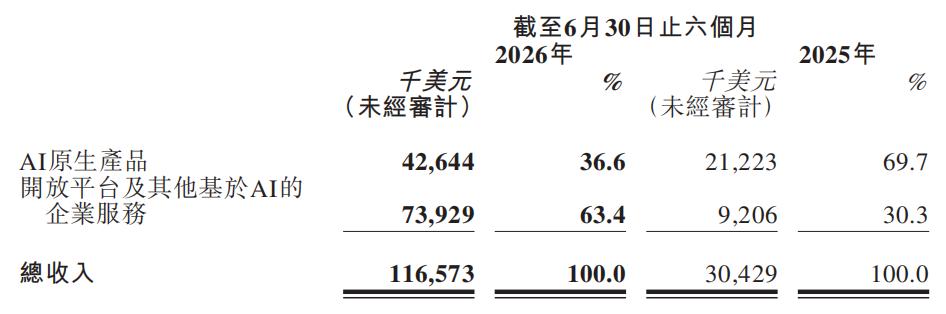
The financial statement attributes the growth mainly to the improvement of user engagement, enhanced willingness to pay, and the continuous commercialization of products such as Hailuo AI.
In other words, both the B-end and C-end business lines are growing, but the demand release speed on the enterprise and developer side is significantly faster, which finally makes the B-end gradually become the main source of new revenue.
In addition to the expansion of revenue scale, MiniMax has also begun to show some synchronous changes in financial efficiency.
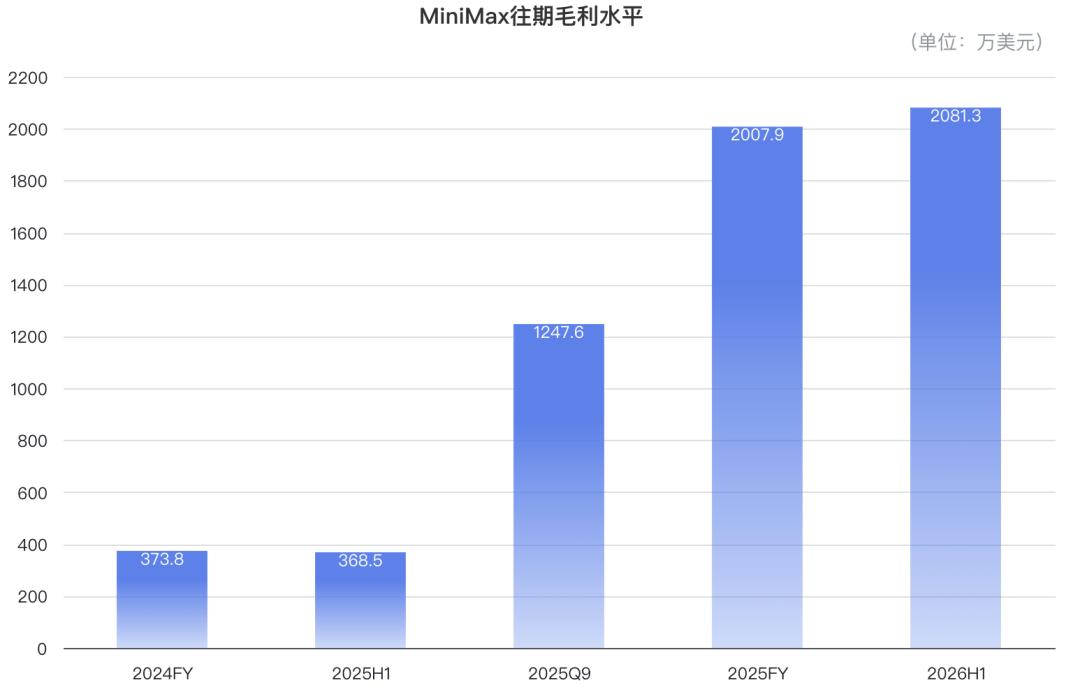
In the first half of this year, MiniMax's gross profit reached 20.81 million US dollars, a year-on-year surge of 464.8%; in the same period, the gross profit margin rose from 12.1% in the same period of last year to 17.9%, which the financial statement mainly attributes to the improvement of infrastructure efficiency.
Sales and distribution expenses have decreased, from 32.84 million US dollars in the same period of last year to 26.97 million US dollars, a year-on-year decrease of 17.9%, which is mainly due to the continuous promotion of the organic user growth strategy, and the corresponding reduction in promotion expenses.
In terms of R&D, MiniMax still maintains high investment.
In the first half of this year, the company's R&D expenditure reached 296.9 million US dollars, a year-on-year increase of 138.8%, which is mainly used for investment in basic models, multimodal capabilities and model training. Although the absolute scale continues to expand, its growth rate is significantly lower than the 283.1% revenue growth in the same period.
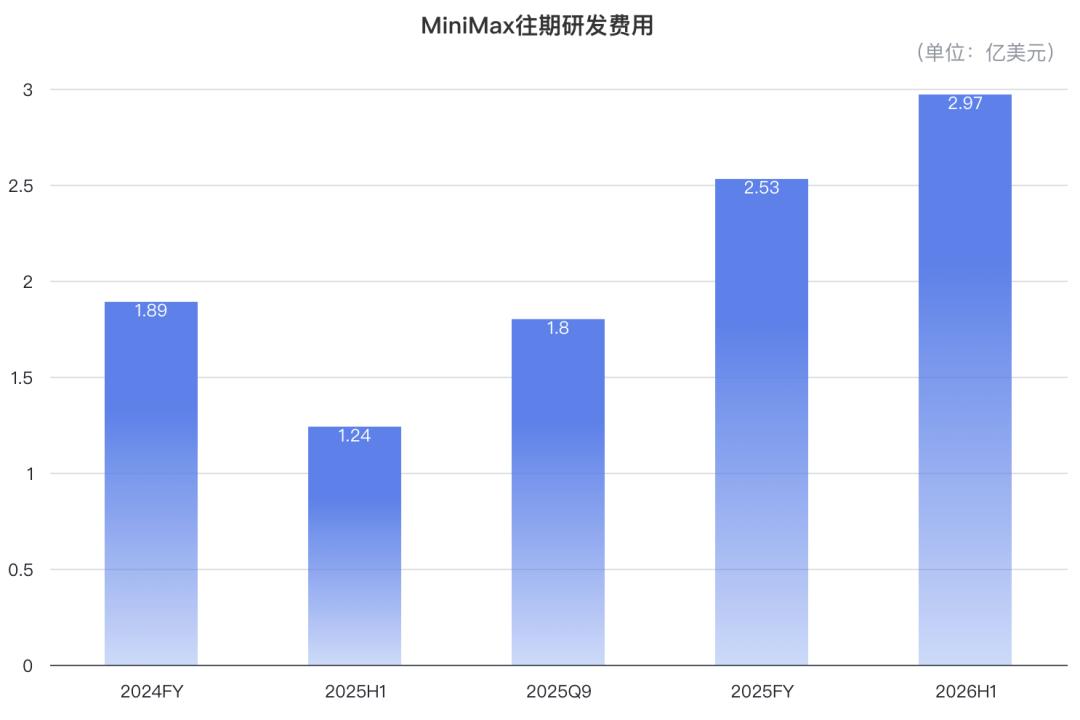
In fact, for foundation model companies, revenue growth is often accompanied by a synchronous increase in expenditures on model training, inference and infrastructure.
The current state of MiniMax is that commercial revenue is beginning to expand at a faster speed, and some efficiency indicators such as gross profit margin and customer acquisition cost have also improved.
Therefore, through this financial report, MiniMax's current state can be roughly summarized as:
The speed of commercialization has accelerated significantly, and the B-end has rapidly become the main source of new revenue; at the same time, gross profit and partial expense efficiency continue to improve, while model R&D and infrastructure are still in the stage of high investment.
Going one step further, a new question arises——
The B-end has quickly become MiniMax's main growth driver, why now?
What drives MiniMax's skyrocketing growth?
The rise of the B-end business needs to be viewed in combination with a series of recent developments of MiniMax.
First of all, regarding the revenue growth rate, after entering the third quarter, the growth trend of the first half of the year continues.
According to Yan Junjie, CEO of MiniMax, disclosed during the conference call, the ARR announced by MiniMax in February this year was 150 million US dollars; by August, this figure has exceeded 800 million US dollars, expanding to about 5.3 times in half a year.
MiniMax's revenue structure has also changed:
For the whole of last year, MiniMax roughly followed the revenue structure of "30% B-end and 70% C-end"; in the first half of this year, it has turned to over 60% from B-end; by August, from the perspective of ARR structure, the ratio of To B to To C has further reached about 80/20.
Looking at another data that is closer to the actual usage of the model: in July this year, MiniMax's Token consumption has reached 20 times that of January.
The three indicators rise rapidly at the same time, pointing to the same change——
MiniMax's models are increasingly being used in the real workloads of enterprises and developers, and its model capabilities are continuously bringing API calls and commercial revenue.
This growth is not only due to the increase in the number of users, but also the increase in unit user consumption brought by the change of usage scenarios, both multipliers are growing.
First, the most intuitive number of users: by May, the number of enterprise customers and developers on the platform exceeded 2 million, which is 10 times that at the end of last year.
Especially after the release of the M3 model, the capability improvement it brings is continuing to drive existing customers to expand their usage.
On the other side of growth, the usage intensity of individual users has become much higher.
In the past, people chatted with AI, but now more and more Agents are interacting with AI, and the Token consumption is not at the same level at all.
This also explains why the Agent-driven inference demand grows significantly faster than the number of human users and messages.
In July, the open source of the video generation model H3 added another strong boost to MiniMax's growth.
After H3 was open sourced, it obtained more than 24 million downloads within three weeks, and the open source community developed more than 300 derivative models based on it, which exceeded market expectations.
MiniMax stated at the conference call that the performance of H3 has changed the pattern that advanced models all belong to large factories and follow a closed route.
The open source model allows a large number of developers to get familiar with MiniMax's technical system through the open source model, and turn to paid API calls when they need cloud services, which brings a further explosion in the usage of official online services.

With such a surge in demand, can MiniMax's models keep up?
It should be noted that the Agent workflow is different from the previous chat scenarios, every step requires the model to be accurate enough, one wrong step may cause the entire workflow to fail.
Fortunately, the M3 released by MiniMax in June is a representative of model capabilities that "have kept up".
It can not only retrieve and reference documents, but also operate interfaces. With such comprehensive capabilities, developers dare to integrate it into real business scenarios.
But on the one hand, the model is getting smarter and smarter, on the other hand, the Token consumption is getting higher and higher, both aspects are putting higher requirements on the computing infrastructure.
So here comes the question——
Can such powerful intelligence be continuously supplied at a sufficiently low cost?
Higher intelligence and higher cost performance are not an either-or choice
For MiniMax's current most powerful M3 model, the price per million tokens is only 1.2 US dollars, which is much lower than the median price of models at the same level (2.2 US dollars).
How can such a low price be sustained?
Some people may think it is a commercial strategy, but the reason why MiniMax set this price is actually very simple——because the computing power cost of the inference link is really not as high as people imagine.
However, this pricing strategy has also brought a stereotype to MiniMax: large volume and sufficient supply.
This doesn't seem like a bad comment, but it is often followed by another statement, that is, "the intelligence level is a bit worse".
At this conference call, MiniMax responded to this question.
This stereotype largely comes from people's cognitive dislocation, many people think that between high intelligence and high cost performance, you can only choose one.
But in MiniMax's view, the two are not mutually exclusive, what they pursue is not to make a trade-off between intelligence and cost.
In MiniMax's cognition, cost performance is a means and a path, not an end or a destination, what they ultimately want to achieve is a higher level of intelligence.

Reducing the cost of per-unit intelligence benefits both the business and technology sides.
From a commercial perspective, customers can run more calls and more complex workflows with the same budget, so they will be willing to integrate the models into their production processes.
From a technical perspective, the same computing power can run more post-training and experiments, so that model iteration can be accelerated.
The two things are interlocked and mutually reinforcing, the stronger the model is, the larger its usage will be, and the more revenue it will generate.
With more revenue, MiniMax can invest more computing power to continue optimizing inference efficiency, make the model stronger, and start the next round of positive cycle.
Of course, this cycle must be supported by infrastructure, otherwise it is just empty talk.

MiniMax is one of the first batches of independent large model companies in China to establish a large-scale infrastructure system, with ETTR (Effective Training Time Ratio) reaching 97%.
And with self-built computing power, training and inference resources can be scheduled in a mixed way. When the online inference traffic is at a low ebb, the idle computing power can be directly used for reinforcement learning training.
The self-built cluster ensures stable training, keeps the inference cost under control, and the saved computing power can be used for post-training.
From this point of view, the relationship between model capability, inference efficiency and infrastructure has become increasingly inseparable.
The model architecture determines the upper limit of intelligence, inference and system optimization determine how much effective intelligence can be generated per unit of computing power, and infrastructure determines whether such large-scale training and