After raising 700 million yuan in Series A financing, where does Habitat intend to bring the concept of "home"?
On August 20, Habitat, a smart residential brand, announced the completion of a 700 million-yuan Series A financing round led by the Science and Innovation Fund of Xinbei District, Changzhou. This is also the largest single financing deal in China's home furnishing industry on the primary market in the past three years. Previously, Habitat completed its first round of financing of 653 million yuan in 2024.
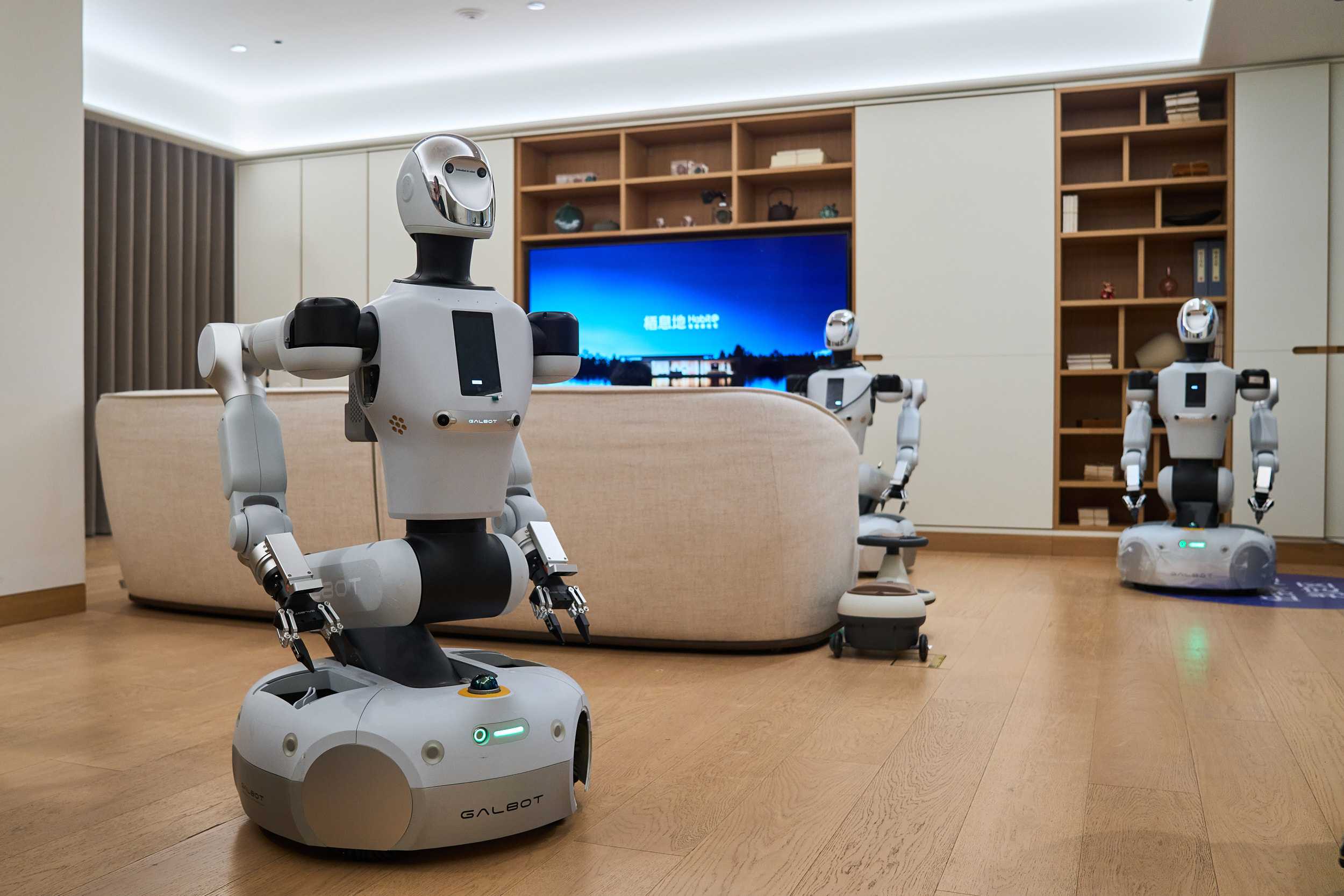
Almost at the same time, the 2026 World Humanoid Robot Games provided an observation perspective: the organizing committee added a home scenario competition, which required a sufficiently realistic home environment that could provide unified conditions for participating teams from different cities. After several rounds of coordination, the Beijing Experience Center of Habitat was finally selected as the exclusive venue provider for the home scenario.
The venue fully adopts the product standards that Habitat delivers on a daily basis in multiple cities across the country. Shen Yanan, founder of Habitat, described it this way, "Buy the venue, move in and you can live right away". This brings up a more thought-provoking question — when AI begins to move from screens to the physical world, will the "home" we are familiar with also change accordingly?
AI Enters the Home, the Home Needs to Evolve First
The problem reflected by the robot games venue lies not only in the capabilities of the robots themselves, but also in the home environment that carries them.
The home is a highly non-standard working environment with different apartment layouts, equipment and interaction modes, and the algorithm iteration of embodied intelligence will not automatically eliminate these differences.
Take turning on the light as an example. In a traditional residence, the robot needs to identify the position and function of the switch before completing the mechanical operation. When moved to another family, the shape, position and control logic of the switches may all change. Especially for more complex devices such as knobs and touch panels, the adaptation cost will only rise further.
Smart homes offer another path. Habitat has connected fixed devices such as temperature regulation, fresh air system and lighting into a unified system, with a built-in spatial agent named "Xiao Qi". When the robot needs to turn on the light, it can directly interact with the residential system, and "Xiao Qi" will call the lighting system.
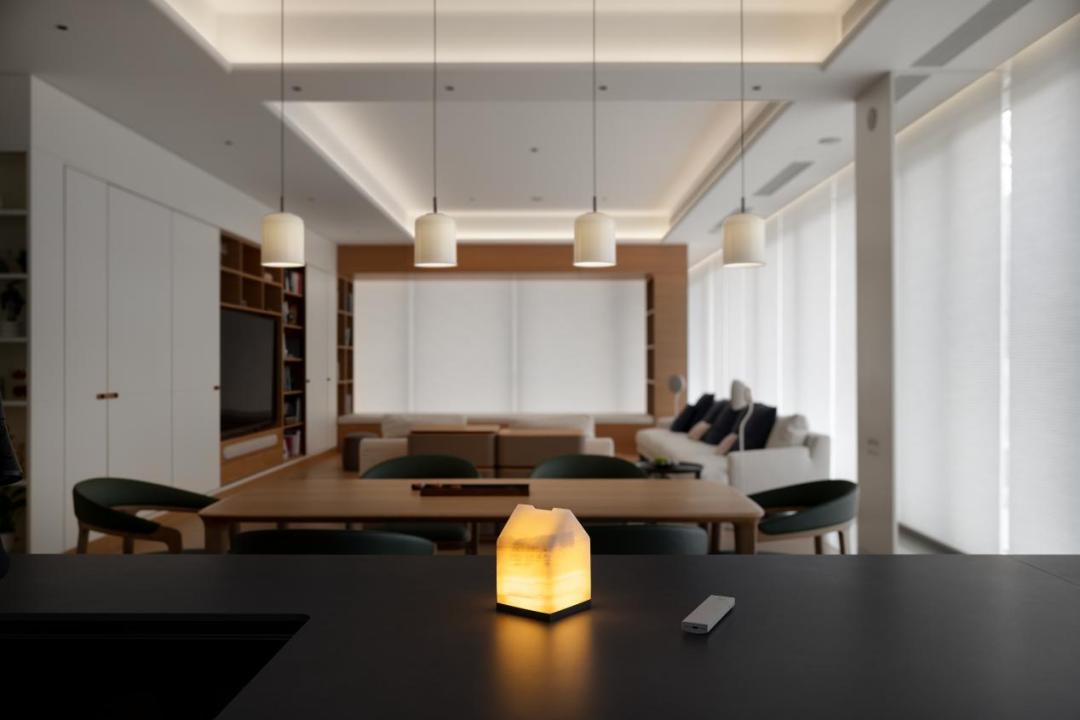
Home spatial agent Xiao Qi (the picture shows one of its embodied forms)
Shen Yanan calls this relationship a "two-way mutual reinforcement" — the more fully the residential infrastructure is prepared, the less repeated adaptation robots need for different home environments, and the more opportunities they have to take on truly valuable work earlier.
Robots are just one observation perspective. Whether it is embodied devices or 24/7 running spatial agents, the premise for AI to truly work in the home is that the residence first becomes a whole that can be uniformly perceived, invoked and continuously upgraded.
This is more universally meaningful than retrofitting residences specifically for a certain type of robot, and it brings the real problem back to the residence itself. Shen Yanan is used to using the concepts of "custom-built PC (buying parts to assemble a computer)" and "laptop" to intuitively illustrate the differences between the traditional home furnishing model and Habitat's model.
Under the traditional home furnishing model, consumers need to find design, materials, woodwork, equipment and construction separately, and then combine these links into a home. Devices from different brands operate independently, the final result is highly dependent on personal experience, and there is no unified interface. Such a space is difficult to be uniformly invoked, let alone continuously upgraded.
Habitat's solution is to first make the residence a finished product.
However, turning a service that has long relied on the experience of designers, foremen and construction workers into a product that can be continuously researched, developed, manufactured, delivered and iterated is itself a systematic project. It requires enterprises to redefine the product and establish R&D, supply chain and delivery systems around this set of definitions.
The first problem to be solved is how a residence is defined in the first place. Habitat breaks down its products into three levels: the smart home chassis, living functions and appearance suites. Capabilities such as air, water, light and intelligence are precipitated into the chassis, living functions are combined in a modular way, and choices of colors and materials are provided through different suites.
The core of its product definition is to reorganize the capabilities that were previously scattered in design, materials, equipment and construction into a set of product architectures that can be repeatedly researched, developed and iterated. It is worth mentioning that based on this chassis, the residence begins to have unified perception and invocation capabilities. "Xiao Qi" can read the environment, call devices, and actively adjust environmental parameters such as light, temperature and air quality.
Secondly, after the product definition is completed, this set of standards must be truly implemented in the supply chain and construction sites. Before the construction of each Habitat residence starts, a digital twin will be formed first, and the design effect, cost and materials will be confirmed in the digital space first. The same set of data will then run through links such as the supply chain, woodwork manufacturing, construction drawing drafting and work order generation. The residence is fully defined in the digital world first, and then reproduced on the physical site.
This constitutes Habitat's starting point in the AI era: first turn the residential delivery that is highly dependent on manual experience into a definable, researchable, replicable and continuously iterable product, and then let AI further become the organization center of the space.
The Evolution Path of the Home
"Building homes in the way of building cars" is the most easily understood expression of Habitat, which explains what Habitat has done in the past three years, but it is only the first step.
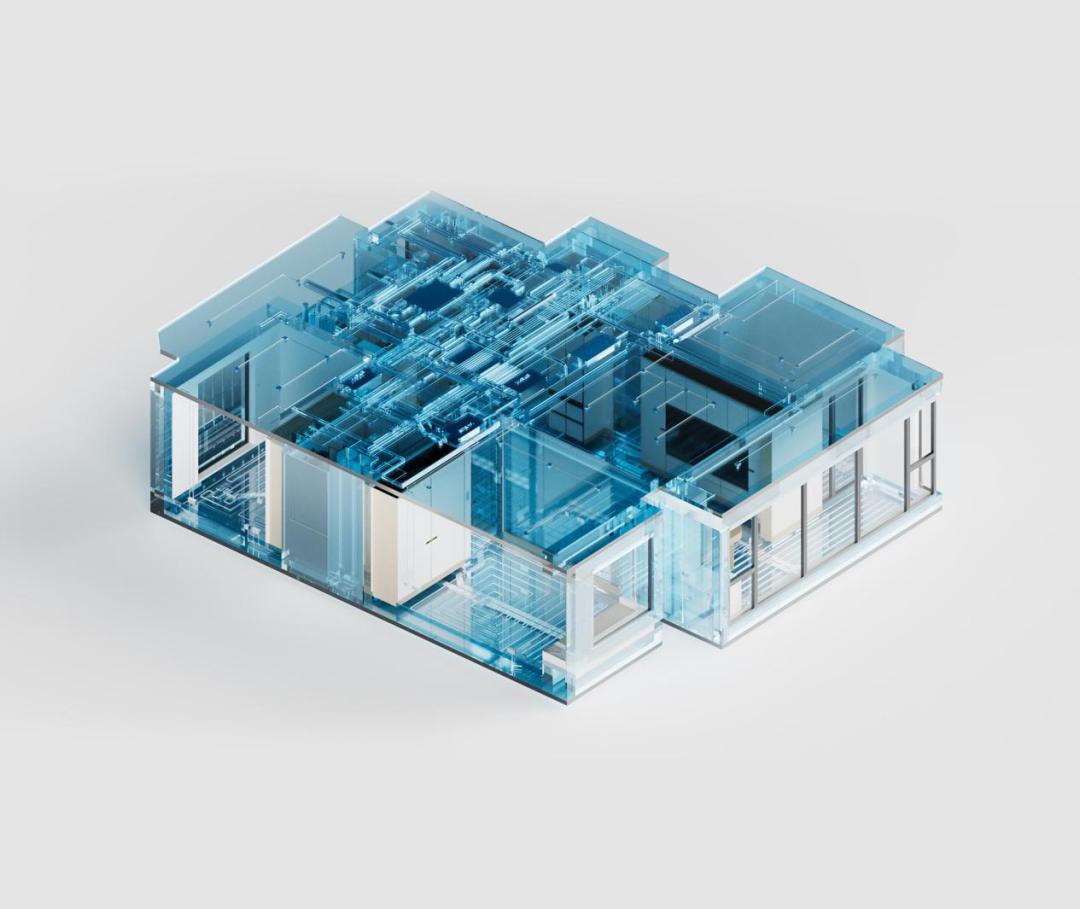
Building homes in the way of building cars
Habitat's previous generation of products, through standardized and productized processes, enables residences to have a unified software and hardware base, and access to spatial agents such as "Xiao Qi".
Shen Yanan defines this as the L1 stage of smart home evolution. In his vision, smart homes will continue to evolve along L1-L4. Each upgrade means that the residence gains more capabilities of understanding, judgment and action. Up to now, L1 has been realized: AI enters the residence, but the underlying architecture still follows the logic of adding agents after the residence is completed.
In the L2 stage, AI will change from an additional capability after product completion to the organization center of the space, which requires re-designing the residence starting from AI, with the software and hardware architecture, communication methods and intelligent hub adjusted accordingly.
Then in the L3 stage, AI further gains action capabilities in the physical world. Embodied intelligence is connected to the residence, so that the spatial agent has "hands and feet" that can move and operate. According to Shen Yanan, the company has begun to consider introducing embodied intelligent products into its product system, and related products may be incorporated into the existing delivery system as early as next year.
In Shen Yanan's view, middle and high-income families will generally have embodied intelligent devices in five years. "The work they undertake will not be limited to cleaning, but more like a physical agent, a family housekeeper that can intervene in the physical world."
L4 is a longer-term vision. Shen Yanan calls it a "spatial intelligent terminal". The home agent will no longer be limited to a fixed residence, and can continue to accompany users when they go out, go on business trips or stay in hotels, and preserve the relationships, habits and memories formed by the whole family over a long period of time. He calls this form a "silicon-based family member".
Shen Yanan uses Tesla as an analogy for this evolution path: L1 corresponds to the integration of software and hardware, L2 corresponds to the AI-native architecture, and L3 corresponds to embodied intelligence. From his perspective, FSD for Tesla is similar to the spatial agent for Habitat: the agent running in the space is the core that can continuously add value.
A detail that is easy to ignore is that Habitat has built a home storage and computing center in every set of residences since its first generation of products. Shen Yanan explained, "It is hard to imagine that the soul of the most important silicon-based family member to you is placed on a public server. The optimal, and only optional place to store it is your own home".
The boundary Habitat has drawn for itself has gone beyond residential delivery.
A complete smart home is the most important product form at this stage, but productization solves the problem of whether the residence can be uniformly defined and invoked, and AI-native solves the problem of who organizes the space.
Moving forward from L1 to L4, the center of gravity of value will gradually shift to the space itself as a terminal. What Habitat is betting on is the redefinition of living space as an intelligent terminal in the AI era.
What is Capital Betting on After the 700 Million Yuan Financing?
Capital's judgment requires both future narratives and facts that have already happened. The 700 million-yuan Series A financing figure itself represents a judgment from capital.
Looking back at the evolution path of smart homes, the present is exactly the node where L1 moves to L2. What capital is betting on is the technological dividend and market space between the two that have not been fully released.
On the one hand, in the eyes of capital, L1-level smart homes have obtained clear market verification. According to Habitat's disclosure, its current annual contracted scale exceeds 1 billion yuan, with revenue and order volume doubling for three consecutive years. Since the launch of the first generation of new products on February 28, 2025, the number of users has maintained a quarterly growth rate of about 50%, and its direct sales network has covered seven cities including Beijing, Shanghai, Hangzhou, Shenzhen, Guangzhou, Chengdu and Wuhan.
The access threshold for AI models and single-point technologies is decreasing, but the underlying residential architecture, product definition, supply chain organization, digital twin and cross-city delivery capabilities require long-term, deep accumulation. Turning complex technologies into stable products and delivering them in different residences is itself a commercial barrier.
These results show that the market has begun to accept the way of purchasing complete smart home products. At the same time, Habitat has been able to achieve stable delivery of L1-level smart home products. According to Habitat's data, the delivery NPS has increased from 27.8 in the early stage of entrepreneurship to 51.1, ranking among the top in the industry, and is still steadily rising.
On the other hand, this round of financing also represents capital's recognition of the evolution path of smart homes. According to 36Kr's understanding, Habitat will hold an autumn technology conference at the Modern Shanghai Design Week on September 7, officially launching the AI-native smart home and its underlying architecture, marking that the smart home industry has officially entered the L2 era.
The concept of AI-native has been popular for a long time. Manufacturers of mobile phones, PCs and even automobiles have all raised the banner and taken frequent actions: mobile phones have increased end-side computing power and personalized operating systems; PCs have reorganized the experience around chips, systems and local agents; automobiles have taken technologies such as intelligent driving and intelligent cockpit as the measurement standards of their technical reserves.
But the core of these different industries is essentially the same — reorganizing computing power, data, operating systems, sensors and control interfaces around AI. What mobile phones, PCs and automobiles are experiencing is the process in which AI moves from the application layer into the system architecture and becomes the organization center.
Residences go a step further than other terminals. It not only carries the data and relationships formed by the family over a long period of time, but also connects air, light, temperature, energy, home appliances and embodied devices. For AI to gain complete perception, judgment and action capabilities, residences will naturally become a link for AI-native terminals to extend to the physical world.
In this regard, Habitat itself is also laying infrastructure for the next stage. According to the financing announcement, this round of funds will be mainly used for the previously announced global headquarters and R&D center for smart homes, as well as the embodied intelligence laboratory and the production-level AI design and delivery system.
The 700 million-yuan Series A financing can be regarded as a comprehensive valuation of Habitat's current ecological niche in the industry by capital. Habitat, which took the lead in moving from L1 to L2, has initially mastered the right to define the industry, and has also obtained the future ticket to the discourse power of the relationship between people and space.
The relationship between people and home has long been one-way.
People are responsible for designing, arranging, using and maintaining the space, while the home passively carries the life that takes place in it. In the process where AI and embodied intelligence gradually penetrate into the home, this relationship begins to become two-way. The unified equipment system, local computing power, data storage and software system enable the home to continuously learn and iterate, and grow with the changes of family members and lifestyles.
It is conceivable that when spatial agents like "Xiao Qi" truly become "silicon-based family members", the residential space can take on more judgment, coordination and daily affairs, and people can return to life itself, devoting time to companionship, rest, interests and creation.
At that time, the living space will become the most important intelligent terminal for human life, and will continuously understand and adapt to people in the long process of cohabitation. This may be the next-generation living style that Habitat is trying to reach.