Bad weather is igniting the gold market
Author | Huang Yida
Editor | Zhang Fan
Recently, the global capital market is experiencing a round of drastic volatility triggered by the interplay of physical constraints in the real world and the continuous tightening of financial conditions.
As expectations of agricultural output reduction caused by strong El Niño or even "super El Niño" keep rising, agricultural product prices have generally strengthened since the beginning of this year. As of August 25, among agricultural products, the most outstanding CBOT soybean oil, CBOT rough rice, CBOT wheat and ICE No.2 cotton have risen by 45%, 35%, 30% and 24% respectively since the start of the year.
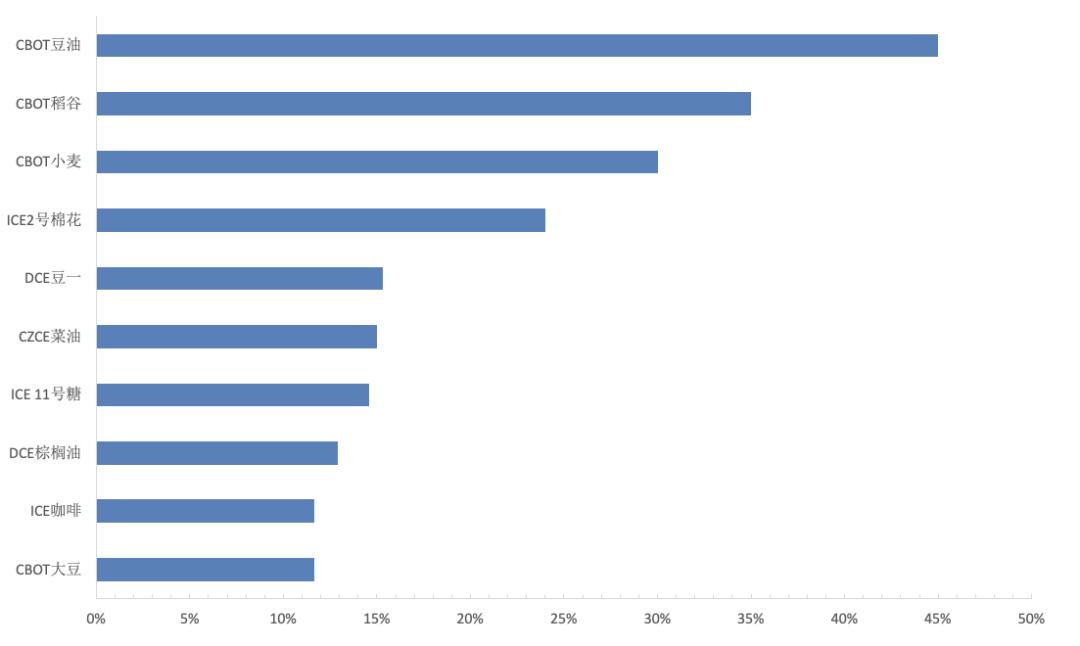
Figure: Price change of major agricultural product futures since the start of the year; Data source: Wind, 36Kr
In terms of the stock market, since mid-to-late June this year, global AI sector assets have entered a continuous adjustment period. As of August 25, the Philadelphia Semiconductor Index has seen a maximum drawdown of 20% in the past two months, while the South Korea KOSPI 50 Index has dropped by as much as 29% in the same period; the core AI sector stocks including Samsung Electronics, SK Hynix and Micron Technology have recorded maximum drawdowns of 43%, 49% and 30% respectively in the same period, a sharp contrast to the trillion-level capital expenditure.
The continuous rise in long-term US Treasury yields is another major risk point for the market at present. Among them, the 30-year US Treasury yield broke through the key 5% level, once peaking at 5.31%, hitting a new high since 2007. As the anchor of global risk-free rate pricing, the rapid rise in US Treasury yields has exacerbated financial market volatility, and also forced the US Department of the Treasury to urgently announce on August 19 that it would use repurchase operations to stabilize US Treasury yield fluctuations, in an attempt to ease market pressure. However, long-term US Treasury yields have risen instead of falling.
Mainly affected by the weakening of the US dollar's credit, the US Dollar Index has been under obvious pressure recently; at the same time, gold, which had undergone previous adjustments, has seen a marked rebound. The performance of the major asset classes mentioned above also shows that the current market is experiencing a round of asset price repricing jointly driven by rising inflation expectations, upward shift of the interest rate center and US dollar credit revaluation.
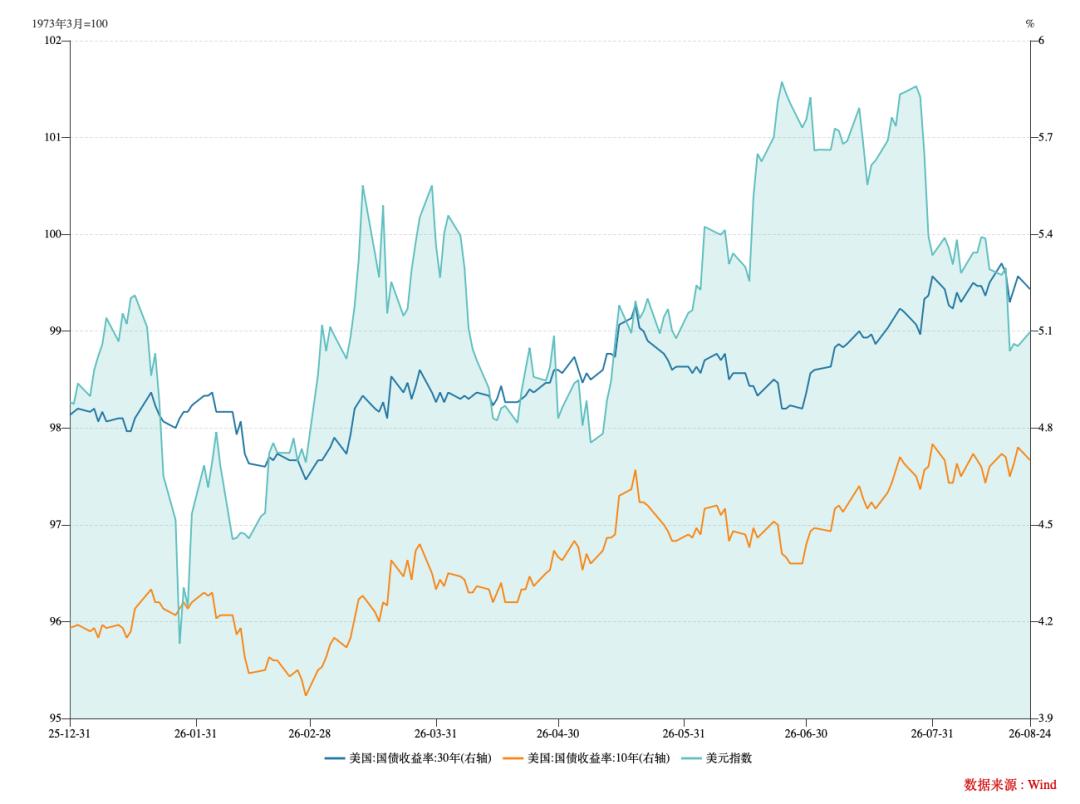
Figure: US Treasury yield trend and US Dollar Index; Data source: Wind, 36Kr
Then, what impact will the future strong El Niño have on the transmission path of inflation-interest rate? Under the expectation of "Higher for Longer", how will the interest rate center evolve? How will relevant macro factors affect the asset allocation logic of gold?
01 El Niño, Always the Strongest in History?
That a super El Niño will lead to agricultural output reduction is a hot topic in the current capital market. Multiple domestic and foreign meteorological institutions including China Meteorological Administration and the World Meteorological Organization generally believe that the existing El Niño phenomenon will escalate into a strong El Niño, or even a super El Niño, from the second half of 2026 to the first half of 2027.
El Niño, as a long-discussed topic, is frequently claimed to be the strongest in history. Will this year's El Niño really be the strongest on record?
In terms of rainfall data, according to Morgan Stanley's forecast, major agricultural exporters in the Asia-Pacific region such as Indonesia, the Philippines, Thailand and Australia will face greater rainfall gaps due to the impact of El Niño, which may lead to a significant reduction in local agricultural output.
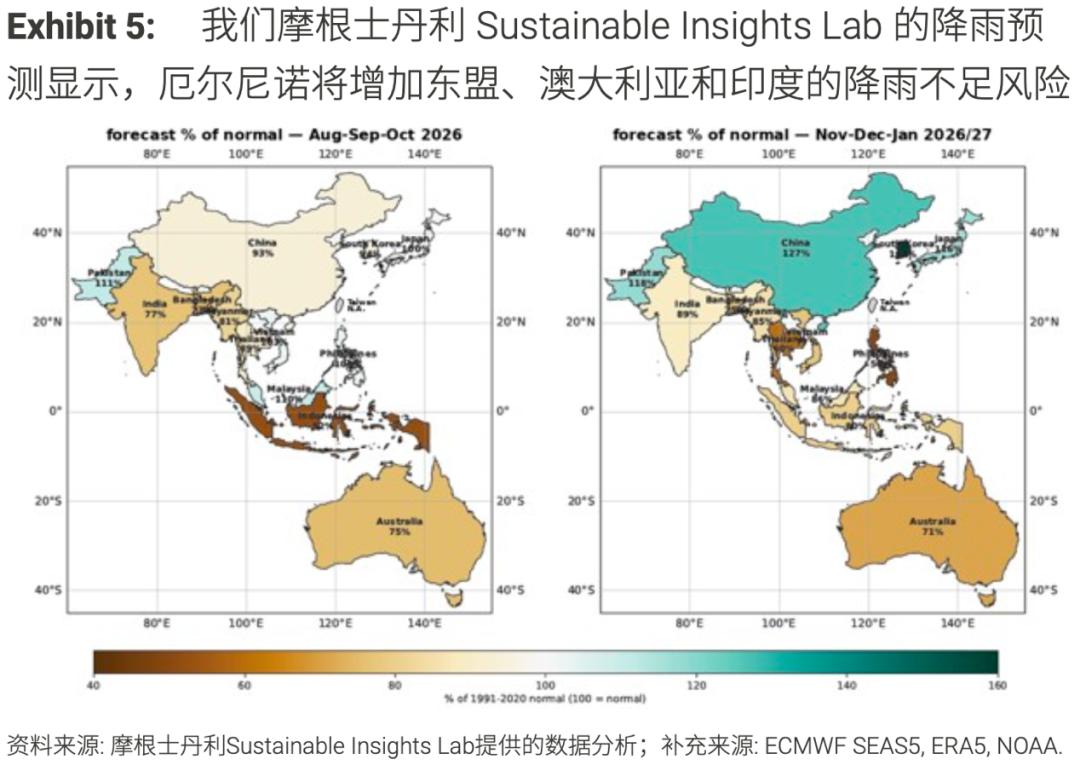
Figure: Morgan Stanley forecasts insufficient precipitation in parts of the Asia-Pacific region; Data source: Morgan Stanley, 36Kr
As the core grain producing regions that account for 89% of global rice output, 48% of vegetable oil output and 44% of wheat output, the expectation of agricultural output reduction in Asia caused by extreme climate has been partially reflected in the current bulk prices of related varieties.
According to historical experience, in average El Niño years, Asia's rice and wheat output will drop by 2.4% and 2.9% respectively, and the export decline will even expand to 2.5% and 7.1%. This round of strong El Niño may lead to a larger decline. With the phased marginal contraction of supply, the price center of related agricultural products will shift upward, which is also one of the mainstream views in the current market.
The market's greater concern is that when agricultural prices rise then, global inflation will be further pushed up, which will keep interest rates at a high level. However, due to several macro-level buffer mechanisms, the impact on the world's major asset classes through the above agricultural price-inflation-interest rate transmission chain may not be as fierce as the market expects.
Also based on historical experience, although El Niño is usually an opportunity for a sharp rise in bulk agricultural product prices, inventories play a quite critical role as a buffer. Inventory data shows that in 2025, the stock-to-consumption ratio (inventory-sales ratio) of rice and wheat in major grain producing areas in the Asia-Pacific region is almost at a relatively high level in history. In particular, countries such as Australia, Thailand and India, which may be relatively severely affected by El Niño in the future, have recorded rice stock-to-consumption ratios of 79%, 64% and 44% respectively in the same period.
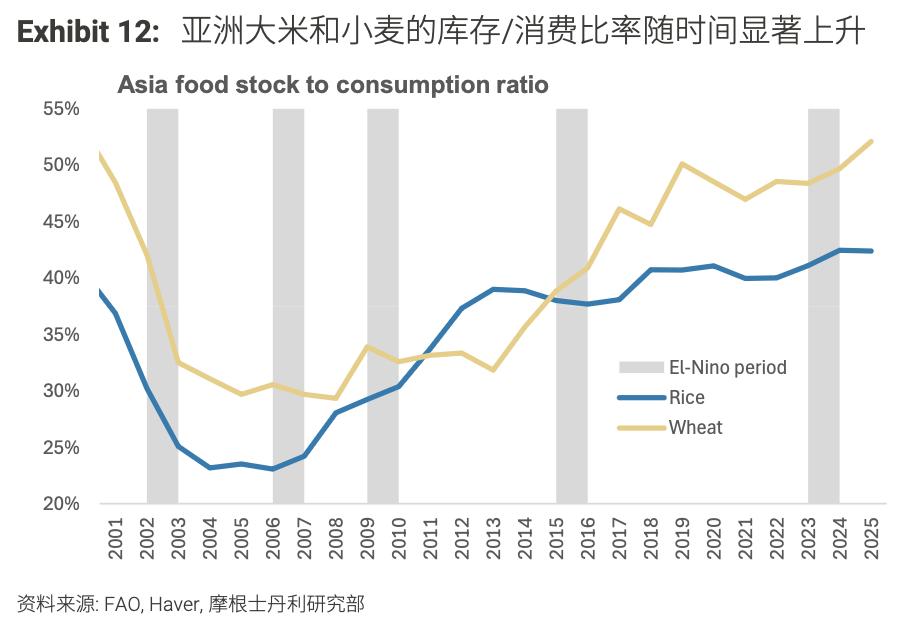
Figure: Stock-to-consumption ratio of rice and wheat in Asia; Data source: Morgan Stanley, 36Kr
Therefore, even if El Niño leads to an overall reduction in the output of major agricultural products such as rice and wheat in the above major producing areas and a decline in per unit yield, high inventories can fill a certain short-term supply gap. Looking at the impact of El Niño on inflation, high inventories combined with government price intervention play a key role in stabilizing agricultural price fluctuations. Meanwhile, the weight of food in CPI of various countries has decreased compared with the past, and the logic that rising food prices push up inflation has therefore been weakened.
Based on the above deduction, under the current background of high grain inventories, affected by El Niño, the prices of major global agricultural products may show a moderate upward trend in the future; at the same time, it is also necessary to pay attention to the structural impact of protectionist measures (such as export restrictions) adopted by affected countries to stabilize their domestic agricultural product prices on international bulk agricultural product prices, as well as the transmission effect to the downstream related industrial chains.
Considering the decline of food's weight in CPI of various countries, El Niño is most likely not to trigger hyperinflation, but to strengthen the "resilience" of inflation. Therefore, following the logic that the future strong El Niño will strengthen the "resilience" of inflation, interest rates will have to remain at a high level for a longer period of time.
Compared with El Niño's support and strengthening of inflation, the AI capital expenditure boom sweeping the technology sector is the core force that truly strongly pushes up inflation. This round of AI capital expenditure expansion is essentially an extremely large-scale heavy industry infrastructure. Trillions of dollars of capital expenditure are converted into a large number of hardware investments such as data centers, power grid and power generation equipment, and communication pipelines, which in turn drives demand in multiple primary industries such as power equipment, utilities, non-ferrous metals, petrochemicals, electronics, communications, mechanical equipment and building materials.
With the continuous advancement of AI infrastructure, strong demand has significantly pushed up the prices of upstream raw materials. In the past year, prices of base metals such as tin, zinc, copper and aluminum have generally risen; at the same time, the collective rise in energy prices, in addition to the demand support from AI infrastructure, also includes the disturbance of geopolitical factors in the Middle East.
Looking at the impact on inflation, affected by El Niño, agricultural products will strengthen the "resilience" of inflation then. The rise in international bulk commodity prices driven by AI infrastructure further increases the upward pressure on inflation through the cost transmission mechanism. If the future inflation path gradually evolves into a continuous rise in the production and operation costs of the whole society, and the real purchasing power of consumption and manufacturing continues to be under pressure, thus forming a stagflation pattern of high costs and weak demand, it will force interest rates to run at a high level for a longer cycle, which is one of the most concerning outcomes for the market.
02 AI Falls, Gold Rises
Based on the transmission effect of El Niño and AI infrastructure on interest rates, we can draw the conclusion that interest rates will be "Higher for Longer" (maintain high interest rates for a longer period of time) in the future, which triggers a systematic revaluation of high-valuation and high-leverage equity assets in the AI sector.
The long-term maintenance of high interest rates first impacts the AI sector on the valuation side. The reason why the technology-oriented growth assets in the AI sector (large models, AI applications, etc.) could obtain extremely high valuation premiums in the past is not only that the market is optimistic about their future earnings growth, but also that in the previous interest rate cut cycle, the expected low interest rate environment reduced the discount rate of long-term cash flow.
Growth assets currently have relatively limited operating cash flow, and earnings realization is concentrated in the medium and long term. When the market's expectation of interest rates switches to "Higher for Longer", the present value of long-term profits declines, which leads to such assets whose pricing logic is mainly based on long-term earnings facing a systematic revaluation of the valuation center.
For AI sector hardware enterprises, the impact path of "Higher for Longer" interest rates is significantly different from that of the above-mentioned technology-intensive assets. For hardware enterprises such as Samsung Electronics, SK Hynix and Micron Technology, they already have strong profitability and abundant cash flow at present. The impact of long-term high interest rates is mainly reflected in the cost side, return on investment, and the revaluation of the sustainability of AI capital expenditure.
Such hardware enterprises are generally asset-heavy, and the capacity expansion of related products relies on a large amount of continuous capital investment. In a high interest rate environment, the rise in corporate financing costs will lower the return on investment of new production capacity, and some enterprises may slow down the pace of capital expenditure as a result. From a cyclical perspective, high financing costs inhibit the disorderly expansion of production capacity, supply constraints are strengthened, and a more balanced supply and demand pattern is conducive to hardware enterprises maintaining strong profitability.
Another key impact of the high interest rate environment on AI sector hardware enterprises mainly lies in whether high interest rates will weaken the sustainability of the AI capital expenditure cycle. If the high interest rate environment continues, cloud vendors and technology giants may put forward higher requirements for the return on investment of AI infrastructure, thus affecting the demand expectation of core hardware, and then triggering the valuation revaluation of hardware enterprises. On the industrial side, the continuous high interest rate may be an opportunity for industry reshuffling, and the logic that the strong will become stronger is further strengthened.
Overall, based on the overall positive expectation of the AI sector, the long-term high interest rates caused by inflation actually push the pricing logic of the AI sector into a new stage, that is, the core of market trading has switched from the high growth expectation of the AI sector to whether the high growth of the AI sector can cover the investment cost. Therefore, after the end of this round of collective adjustment of the AI sector, the market will diverge into structural opportunities. Factors such as performance, cash flow and return on capital will become the core investment highlights, which may be the most critical change in the pricing of AI sector assets under the "Higher for Longer" interest rate environment.
03 "US Treasury Repurchase Paradox" Boosts Gold Price
During the period when the AI market was hot this year, investors sold off gold one after another and poured into technology stocks. Especially at the beginning of the year, technology giants increased their capital expenditure by issuing bonds, and investors welcomed the move with rising stock prices. However, the current AI narrative has changed, and the market has begun to worry about macro risks brought by inflation, high interest rate environment and debt pressure, leading some funds to flow back to gold from technology stocks, and the gold price has also seen a round of volatile upward trend recently.
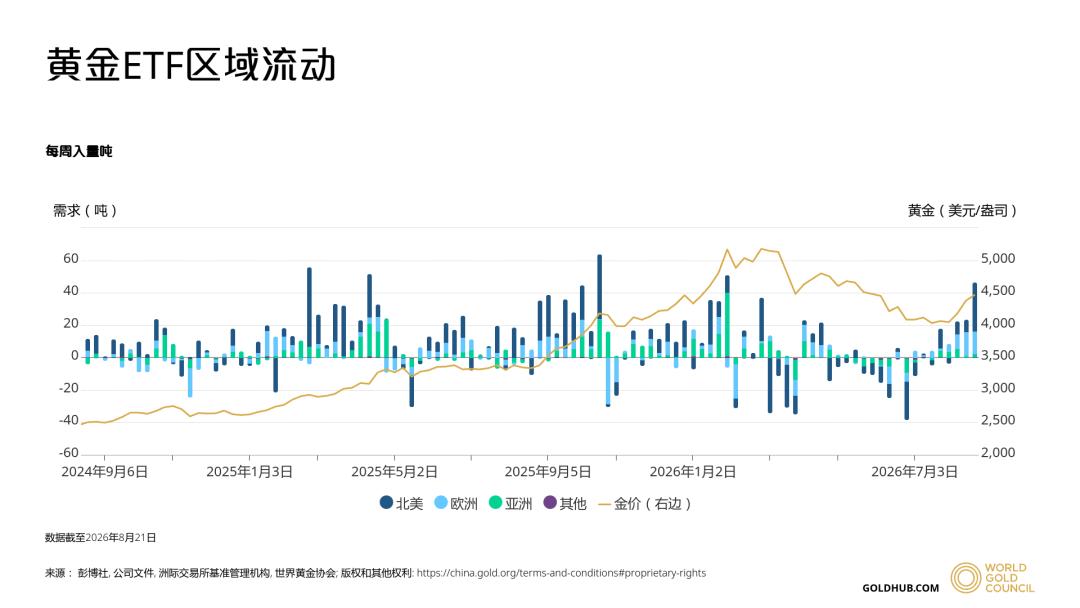
Figure: Recent gold price rise drives capital inflow into gold ETFs; Data source: World Gold Council, 36Kr
As of August 25, the COMEX gold futures price once stood at $4700 per ounce. The recent gold price rebound, on the one hand, shows that the long-term allocation logic of gold as a non-credit asset is still valid. The previous continuous adjustment of gold price more reflects the adjustment needed after the over-optimistic expectation following the long-term rise of gold price, rather than a change in the core logic.
On the other hand, in addition to the rise in safe-haven demand brought by geopolitical events, the weakening of US dollar credit and the rising pressure on US fiscal sustainability are more important factors driving the rise in gold prices. Especially after the US Department of the Treasury announced the US Treasury repurchase, long-term interest rates rose instead of falling, indicating that the market's focus has shifted from short-term liquidity improvement to the long-term challenges facing US fiscal sustainability and US dollar credit.
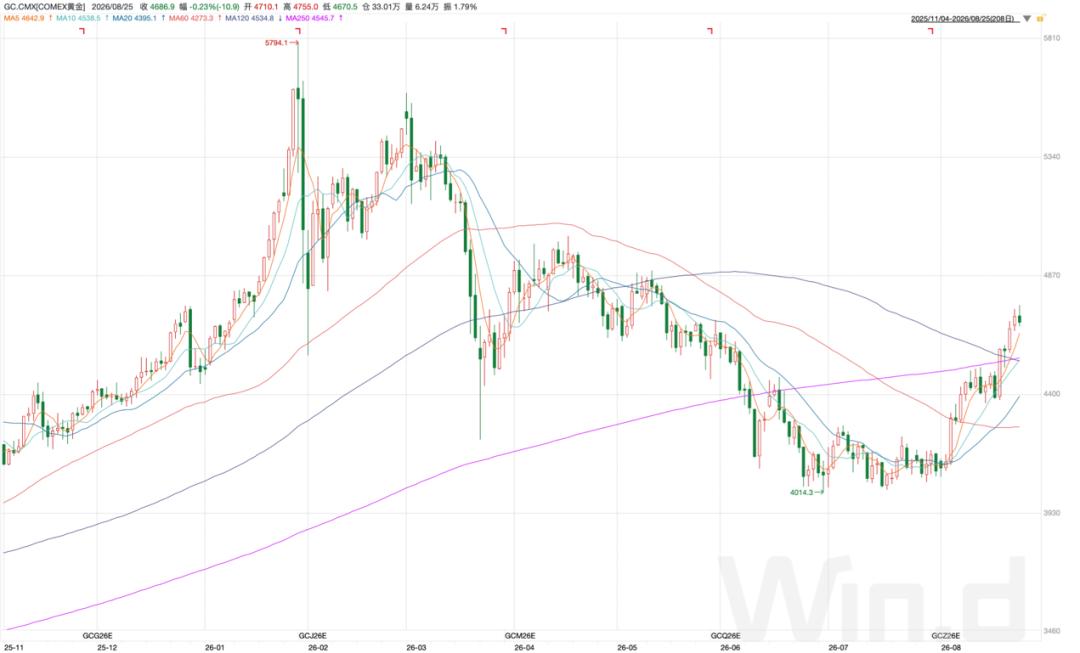
Figure: COMEX gold futures trend; Data source: Wind, 36Kr
At the same time, the current level of US Treasury yields also includes the market's pricing of the US Treasury repurchase paradox. Although US Treasury repurchase can improve market liquidity and theoretically ease the upward pressure on long-term interest rates, it cannot change the long-term trend of expanding US fiscal deficit and growing debt scale. Under the constraint of high deficit, the US government still needs to rely on debt financing to maintain fiscal operation. Repurchase is more of a debt management tool, rather than a solution to fiscal pressure. At the same time, the US dollar may fall into a Soros-style negative feedback: inflation -> continuous high interest rates -> worsening fiscal deficit -> US dollar depreciation -> imported inflation.
Therefore, the market interprets it as a signal of rising fiscal pressure and repricing of US dollar credit risk, further strengthening concerns about the prospects of US dollar assets.