The better AI works, the more overworked wage earners get?
If every generation of productivity tools inevitably changes the way people work, it will most likely also change the way people slack off at work along the way.
And it will most likely also change — the way people slack off at work.
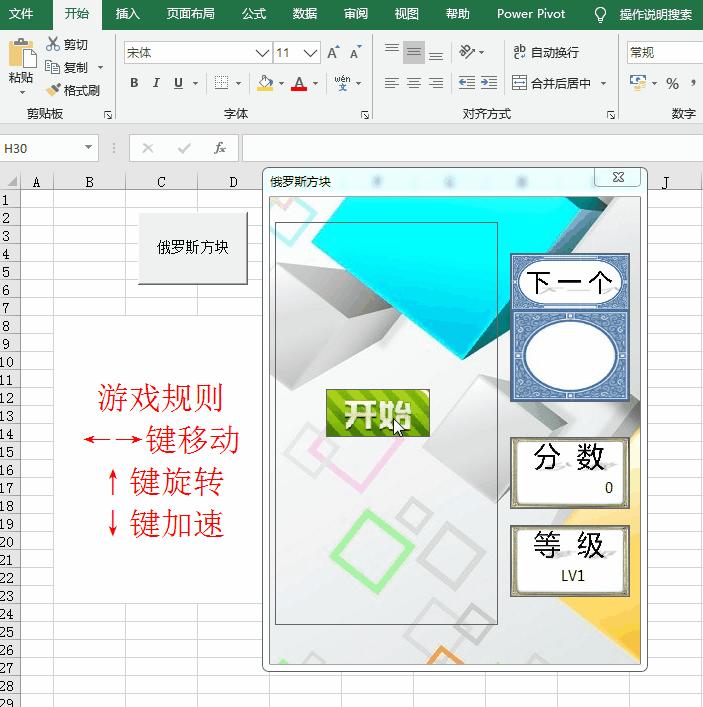
In the earliest days, people used to draw, play gomoku, and even build Tetris in Excel. After collaborative documents emerged, out of concerns that their chat interfaces would be monitored, people started chatting, passing secret codes, and making covert contacts across spreadsheet cells.
Later, as WeCom and Lark became widely popular, slacking off at work gradually became organized, underground, and group-chat centered. On the surface, everyone is replying "Got it", "Sure", "Right away", but behind the scenes, they have already gone through three full rounds of meme battles.
And now, large language models are here. Humans have finally got a way to slack off that probably looks the most like real work across the whole world.
If you look over their shoulder, there is no Taobao, no video streaming sites, no WeChat chat window, no novel page on the screen.
There is only a fairly professional-looking LLM interface.
When a leader walks past behind them, they might even think with a hint of relief: Not bad, this employee has started to embrace AI.
But if you lean in to take a closer look, you will find this person is typing questions like:
"Combine my Bazi, MBTI, attachment style, and the look my boss gave me today, and judge if I have a chance of getting a promotion this year."
"Do you think my colleague suddenly replied 'Uh-huh' to me because they have a problem with me?"
"If I quit my job without a new offer tomorrow, how will my life script develop in the next three years?"
"Simulate a boss with extremely strong controlling desire, I want to have a fight with you."
In a sense, AI has taken slacking off out of the rough "anti-productivity" stage and brought it into an advanced stage of "disguised as high productivity".
The new type of slacking off in the AI era: Not exactly being lazy, it is your brain "saving itself"
In the AI era, apart from creating more productivity, large language models have also become a soul soother for office workers. Fortune-telling, MBTI testing, analyzing chat records, interpreting the boss's tone, complaining about colleagues, simulating resignation, predicting promotion, writing your own workplace power fantasy stories...
AI can chat with you about even a tiny little thing, from psychological analysis to workplace politics, then from MBTI all the way to Bazi.
At this point, even though slacking off is not a phenomenon that companies would love to see, no one seems to have really studied: why do we need to slack off?
Many companies are used to regarding slacking off as a loss of productivity. If an employee leaves their task for five minutes, it is like the company has lost five minutes of working hours out of thin air.
But the human brain is never a machine that can run at full load continuously for 8 hours.
There is a very classic psychological phenomenon called "vigilance decrement": when people perform the same attention-demanding task for a long period of time, their performance will gradually decline.
An experiment conducted by the University of Illinois found that in a 50-minute continuous attention task, most people's performance drops significantly over time; even two very short task switches in the middle can significantly alleviate this decline. The researchers thus proposed that briefly stepping away from the task does not necessarily undermine concentration, but may instead help people refocus.
In other words: getting distracted is not necessarily a bug in the work system. Sometimes, it is literally the heat dissipation system of the human brain.
What is more interesting is that rest may even be part of creativity.
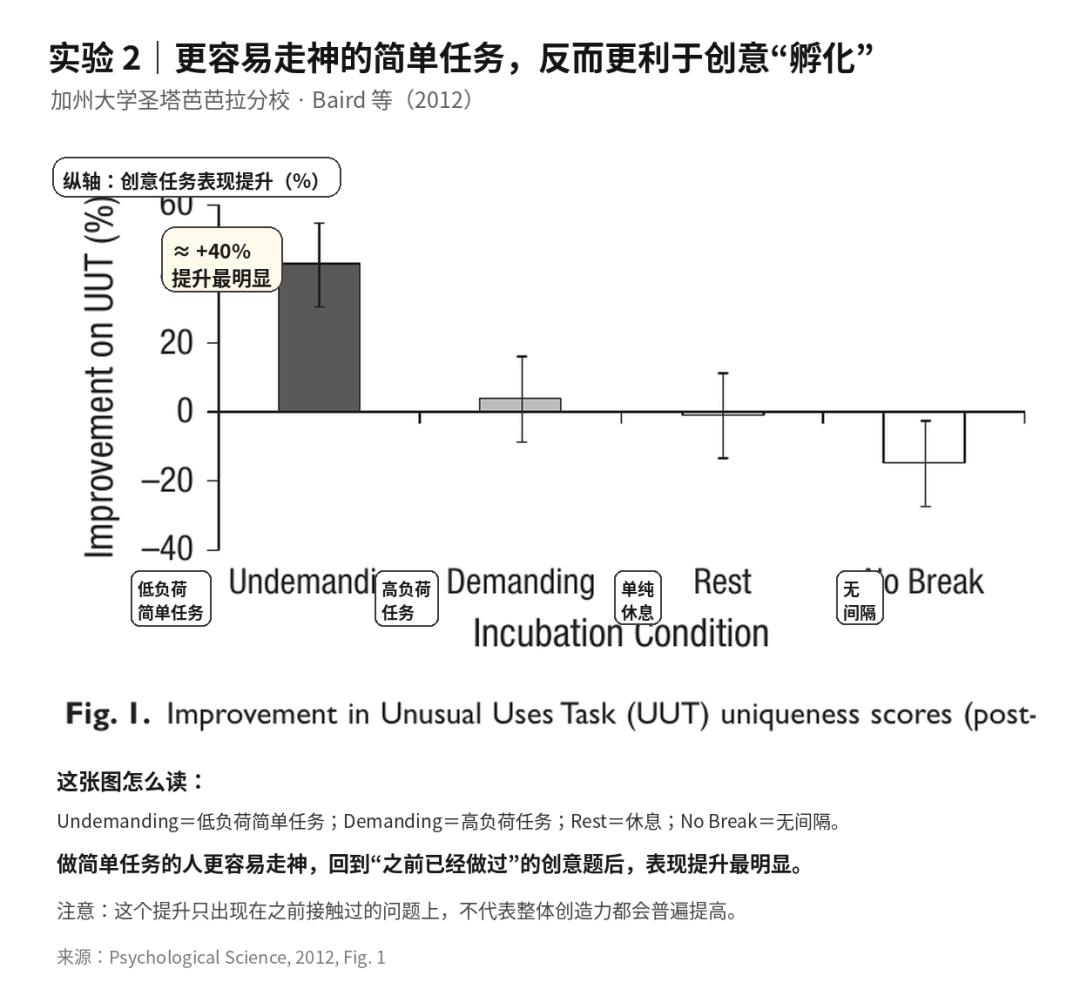
Researchers from the University of California, Santa Barbara once conducted a creativity experiment. Participants first completed a creative task, then moved on to different interval activities. The results showed that compared with those who kept doing high cognitive-load tasks, took pure rest or had no interval at all, people who did simple tasks and thus got distracted more easily showed more significant improvement in their subsequent performance of solving creative problems.
After AI arrives, office workers face a new problem: efficiency inflation
In the past, an employee could finish 5 tasks a day.
After AI came along, we are expected to finish 10.
After a while, we mastered better Agents and can finish 15. Then the company says: 15 will be the new standard from now on.
As a result, we enter a very delicate state: AI does save time, but office workers do not get more free time because of it.
The time saved is immediately taken up by the next task. This can be interpreted as a phenomenon called: efficiency inflation.
Just like after Excel became popular, no company would reward you for not needing to calculate spreadsheets manually; after emails appeared, no one would assume you can work two hours less every day just because communication got faster.
The efficiency boosted by technology will eventually easily be eaten up by increased workload. Worse still, we are already living in a highly fragmented working environment.
Microsoft's 2025 Work Trend Index once counted that among employees with high message volume, they get interrupted by meetings, emails or chat messages on average roughly every two minutes during their core working hours.
So in the AI era, what office workers should really protect may no longer be just "time".
It is a much scarcer resource: cognitive headroom.
Do you still have a little space in your mind to think about things that do not need to be delivered immediately? That is probably exactly what AI should really help us save for.
Another change brought by AI, which is more hidden than "work is getting more and more saturated", is that it is turning many people's jobs from "producing answers" to "judging answers".
In the past, when you wrote a proposal, you needed to find materials, sort out logic and make judgments all by yourself. Now AI can generate a fairly complete version for you in just a few minutes. The efficiency is certainly improved, but the problem also arises: when answers become easier and easier to get, the ability to judge answers becomes more valuable.
An experiment done in partnership with BCG consultants is particularly interesting.
Within the scope of tasks that AI is good at, consultants using GPT-4 completed tasks about 25% faster, and their work quality also improved significantly; but when the tasks exceeded the capability boundary of AI, consultants using AI were 19 percentage points more likely to give wrong answers than those who did not use AI.
Another study targeting knowledge workers also found that: the more people believe AI is competent for a task, the less critical thinking they tend to put in. This means that what really sets people apart in the AI era may no longer be "whether you can get the work done", but: after AI produces the result, do you know what is wrong with it?
And the ability of judgment can never be fully outsourced.
It comes from real projects you have done, pitfalls you have stepped into, understanding of the business, and observation of people. So the most worrying thing about AI is not that it makes people lazy, but that it makes people more and more used to skipping the thinking process.
AI can help you finish the work, but do not let it finish your personal growth for you by the way.
So in the AI era, what office workers really need to learn is not just Prompt Engineering
There is a set of data in Microsoft's 2026 Work Trend Index: 66% of AI users said AI allows them to spend more time on high-value work; 58% said they are completing work that they could not do a year ago.
Notice that it does not say: "I write more weekly reports a day."
Instead, it says: I started doing things I could not do before.
I think this is the real dividend AI should bring to ordinary office workers.
It is not to make you a faster screw. Instead, after removing part of the repetitive labor, it lets you expand the boundary of your capabilities.
So if someone asks me now: How exactly should workplace professionals use AI?
I might give three suggestions.
1. Let AI do the work for you, but do not let AI define the problem for you
The easiest tasks to hand over to AI are those with roughly clear answers but very time-consuming processes.
Sorting meeting minutes, converting formats, aggregating materials, extracting information, generating basic first drafts, batch processing.
Outsource these tasks whenever you can. But for the problems that truly determine the final result, try to figure them out by yourself:
What exactly am I trying to solve?
What are the criteria for judging good or bad results?
Who will this proposal actually affect?
What final decision do I need to make?
The biggest gap in the workplace in the future will most likely not be: who can make AI answer questions. Instead, it will be: who can spot the real problem earlier than others.
2. Reserve a part of the time saved by AI for yourself
This seems to be the easiest thing to do, but it is actually the hardest. If AI cuts a 2-hour task down to 30 minutes, do not subconsciously immediately ask: "What else can I do?"
You can instead ask: "For this one and a half hours, what thing is more valuable to the version of me a year later?"
Learn a new tool; truly understand an industry; read a full report instead of the AI-generated summary; have a chat with a talented person; review a completed project; go see how real users actually use your product; or even just sit and think quietly for a while.
Because AI can help you amplify your output, but your input will not come into being out of thin air. If a person is frantically using AI to generate output every day without taking in any new experience, new knowledge or new observation, they will easily end up becoming: a person with a super loudspeaker but nothing new in their mind.
3. Stop asking "Can AI replace me", and start asking "To what extent can AI amplify my capabilities"
This is the question I think workplace professionals should replace right now.
People keep asking: Will AI take my job? How many years does this position have left? Is this skill becoming useless soon?
These questions are of course important. But they can easily put people in a passive state: waiting every day to see what will be eliminated by technology.
A more valuable question is: If I have an almost unlimited number of researchers, writers, data assistants, training partners and execution helpers, what things that I could not do before can I do now all of a sudden?
An operation specialist can start doing data analysis on their own.
A salesperson can quickly research unfamiliar industries.
A product manager can simulate different user perspectives at the same time.
An ordinary workplace professional can also have the information processing capability that used to be only available to large teams.
The truly terrifying part of AI is not just that it will replace some jobs.
Instead, it is drastically reducing the cost for an ordinary person to call on powerful capabilities.
In the past, if you lacked a certain capability, you had to hire a person who has it.
In the future, if you lack a certain capability, you can first turn to an Agent.
So what is really worth doing is not to worry every day "whether I still have value". Instead, keep asking: What was the thing that used to limit me?
If that limitation is nothing more than time, materials, execution capability or information gap, it is most likely being torn down little by little by AI.
The most valuable "slacking off" in the AI era may no longer be hiding from your boss and scrolling on your phone for 10 minutes. Instead, when everyone is hurrying to trade efficiency for more tasks, you secretly convert part of that efficiency into a stronger version of yourself.
After all, when machines are getting better and better at doing work, what office workers really need to learn may not be how to do more work than machines. Instead, it is: how to turn the capabilities of machines into your own leverage.
This article is from the WeChat Official Account "Liepin" (ID: liepinwang), the author is JJ, published with authorization from 36Kr.