How come a group of Chinese farmers who know nothing about Western music manage to produce 40% of the world's total violins?
500 years ago during the European Renaissance, in the small city of Cremona near Milan, Italy, luthiers crafted the world's first modern violin. Since then, this place has become a sacred site of violin manufacturing across the world, giving birth to numerous master luthiers and hundreds of famous violins that have been passed down to this day.
500 years later, Huangqiao Town in Taixing, Jiangsu, China is known as the "Cremona of the East". It produces more than 1 million string instruments every year, most of which are sold to over 90 countries in Europe and America, accounting for 40% of the global market.
Huangqiao Town is not only the "Capital of China's String Instrument Industry", but also the world's largest violin production base.
It is hard to imagine that an ordinary rural town once famous for "Huangqiao Sesame Cakes", with farmers who had no connection at all to Western music, somehow formed a deep bond with the violin, known as the "Queen of Instruments".
Huangqiao Town produces 70% of the nation's and 40% of the world's string instruments
In 2025, Huangqiao Town won the title of "Capital of China's String Instrument Industry" again. Ever since it obtained this title in 2009, Huangqiao Town has firmly held the leading position.
The reason is simple: no other place in China can rival it. Around the world, Huangqiao Town is also the largest production base for the string instrument industry.
There are more than 230 enterprises producing string instruments in the town, and the number of individual workshops is even larger. Every year, Huangqiao produces over 1 million string instruments of various types, and also makes more than 2 million other instruments such as guitars and ukuleles.
In terms of output alone, Huangqiao far outperforms other regions in China. It is worth noting that another key town for the string instrument industry, Queshan in Henan Province, has an annual output of 400,000 violins, which is less than half of Huangqiao's output.
As the world's largest string instrument industry cluster, Huangqiao Town has ranked first in the world in violin sales for 25 consecutive years.
The string instruments produced every year account for more than 70% of the country's total output and over 40% of the global market. These string instruments sold across China and more than 90 countries in Europe and America bring Huangqiao Town an annual revenue of 2.453 billion yuan.
How did they start making Western instruments?
From material selection to final assembly, the birth of a violin goes through 197 processes. Why did Huangqiao Town, which had never had any connection with violins, choose this industry and even become the world's number one?
All of this dates back to 1968.
That year, several educated youth who had worked in the Shanghai Violin Factory were sent to work in Xiqiao Commune. The commune funded them to set up a "commune-run" instrument workshop, processing parts such as violin heads and bow sticks for the Shanghai Violin Factory.
Five years later, the first violin in Huangqiao's history was born. At that time, Huangqiao only made the lowest-grade violins, and processing a single violin head only sold for 50 cents. With no technology and no capital, no one expected this place to become the world's largest violin production base.
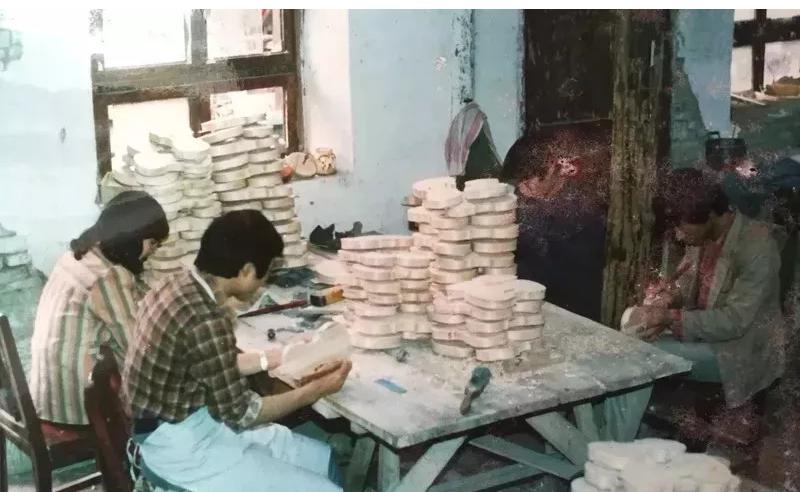
In the 1980s, the Xiqiao Musical Instrument Factory had a very simple production environment.
In 1988, it had already become the number one in the same industry across the country, with its output accounting for 20%
It was not until 1984 that they signed a 10-year joint operation agreement with the Shanghai Violin Factory, and became the "Taixing Branch of Shanghai Violin Factory".
With technical support, Huangqiao's string instrument industry finally truly stood at the starting line.
Ten years of hard work for a single sword.
When the contract with Shanghai Violin Factory expired in 1995, Xiqiao Musical Instrument Factory, which started to operate independently, finally achieved explosive growth by digesting and absorbing the technologies from Shanghai and foreign manufacturers over the past 10 years, plus its own price advantage.
It produced 87,000 string instruments in one year, surpassing the early established leading violin production bases such as Shanghai and Guangzhou, and became the number one in China.
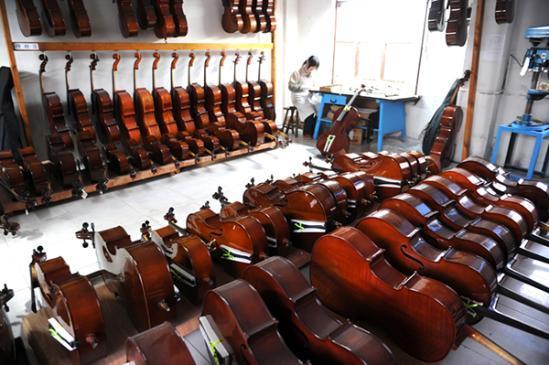
Violin shop in Huangqiao Town
After all, the domestic market is still niche, and the larger market is overseas. Huangqiao seized the opportunity once again.
In early 1995, the US AXL International Musical Instrument Company was going to participate in the World Musical Instrument Expo, and 95 kinds of samples had to be produced within 2 months. It was the Spring Festival period at that time, and normally it would take 3 months to complete, but Xiqiao Musical Instrument Factory took only 53 days to finish the batch of goods.
This move deeply impressed AXL, and the two sides hit it off the next year to establish Taixing Fengling Musical Instrument Co., Ltd.
Violins produced in Huangqiao began to be exported to the world on a large scale, with half of the output sold to Europe and America through AXL. Meanwhile, the internationally popular industry standards were brought to Fengling, and even to all violin manufacturing enterprises in Huangqiao through AXL.
Since then, more and more farmers put down their hoes and picked up lutherie tools, and the reputation of the "Town of Violins" has spread far and wide.
Barrel makers turned luthiers, a single violin sells for 130,000 yuan
Most of the violins in Huangqiao Town are made by farmers who are used to holding hoes, and this strong contrast seems unreasonable.
Huangqiao spent 50 years building the world's top violin manufacturing industry from scratch, and such rapid development seems reasonable.
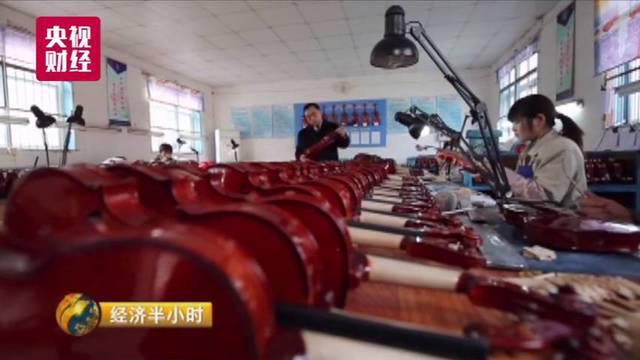
News report
In 2007, the Los Angeles Times once published a report on the violin industry in Huangqiao Town ——
Thanks to assembly line production and skilled workers who are satisfied with earning 50 cents an hour, Fengling can sell its products for less than $25... They have pushed Germany and France out of the low-cost violin market.
Seizing the market by relying on price advantages is indeed the truth that Huangqiao has become the world's largest violin production base, but it is not the whole story.
Even violin manufacturers in Cremona admit that the violin making level in Huangqiao Town has been continuously improving.
In 2020, Lü Bojian, the oldest luthier in Huangqiao Town, was 80 years old. His most expensive violin was bought by the principal violinist of a foreign orchestra a couple of years ago. That violin made by Master Lü 40 years ago was sold for 138,000 yuan.
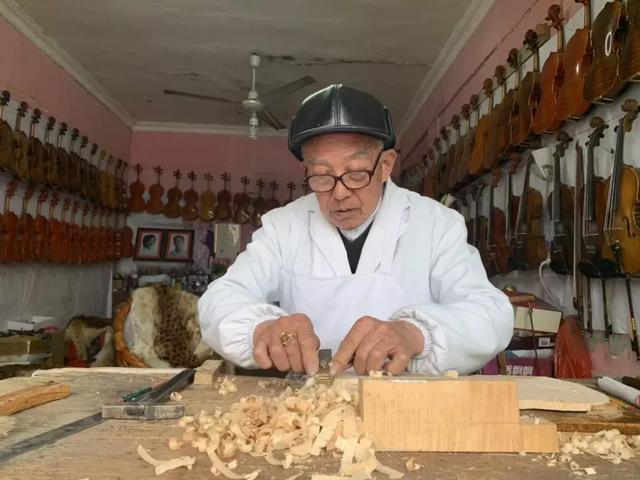
Lü Bojian, one of the earliest group of people who made violins in Huangqiao Town
Not every violin can be sold at such a high price, but the average price of his violins is over 10,000 yuan. However, the legend is not the price of this violin. This old man neither understood violins nor knew how to make them before, he was just a barrel maker who made a living by woodworking skills in the village.
Lü Bojian entered Xiqiao Musical Instrument Factory in 1972 to learn to make violins, and later opened his own studio. His two sons and eldest grandson also inherited his craft. The reason why he became a well-known local luthier is inseparable from not only the craftsmanship he honed day after day for decades, but also the strong learning atmosphere of the violin industry in Huangqiao Town.
In the entire violin industry of Huangqiao Town, 40% of the practitioners started their own businesses after leaving Fengling Musical Instrument. This "Huangpu Military Academy" of Huangqiao's violin industry has been particularly good at learning and innovation from the very beginning.
Even when they swept the international market and became the world's top seller, they never stopped learning.
In addition to buying violins made in Italy, Japan and South Korea for all workers to study and find their advantages, and carry out "reverse R&D" to learn from others' strong points, they have also hired the only "Great National Craftsman" in the musical instrument industry and professors from the Central Conservatory of Music as technical instructors for more than 20 consecutive years, to give lectures and guidance for local luthiers in Huangqiao, and cultivate high-level technical workers.
On the other hand, the violin industry in Huangqiao Town keeps researching and innovating on materials and technologies. They pioneered a new technology for violin wood treatment, which not only shortens the treatment time, but also improves the sound quality.
Nowadays, dozens of new practical patents for musical instruments such as violins and guitars not only help them open up a larger market, but also change the situation that the world's string instrument manufacturing industry was monopolized by a few countries for hundreds of years.
Decades of continuous learning and catching up have helped the people of Huangqiao realize their dream of being the "Cremona of the East".
Today, the violins produced in Huangqiao Town cover all quality levels ranging from several hundred yuan to hundreds of thousands of yuan. This place is no longer what overseas media described as a region that dominates the industry only by cheap labor, low quality and low prices.
E-commerce sells Huangqiao's violins to the whole world
Every era always brings different opportunities to people. Just like how Fengling Musical Instrument became the top in China and the world's largest violin manufacturer back then, today's e-commerce provides more luthiers with a stage to show themselves to the world, gives more ordinary people in Huangqiao the chance to get rich, and also changes the violin industry in Huangqiao Town.
In the first few years when Huangqiao's violin industry went global, the industrial cluster had not yet reached its current scale. Although the export volume was large, 60% of the products were OEM processed, and they only earned hard processing fees all year round.
The choice for most people was to enter a larger factory, become a member of the assembly line, and get a stable but not high salary.
Even so, skilled craftsmen did not have the confidence to start their own business. After all, they only had technology, and no sales channels meant nothing.
It was not until the rise of e-commerce that people found that the market would come to them on its own. Therefore, Fengling Musical Instrument Factory became the "Huangpu Military Academy" of the local violin manufacturing industry.
Many people went in to learn, and many of them came out to start their own businesses.
Skilled luthiers like Lü Bojian opened their own studios, bringing their sons and grandsons into this industry. Some outsiders who became interested in this field also switched careers to learn violin making and opened their own studios. There are even some young people who returned to start their own businesses after studying in professional conservatories of music.
The prosperity of the market has attracted more people to join in, expanding the violin industry in Huangqiao Town. At the same time, they also inject fresh blood and more diversified choices into the industry.
In addition to the expansion of the industrial scale, e-commerce also allows more farmers to become a part of the violin industry chain in their spare time after farming.
In Xiqiao Community, where violin making is most concentrated, more than a hundred households, mostly neighbors, supply violins and accessories for 40 online stores. Most of them once worked in violin factories, mastered the skills and then left the factories to become a part of the violin industry chain. For example, the strings and bows used by Lü Bojian come from his neighbors respectively, and the families cooperate very well with each other.
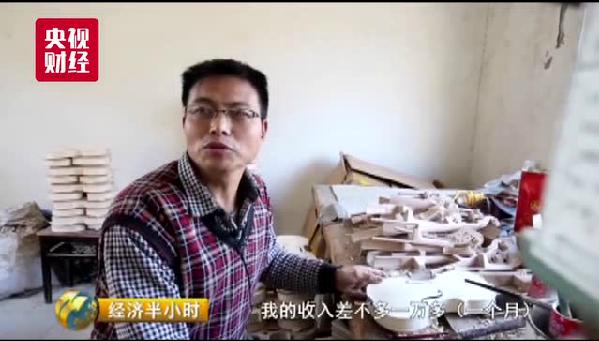
E-commerce has driven more farmers to join the violin industry chain and increased their income
They work in the fields during the busy farming season, and make violins at home in the slack season. The accessories they make not only supply local luthiers in Huangqiao, but also are sold in their own online stores. There are quite a number of households that "take care of both farm work and violin making".
Their online stores have become the facade to receive individual customers such as violin lovers and students at home and abroad, and also serve as a window to promote Huangqiao's violins.
From "Sesame Cake Town" to "City of Music Lovers"
After more than 50 years of development from scratch, and growing from a supporting role to a leading role, the violin industry in Huangqiao Town has now become a local characteristic industry, even more famous than the well-known Huangqiao sesame cakes.
Local people joke that in the past, they gave sesame cakes as characteristic gifts to others, but now probably only people in Huangqiao will give violins as local specialties to relatives and friends all over the world.
However, the people of Huangqiao can't stand the embarrassment that they can only make violins but never hear the music played by the instruments.
Huangqiao Town is trying to transform from manufacturing industry to cultural industry.
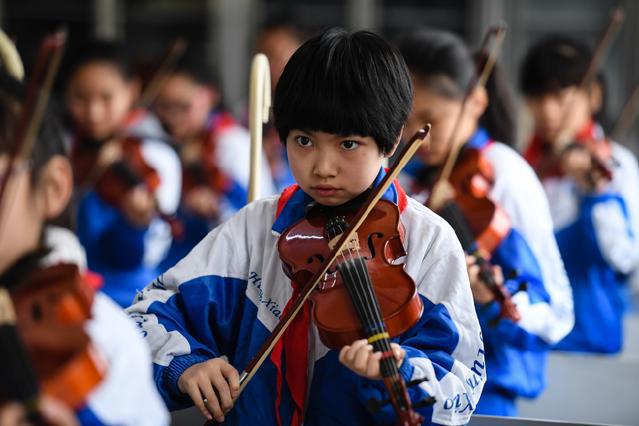
Students from Huangqiao Primary School are having a violin class. Image source: X