What mistakes did we actually make when promoting 5G back then?
In recent months, news about 6G has frequently emerged online, always drawing widespread public attention and discussions. I can faintly sense that the pre-launch promotion for 6G is about to kick off.
This is quite understandable. 5G has been commercially deployed for seven years, and its peak construction period has passed. The whole industry is eager to launch the construction of next-generation communication technologies as soon as possible to drive new performance growth.
To be honest, I, Xiaozaojun, am no stranger to this rhythm of "promotion first, technology later". I started running a communication-focused We Media account in 2017, right when the pre-promotion for 5G was in full swing, and reaped a wave of traffic dividends.
Looking back on those years now, I personally believe that there are parts worth reflecting on in the 5G promotion by the domestic media industry. The hustle and bustle back then, as well as some inappropriate guidance, to a certain extent, raised the public's overly high expectations for 5G, and laid the groundwork for the subsequent sense of gap between expectation and reality.
Nowadays, many users still hold negative attitudes towards 5G, which is actually the aftereffect caused by misleading promotion in the past.
In this article, I will conduct a thorough review of the misconceptions in 5G-era promotion, to avoid repeating the same mistakes.
Mistake 1: Over-exaggerating technical indicators, and confusion over some technical concepts
5G is a specialized technology in the communication field with certain professional thresholds. Journalists, especially those working for public media, usually lack a professional communication background, making it difficult for them to fully understand 5G technical concepts, and they are prone to misinterpreting the technical indicators in professional materials.
Sometimes, the official materials released by enterprises are rigorous, but after being reprocessed and rephrased by the media, they get distorted. By the time they reach readers, the meaning has completely changed. Those traffic-driven We Media accounts are even more outrageous: they deliberately take statements out of context, use exaggerated titles and content to attract attention, and show no regard for any level of rigor.
At that time, many media outlets reporting on 5G failed to clearly explain the difference between "theoretical value" and "actual experience value" to the public, and even directly used the limit test data obtained in laboratory environments for promotion, which caused serious misleading to the public.
As a wireless communication technology, many 5G indicators have corresponding environmental backgrounds and technical prerequisites. These prerequisites are often ignored during promotion.
For example, in the early stage of 5G pre-promotion, we often heard the statement that "the download rate can reach 10Gbps (10,000 Mbps)".
In fact, on the one hand, this is the theoretical rate, which requires extremely ideal channel conditions, exclusive resources for a single user, and no external electromagnetic interference.
On the other hand, it was based on the premise of using the millimeter wave frequency band at that time, while China mainly adopts the Sub-6GHz frequency band instead of millimeter wave. Even the current 5G-A with 3CC carrier aggregation can only reach a maximum of about 5Gbps, far from 10Gbps.
The indicator of "as low as 1 millisecond latency" is also widely misinterpreted.
This actually refers to the theoretical limit of air interface latency in the uRLLC (Ultra-Reliable Low-Latency Communications) scenario, which can only be achieved with end-to-end network slicing transformation and the cooperation of edge computing. Ordinary mobile phone users cannot reach this standard at all when using 5G, and a latency of several tens of milliseconds is already a good result.
What is even more absurd is the indicator of "connection density of millions of units per square kilometer".
I still remember that an official media once published an article claiming that 5G supports 1 million people accessing the internet at the same time per square kilometer, which left me stunned. This indicator actually refers to the maximum number of IoT terminals that can be deployed per square kilometer in the mMTC (Massive Machine-Type Communications) scenario, all of which are low-power, low-rate devices such as sensors, water meters and electricity meters.
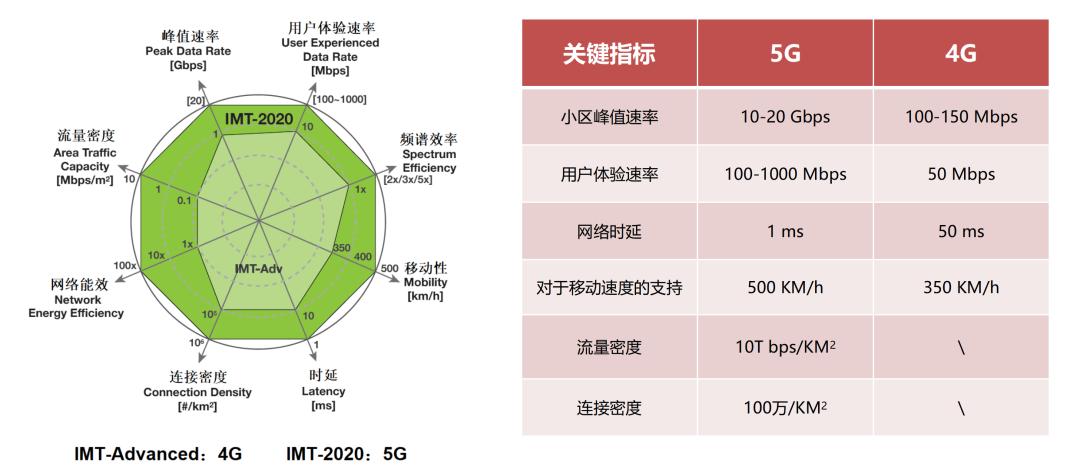
Many of 5G's technical indicators are actually widely misunderstood
5G introduced many technical concepts at that time. For example, D2D, which is mainly oriented to scenarios of IoT (such as connected vehicles) terminals, was also unilaterally interpreted as direct communication between mobile phones. As for network slicing, its original intention is to provide customized logical private networks for different industry applications, but it was simply interpreted as "one private network for each user", and the operational and technical support behind it was ignored.
5G is advanced and valuable. As an emerging industry, a field where we have technical advantages, and an inevitable stage for society to move towards digital intelligence, the country will definitely promote and popularize it. The biggest mistake made by many media outlets is mechanically applying the logic of 4G to 5G, and viewing 5G entirely from the perspective of personal mobile communication. They did not understand the concepts of many IoT scenarios at all, let alone spread them correctly.
From the perspective of the public, it is understandable that they do not have relevant professional knowledge. However, some media, as the main body of promotion, failed to assume the responsibility of professional interpretation. Instead, in order to pursue communication effects, they completely abandoned rigor, seriously raised the public's psychological expectations, and laid the groundwork for the subsequent public backlash against 5G's reputation.
Mistake 2: Creating the illusion of "omnipotence", forcibly constructing and boasting about non-existent application scenarios
Looking back around 2019, overwhelming promotions emphasized 5G's "high rate, low latency, massive connections". Media outlets also particularly used highly vivid scenarios such as "downloading a movie in a second", "remote surgery", "VR classroom", "self-driving", and "holographic projection" to attract public attention.
Although this narrative method is intuitive, it created an illusion for the public: as soon as 5G is launched, these sci-fi-like applications will immediately enter daily life and be fully popularized.
But the reality is that the emergence of technology does not mean the immediate maturity of application scenarios. 5G does provide stronger network performance, but the birth of killer applications requires the coordinated cooperation of all parties in the industrial chain, the synchronous evolution of other technologies, and the support of resources and content.
To put it bluntly, it takes time. This is a systematic project, which is completely different from the popularization of smartphones. Many 5G applications are oriented to the B-end scenario. There are essential differences between the business logic of the B-end and the C-end, so hit applications cannot emerge as easily as in the C-end market.
In the early stage of 5G commercial use, some users have already realized this. They found that apart from the good-looking speed test results, the experience of watching videos and chatting on instant messaging apps with 5G mobile phones is not essentially different from that of 4G. The so-called remote surgery and holographic calls seem to be only demonstration projects and have not been implemented on a large scale.
What users need are useful functions and perceptible experiences, not gorgeous technical parameters or fancy PPT presentations. If the functions you provide are not usable, the experience even declines (as I will mention later), the tariff rises, and the battery life shortens, it will inevitably lead to a strong psychological gap and emotional backlash.
This feeling continued to spread and formed a negative social consensus, that is, the "5G useless theory".
Everything should be done with a proper "degree". In this era where "everything is for traffic", the "degree" of promotion is completely out of control (even official institutions cannot avoid this).
Excessive efforts and exaggerated promotion, which treat future possibilities as current certainties to sell, cannot truly promote industrial implementation. On the contrary, it will erode public trust and make the subsequent promotion of technologies such as 6G face greater difficulties.
Mistake 3: Ignoring the construction cycle and cost, downplaying the negative defects of the technology
In the promotions back then, the complexity and long-term nature of communication network construction were rarely popularized to the public.
Constructing 5G is not as simple as many people think: buy base station equipment and hang it on the tower, and then the work is done. In fact, it involves massive site survey, planning and design work. The existing base stations also need power transformation, transmission capacity expansion and antenna position adjustment. These tedious and time-consuming engineering details are often invisible to the media and ordinary users.
China's speed in 5G construction has already been very fast. No other country in the world could complete such a large-scale deployment in such a short period of time.
Even so, the coverage of 5G network is still a long-term process. The media did not make necessary explanations during the promotion, which led to a sense of "being cheated" when users got 5G mobile phones and subscribed to 5G packages, only to find that the 5G signal is intermittent and often falls back to 4G.
We also have an issue that has never been clearly explained: 5G itself adopts higher frequency bands, which improves performance such as rate, but the coverage capability will decrease accordingly. It is actually unfair for users to often compare 5G signals with 4G signals. This is like comparing the speed of a truck with a car, ignoring the core elements. If the frequency band and resources of 4G are allocated to 5G, the coverage effect of 5G will be better than 4G. But we cannot shut down the 4G network all at once.
The high power consumption of 5G is also a widely criticized "pain point".
In fact, the media did not explain this issue clearly at that time. 5G antennas (AAU) have more antenna elements and beamforming capabilities. As active devices, they have stronger performance. 4G uses passive antennas, which cannot be adjusted at all, and even the downtilt needs to be adjusted manually, with weaker performance. It is inevitable that 5G consumes more power than 4G.
However, when comparing power consumption, we should not look at the absolute power consumption, but the energy consumption per bit. The energy consumption per bit transmitted by 5G is far lower than that of 4G.
For example, this cow of 5G eats several times more grass (consumes more power), but carries dozens of times more cargo (transmits more data). Do you think it is good or not?
There is also the issue of base station shutdown. In order to save energy, operators will shut down some 5G base stations during idle hours at night, which was hyped by some traffic We Media claiming that operators are building 5G base stations just to cope with superior inspections and treat them as useless decorations.
In fact, shutting down base stations according to business volume (such as symbol shutdown, channel shutdown, etc.) is a mature network energy-saving strategy, which is reasonable and necessary. The fact that 5G can realize flexible shutdown on demand even reflects its technical advancement.
Of course, in the development process of 5G, some problems have indeed not been properly solved for a long time. For example, the price of modules has remained high, which increases the difficulty of large-scale implementation. But the industry has been working hard to solve these problems, such as launching the lightweight RedCap technology.
Problems are not to be feared. What is terrible is concealment and misunderstanding. When promoting 5G, some media avoided talking about the shortcomings of 5G, which made the public lack necessary psychological expectations and scientific cognition. As a result, when the problems were exposed later, the public reacted more strongly.
Conclusion
All in all, in the development process of 5G, we did make some mistakes in promotion. Too radical, too high-profile, too extensive, lacking rationality, patience and rigor, which led to the lack of correct cognition among the public and even the industry.
To put it harshly, this kind of promotion has even become a "killing by excessive praise". It overdraws public trust and fails to create a more tolerant and scientific development environment for 5G. The cost of rebuilding trust is even higher.
Any new technology will inevitably go through the process of the Gartner Hype Cycle. The initial stage is always accompanied by hype, then it will inevitably experience the burst of the bubble and fall from the pedestal, and finally it may return to the track of rational development.
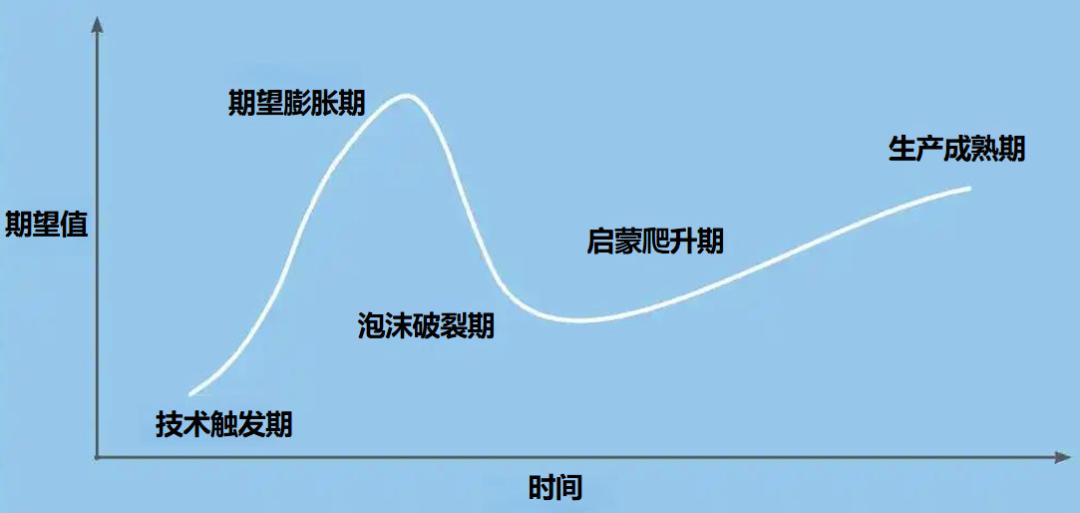
Gartner Hype Cycle
The responsibility of the media is to guide the public to establish reasonable expectations, reduce information asymmetry, objectively present the advantages and disadvantages of technologies, suppress hype as much as possible, and avoid excessive belittling.
Now, the pre-promotion for 6G has quietly started. Various concepts and hype may stage a comeback. It is hoped that the media industry and the whole society can learn lessons from 5G, and adopt a more pragmatic, transparent and rational attitude towards 6G.
If you really want 6G to thrive, let it stay away from hype, return to the essence of technology, and win the recognition of users and the market with its real performance.
This article is from the WeChat official account "Fresh Date Class" (ID: xzclasscom), author: Xiaozaojun, authorized for release by 36Kr.