Xiaomi quietly released three chips, with its sights set on far more than just AI smartphones | The Frontline
Xiaomi Unveils Three New Chips
By Xiao Man
Edited by Si Lai
With no live streaming broadcast and Lei Jun not present at the scene, Xiaomi released three new chips in only 40 minutes.
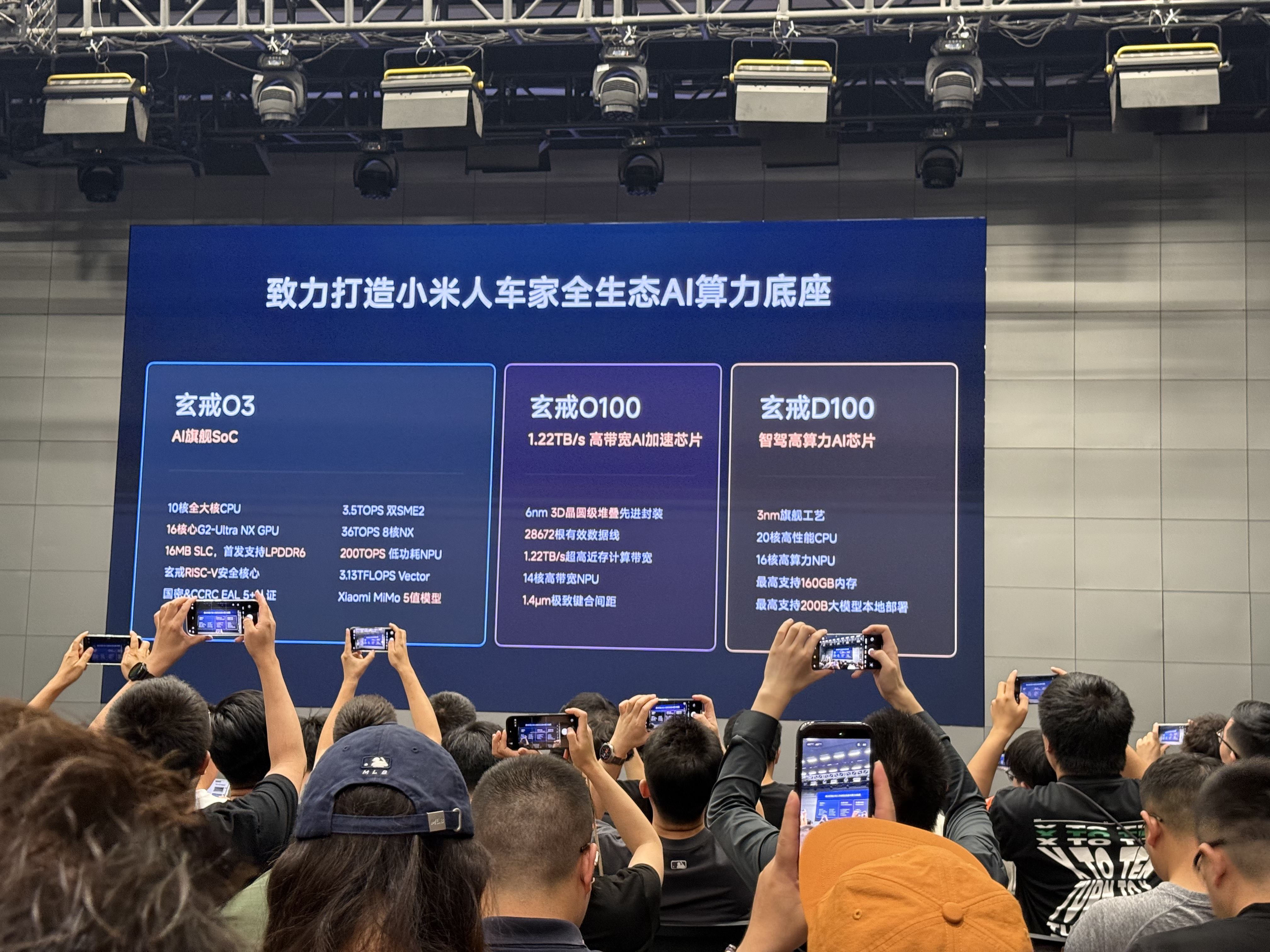
On August 24, 2026, Xiaomi launched three Xuanjie chips in one go, namely the AI flagship SoC Xuanjie O3, the AI acceleration chip Xuanjie O100, and the high-computing power autonomous driving AI chip Xuanjie D100.
In the past few years, self-developed chips by mobile phone manufacturers have usually focused on niche fields such as imaging, communication, and power management. However, as large models are gradually deployed in mobile phones, automobiles and robots, end-side AI capabilities have become the key investment priority for mobile phone manufacturers developing self-designed chips.
AI models are getting increasingly larger. How to provide higher AI computing power while solving the "memory wall" problem during model operation has become the core proposition of new-generation chip design.
Xuanjie O3 is the second flagship SoC independently developed and designed by Xiaomi. It continues the 3nm process technology, and the total number of transistors has increased from 19 billion of the previous generation to 24 billion.
A notable change of Xuanjie O3 is the further enhanced AI computing capability. In addition to the NPU dedicated to processing AI tasks, Xiaomi has also deployed AI acceleration units in multiple core modules of the chip to handle AI tasks of different scales, avoiding the decline in operating efficiency and power waste caused by frequent access to the NPU for lightweight AI demands.
It is revealed that Xuanjie O3 will make its debut on the Xiaomi 18 Fold in September this year.
Compared with O3, Xuanjie O100 better reflects the ongoing changes in current AI chip design. In the past few years, the most common indicator for chip competition was computing power. However, as the parameter scale of large models continues to grow, what limits the running speed of models is not only the computing capability.
The performance of computing units is improving faster and faster, which requires continuous reading of model parameters and intermediate data from the memory. If the data transmission speed cannot keep up, the computing units can only wait. This is an increasingly obvious "scissors gap" in the AI chip field: the computing power continues to grow, but memory bandwidth and data transmission capability have become new bottlenecks.
Whether it is Apple, Huawei or Xiaomi, they have begun to try to solve this problem from the chip architecture level.
Apple continues to increase the capacity and bandwidth of unified memory, so that CPU, GPU and Neural Engine can share data; Huawei is also continuously enhancing the high-bandwidth storage capability in its AI chips.
The AI acceleration chip Xuanjie O100 independently developed and designed by Xiaomi adopts the end-side AI near-memory computing architecture. In terms of chip design, the data transmission delay is greatly reduced by vertically stacking the computing unit and the storage unit or shortening their physical distance.
The chip adopts 3D Wafer On Wafer 3D stacking technology, and uses Hybrid Bonding technology to bond 2 layers of DRAM wafers and 1 layer of NPU computing wafer together at high temperature.
The memory bandwidth of Xuanjie O100 reaches 1.22TB/s, and it is also integrated with a 14-core NPU dedicated to large models. With the ultra-high density interconnection paths between the internal computing unit and the storage unit, the inference speed of end-side large models can reach up to 330 Token/s.
Xiaomi demonstrated the prototype devices equipped with Xuanjie O100 and Xuanjie O3 at the scene. In the offline mode, through Xiaomi's built-in MIMO large model, basically zero-delay output can be achieved.
As more and more AI tasks begin to be completed directly on terminal devices, terminal carriers such as mobile phones, PCs and automobiles have put forward higher requirements for real-time performance, privacy and offline capability.
The day after Xiaomi's chip release, Apple also launched its new-generation M6 and M5 Ultra chips. The M6 adopts the 2nm process for the first time, targeting daily office, development, creation and end-side AI tasks; the M5 Ultra further improves the performance, memory capacity and local AI capability of desktop chips through a new multi-chip packaging architecture.
For its automotive business, Xiaomi has also launched the self-developed 3nm high-computing power autonomous driving AI chip Xuanjie D100, which includes a 20-core CPU and a powerful 16-core high-computing power NPU. A single chip supports a maximum memory capacity of 160GB, and can support the local deployment of models with more than 200B parameters at most.
Xuanjie D100 also supports multi-chip integrated computing, which can provide ultra-high AI computing power for individual users locally to realize complex AI task processing. It can also be applied in the automotive field to run autonomous driving algorithms.
This is the most aggressive move Xiaomi has made in self-developed chips since it started the related R&D in 2016.
At the beginning, Xiaomi did not have enough understanding of the difficulty of chip R&D, so it turned to the small chip route. It was not until 2021 that Xiaomi restarted the R&D of flagship SoCs, and launched its first chip product Xuanjie O1 in 2025. After only one year, Xiaomi has launched three new chips.
It is reported that Xiaomi has invested a total of over 18 billion yuan in chip manufacturing in the past five years, with a total planned budget of 50 billion yuan, and its current R&D team has more than 3000 members.
As the trend of end-side AI accelerates, Xiaomi's core businesses including smartphones, Xiaomi Automobile and robots will all rely on chips as the AI infrastructure. However, Xiaomi has made it clear that its self-developed chips will focus on end-side AI inference: "AI training chips are oriented to data centers, which is a completely different track. Xiaomi's current strategic choice is to do a good job in end-side computing power."