Three Years of Tremendous Changes for Short Dramas Going Global
In May this year, after finishing a live-action short drama for TikTok, all the production projects received by Haoli Media were AI short dramas. Wang Wenjin, the founder, told "Newberry" that almost all leading short drama platforms that expand their business overseas from China no longer shoot live-action short dramas. "Going all in on AI" has become the industry consensus and a collective action.
It has only been three years since short dramas went global, and the industry has taken a sharp turn.
Not long ago, some actors' schedules were booked up for months in advance. Now they frequently send messages to Wang Wenjin to inquire whether there is any project to "kick off". Directors who previously refused to return to China for filming have now taken the initiative to state that "it is also acceptable to shoot in China".
The changes are also clearly reflected in the financial statements. Her first English short drama took 7 days to shoot, with a cost of 110,000 US dollars and a daily salary of 350 US dollars for the leading actress. Later, the most expensive actor earned 6,000 US dollars a day. Now, to complete an AI short drama, there is no need for a film crew, and the cost is directly reduced by 90%.
The industry has changed overnight. From skyrocketing popularity to a sharp downturn, the live-action short drama sector is probably the business that has experienced the most drastic roller-coaster ride.
01
The Past Glory in Los Angeles
In October 2023, Wang Wenjin started filming her first short drama in Los Angeles, with a gangster romance theme. The platform wanted to launch it for the Christmas schedule, so the preparation time was compressed to less than ten days. At that time, Hollywood had just ended a large strike, and the leading actor had not filmed for a long time. He was so nervous after joining the crew that he could not remember his lines, and finally broke down and left the set. Helplessly, the crew paid extra to find a substitute actor, and finally completed the shooting in 7 days.
Such a hastily produced short drama achieved good performance after its launch. It was translated into Indonesian, German, Portuguese, Spanish and French, with copyrights distributed to multiple platforms, and the cumulative revenue exceeded 1 million US dollars. The leading actress in the drama had only performed in musicals and stage plays before, without any experience in short dramas, and later became a hit actor. Wang Wenjin shared with us that the first short drama many actors and directors in Hollywood participated in was produced by her.
But at that time, everyone thought that engaging in the short drama industry was devaluing themselves. Wang Wenjin remembered that in 2023, many film and television practitioners posted on their social media, "Don't talk to me about short drama projects". Later, it was these same people who took the initiative to look for short drama projects, because there were no other film and television projects available.
In fact, the business of short dramas going global did not emerge until August 2022. ReelShort under Maple Interactive topped the US iOS entertainment chart in November 2023, with its download volume once exceeding that of TikTok, and the share price of its affiliated company Chinese Online doubled in half a month. Domestic platforms and hot money poured into Los Angeles following this signal, and North American film and television practitioners joined the industry or switched to making short dramas one after another.
Back in 2023, Lin Shan (a pseudonym), the founder of a production company, found that all her friends were shooting short dramas, among which the leading actors quoted hundreds of dollars a day. She told "Newberry", "I can't believe someone would be willing to do this job." Previously, she worked as a commercial advertising producer and casting director, and the quotation she offered to actors was always tens of thousands of dollars a day, with the most expensive supermodel earning more than 200,000 dollars a day.
Unimaginable as it was, the realistic trend was unstoppable. That year, she joined the crew of a short drama overseas and was responsible for casting.
Since the summer of 2024, Lin Shan's team has been shooting short dramas overseas. In 2025, she did casting for a platform and handled 50 short dramas a year, participating in up to 10 short dramas a month at peak times.
Directors who had been nominated for international film and television awards also joined their crew. "Why did they give up their pursuit of film and television works? Because they need to make a living." Lin Shan calculated the accounts: shooting a short drama takes a little more than a week, and they can earn more than 10,000 US dollars. The key is that the payment is settled quickly, and the money arrives in one or two weeks. Traditional film and television projects not only take a long time to shoot, but also the payment return cycle often lasts for one or two years.
When the overseas expansion of short dramas started, Zhao Ying (a pseudonym) was one group of film and television students who just graduated in Los Angeles. After graduation, she also established a short drama production team. She told "Newberry" that almost all her classmates are making short dramas, some of whom even worked for the six major Hollywood studios. "The shooting rate of long dramas is indeed relatively low, so many people will choose to make short dramas."
There are many factors for the rise of short dramas, such as users' long-term formed consumption habits of short video content, or the industry's consideration of cost. Another important driving factor is that the production capacity of domestic screenwriters is extremely high.
Li Ya (a pseudonym) used to be a screenwriter for Chinese dramas at a domestic long-video platform. In June 2023, she began to switch to writing overseas short dramas. After three years in the industry, she has written more than 20 short dramas, two of which have exceeded 100 million views. Among them, *The Boy I Couldn't Reach* has more than 200 million views on TikTok, and *Echoes of Your Heartbeat* played on LoveShots also got 180 million views.
During the busiest Spring Festival schedule, she wrote 6 short drama scripts in one month, with an average of 30,000 words per script, and the remuneration for each live-action short drama was about 40,000 to 50,000 yuan. In addition to the remuneration, Li Ya also "got" tenosynovitis.
In the past three years, the scale of short dramas going global has exceeded 100 billion yuan. Data from DataEye Research Institute shows that the overall scale of the overseas micro-short drama market in 2025 was about 4 billion US dollars, with 1.855 billion downloads on both ends, a year-on-year surge of over 300%, and in-app purchase revenue of 2.279 billion US dollars, a year-on-year increase of 129%. As of the first half of 2026, Chinese short drama players still account for about 80% of the global short drama market share.
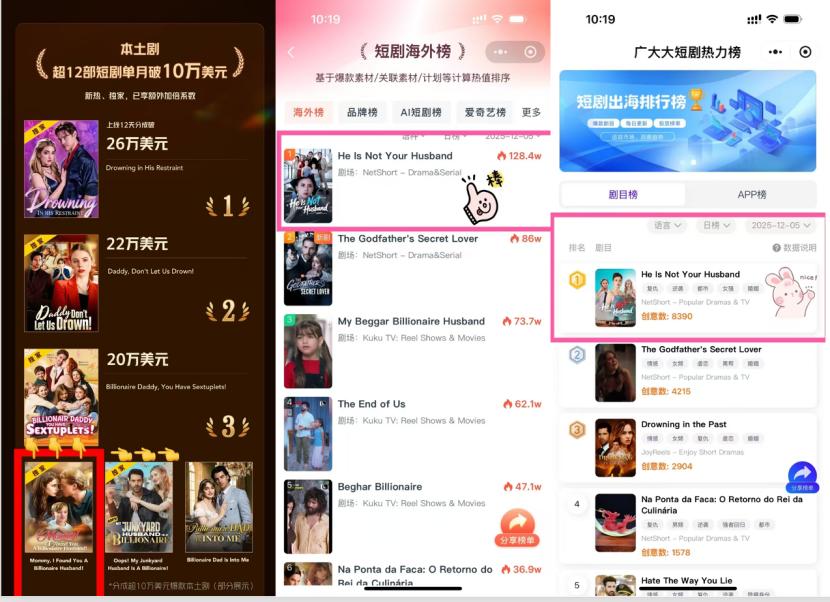
Wang Wenjin successfully caught up with the wave of short dramas going global. Haoli Media has cooperated with more than 20 short drama platforms and filmed 35 English short dramas. *He is not your husband* produced for iReader iDrama won the first place in the short drama launch list of that month. Their self-produced hit short drama *Mommy, I Found You a Billionaire Husband* had more than 100 million views 14 days after its launch on TikTok.
From 2023 to the summer of 2024, it was the most glorious period for the Los Angeles short drama industry. At that time, no one expected that the time left for it was actually running out.
02
Misalignment Between Chinese and Foreign Demands
The initial approach for short dramas going global was to translate the hit works that had been verified in China and then resell them overseas. This logic worked at the beginning: the works that had achieved good data in China saved a lot of trial and error costs, but soon everyone found that some content could not be translated and conveyed properly. Eventually, all practitioners embarked on the path of original creation.
But original creation is not easy. At first, platforms required to find American directors on the grounds that local dramas should be shot by locals, but later they all turned to Chinese directors or Chinese directors who can speak Chinese.
Wang Wenjin explained that foreign directors cannot watch a large number of Chinese short dramas, so it is difficult for them to quickly understand this set of logic. Moreover, there will be conceptual conflicts. For example, the male and female protagonists pass by each other and fail to recognize each other many years after reunion, which is very common in China, but overseas directors cannot understand it. "They will not shoot the content that they cannot understand."
In communication with many producers and screenwriters, "Newberry" found that when overseas short drama platforms look for production contractors to place orders, they will bring their own scripts, most of which are written by domestic screenwriters.
The problem is that local domestic screenwriters may not understand what overseas audiences want to watch.
Most of the time, Li Ya works as an independent screenwriter, and she also worked for several leading overseas short drama platforms for a short period. When she worked at a platform, she found that most of the screenwriters in the team were originally writing domestic short dramas, knew little about overseas culture, and often needed a lot of communication to revise a script well. "But when writing the next script, the same problem will appear again."
She pointed out that domestic screenwriters who write free short dramas like to use flashback and narrative interlude, and overseas audiences often cannot keep up with such narrative rhythm. "If the plot is too complicated, they can't understand it and will abandon the drama."
There is also a big gap in emotional scenes. The domestic style pays attention to foreshadowing and subtlety, while overseas styles are more direct with greater content scale. Take a gangster romance short drama as an example: the heroine is spotted by a gangster leader at a glance when walking on the street, and the two immediately start an entanglement. Such a plot setting is hardly acceptable to domestic audiences.

Based on various problems, the intermediate links from script to implementation of live-action short dramas are often extremely complicated.
Zhao Ying said that the early scripts were literally translated from Chinese to English, which foreign directors could not understand at all. After getting the scripts, her team would work with directors and producers to do secondary creation. Lin Shan's approach is more thorough: the received English scripts are written by Chinese screenwriters, and the platforms have done a round of localization. Her team will make another round of revisions, and submit them back to the platform for approval before starting shooting.
When on the set, the conflicts further escalate. Lin Shan said that plots such as kneeling down and slapping in the face, which are common in Chinese scripts, are unimaginable locally. She judged that overseas audiences watch these plots mostly out of novelty. "In fact, people all over the world have no essential difference."
Some themes are completely unadaptable to the local context. Wang Wenjin said that the domestic "son-in-law" theme cannot achieve good performance overseas at all, because there is no such oppressive relationship between mother-in-law and son-in-law in Western culture. Zhao Ying once shot a script whose theme can be summarized as "children playing the victim for sympathy". The original Chinese version was a big hit, but the performance after its overseas launch was very poor.
Therefore, the popular themes are constantly changing. Wang Wenjin has experienced several rounds of changes: first, romance with werewolf elements, because werewolf-themed stories became hits in the web novel era, and platforms with web novel background immediately adapted werewolf stories; gangster themes were popular for a while; then came the "face-slapping" revenge themes such as heir returning, real and fake rich daughters; then came the "regret flow" themes; now social themes such as grabbing parking spaces and grabbing first-class cabin seats are popular.
Perhaps platforms can continuously and sensitively capture the changes of these themes, but no one can draw a conclusion about how much output is needed to produce a hit. After continuous investment for only three years, platforms can no longer balance their accounts.
03
The Changing Cost Calculation
The financial situation in Los Angeles has changed unconsciously, and it is moving in a negative direction.
In October 2023, the production cost of Wang Wenjin's first short drama was 110,000 US dollars; by January 2025, the cost of the works she shot in Los Angeles was close to 200,000 US dollars. In just over a year, the production cost almost doubled.
The four live-action dramas Lin Shan shot this year have an average cost of about 150,000 US dollars, and one of the dramas exceeded the budget, so she paid an extra 10,000 US dollars out of her own pocket. She said that the production contractor of a drama can earn 30,000 to 40,000 US dollars from it, on the premise of compressing the cost to the extreme.
The behind factor is the rising labor cost all the way. Wang Wenjin said that in 2023, someone voluntarily applied to be a production assistant for free. Later, the short drama he participated in became a hit, and he himself became a short drama director with a unit price of 10,000 US dollars. In 2024, Lin Shan offered a leading actress a daily salary in three digits, but when she looked for the actress again in March 2026, the quotation reached 1,200 US dollars.
When the cost cannot be controlled, platforms choose to move their production bases.
"Newberry" learned that in December 2024, MiniShorts, a short drama platform under ByteDance, was the first to move overseas short drama production back to China. After that, all platforms followed this practice one after another. From Los Angeles to Hengdian, the trend of going global has blown back to China.
In Wang Wenjin's view, short dramas are essentially fast-moving consumer goods on the Internet, with a short life cycle and a cost ceiling. To return to China for filming, the only problems to be solved are actors and scenes. There are plenty of scenes in China, and actors can just fly over, but the cost can be saved by nearly half.
However, Lin Shan put forward another view: profits mainly come from cost reduction, not the price difference between China and foreign countries. "It costs 150,000 US dollars to shoot a drama overseas, and it is almost the same to shoot in China, there is no difference."
For platforms, it has been difficult to balance the accounts from the very beginning. Wang Wenjin has cooperated with more than 20 platforms, and there are some small platforms that cannot persist and have stopped operating. She calculated that shooting a live-action drama costs at least 1 million yuan, and a platform needs at least 30 to 50 dramas to form a content library, which means the content production cost is at least 30 million yuan, not to mention the paid traffic investment. In her opinion, the important reason why platforms stop operating is insufficient capital.
Data from DataEye shows that 70% to 80% of the download volume of overseas short dramas relies on paid traffic investment. The customer acquisition cost per user in North America has reached 5.28 US dollars, with a maximum of 15 US dollars. Nearly 80% of the revenue of some platforms has to be re-invested in traffic purchase.
The financial reports of platforms are the most straightforward evidence. In the 2025 annual report, the net loss of Chinese Online expanded to 671 million yuan, and the new platform FlareFlow alone lost 470 million yuan; Maple Interactive, the parent company of ReelShort, saw its revenue double to 5.72 billion yuan, but turned from profit to loss; Kunlun Wanwei has lost nearly 1.6 billion yuan for two consecutive years, with 4.182 billion yuan spent on traffic investment in one year; iReader's promotion fee was nearly 2 billion yuan, and it delivered its first annual loss since its listing.
It seems that the revenue of all platforms is growing, but no one has really made money.
In contrast, production companies like Haoli Media have limited risks and stable earnings, but their business is not easy.
This is a typical service trade business: the team is based in China, actors and